


This article was automatically translated from the original Turkish version.
+2 More
Cuneiform script is one of the earliest documented writing systems developed by the civilizations of Mesopotamia. As one of the first systematic attempts by humanity to convert spoken sounds into permanent symbols, cuneiform did not merely facilitate communication but also played a pivotal role in establishing social order, recording legal documents, and forming historical memory. In this sense, it is regarded as the instrument symbolizing the transition from prehistoric to historical times.
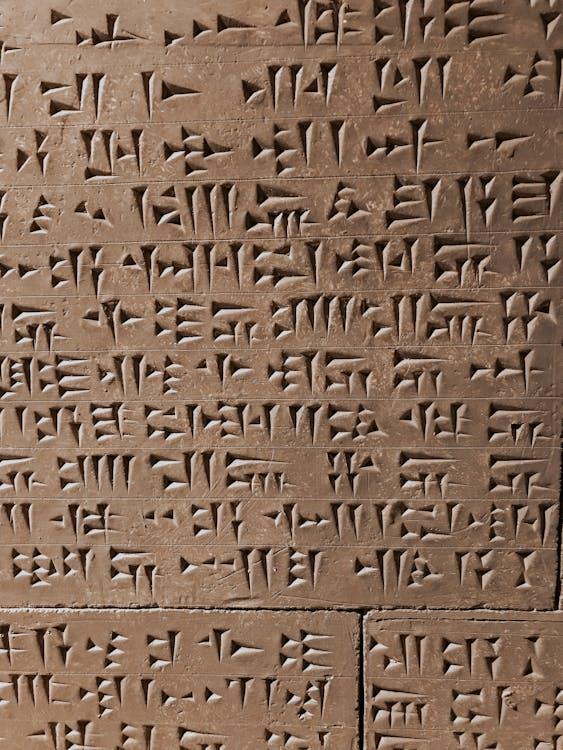
Example of Cuneiform Script (pexels)
The emergence of cuneiform writing arose from the Sumerians’ need in the 3200s BCE to organize temple and palace economies in the city of Uruk. Initially, simple pictograms used to record economic activities gradually evolved into more abstract and symbolic forms. During this process, small clay counting tokens known as “tokens” and sealed clay envelopes called “bulla” played a crucial role. These tools were employed to ensure the secure recording of goods delivered to temples and to document the movement of products.
Researchers such as Pierre Amiet and Denise Schmandt-Besserat have noted that the evolution of writing began with these physical counting devices and can be traced back to the Neolithic period. Over time, the shapes of the tokens were inscribed onto clay tablets, transforming pre-literate symbolic systems into the earliest forms of writing.
Cuneiform derives its name from the wedge-shaped marks that characterize its signs. The symbols consist of horizontal, vertical, and angular lines, created by pressing a reed stylus into soft clay. Circular curves are rarely found. Its most distinctive feature is the triangular tip of each stroke. Different cultures, such as the Assyrians and Babylonians, adapted this script in distinct styles: Assyrian cuneiform was more formal and angular, while Babylonian cuneiform was softer and more curved. Over time, the script evolved from pictograms toward a phonetic system, transforming cuneiform into a syllabic writing system. This development enabled the script to become a versatile medium capable of expressing not only concrete objects but also abstract concepts.
Cuneiform was typically inscribed on soft clay tablets. Reed styluses were used for writing, with their tips pressed into the clay to form the signs. After inscription, tablets were either dried in the sun or fired in kilns to make them durable. Particularly important documents such as diplomatic records, legal texts, and literary works were preserved on robust clay tablets. Tablets could be rectangular, oval, or round, and some were inscribed on both sides. Official documents were often sealed and stored systematically in archives.
The earliest known sightings of cuneiform inscriptions by European travelers occurred in the 17th century at Persepolis and its surroundings. In 1621, Pietro della Valle introduced these inscriptions to Europe, but it was not until the 19th century that the script was successfully deciphered.
The Behistun (Bisutun) Inscription marks a turning point in the decipherment of cuneiform. Written in three languages—Old Persian, Elamite, and Akkadian—it was decoded through linguistic comparison. Thanks to the work of scholars such as Grotefend, Rawlinson, Tychsen, and Oppert, cuneiform was largely deciphered by 1857, making tens of thousands of Mesopotamian tablets readable for the first time.
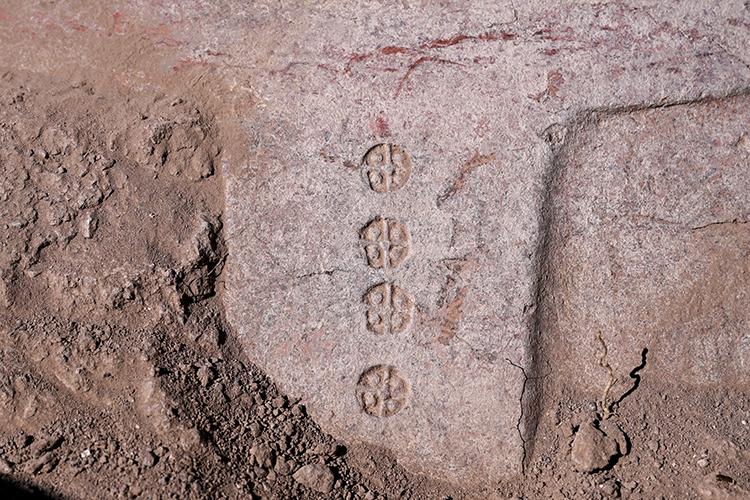
Cuneiform-inscribed Pithos Found in the Van Urartu Storage (AA)
Cuneiform was adapted to write many languages, beginning with Sumerian. Other languages that employed cuneiform include Akkadian, Assyrian, Babylonian, Elamite, Hittite, Urartian, Eblaite, and Old Persian. Each language modified the script according to its own phonetic and morphological structure. In this way, cuneiform functioned as a hybrid system incorporating both ideographic and phonetic elements. For instance, while the Hittites used cuneiform, they also employed another writing system known as Hittite Hieroglyphs. In the Ugaritic language, cuneiform evolved into one of the earliest alphabetic systems with 30 characters.
Cuneiform is not merely a tool of communication but is also recognized as one of the most enduring information-carrying systems in human history. With its invention, the storage of knowledge, transmission to future generations, and the formation of collective memory became possible. This writing system enabled the documentation of Mesopotamian civilizations’ administration, trade, law, and religious practices, laying the foundation for the dawn of written history.
Azertürk, Semine İmge. "Çiviyazısı ve Çin’in Fal Yazıtları." Sosyal Bilimler Enstitüsü Dergisi, no. 37 (2014): 70–85.
Britannica. "Cuneiform." Accessed [insert date]. https://www.britannica.com/topic/cuneiform
Hüseynli, Nazim. "Çivi Yazısının Gelişim Evreleri ve Sümerlerle Bağlantısı." Euroasia Journal of Social Sciences and Humanities 8, no. 2 (2021): 129–142.
Khan Academy. "Cuneiform." Accessed [insert date].
Kurşun, Fatıma Büşra. Çivi Yazısı. Master's thesis, Aksaray Üniversitesi, 2024.
Kınal, Füruzan. "Çîvî Yazısının Doğuşu ve Gelişmesi." Türk Tarih Kurumu Konferansları, 1971.
“Çivi Yazısı Nasıl Yazılır?” Arkeofili. Accessed [insert date]. https://arkeofili.com/civi-yazisi-nasil-yazilir/
“Çivi Yazısı.” *Kayıp Diller*. https://kayipdiller.com/civi-yazisi/

Origins
Formal Characteristics
Writing Materials and Method
The Decipherment Process
Languages Used and Spread