
Bu içerik Türkçe olarak yazılmış olup yapay zeka ile otomatik olarak İngilizceye çevrilmiştir.
+1 Daha
Nardugan Bayramı
(Yapay Zeka ile Oluşturulmuştur)
Nardugan Bayramı is a New Year festival celebrated among certain Turkic communities during the winter season. This festival, which has been observed for approximately 3,200 years, symbolizes the rebirth of the sun, the shortening of the night, and the lengthening of the day. Its name is derived from the combination of the Mongolic word “nar” (sun) and the Turkish word “tugan” (born), meaning “new sun” or “birth of the new year.” Nardugan is celebrated with rituals that reflect the cyclical nature of nature, social unity, and wishes for abundance.
Throughout history, Nardugan Bayramı has been observed by Turkic communities across Central Asia and Anatolia. Although migration, the adoption of different religions, and cultural interactions caused its observance to fade in some regions, it has been revived as a festival since 2010 in Türkiye, particularly in the village of Gündoğan, located in the Bodrum district of Muğla.

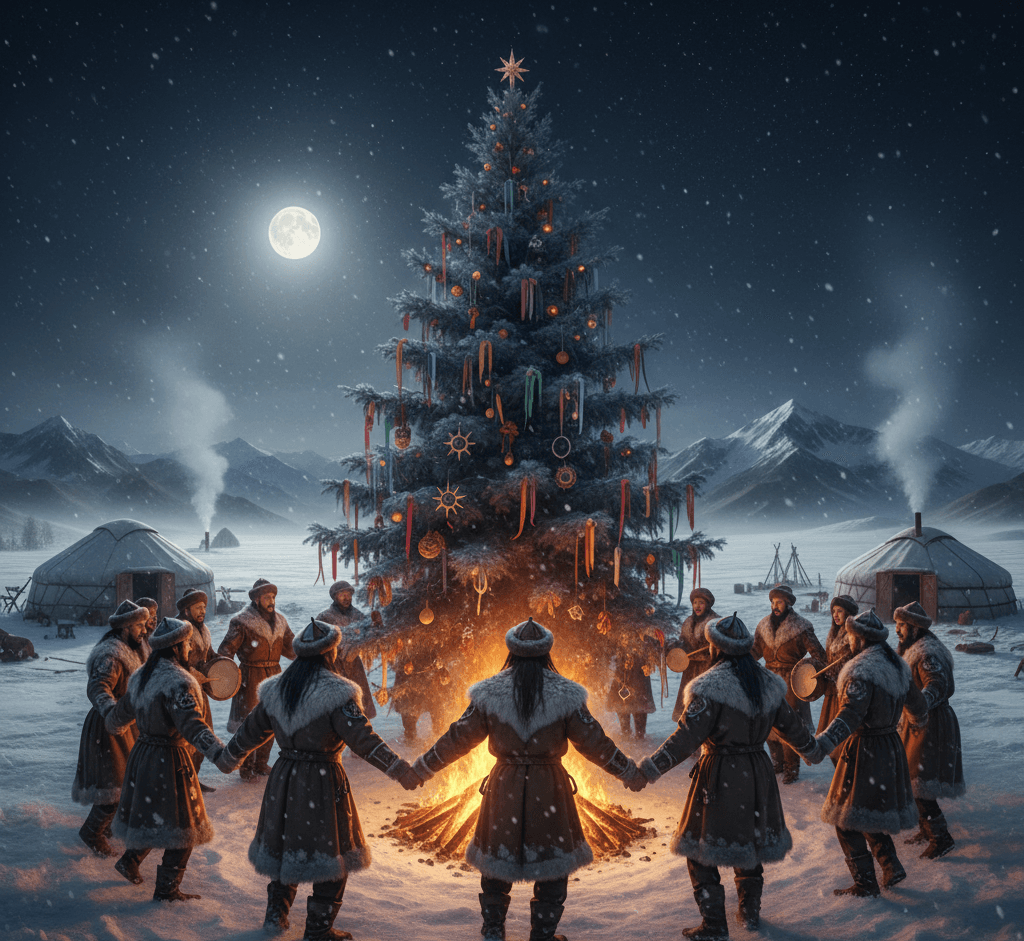
Illustration related to Nardugan Bayramı (Generated by Artificial Intelligence)
Throughout history, the Turkic peoples have lived under the influence of various religious and belief systems. Before Islam, the worship of Tengri, shamanism, nature cults, and ancestor veneration were dominant, while religions such as Buddhism, Manichaeism, Judaism, and Christianity were also adopted. This multifaceted belief system shaped the solar and lunar cults that form the foundation of Nardugan Bayramı, as well as the ritualization of natural phenomena through figures such as Ülgen and Erlik.
During the Göktürk and Uyghur periods, the sun and moon were regarded as mythological symbols. The sun represented goodness and abundance, while the moon symbolized night and mystery. The struggle against evil spirits was interpreted as a battle between night and day, and this conflict was symbolically celebrated in Nardugan rituals.
The term Nardugan has been known by various names among different Turkic communities. The Tatars call it Koyaş Tuğa, the Udmurts and Misher Tatars call it Raştua or Zırizyalar, the Chuvash call it Nardava, the Mokshas call it Nartavan or Nartukan, and the Bashkirs call it Nardvan. It is also commonly referred to as Nardugan or Mardugan.【1】 These variations in naming emerged due to the nomadic lifestyle of the Turkic peoples and their wide geographic dispersion.
Nardugan Bayramı is particularly associated with winter solstice. On December 21, the longest night of the year, night is symbolized by Erlik and day by Ülgen. At the end of the night, the victory of the sun is celebrated, and the festive spirit of the new year begins with the first full moon of the month. These celebrations include rituals that signify the renewal of nature, wishes for fertility and abundance, as well as strengthening social solidarity and family bonds.
Before the festival, homes are cleaned and special meals are prepared. Families gather to share meals in preparation for the celebration. Participants wear their finest and cleanest clothing, reflecting communal unity and festive joy.
At the center of the celebrations stands a tree known as Akçam, also called the Life Tree or Ülgen Tree. This tree is decorated with offerings and prayers hung from its branches, serving as a focal point for gifts presented to the deity Ülgen. Participants tie ribbons and fabric strips to the tree’s branches to convey their wishes. The Akçam tree is predominant in Siberia, the Altai, and the Ural-Altai regions and is widespread in the territories inhabited by Turkic communities. It holds both aesthetic and ritual significance in the festivities.
Historical and ecological data suggest that the Akçam tree used in Nardugan celebrations is likely of the species Abies sibirica. Palynological studies indicate that the Abies sibirica species has been one of the dominant trees in the region for approximately 8,500 years. Its whitish-green color and needle-like leaves played a role in its symbolic identification by Turkic peoples as the Tree of Life.【2】

Akçam (Generated by Artificial Intelligence)
Participants sing songs in groups and dance around the Akçam tree. Women and young girls prepare felt-like ribbons, embroidering them with motifs of the Tree of Life to hang their wishes.【3】 Although Erlik is regarded as an evil figure, on this special night he brings gifts and participates in the celebrations as a symbol of goodwill. Erlik wears traditional Turkic attire, including a kaftan, headgear, belt, and leather boots. On the days when daylight overcomes the night, prayers and wishes are hung from the branches of the Akçam tree, and the gifts and offerings placed beneath it constitute the central ritual of the festival, believed to be accepted by Ülgen.【4】
Nardugan Bayramı is not merely a New Year celebration; it encompasses multidimensional symbols such as the cycle of nature, the struggle between good and evil, abundance, and social solidarity. The battle between night and day is a mythological narrative conveyed through the figures of Erlik and Ülgen. The wishes and offerings hung on the Akçam tree form the central ritual through which communication with the deity Ülgen is established.
The festival is celebrated annually on December 22, recognized as the winter solstice—the longest night of the year. The celebrations are timed to coincide with the first full moon of the month, marking the beginning of the new year.
Throughout history, Nardugan Bayramı has been observed across a wide geographic area and among diverse communities. Today, the Tatars, Bashkirs, Chuvash, and Karachay-Malkar peoples continue to observe the festival. In addition to Turkic communities, historical records indicate the presence of Nardugan traditions among Iranian groups, Bessarabian Armenians, and the Komi people. In Türkiye, since 2010, it has been celebrated in the village of Gündoğan in Bodrum as a festival with festive atmosphere. Bonfires are lit, local games are played, and traditional folk dances revive the communal spirit. Women participate in colorful printed garments, and fabric scraps are symbolically tied to the Akçam tree.
Nardugan Bayramı Celebrations in Bodrum-Gündoğan, 2024 (Bodrum City TV)
Nardugan Bayramı shares similarities with the modern celebration of Christmas in terms of form and ritual, yet it also has distinct differences. Both festivals revolve around tree decoration, gift-giving, singing, and dancing. The key difference lies in Nardugan’s foundation in the figures of Ülgen and Erlik, whereas Christmas is rooted in Christian belief. It has been debated whether the Nardugan tradition may have been introduced to Europe through the Huns and contributed to the origins of the Christmas tree custom.【5】
Nardugan Bayramı is not merely a New Year festival; it embodies multidimensional symbols such as the cycle of nature, the struggle between good and evil, abundance, and social solidarity. The battle between night and day is a mythological narrative conveyed through the figures of Erlik and Ülgen. The wishes and offerings hung on the Akçam tree form the central ritual through which communication with the deity Ülgen is established.
Ayaz Ata is a wise, elderly figure who leads the rituals of Nardugan Bayramı in Turkic societies. He is regarded as a benevolent being who aids people during winter, mediates goodness, and brings an end to the cold. During the ceremonies, Ayaz Ata wears his most magnificent garments and guides the presentation of gifts to the deity Ülgen. Due to his advanced age, a girl of grandchild’s age is typically assigned to assist him. This person may be his actual granddaughter or another individual of suitable age. Among northern Turkic peoples, Ayaz Ata appears after December 22, and the celebrations continue until February 1.
In Uzbek, Ayaz Ata is known as Ayoz Bobo or Ayaz Ota; in Kyrgyz and Kazakh, as Ayaz Ata; in the Bashkir dialect, as Kış Babası with his granddaughter Kar Güzeli; and in Tatar culture, as Qış Babay and Kar Kızı. In Turkic mythology, the cult of Ayaz Ata was integrated into winter solstice rituals through shamans. The six legs of Ayaz Ata’s sleigh represent the six stars of the Ursa Major constellation and the six openings in the sky. Ayaz Ata acts as an intermediary between the Turkic people and the Moon God, seeking the end of winter.
While some recognize the existence of Ayaz Ata and Nardugan Bayramı, other perspectives challenge their authenticity. For instance, Professor Dr. Ahmet Taşağıl argues that there is no mythological figure named Ayaz Ata or festival called Nardugan in Turkic culture. He notes that although Turkic communities lived for centuries under Christian cultural influence, even among Christian Turkic groups such as the Chuvash and Gagauz, no trace of Ayaz Ata exists. He further emphasizes that no historical records from the pre-Islamic Turkic period mention Ayaz Ata or Nardugan, offering a critical perspective on the historical origins of these traditions.【6】
Aryol, Hakan. "İslamiyet Öncesi Türk Gelenekleri: Nardugan Bayramı Örneği." *Uluslararası Uygur Araştırmaları Dergisi* 20 (2022): 64-69. Accessed December 3, 2025. https://dergipark.org.tr/en/pub/uygur/issue/74126/1200267
Bodrum Kent TV. "Gündoğan'da Nartugan Kutlaması." YouTube, 0:46. Accessed December 3, 2025. https://www.youtube.com/watch?v=XtsDL8eGFds
Kahveci, Gülzade. "Traditional Usage of The Fir Species: Fir as A Christmas Tree from Middle Asia to Europe." *Kastamonu University Journal of Forestry Faculty* 12, no. 3 (2012): 8-14. Accessed December 3, 2025. https://dergipark.org.tr/en/pub/kastorman/issue/17232/179970
Prof. Dr. Ahmet Taşağıl. "Ahmet Taşağıl | Soru-Cevap | 5 | Ayaz Ata-Moğollar Türk Müdür?" YouTube, 25:37. February 3, 2020. Accessed December 3, 2025. https://www.youtube.com/watch?v=gSjpJr-WsVw
İncekaya, Gülsüm. "'Noel Baba'dan Önce Ayaz Ata Vardı.' Anadolu Ajansı, December 26, 2018. Accessed November 3, 2025. https://www.aa.com.tr/tr/dunya/noel-babadan-once-ayaz-ata-vardi/1348888
[1]
Hakan Aryol. "İslamiyet Öncesi Türk Gelenekleri: Nardugan Bayramı Örneği." Uluslararası Uygur Araştırmaları Dergisi 20 (2022): 66. Erişim 3 Aralık 2025. https://dergipark.org.tr/en/pub/uygur/issue/74126/1200267
[2]
Gülzade Kahveci. "Traditional Usage of The Fir Species: Fir as A Christmas Tree from Middle Asia to Europe." Kastamonu University Journal of Forestry Faculty 12, no. 3 (2012): 13. Erişim 3 Aralık 2025. https://dergipark.org.tr/en/pub/kastorman/issue/17232/179970
[3]
Aryol. "İslamiyet Öncesi Türk Gelenekleri: Nardugan Bayramı Örneği." s. 66. Erişim 3 Aralık 2025. https://dergipark.org.tr/en/pub/uygur/issue/74126/1200267
[4]
Kahveci. "Traditional Usage of The Fir Species: Fir as A Christmas Tree from Middle Asia to Europe." s. 12. Erişim 3 Aralık 2025. https://dergipark.org.tr/en/pub/kastorman/issue/17232/179970
[5]
Kahveci. "Traditional Usage of The Fir Species: Fir as A Christmas Tree from Middle Asia to Europe." s. 12-13. Erişim 3 Aralık 2025. https://dergipark.org.tr/en/pub/kastorman/issue/17232/179970
[6]
Prof. Dr. Ahmet Taşağıl. "Ahmet Taşağıl | Soru-Cevap | 5 | Ayaz Ata-Moğollar Türk Müdür?" 3 Şubat 2020, YouTube, 25:37, Erişim 3 Aralık 2025. https://www.youtube.com/watch?v=gSjpJr-WsVw


Nardugan Bayramı
(Yapay Zeka ile Oluşturulmuştur)
Henüz Tartışma Girilmemiştir
"Nardugan Festival" maddesi için tartışma başlatın
Historical Background
Etimology and Regional Names
Meaning of Nardugan Bayramı
Observance of Nardugan Bayramı
Preparations
Life Tree / Akçam / Ülgen Tree
Rituals and Symbols
Scheduling and Calendar Connection
Geographic Spread and Communities
Christmas and Nardugan
Symbolic Dimensions of the Celebrations
Symbol of Winter and the New Year in Turkic Culture: Ayaz Ata
Criticism