

Bu içerik Türkçe olarak yazılmış olup yapay zeka ile otomatik olarak İngilizceye çevrilmiştir.
+1 Daha
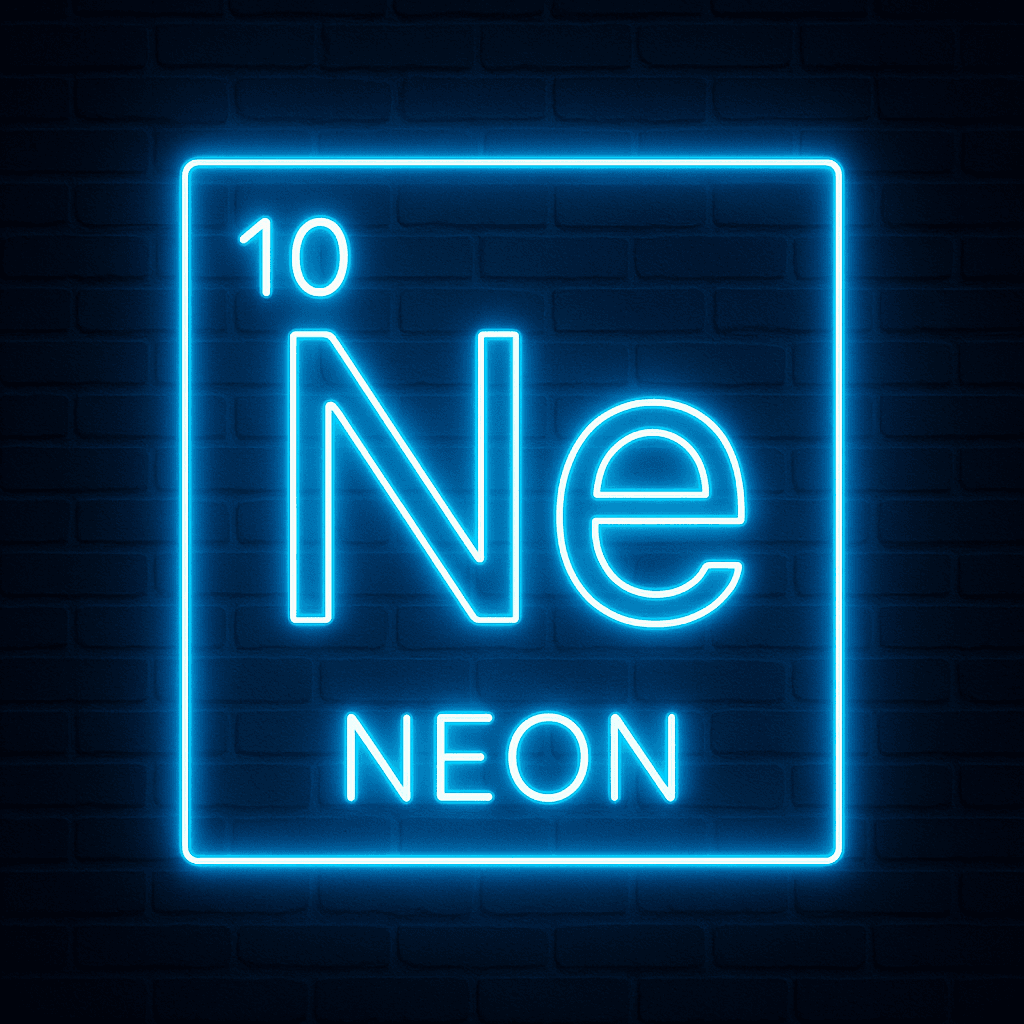
Neon Element (Generated by Artificial Intelligence)
Symbol | What | ||||||||
|---|---|---|---|---|---|---|---|---|---|
Atomic Number | 10 | ||||||||
Group | 18 (Noble gases) | ||||||||
Electron Configuration | 1s² 2s² 2p⁶ | ||||||||
Physical State | inert gas at room temperature odorless Colorless | ||||||||
Melting Point | -248.59 °C | ||||||||
Boiling Point | -246.05 °C | ||||||||
Discovery(ies) | 1898 William Ramsay and Morris Travers | ||||||||
Main Uses | reference gas in spectroscopy plasma displays high-voltage indicators cryogenic cooling systems Neon lamps and signs | ||||||||
Spectral Property | Emits red-orange light under electric current | ||||||||
Neon is an element belonging to the noble gas group, located in group 18 of the periodic table with an atomic number of 10. Its atomic mass is approximately 20.18 g/mol. Under standard conditions it exists as a colorless odorless and tasteless gas. Although present in the atmosphere in very low concentrations (approximately 0.0018% by volume) its distinctive spectral properties and chemical inertness make it useful in various scientific and technological applications.
Neon was discovered in 1898 by Scottish chemist William Ramsay and English chemist Morris Travers. Ramsay had previously discovered helium and argon and separated liquid air into its components through fractional distillation at low temperatures to trace unknown gases in the atmosphere. During this process they obtained a new gas with a boiling point of −246 °C and observed a previously unknown bright red-orange emission in its spectral analysis. This discovery indicated that neon existed in trace amounts in the atmosphere and belonged to the noble gases.

Neon Element (Generated by Artificial Intelligence)
Neon is located in the second period and exists as a gas under standard conditions. Among the noble gases it is one of the most stable after helium and argon. Its atomic mass is approximately 20.18 g/mol. Neon has a high ionization energy and low electron affinity which render it extremely unreactive in chemical reactions. Naturally occurring stable isotopes include Ne-20 Ne-21 and Ne-22 with Ne-20 being the most abundant.
The name of the element is derived from the Greek word "νέος" (neos) meaning "new". Ramsay and Travers deemed it appropriate to name this previously unknown element "new" to reflect its novelty. The name neon emphasizes the addition of a new noble gas to the series of known chemical elements at the time of its discovery.
Neon freezes at −248.59 °C and boils at −246.08 °C. These very low temperatures reflect its weak interatomic interactions. With a density of 0.89994 g/L at 0 °C and 1 atm neon gas is lighter than air. Due to its chemically inert nature it possesses a stable atomic structure and forms only a very limited number of compounds. The bright red-orange glow of neon is observed in discharge tubes under electric current and this property makes it preferred in advertising and lighting applications. Because it does not form chemical bonds compounds of neon are rare and only transient unstable complexes can be formed under extreme conditions.
When subjected to an electric current under low pressure neon emits a characteristic red-orange light. This spectral emission results from the excitation of electrons in neon atoms and their transition to lower energy levels releasing photons at specific wavelengths. Visually striking this light is composed primarily of spectral lines in the visible range between 585 and 650 nanometers. Neon’s distinctive spectrum is uniquely identifiable in gas discharge tubes and serves a diagnostic function in spectroscopic studies.
Neon lighting has been used since the 20th century for aesthetic and directional visual applications in urban environments. Its pure and uniform emission provides high visibility without mixing with other colors making it favored in artistic compositions and signage.
Neon does not tend to form compounds directly with fluorine. The primary reason is its stable electron configuration and very high ionization energy. In contrast fluorine the element in the periodic table with the highest electronegativity is highly reactive. Although fluorine has the strongest tendency to gain electrons it cannot form a stable compound with neon due to neon’s stable structure. Experimental studies have only observed the formation of transient and unstable complexes. This confirms neon’s inert nature and the chemical inertness characteristic of noble gases.
Neon is a rare gas found in Earth’s atmosphere at a volume concentration of approximately 0.0018%. It is not found in significant quantities in the Earth’s crust or oceans. Throughout the universe it is abundant especially in stars and the Sun. Due to its chemical inertness no stable compounds of neon are known; only short-lived and unstable complexes can be formed under extreme conditions.

Neon Tube (Pixabay)
The primary application of neon is its bright red-orange glow in electric discharge tubes. This property has led to its widespread use in illuminated advertising signs known as neon signs. Liquid neon is also used as a cryogenic refrigerant in low-temperature applications. Although this use offers certain advantages compared to liquid helium it is limited by economic factors. Neon gas is also employed in electron microscopes high-voltage indicators lasers and vacuum tubes. Since neon does not form chemical compounds it is valued not as a reactive agent but as an element whose physical properties are utilized.
Girgin, Figen. “Sanatta Neon Işıkları.” *Hitit Üniversitesi Sosyal Bilimler Enstitüsü Dergisi* 11, no. 3 (2018): 2315–2329. https://dergipark.org.tr/tr/pub/hititsosbil/issue/39369/425113.
National Center for Biotechnology Information. "Neon." *PubChem*. Accessed June 25, 2025. https://pubchem.ncbi.nlm.nih.gov/element/Neon.
Pixabay. "Neon Tüp Sanayi Neon Işıkları." Accessed June 26, 2025. https://pixabay.com/tr/photos/neon-t%C3%BCp-sanayi-neon-%C4%B1%C5%9F%C4%B1klar%C4%B1-234887/.
TÜBİTAK Bilim Genç. "Neon." bilimgenc.tubitak.gov.tr. Accessed June 26, 2025. https://bilimgenc.tubitak.gov.tr/periyodik-tablo/neon.
TÜBİTAK Bilim Genç. "Soygaz Avcısı William Ramsay." bilimgenc.tubitak.gov.tr. Accessed June 26, 2025. https://bilimgenc.tubitak.gov.tr/makale/soygaz-avcisi-william-ramsay.

Neon Element (Generated by Artificial Intelligence)
Symbol | What | ||||||||
|---|---|---|---|---|---|---|---|---|---|
Atomic Number | 10 | ||||||||
Group | 18 (Noble gases) | ||||||||
Electron Configuration | 1s² 2s² 2p⁶ | ||||||||
Physical State | inert gas at room temperature odorless Colorless | ||||||||
Melting Point | -248.59 °C | ||||||||
Boiling Point | -246.05 °C | ||||||||
Discovery(ies) | 1898 William Ramsay and Morris Travers | ||||||||
Main Uses | reference gas in spectroscopy plasma displays high-voltage indicators cryogenic cooling systems Neon lamps and signs | ||||||||
Spectral Property | Emits red-orange light under electric current | ||||||||
Henüz Tartışma Girilmemiştir
"Neon (Ne)" maddesi için tartışma başlatın
Discovery
Classification and Fundamental Properties
Etimology
Physical and Chemical Properties
Spectral Properties and Visual Effect
Electronegativity and Reactivity of Neon
Natural Occurrence and Neon Compounds
Applications