


Bu içerik Türkçe olarak yazılmış olup yapay zeka ile otomatik olarak İngilizceye çevrilmiştir.
+1 Daha
The NST device (Non-Stress Test device) is an electronic monitoring and recording system that simultaneously tracks the fetal heart rate and uterine contractions during pregnancy. It is widely used in obstetric clinics to assess fetal well-being. It is preferred due to its non-invasive nature, requiring no physical intervention for either the mother or the fetus. The primary purpose of the device is to record changes in fetal heart rate in response to fetal movements, thereby providing information about oxygenation levels.
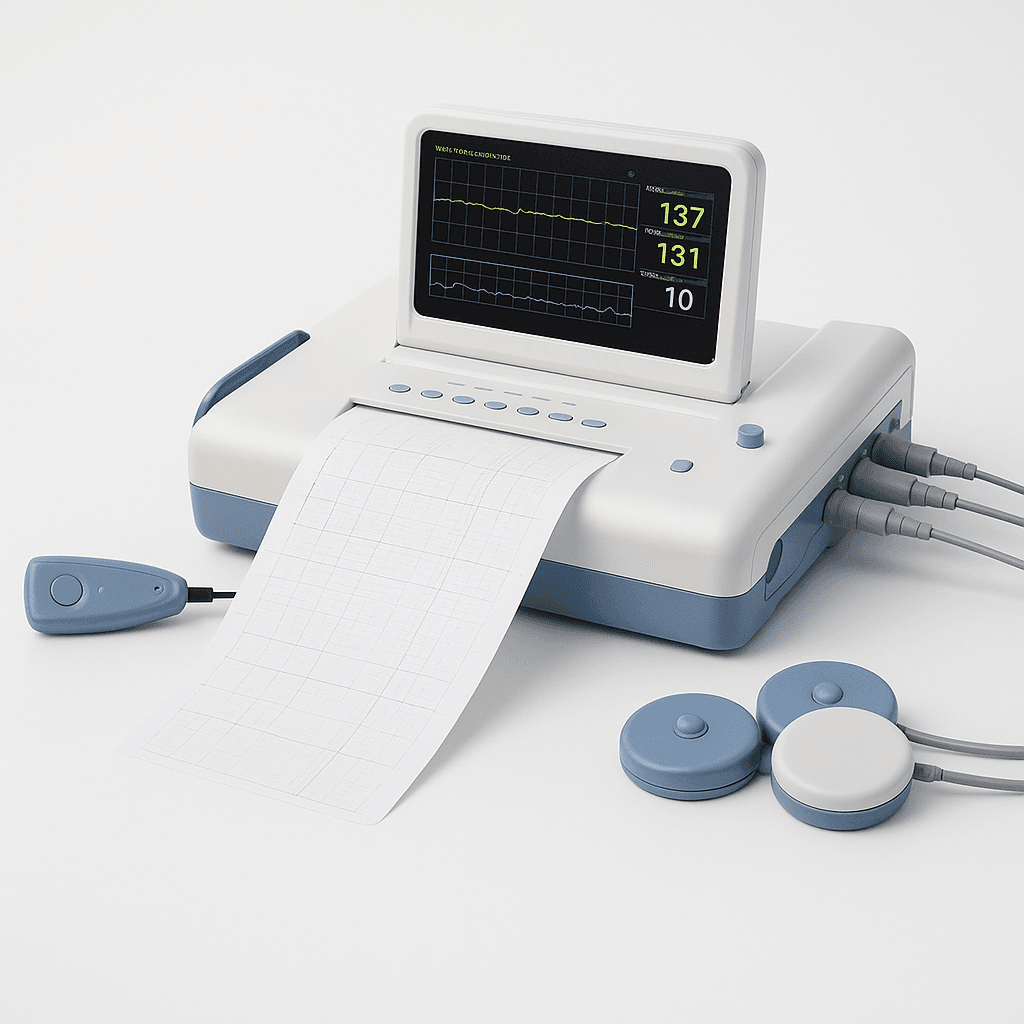
Visual of the NST Device (Generated by Artificial Intelligence)
The NST device primarily consists of the following units:
In modern devices, data can also be stored digitally and patient monitoring can be conducted electronically.
The device continuously measures the fetal heart rate using a Doppler probe that operates with ultrasonic waves. Simultaneously, uterine contractions are detected via the tocodynamometer probe. These two sets of data are recorded on the same time scale to enable evaluation. When the mother presses the button to indicate fetal movement, these time intervals are interpreted alongside the heart rate graph.
The NST device is typically used by placing two probes on the abdomen of a pregnant woman who is seated or semi-reclined on an examination table. The probe positions are adjusted by healthcare personnel according to fetal position. The test duration averages 20 to 40 minutes. Performing the test in a quiet and comfortable environment supports more accurate results from the device.
The output provided by the device usually appears as a graph with two lines:
This data allows for classification as reactive or non-reactive. The device itself does not interpret the results; evaluation is performed by healthcare professionals.
The NST device is used primarily in the third trimester and later stages of pregnancy to monitor fetal health. It is also commonly used in the following situations:
Devices are generally designed in portable form, with battery-powered models also available. They typically have sensitivity to record fetal heart rates within the range of 110 to 160 bpm. The tocodynamometer unit is equipped with sensors that measure contraction intensity in millimeters. Most devices include a built-in thermal printer.
The NST device is not used to make definitive diagnoses of fetal health. In cases of non-reactive results, further testing may be required. Additionally, data obtained during fetal sleep cycles may be misleading. The outputs from the device gain clinical meaning only when integrated with clinical judgment.
NST (Non-Stress Test) and the NST device used to perform this test are non-invasive and widely used monitoring methods for assessing fetal well-being during pregnancy. The NST test provides information about intrauterine oxygenation levels by observing the relationship between fetal heart rate and uterine contractions. The NST device used during this test is an electronic system that graphically records fetal heart rate and uterine activity.
Due to its practical use and ability to provide direct fetal monitoring, the NST device plays a significant role in the surveillance of high-risk pregnancies. However, data obtained from the device alone does not have diagnostic value; test results must be interpreted within the clinical context. In cases of non-reactive results, further diagnostic tests may be necessary for interpretation. Therefore, NST functions as a screening tool in fetal monitoring and is used as part of the overall assessment process.
Warning: The content in this article is provided solely for general encyclopedic informational purposes. The information herein should not be used for diagnosis, treatment, or medical advice. Before making any decisions regarding health, you must consult a physician or qualified healthcare professional. The author and KÜRE Encyclopedia assume no responsibility for any consequences arising from the use of this information for diagnostic or therapeutic purposes.
Accessed November 26, 2025.
Accessed November 26, 2025.
Accessed November 26, 2025.
Acıbadem Sağlık Grubu. "NST (Non-Stres Test) Nedir?" Accessed July 20, 2025. https://acibadem.com.tr
Florence Nightingale Hastaneleri. "NST (Non Stres Test) Nedir?" Accessed July 20, 2025. https://florence.com.tr
Liv Hospital. "NST Nedir?" Accessed July 20, 2025. https://livhospital.com
Memorial Sağlık Grubu. "NST Testi Nedir?" Accessed July 20, 2025. https://memorial.com.tr
Okan Üniversitesi Hastanesi. "NST (Nonstress Testi) Nedir?" Accessed July 20, 2025. https://okanhastanesi.com.tr

Henüz Tartışma Girilmemiştir
"NST Device" maddesi için tartışma başlatın
Device Components
Working Principle
Usage and Application Environment
Evaluation Method
Applications of the Device
Technical Specifications and Hardware Requirements
Limits and Precautions