


Bu içerik Türkçe olarak yazılmış olup yapay zeka ile otomatik olarak İngilizceye çevrilmiştir.
Length(s)(Text) | 2.0 m | ||||||||
|---|---|---|---|---|---|---|---|---|---|
Name(s) | Orlan-10 | ||||||||
Cruising Speed | 115 km/h | ||||||||
Empty Weight | 9 kg | ||||||||
Production Quantity (Stated) | More than 1,000 Orlan-10s by 2018 | ||||||||
Introduction / Service Entry Year | 2011 | ||||||||
First Flight Date | 1 January 2011 | ||||||||
Manufacturer / Contractor | Special Technology Center (STC) | ||||||||
Country of Origin | Russia | ||||||||
Category(ies) | Military Drones | ||||||||
Endurance | 16 hours | ||||||||
Wingspan | 3.1 m | ||||||||
Orlan-10 is classified as an unmanned aerial vehicle (UAV) system designed for reconnaissance purposes. This platform, categorized under “Military Drones,” is defined as a fixed-wing reconnaissance unmanned aerial vehicle and is associated with intelligence-surveillance-reconnaissance (ISR) and similar mission roles. The system is capable of carrying mission payloads including electro-optical sensors, electronic and signals intelligence, laser imaging, and electronic warfare equipment.【1】
The manufacturer is the “Special Technology Center” (STC), based in Saint Petersburg. Developed for the Russian Armed Forces, the Orlan-10 was designed as a reconnaissance platform with its primary use linked to surveillance and reconnaissance functions.【2】
The first flight of the Orlan-10 took place on 1 January 2011. The system entered service in 2011. By 2018, more than 1,000 units of the Orlan-10 platform had been produced. As of 2018, it is stated that the Orlan-10 family includes 11 different variants.【3】
In August 2022, additional orders were placed for the Orlan-10 and Orlan-30. The Orlan-30, a larger variant compared to the Orlan-10, was introduced in 2020. It was noted that after testing in 2019, the Orlan-30 was offered with a laser designator option. The export version of the Orlan-30 was first exhibited in August 2023.
There are various records and claims linking the use of the Orlan-10 to conflicts in Ukraine since 2014. Incidents reported in May 2014, in which Ukrainian forces downed at least one Orlan-10, are among the earliest examples from this period. The system is frequently mentioned in connection with operations during the “War in Donbass.”

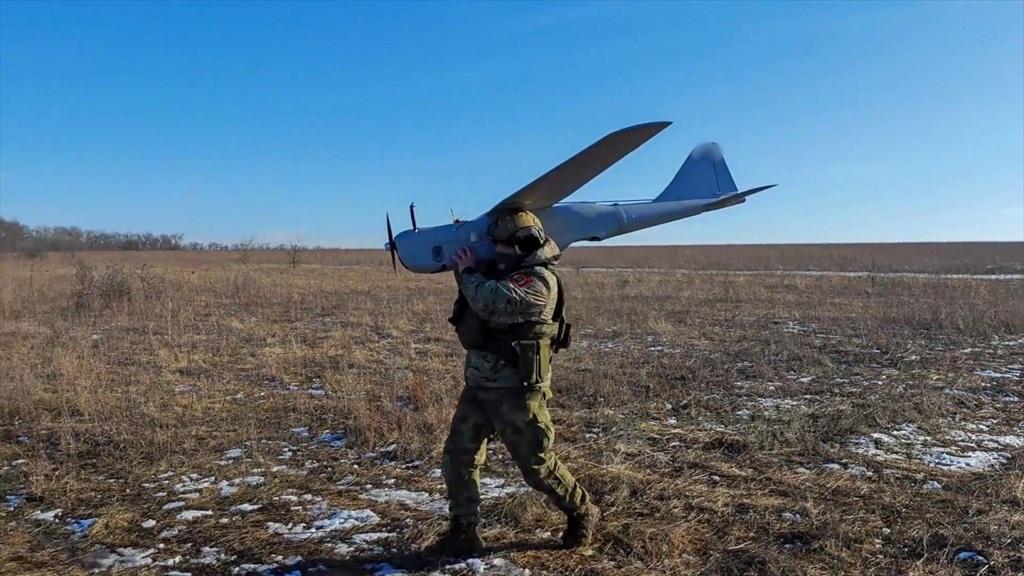
Orlan-10 UAV – Anadolu Agency
The Orlan-10 is described as a fixed-wing unmanned aerial vehicle with a conventional external design. The fuselage forms the main structural element running the length of the aircraft. The engine is mounted in the nose section and drives a two-bladed propeller to generate thrust. The wings are shoulder-mounted on the fuselage.
The tail unit consists of a single vertical stabilizer and two horizontal stabilizers. This configuration reflects a typical fixed-wing UAV layout for flight stability and control surface functionality. The Orlan-10 is launched using a rail catapult system and recovered via parachute. This method eliminates the need for a more complex and heavier landing gear system. The system is transported in a rigid carrying case and assembled at the launch site prior to flight.
The wingspan of the Orlan-10 is listed as 3.1 m. Two different values are given for its length: 2.0 m and 1.8 m. The empty weight is 9 kg.
The maximum takeoff weight is listed as 16 kg. It is also reported as 15 kg and 18 kg. The maximum useful payload capacity is 6 kg. The maximum target payload weight is specified as 5.5 kg.【4】
The Orlan-10 is a UAV powered by a single-cylinder, four-stroke, glow-fuel piston engine manufactured by Saito Manufacturing, model FA-62B. This engine produces an output of 0.71 kW (0.95 hp). Another propulsion option mentioned for the Orlan-10 is the A-95 series gasoline engine. The propulsion system of the Orlan-10 consists of a power unit mounted in the nose driving a propeller to generate thrust.
The Orlan-10 is listed with a maximum speed of 150 km/h. Its speed range is 90–150 km/h. The cruise speed is 115 km/h.
The Orlan-10 is a platform with a service ceiling of 5,000 m. Its endurance is 16 hours.
The Orlan-10 is listed with an operational range of 110 km. Some sources report its operational range as 150 km. Its flight range is also stated as 600 km. The communication range of the Orlan-10 is 120 km.
The Orlan-10 is operated via a ground control station (GCS). The mobile GCS used for the Orlan-10 has command and control capacity to manage up to four UAVs simultaneously. The communication architecture of the Orlan-10 is based on three separate radio signals, forming a system that transmits operator commands, video feeds, and navigation data.
The Orlan-10 uses GLONASS for navigation. Its navigation infrastructure is described as capable of integrating Galileo and BeiDou systems. Reconnaissance missions conducted with the Orlan-10 typically operate within an altitude band of 1,000–1,500 m.
The Orlan-10 is an unmanned aerial vehicle with a payload capacity of 6 kg. The War & Sanctions dataset lists the maximum target payload weight as 5.5 kg.
It is stated that the Orlan-10 uses a Canon EOS 750D/EOS 800D digital SLR camera for imaging. The optical component paired with this camera is identified as the EF 85mm f/1.8 USM lens. For thermal imaging, the TM2005016-F19 Lynred PICO640gen2 infrared camera is used.【5】
The Orlan-10 is an unmanned aerial vehicle equipped with electro-optical sensors. It is a platform capable of carrying electronic intelligence (ELINT) and signals intelligence (SIGINT) payloads. The system can perform missions with laser imaging and electronic warfare (EW) payloads.
The Orlan-10 is a UAV launched via a catapult system. Its recovery method is parachute-based. The rail catapult infrastructure is associated with a launch system referred to as the “catapult rail system.” This rail setup features a lightweight assembly structure.
The Orlan-10 is assembled at the launch site after being removed from its rigid carrying case. Pre-launch preparation involves mounting the main wing and tail surfaces onto the fuselage. The system becomes flight-ready after a configuration phase during which payload-specific adjustments are made.
The Orlan-10 is operated via a mobile ground control station. This ground control station is an operational component with command and control capacity to manage multiple UAVs simultaneously.
The Orlan-10 is a UAV with a composite fuselage. The composite structure is designed to reduce radar signature.
The Orlan-10 is a UAV operated by Russia. It is also listed as being operated by Kazakhstan, Kyrgyzstan, and Myanmar. The system is identified as being used by customers in Myanmar and Russia.
Since 2014, the Orlan-10 has been used in the context of Russia–Ukraine conflicts as a reconnaissance and surveillance UAV. It is associated with a reconnaissance-targeting cycle that enables Russian artillery units to conduct engagements against Ukrainian targets within short timeframes, such as “just three minutes.” This use corresponds to an operational model that accelerates battlefield detection, tracking, and fire control processes.
The Orlan-10 is a small UAV with a maximum speed of approximately 150 km/h. Its service ceiling is listed as 16,400 ft (16,404 ft) and its endurance is 16 hours. Its payload suite includes electro-optical sensors, electronic intelligence (ELINT), signals intelligence (SIGINT), laser imaging, and electronic warfare (EW) equipment. These technical characteristics are evaluated in the context of a challenging profile for detection and evasion.
Use of the Orlan-10 during the Donbass conflict is documented in field reports and accounts. Ukrainian forces have claimed since around 2014 to have shot down multiple Orlan-10 units.
In the Syrian civil war, the Orlan-10 was used by the Russian Ground Forces for reconnaissance, aerial imagery, and 3D mapping. This mission set combines terrain and target area imaging with operational planning-oriented cartographic activities.
During the search and rescue operation for the surviving pilot of a Su-24M2 bomber shot down in 2015, the Orlan-10 was among the supporting platforms. In this context, the Orlan-10 is described as a reconnaissance asset providing situational awareness and target/area detection for search and rescue operations.
Airforce Technology. "Orlan-10 Unmanned Aerial Vehicle (UAV)." Accessed December 19, 2025. https://www.airforce-technology.com/projects/orlan-10-unmanned-aerial-vehicle-uav/
Defence Turk. “Rus yapımı Orlan-10 İHA İdlib’de düştü.” Accessed December 19, 2025. https://www.defenceturk.net/rus-yapimi-orlan-10-iha-idlibde-dustu
FlightGlobal. “Russia’s workhorse Orlan-10 UAV relies on western technologies.” Accessed December 19, 2025. https://www.flightglobal.com/military-uavs/russias-workhorse-orlan-10-uav-relies-on-western-technologies/151449.article
GlobalMilitary.net. "Orlan-10." Accessed December 19, 2025. https://www.globalmilitary.net/aircraft/orlan-10/
GlobalSecurity.org. "Orlan-10." Accessed December 19, 2025. https://www.globalsecurity.org/military/world/russia/orlan-10.htm
MilitaryFactory.com. "Orlan-10 UAV (aircraft_id=1877)." Accessed December 19, 2025. https://www.militaryfactory.com/aircraft/detail.php?aircraft_id=1877
ODIN (TRADOC). “Orlan-10 Russian Unmanned Aerial Vehicle (UAV).” Accessed December 19, 2025. https://odin.tradoc.army.mil/WEG/Asset/Orlan-10_Russian_Unmanned_Aerial_Vehicle_(UAV)
War & Sanctions (GUR). "UAV: Orlan-10 (ID 207)." Accessed December 19, 2025. https://war-sanctions.gur.gov.ua/en/uav/207
[1]
FlightGlobal. “Russia’s workhorse Orlan-10 UAV relies on western technologies.” Erişim Tarihi: 19 Aralık 2025. https://www.flightglobal.com/military-uavs/russias-workhorse-orlan-10-uav-relies-on-western-technologies/151449.article
[2]
GlobalMilitary.net. “Orlan-10.” Erişim Tarihi: 19 Aralık 2025. https://www.globalmilitary.net/aircraft/orlan-10/
[3]
GlobalMilitary.net. “Orlan-10.” Erişim Tarihi: 19 Aralık 2025. https://www.globalmilitary.net/aircraft/orlan-10/
[4]
War & Sanctions (GUR). “UAV: Orlan-10 (ID 207).” Erişim Tarihi: 19 Aralık 2025. https://war-sanctions.gur.gov.ua/en/uav/207
[5]
GlobalMilitary.net. “Orlan-10.” Erişim Tarihi: 19 Aralık 2025. https://www.globalmilitary.net/aircraft/orlan-10/

Length(s)(Text) | 2.0 m | ||||||||
|---|---|---|---|---|---|---|---|---|---|
Name(s) | Orlan-10 | ||||||||
Cruising Speed | 115 km/h | ||||||||
Empty Weight | 9 kg | ||||||||
Production Quantity (Stated) | More than 1,000 Orlan-10s by 2018 | ||||||||
Introduction / Service Entry Year | 2011 | ||||||||
First Flight Date | 1 January 2011 | ||||||||
Manufacturer / Contractor | Special Technology Center (STC) | ||||||||
Country of Origin | Russia | ||||||||
Category(ies) | Military Drones | ||||||||
Endurance | 16 hours | ||||||||
Wingspan | 3.1 m | ||||||||
Henüz Tartışma Girilmemiştir
"Orlan-10 Unmanned Aerial Vehicle" maddesi için tartışma başlatın
Development History and Historical Background
Technical Specifications
System Structure and Aerodynamic Configuration
Dimensions and Mass Characteristics
Propulsion System and Engine
Flight Performance
Avionics, Navigation, and Communication
Payload, Sensors, and Capacity
Launch, Recovery, and Ground Elements
Materials and Structural Features
Operational Use and Areas of Activity
Operators and Users
Military Use