


Bu içerik Türkçe olarak yazılmış olup yapay zeka ile otomatik olarak İngilizceye çevrilmiştir.
+2 Daha
Location | Özkonak Township Türkiye Nevşehir Avanos | ||||||||
|---|---|---|---|---|---|---|---|---|---|
Distance(s) | 14 km from Avanos | ||||||||
Period of Construction | 400s BCE (Estimated) | ||||||||
Geological Structure | Volcanic Granite-Based Tuff Layers | ||||||||
Number of Floors | 4 | ||||||||
Discovery and Opening to Visitation | 1972 | ||||||||
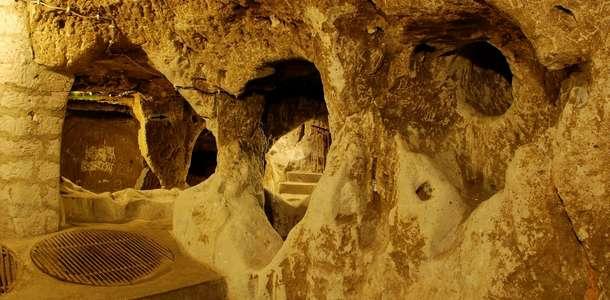
Özkonak Underground City is a structure located in the Özkonak Village, 14 kilometers north of the Avanos District in Nevşehir Province, within Türkiye’s Central Anatolia Region. It was constructed on the northern slopes of İdiş Mountain, in an area characterized by thick layers of volcanic tuff composed of granitic material. The structural properties of the tuff rock—easily carveable, hardening upon exposure to air, and offering favorable thermal and humidity conditions—enabled the formation of such subterranean settlements.

Özkonak Underground City (Government of Nevşehir, Republic of Türkiye)
The exact construction date of Özkonak Underground City is unknown, but it is estimated to have been built in the 400s BCE. Archaeological assessments indicate that the region was part of a local principality belonging to a 24-state federation known as Kabal during the Late Hittite period. Subsequently, it came under successive rule by the Persians, Hellenistic kingdoms, and Romans. During the Hellenistic period, a sanctuary dedicated to Zeus accommodating up to 3,000 people is believed to have existed in the area. After the Roman period, during Byzantine rule, the first Christian communities fleeing Arab raids settled in the region under the leadership of Saint Basil, carving out their own subterranean city within the rock.
The underground city consists of four levels, connected by tunnel-like passages. A large portion of the city remains unexcavated. The entrance area was later modified with cut-stone doors and staircases. Immediately after the entrance lies a stable, followed by a series of functional spaces including halls, kitchens, storage rooms, wine cellars, ventilation shafts, water wells, and food storage chambers.
The residential units are arranged in an apartment-like layout, with spaces linked by narrow corridors. A distinctive feature of Özkonak Underground City is the presence of very narrow and elongated holes constructed between levels to facilitate communication. These holes served both as a means of communication and as part of the ventilation system.

Özkonak Underground City (Government of Nevşehir, Republic of Türkiye)
The defense systems employed in the underground city exhibit more advanced features compared to other subterranean cities in the region. Entrances and corridors are sealed with rolling stones, which feature holes designed for launching arrows or spears at attackers or for surveillance. Additionally, specially carved recesses were constructed to pour hot oil onto intruders. These intensive defensive measures distinguish Özkonak Underground City from other similar structures in the region.
The underground city contains numerous areas designed to meet essential living needs. Particularly notable are the wine cellars, equipped with grape crushing troughs and vessels for collecting grape juice. Storage rooms, cisterns, and living quarters were also designed to support long-term habitation. At the lowest level, a narrow corridor leads to an area believed to have been used as a prison.
Ministry of Culture and Tourism of the Republic of Türkiye. "Müze Kart – Özkonak Yeraltı Şehri." *muze.gov.tr*. Accessed May 15, 2025. https://muze.gov.tr/muze-detay?DistId=OZK&SectionId=OZK01
T.C. Nevşehir Valiliği. "Özkonak Yeraltı Şehri." nevsehir.gov.tr. Accessed May 15, 2025. http://www.nevsehir.gov.tr/ozkonak-yeralti-sehri
Turkish Museums. "Nevşehir Özkonak Yeraltı Şehri." Turkishmuseums.com. Accessed May 15, 2025. https://www.turkishmuseums.com/museum/detail/2209-nevsehir-ozkonak-yeralti-sehri/2209/1

Location | Özkonak Township Türkiye Nevşehir Avanos | ||||||||
|---|---|---|---|---|---|---|---|---|---|
Distance(s) | 14 km from Avanos | ||||||||
Period of Construction | 400s BCE (Estimated) | ||||||||
Geological Structure | Volcanic Granite-Based Tuff Layers | ||||||||
Number of Floors | 4 | ||||||||
Discovery and Opening to Visitation | 1972 | ||||||||
Henüz Tartışma Girilmemiştir
"Özkonak Underground City" maddesi için tartışma başlatın
History
Architectural Features and Structural Elements
Defense System
Functional Areas