

Bu içerik Türkçe olarak yazılmış olup yapay zeka ile otomatik olarak İngilizceye çevrilmiştir.
+1 Daha
(Yapay Zeka ile Oluşturulmuştur)
The Pedro Pan Operation (in Spanish, Operación Pedro Pan) is a campaign conducted between 1960 and 1962 and regarded as one of the largest child evacuation operations of the Cold War era. Under this operation, more than 14,000 Cuban children were sent to the United States via a secret air bridge without their parents.【1】 The operation was named after the famous child character Peter Pan by Scottish author J.M. Barrie.【2】
The Pedro Pan Operation began in December 1960 and ended in October 1962.【3】 Lasting approximately 22 months, it emerged as a consequence of the social and political fears generated by the new regime policies implemented by Fidel Castro after the Cuban Revolution.【4】 Following his rise to power in 1959, the Castro government initiated the construction of a new education system based on Marxist-Leninist ideology, closed Catholic schools, and imposed restrictions on private property and religious institutions.【5】 These policies caused many parents to fear that their children would be “re-educated” in communist ideology, deprived of religious instruction, and stripped of parental rights, which were transferred to the state.

Fidel Castro’s Rise to Power (Generated by Artificial Intelligence)
In this context, the Catholic Church and certain U.S. institutions developed a secret plan. The objective of the operation was to protect children from “communist re-education” and temporarily relocate them to a safe country, namely the United States. The organization of the operation involved Catholic priests in Cuba, the U.S. Department of State, the Archdiocese of Miami, and Monsignor Bryan O. Walsh. Walsh coordinated the children’s needs for shelter, education, and psychological support through the Catholic Welfare Bureau in Miami.
The operation was conducted entirely in secrecy. Families delivered their children to Catholic institutions or intermediaries in Havana. There, documents were prepared and the children were included in flights organized by Pan American Airways (Pan Am). Each flight carried between 20 and 40 children; upon arrival in Miami, they were met by Catholic officials. The age range of the migrating children was between six and 18 years.【6】 Most were children of middle-class families; they did not speak English, had no exposure to Western culture, but had received religious education.
From the perspective of the United States, this operation was framed as a humanitarian effort to defend Western values against the dangers of communism. From the Cuban regime’s perspective, it was seen as an example of U.S. interference in internal affairs and propaganda.

Children from the Pedro Pan Operation Being Reunited with Their Families (Generated by Artificial Intelligence)
The Pedro Pan Operation is recognized as the largest unaccompanied child migration in the history of the Western Hemisphere and, in this regard, is considered one of the most extensive humanitarian movements of the 20th century. Such a large-scale child evacuation had previously occurred only in Europe during World War II; however, Pedro Pan arose not from wartime conditions but from ideological polarization.
The historical significance of the operation has been assessed from multiple perspectives. Humanitarianly, the Pedro Pan Operation was an organized migration movement aimed at removing Cuban children from their homeland due to ideological conflict. The process caused children to be separated from their families for extended periods, resulting in various emotional consequences. Many children lived for years without their parents, and some never saw them again.
Politically and historically, the operation is viewed as an extension of U.S. anti-communist policies in Latin America. Although the Washington administration did not formally organize the operation, it facilitated its execution by granting visa exemptions and providing logistical support to Catholic institutions.
From an educational and cultural standpoint, the majority of the children sent to the United States successfully adapted to their new lives, completed their education, and built successful careers in business, academia, or public administration. These individuals are now known as the “Pedro Pan generation” and are regarded as part of Latin American migration history. One personal example of this broader success is Ivonne Garay, who participated in the Pedro Pan Operation, became an elementary school teacher, married an American, and raised a family of two children.【7】

Images of the Catholic Welfare Bureau and Volunteers Feeding Migrant Children (Generated by Artificial Intelligence)
The Cuban Revolution of 1959, led by Fidel Castro, transformed the island’s social, economic, and political structure.【8】 After the revolution, Cuba adopted a state system based on Marxist-Leninist ideology. The Castro government implemented an economic policy that limited private property, nationalized large landholdings through land reform, and took over private enterprises. At the same time, Catholic and private schools across the country were closed, and the entire education curriculum came under state control.
Marxist thought and revolutionary ideology were embedded into the education system with the aim of instilling in children the consciousness of becoming “new socialist individuals.” The activities of the Catholic Church were restricted; missionary schools and religious communities were brought under state control. During this period, many priests and teachers were expelled or imprisoned. Dissenting voices were silenced, the press was brought under state control, and civil society organizations and religious institutions were subordinated to state authority. By 1961, Cuba had entered into an open ideological and military alliance with the Soviet Union, becoming one of the direct fronts of the Cold War.

Visual Depicting Cuba’s Shift Toward Marxist-Leninist Ideology Following Fidel Castro’s Rise to Power (Generated by Artificial Intelligence)
Following the Cuban Revolution, the United States regarded the establishment of communism in the Caribbean as one of the most serious threats of the Cold War. During this period, the Washington administration developed various military and diplomatic strategies to prevent the spread of communist regimes in Latin America. One of these strategies involved creating facilitative policies for refugees from Cuba, particularly children.
In 1960, the U.S. Department of State issued a special decision granting Cuban children visa-free entry into the United States.【9】 This regulation facilitated the children’s entry into the U.S. through documents prepared by the Catholic Church. In practice, children were permitted to fly from Havana to Miami without passports. Additionally, during the operation, U.S. Embassy staff maintained secret communication with Cuban families to assist in preparing the necessary paperwork.
The operational coordination of the Pedro Pan Operation was largely carried out by the Catholic Church. The Archdiocese of Miami worked in coordination with Catholic institutions in Cuba and the U.S. Department of State. At the center of this organization was Monsignor Bryan O. Walsh, director of the Catholic Welfare Bureau in Miami, who assumed both the moral and logistical responsibility for the operation.
The Catholic Church established a secret network within Cuba to communicate with families, prepare children’s documents, and obtain travel permissions. Priests and volunteers in Havana organized the safe transport of children to the airport. On the U.S. side, the Archdiocese of Miami established temporary reception centers for the children’s arrival and coordinated housing, health services, and psychological support. The Catholic Welfare Bureau also managed processes such as nutrition, educational planning, and placement with foster families.

Temporary Shelter Center of the Archdiocese of Miami During the Pedro Pan Operation (Generated by Artificial Intelligence)
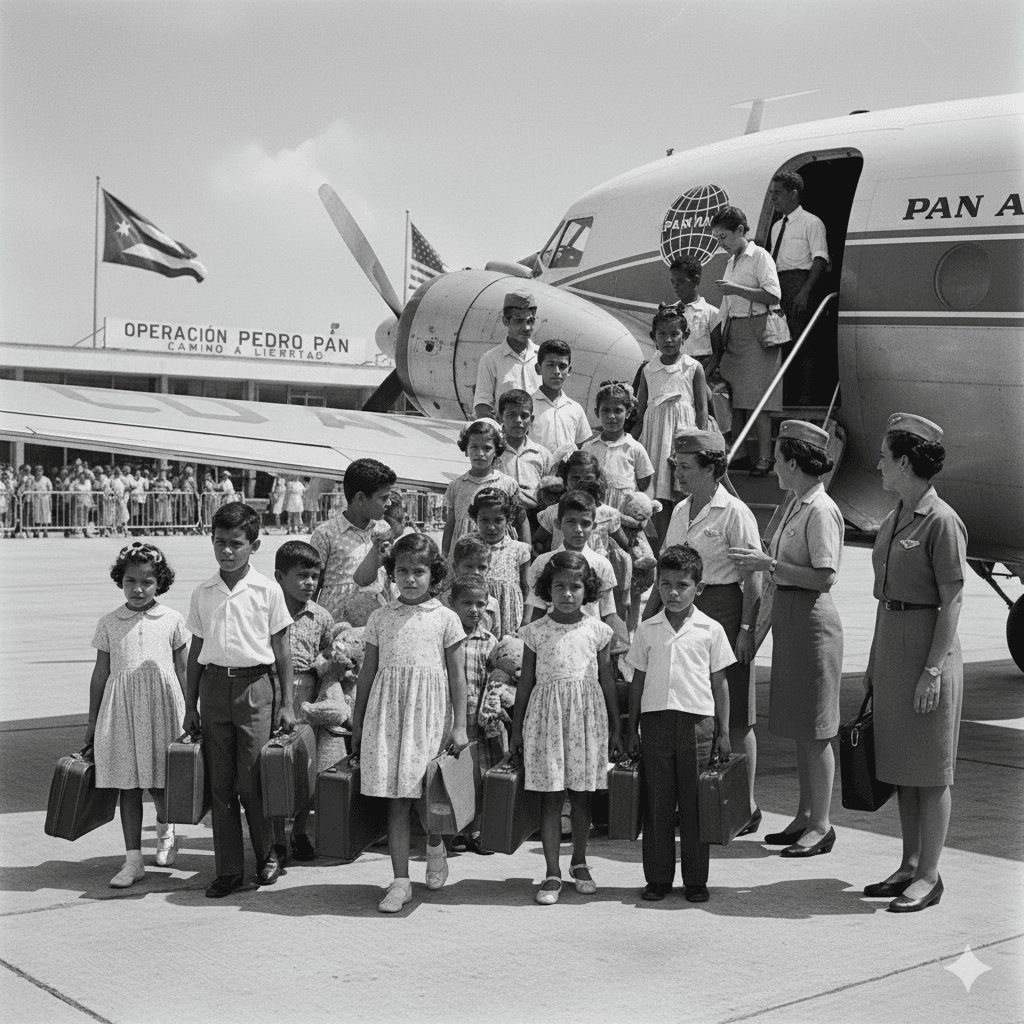
The Pedro Pan Operation relied on a completely secret air transport network. This clandestine air bridge was established along the risky route between Havana and Miami. The evacuations were carried out by Pan American Airways (Pan Am), one of the largest airlines of the era. Flights were typically conducted at night or early in the morning to avoid attention. To prevent detection by Cuban authorities, children were led to believe they were traveling for educational purposes or visits.
In the early stages of the operation, Catholic volunteers stationed at Havana International Airport helped facilitate children’s boarding by verifying their identification documents. Pan Am crew members also supported the process by accompanying the children. Upon arrival in Miami, the first institution to receive the children was the Catholic Welfare Bureau. There, the children were registered, underwent health screenings, and were directed to temporary shelter centers.

Evacuation Image Conducted via Pan American Airways (Generated by Artificial Intelligence)
After the initial reception process in Miami, children were placed according to specific criteria. Approximately one-third were children who had relatives or family friends in the United States; this group was sent directly to live with known individuals in a family-like environment. However, most children had no such options. Those without relatives were placed by Catholic institutions with foster families, orphanages, or church-affiliated care homes.
The Catholic Welfare Bureau documented each child’s placement in a registered system, recording which family, institution, or state they were assigned to. In accordance with Monsignor Walsh’s explicit instructions, no child was formally adopted; instead, the possibility of family reunification remained the priority. The placement process encompassed not only housing but also education, language learning, and social integration programs. Children were enrolled in Catholic schools or local public schools to continue their education.
In later stages of the operation, children had to be sent not only to Florida but also to other regions of the United States, as Florida’s camps quickly exceeded capacity. Consequently, children were distributed across 35 different states.【10】 Illinois, Wisconsin, California, New York, New Jersey, and Texas were among the primary states accepting Pedro Pan children. However, children who did not speak English or were unfamiliar with a Latin cultural environment experienced difficulties adapting, particularly in the Midwest and Northern states.

Process of Visa Procedures During the Pedro Pan Operation (Generated by Artificial Intelligence)
The Cuban Missile Crisis, which erupted in October 1962, was a critical event in Cold War history and directly affected the Pedro Pan Operation. This nuclear crisis between the United States and the Soviet Union led to the suspension of all commercial and civilian flights between Havana and Miami. This decision caused the abrupt termination of the operation. By that time, approximately 14,000 children had been transported to the United States, but hundreds more remained in Cuba awaiting evacuation.【11】 The halt in flights delayed for many years the hopes of families for reunification. Thousands of children remained separated from their parents. Many children had to wait until 1965 before they could reestablish contact with their parents in Cuba.

The Cuban Missile Crisis (Generated by Artificial Intelligence)
Three years after the operation ended, in 1965, diplomatic negotiations between the United States and Cuba led to the launch of the “Freedom Flights” program. Some Pedro Pan children were able to reunite with their families through these flights. However, the years that had passed caused emotional ruptures within families. Some children reunited with their parents after a decade; for others, reunification never occurred.

Freedom Flights Program (Generated by Artificial Intelligence)
Indeed, prolonged separations left psychological impacts on both children and parents. Many of the children sent to the United States experienced loneliness, identity confusion, and issues of belonging due to separation from their families; some felt alienated due to their inability to speak English or cultural differences. Meanwhile, parents remaining in Cuba suffered anxiety and guilt over the safety and future of their children.【12】
Conde, Yvonne M. *Operation Pedro Pan: The Untold Exodus of 14,048 Cuban Children*. London & New York: Routledge (Taylor & Francis), 2000. Accessed November 12, 2025. https://api.taylorfrancis.com/content/books/mono/download?identifierName=doi&identifierValue=10.4324/9780203905142&type=googlepdf.
Cruz, Bárbara C. “Operation Pedro Pan: The Flight to Neverland for more than 14,000 Cuban Children.” *Social Education*, no. 77, no. 1 (January/February 2013). Accessed November 12, 2025. https://www.socialstudies.org/system/files/publications/articles/se_77011323.pdf.
Mihanović, Karlo. “Operation Peter Pan and the Mariel Boatlift – Cuban emigration to the U.S. in a changing Cold War context.” Master's thesis, University of Zagreb, 2023. Accessed November 12, 2025. https://repozitorij.unizg.hr/islandora/object/ffzg:8893.
Smith, Marilyn. "Operation Peter Pan." Southern Illinois University (OpenSIUC). Accessed November 12, 2025. https://opensiuc.lib.siu.edu/cgi/viewcontent.cgi?referer=&httpsredir=1&article=1311&context=gs_rp.
[1]
Conde, Yvonne M, "Operation Pedro Pan: The Untold Exodus of 14,048 Cuban Children." London & New York: Routledge (Taylor & Francis), (2000). s. 4, Erişim tarihi: 12 Kasım 2025. https://api.taylorfrancis.com/content/books/mono/download?identifierName=doi&identifierValue=10.4324/9780203905142&type=googlepdf.
[2]
Cruz, Bárbara C, ‘‘Operation Pedro Pan: The Flight to Neverland for more than 14,000 Cuban Children’’, Social Education, sayı. 77, no. 1 (Ocak/Şubat 2013). s. 24, Erişim tarihi: 4 Kasım 2025. https://www.socialstudies.org/system/files/publications/articles/se_77011323.pdf.
[3]
Conde, Yvonne M. (a.g.e), s. 8.
[4]
Mihanović, Karlo. Operation Peter Pan and the Mariel Boatlift – Cuban emigration to the U.S. in a Changing Cold War Context. Yüksek Lisans Tezi, University of Zagreb, (2023). s. 3, Erişim tarihi: 4 Kasım 2025. https://repozitorij.unizg.hr/islandora/object/ffzg:8893.
[5]
Conde, Yvonne M. (a.g.e), s. 8.
[6]
Cruz, Bárbara C. (a.g.e), s. 24-25.
[7]
Cruz, Bárbara C. (a.g.e), s. 26.
[8]
Cruz, Bárbara C. (a.g.e), s. 23.
[9]
Cruz, Bárbara C. (a.g.e), s. 25.
[10]
Cruz, Bárbara C. (a.g.e), s. 26.
[11]
Cruz, Bárbara C. (a.g.e), s. 27.
[12]
Cruz, Bárbara C. (a.g.e), s. 26.

(Yapay Zeka ile Oluşturulmuştur)
Henüz Tartışma Girilmemiştir
"Pedro Pan Operation" maddesi için tartışma başlatın
Definition and Scope
Historical Significance
Background and Causes
Post-Cuban Revolution Situation
The Role of the United States and Visa Exemptions
Organization by the Catholic Church
Implementation and Operation
Impact of the Cuban Missile Crisis