


Bu içerik Türkçe olarak yazılmış olup yapay zeka ile otomatik olarak İngilizceye çevrilmiştir.
Permutation is the ordered arrangement of elements within a specific set. Mathematically, permutations are operations sensitive to ordering and constitute one of the fundamental building blocks of combinatorial theory. Permutations are frequently used not only in pure mathematics but also in applied fields such as statistics, computer science, and cryptography.
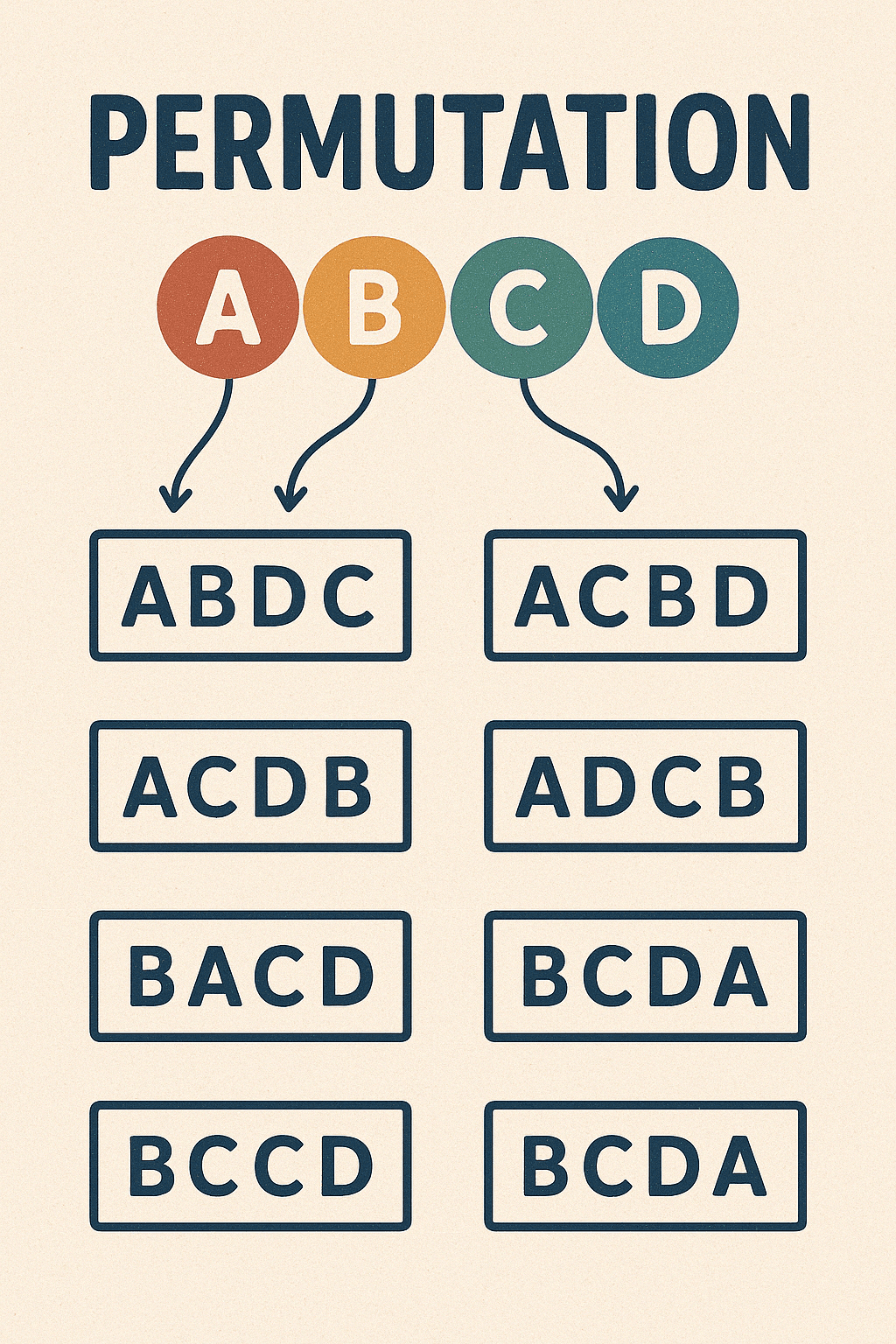
Permutation (generated by Artificial Intelligence.)
The number of different arrangements that can be formed by rearranging n distinct elements of a set is expressed as n! (n factorial). For example, all permutations of a set with three elements are: (a, b, c), (a, c, b), (b, a, c), (b, c, a), (c, a, b), (c, b, a), totaling six different arrangements (3! = 6) [NIST, 2023].
These types of permutations are called full permutations. However, in some cases, partial permutations (partial permutations) are also considered, where only r elements out of n are arranged. In this case, the number of permutations is calculated using the formula:
The formula for this is:
Permutations are often expressed mathematically in function form. In this context, a permutation is defined as a function that maps the elements of a set to one another in a one-to-one and onto manner. For example, a permutation of the set {1, 2, 3} can be given as f(1) = 2, f(2) = 3, f(3) = 1.
According to Weisstein, permutations can be arranged in lexicographic order and these orderings can be computed algorithmically. This property is particularly useful in computer science for enhancing the efficiency of algorithms.
Permutations are also studied in the context of group theory. Specifically, the Sₙ (symmetric group) represents the group consisting of all permutations of a set with n elements. These group structures form the foundation of abstract algebra and provide the underlying framework for combinatorial computations. An important feature of this structure is that every permutation can be expressed as a composition of transpositions (single swaps).
Equally important as the mathematical foundations of permutations is how the concept is taught. Teaching techniques based on constructivist approaches help students correctly grasp the idea of ordering. A study published in DergiPark indicates that students frequently confuse the concepts of permutations and combinations, but problem-based and discussion-oriented teaching methods have been shown to reduce this confusion.
Permutations are effectively used in the following fields:
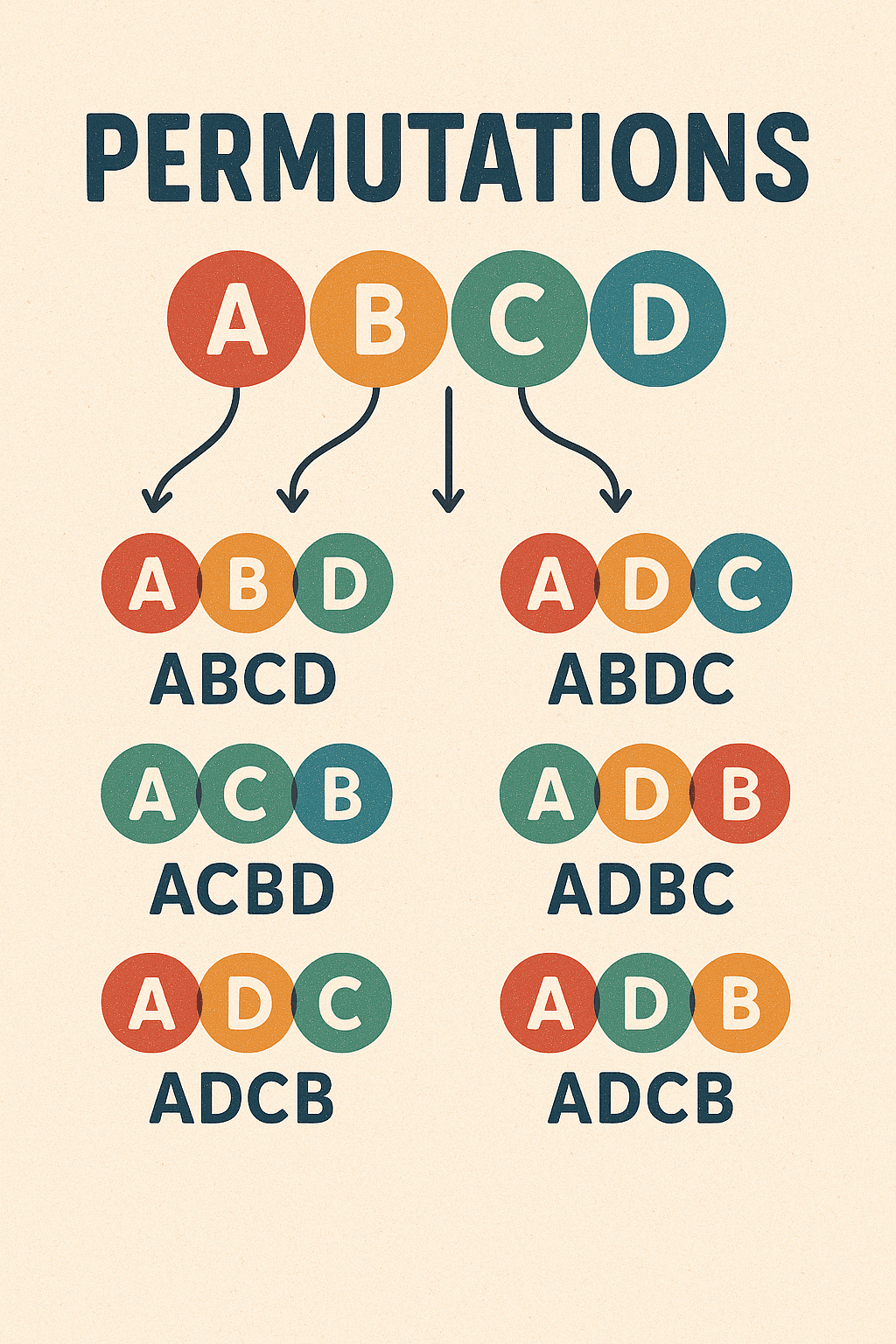
Permutation (generated by Artificial Intelligence.)
We wish to determine the number of possible rankings for five different teams participating in a competition at TEKNOFEST. The number of different arrangements these five teams can have is:
P(5) = 5! = 5 × 4 × 3 × 2 × 1 = 120
This means that the five different teams can form a total of 120 distinct arrangements.
When all elements in a permutation calculation are distinct, the direct formula n! is used. However, when a word or set contains repeated elements, the formula for permutations with repetition is applied:
This word contains a total of 9 letters. However, some letters are repeated:
According to the formula:
Thus, the total number of distinct arrangements of the letters in "TEKNOFEST" is 90,720. Such calculations are particularly important in fields such as brand design, encryption systems, and poster design.
National Institute of Standards and Technology (NIST). *NIST Digital Library of Mathematical Functions*. Gaithersburg, MD: U.S. Department of Commerce, 2023. https://dlmf.nist.gov/1.10
Weisstein, Eric W. “Permutation.” *MathWorld—A Wolfram Web Resource*. Accessed April 15, 2025. https://mathworld.wolfram.com/Permutation.html
Yılmaz, Selim, and Rıza Gürbüz. “Kombinasyon, Permütasyon ve Olasılık Konularının Öğretiminde Yapılandırmacı Yaklaşım.” Dicle Üniversitesi Ziya Gökalp Eğitim Fakültesi Dergisi 9 (2007): 49–60. https://dergipark.org.tr/tr/download/article-file/39542

Henüz Tartışma Girilmemiştir
"Permutation" maddesi için tartışma başlatın
Mathematical Definition and Fundamental Concepts
P(n, r)=
Structural Properties and Ordered Representations
Symmetric Groups and the Algebraic Interpretation of Permutations
Teaching Permutations and Conceptual Understanding
Application Areas
Applied Permutation Example: TEKNOFEST Competitions
Permutations with Repetition and Applied Example: "TEKNOFEST"
P=
Example: "TEKNOFEST"
P== =90,720