

Bu içerik Türkçe olarak yazılmış olup yapay zeka ile otomatik olarak İngilizceye çevrilmiştir.
+1 Daha
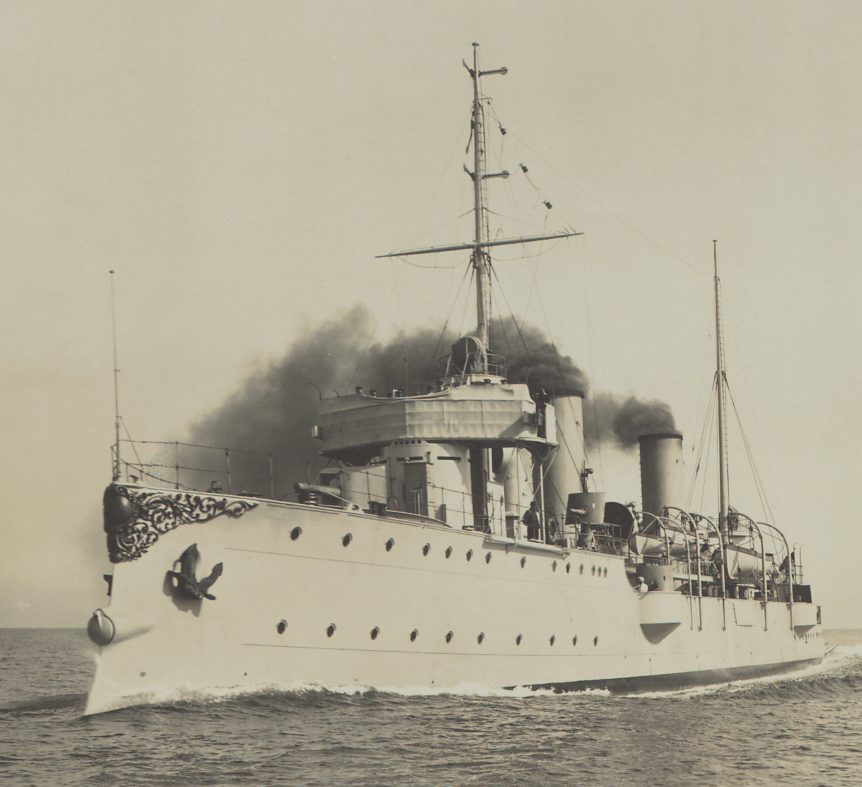
Peyk-i Şevket is the first ship of its class and a torpedo cruiser of the Ottoman Navy. It was constructed between 1906 and 1907 at the Germaniawerft Shipyard in Kiel, Germany, and entered Ottoman service in November 1907. During the Republican era, it served in the Turkish Naval Forces under the name TCG Peyk.

Peyk-i Şevket (Peyk-i Şevket Berk-i Satvet: Imperial Torpedo Cruisers)
Peyk-i Şevket measured 80.1 metres in length, 8.4 metres in width, and had a draft of 4.6 metres. Its initial displacement of 775 tonnes increased to 850 tonnes following modernization in 1938. The vessel featured a steel hull but lacked armour protection. Its crew initially numbered 125 personnel and rose to 145 by 1915. The ship was powered by two Germania-built triple-expansion steam engines, driven by four Schulz-type water-tube coal boilers. Its maximum speed upon completion was 22 knots (41 km/h), though this declined over time to approximately 18 knots. With a range of 3,240 nautical miles, the vessel possessed considerable operational mobility. Its armament consisted of three 450 mm torpedo tubes, two 105 mm guns, six 57 mm guns, two 37 mm guns, and two machine guns. During its modernization between 1936 and 1938, this armament was replaced by two 88 mm guns and four 37 mm guns.
After joining the Ottoman Navy in 1907, the ship was unable to participate actively in the Italo-Turkish War due to its internment by the British at Suez at the war’s outset. During the First Balkan War in 1913, it took part in naval bombardments against Bulgarian forces threatening Istanbul, operating from the Black Sea. In World War I, it performed significant duties; it participated in the Black Sea Raid on 29 October 1914 but failed to complete its mission due to mechanical failure. On 6 August 1915, it was torpedoed and severely damaged by the British submarine HMS E11. It managed to beach itself near Güvercinlik and was repaired, returning to service in 1917. In the final year of the war, it escorted troop shipments in the Black Sea.
In 1923, its name was shortened to Peyk and it was integrated into the Turkish Navy. It underwent two major modernizations at the Gölcük Shipyard, between 1925 and 1927, and again between 1936 and 1938. Its bow design was modified and its superstructure rebuilt. In 1944, the vessel was transferred to the Reserve Fleet and was decommissioned in 1948. It was subsequently scrapped at Gölcük between 1953 and 1954.

Henüz Tartışma Girilmemiştir
"Peyk-i Şevket (TCG Peyk)" maddesi için tartışma başlatın
Design and Technical Specifications
Service History
Republican Era