
Bu içerik Türkçe olarak yazılmış olup yapay zeka ile otomatik olarak İngilizceye çevrilmiştir.

A famous, ferocious storm is raging across the Eastern Mediterranean. The waves have long surpassed six meters. I cannot describe the howling of the wind—it is literally competing with thunder. There is a well-known rule in maritime navigation: under such conditions, no manned vessel may be put to sea. Why? Because human biological limits exist. Seasickness sets in. Physical exhaustion begins. Resisting the merciless face of the sea is not an easy task.
But when we return to one of the command and control centers in Ankara, the scene is entirely different. The engineers standing before those massive screens show not the slightest concern. Why? Because right in the heart of that very storm, a ghostly fleet is cutting through the churning waters—without a single human aboard. Meet the renowned autonomous naval force.
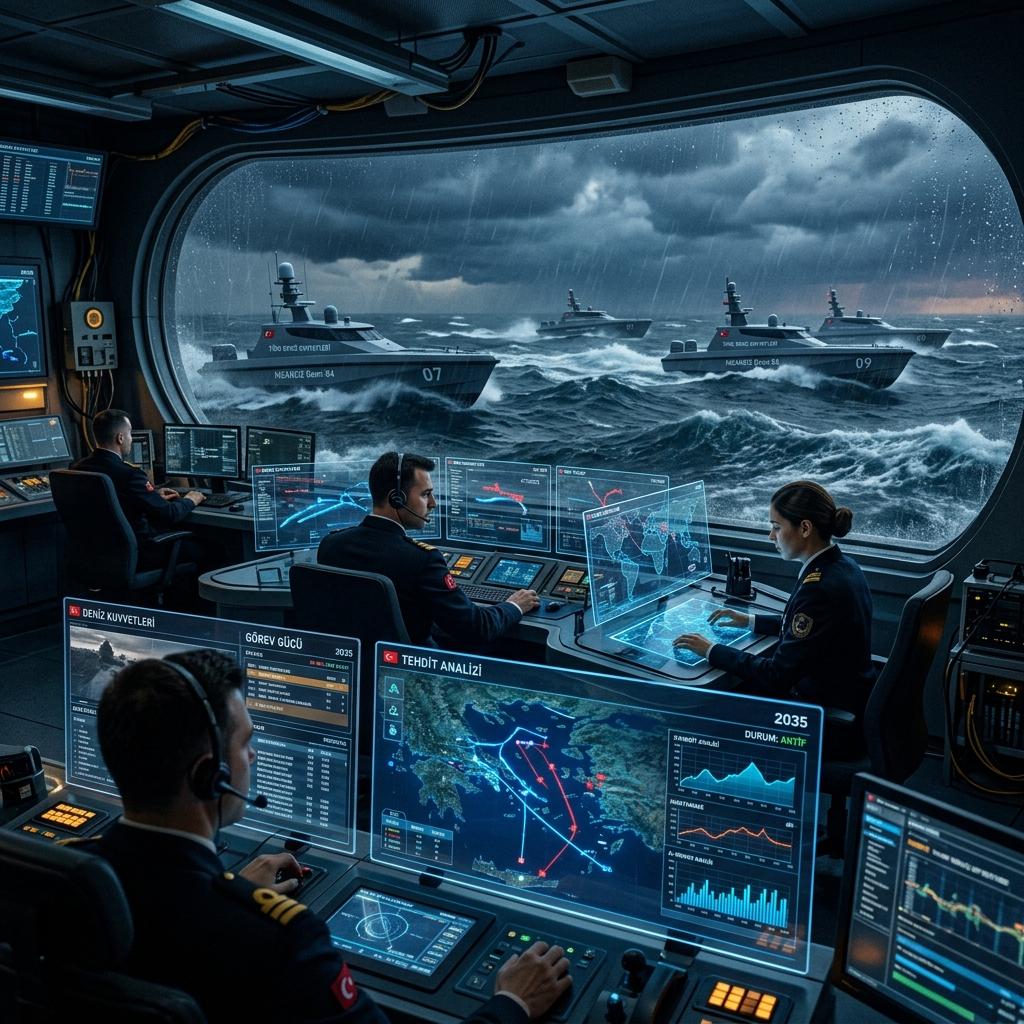
Otonom Filoyu Sevk ve İdare Eden Komuta Kontrol Merkezi Temsili (Yapay Zeka ile Oluşturulmuştur.)
Once, we dominated the seas by filling our sails with wind. Now, the situation is vastly different. On this stage, only algorithms are present. They process data from sensors in real time and with perfect accuracy.【1】 The area we call the Blue Homeland is no longer merely blue lines on a map. It has become an entirely new domain of digital sovereignty, extending from meters below the water’s surface to satellites in orbit.
Not long ago, how did we defend our maritime borders? Imagine weary soldiers on a swaying deck, binoculars trained on the horizon. The moment a blur appeared on the horizon, they would immediately grab the radio. Today, unmanned maritime vehicles are on duty, patrolling the blue waters and carrying out critical missions including reconnaissance and electronic warfare.【2】 These platforms do not merely observe; they simultaneously collect and integrate environmental data and underwater acoustic signatures using electro-optical cameras, radar systems, and advanced sonar arrays.
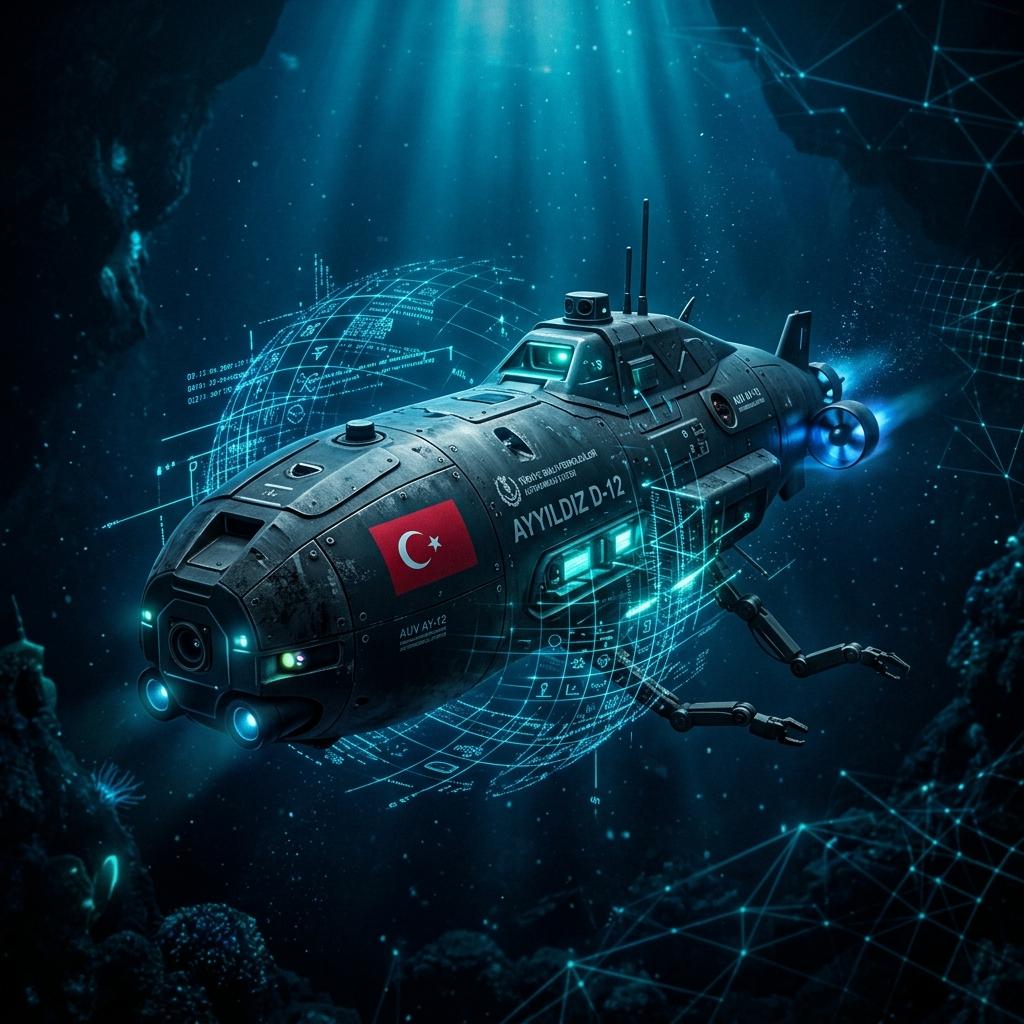
Sensörleriyle Derinliklerde Veri Toplayan Otonom İnsansız Sualtı Aracı (Yapay Zeka ile Oluşturulmuştur.)
This is precisely where the real breakthrough comes into play. Suppose a sound signal is detected. Is it a natural phenomenon in the sea or an enemy platform? The system can analyze this data in seconds and evaluate multiple possibilities. Moreover, it can activate autonomous decision-support systems at every step without waiting for manual commands from the center.【3】 This fleet in the midst of the storm communicates with itself using swarm intelligence. When one unit detects an underwater trace, what do the others do? They instantly synchronize. Through real-time data sharing among themselves, they reconfigure into coordinated formations and autonomously encircle the target. Thanks to the high response speed provided by algorithms, the target is neutralized before it can even approach the defensive line.
You may immediately wonder: Can the enemy hack this? The most critical aspect of this vision lies precisely here. The concept of the "Cyber Homeland" comes into play, enveloping the Blue Homeland like an impenetrable steel dome.
These fleets do not use vulnerable communication lines when transmitting data to the center. Through national cryptographic communication units and secure data links, unauthorized eavesdropping and interception of command channels are prevented.【4】 Enemy forces may attempt electronic warfare by jamming or spoofing GPS signals. However, thanks to inertial navigation systems (INS), the platforms can continue their missions autonomously for extended periods, estimating their position using only their own acceleration and orientation data—even without any external satellite signals.【5】
For decades, maritime dominance was assumed to rely solely on large, heavily armed warships. But with the advent of unmanned systems, naval warfare doctrines have undergone a fundamental transformation. Rather than replacing heavy platforms entirely, autonomous systems with low radar cross-sections and superior maneuverability have emerged as asymmetric force multipliers supporting them. Thanks to their small size and low radar visibility (ghost-like hulls), these platforms are extremely difficult for enemy radars to detect, and through networked communication, they execute coordinated operations.【6】
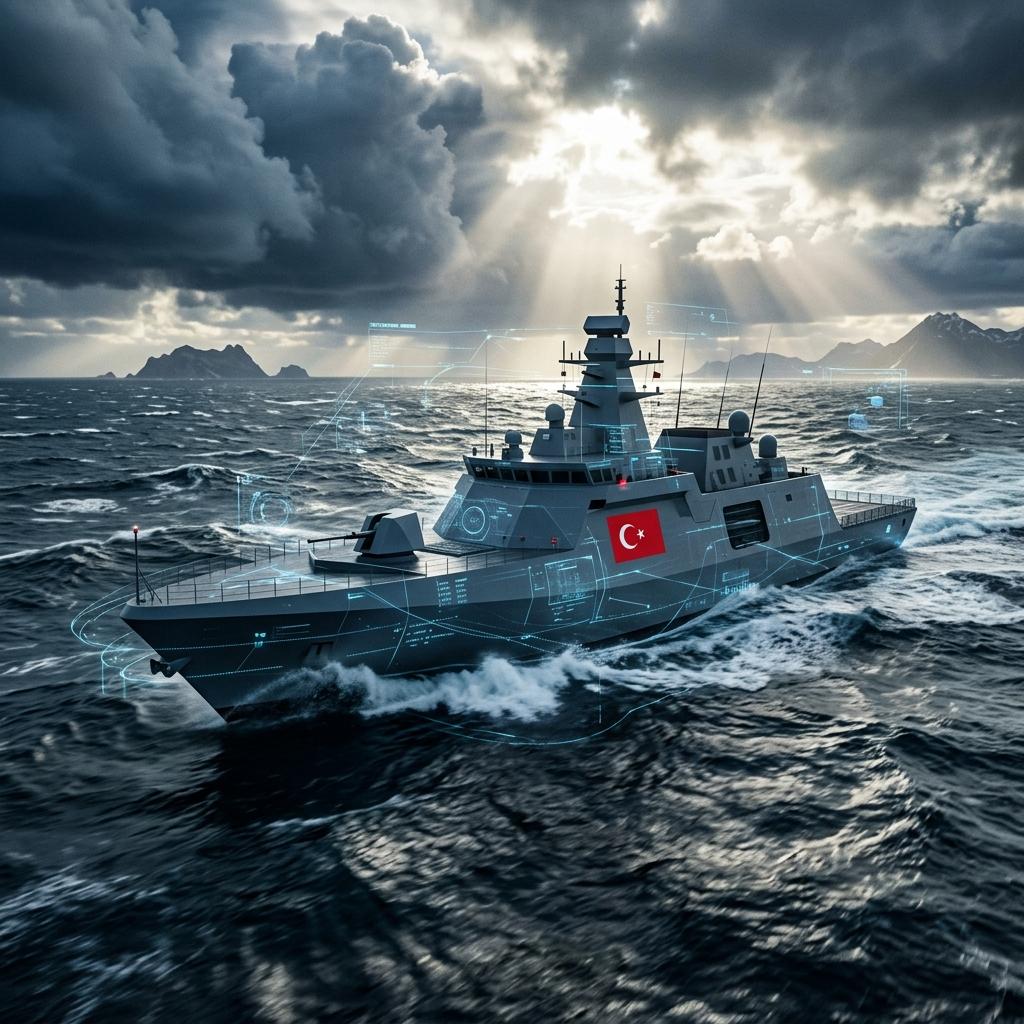
Ağır Deniz Şartlarında Görev İcra Eden İnsansız Deniz Platformu (Yapay Zeka ile Oluşturulmuştur.)
Looking back, the scale of this transformation becomes clearer. Our surface vessels and submarines are no longer mere robots. Think of them as the digital equivalents of the raiders who once patrolled on horseback centuries ago. Instead of wielding swords, they write algorithms. Instead of gunpowder, they fire data.
To be frank, the familiar iodine scent of the sea is now mingled with the reassuring odor of processors and fiber optic cables. Türkiye recognized early on that the only way to defend the Blue Homeland is through technological supremacy. By placing cyber security architecture at the forefront of our autonomous maritime platforms, we are gradually integrating the invisible shield we call the Cyber Homeland into our waters.
Imagine young Turkish engineers in Ankara today, writing code while staring at maps on their screens. They are translating Piri Reis’s vision, once drawn on gazelle skin, into pixels for the modern age. The dominance Barbaros once established with the wind is now echoing through our waters, powered by the flawless operation of algorithms.
History has taught us one unchanging rule: "Whoever controls the sea, controls the world."【7】 Whoever controls data, controls the future.
ASELSAN. "ALBATROS-S." Accessed August 11, 2026.https://www.aselsan.com/tr/savunma/urun/albatros-s
Aydın, Erdal. "Mavi Vatan, Gök Vatan ile Siber Vatan Söz Öbeklerinin Anlamları ve Oluşturulma Yöntemleri." *The Journal of Turkic Language and Literature Surveys* 7, no. 3 (2022): 167-178. Accessed August 11, 2026.https://dergipark.org.tr/tr/download/article-file/2769211
Deniz Haber Ajansı. "Türkiye'nin İnşa Ettiği Milli İnsansız Deniz Araçları." Accessed August 11, 2026.https://www.denizhaber.net/turkiyenin-insa-ettigi-milli-insansiz-deniz-araclari-haber-122003.htm
Dervişoğlu, Salim. "Denize Hâkim Olan Cihana Hâkim Olur." *7. İstanbul Güvenlik Konferansı. TASAM (Türk Asya Stratejik Araştırmalar Merkezi)*. (2021). Accessed August 25, 2026.https://tasam.org/tr-TR/Icerik/70289/denize_hakim_olan_cihana_hakim_olur
Korkmaz, Teoman. "Deniz Harbinin İcrasındaki Değişim, İnsansız Deniz Araçları ve ASELSAN Çözümleri. ASELSAN Mühendislerinin Kaleminden." *Savunma Sanayi*. Accessed August 11, 2026.https://savunmasanayi.org/2026/06/03/deniz-harbinin-icrasindaki-degisim-insansiz-deniz-araclari-ve-aselsan-cozumleri-aselsan-muhendislerinin-kaleminden/
M5 Dergi. "T129 ATAK'tan ADA Sınıfı Korvetlere Kadar Kullanılan Ataletsel Navigasyon Sistemi Ailesi: ANS-510." M5 Dergi. Accessed August 11, 2026.https://m5dergi.com/savunma-haberleri/t129-ataktan-ada-sinifi-korvetlere-kadar-kullanilan-ataletsel-navigasyon-sistemi-ailesi-ans-510/
Meteksan Savunma. "Türkiye'nin İlk Silahlı İnsansız Deniz Aracı 'ULAQ' Mavi Vatan ile Buluştu." Accessed August 11, 2026.https://www.meteksan.com/tr/haberler/ulaq-mavi-vatan-ile-bulustu
TRT Haber. "Marlin SİDA'ya yeni kabiliyet: Dünyada sayılı ülkede var." Accessed August 11, 2026.https://www.trthaber.com/haber/savunma/marlin-sidaya-yeni-kabiliyet-dunyada-sayili-ulkede-var-877064.html
Türk Loydu. "Savunma Sanayiinde Otonom Deniz Araçları." Türk Loydu. Accessed August 11, 2026.https://www.turkloydu.org/yayinlar/makaleler/savunma-sanayiinde-otonom-deniz-araclari/
[1]
Teoman Korkmaz, "Deniz Harbinin İcrasındaki Değişim, İnsansız Deniz Araçları ve ASELSAN Çözümleri. ASELSAN Mühendislerinin Kaleminden," Savunma Sanayi, Erişim tarihi 11 Ağustos 2026, https://savunmasanayi.org/2026/06/03/deniz-harbinin-icrasindaki-degisim-insansiz-deniz-araclari-ve-aselsan-cozumleri-aselsan-muhendislerinin-kaleminden/
[2]
TRT Haber. "Marlin SİDA'ya yeni kabiliyet: Dünyada sayılı ülkede var." TRT Haber, Accessed August 11, 2026.https://www.trthaber.com/haber/savunma/marlin-sidaya-yeni-kabiliyet-dunyada-sayili-ulkede-var-877064.html
[3]
Türk Loydu, "Savunma Sanayiinde Otonom Deniz Araçları," Türk Loydu, Erişim tarihi 11 Ağustos 2026, https://www.turkloydu.org/yayinlar/makaleler/savunma-sanayiinde-otonom-deniz-araclari/
[4]
Meteksan Savunma. "Türkiye'nin İlk Silahlı İnsansız Deniz Aracı 'ULAQ' Mavi Vatan ile Buluştu." Accessed August 11, 2026.
[5]
M5 Dergi. "T129 ATAK'tan ADA Sınıfı Korvetlere Kadar Kullanılan Ataletsel Navigasyon Sistemi Ailesi: ANS-510." M5 Dergi, Accessed August 11, 2026.https://m5dergi.com/savunma-haberleri/t129-ataktan-ada-sinifi-korvetlere-kadar-kullanilan-ataletsel-navigasyon-sistemi-ailesi-ans-510/
[6]
Deniz Haber Ajansı. "Türkiye'nin İnşa Ettiği Milli İnsansız Deniz Araçları." Accessed August 11, 2026.https://www.denizhaber.net/turkiyenin-insa-ettigi-milli-insansiz-deniz-araclari-haber-122003.htm
[7]
Salim Dervişoğlu, "Denize Hâkim Olan Cihana Hâkim Olur," 7. İstanbul Güvenlik Konferansı, TASAM (Türk Asya Stratejik Araştırmalar Merkezi), (2021), Erişim tarihi 25 Ağustos 2026, https://tasam.org/tr-TR/Icerik/70289/denize_hakim_olan_cihana_hakim_olur
Ghost Fleets of Silent Waters
But Can the Enemy Hack This?
From Massive Frigates to Steel Algorithms