


Bu içerik Türkçe olarak yazılmış olup yapay zeka ile otomatik olarak İngilizceye çevrilmiştir.

The month of Ramadan… Lights, decorations… An effort to either replace or rediscover our lost spirituality through objects.
This year, Ramadan is dazzling everywhere—especially streets, schools, and homes. We do not yet know whether this will become a lasting tradition or fade away. Yet, there are certainly those who wonder where this trend of decoration originated and how it became so widespread.
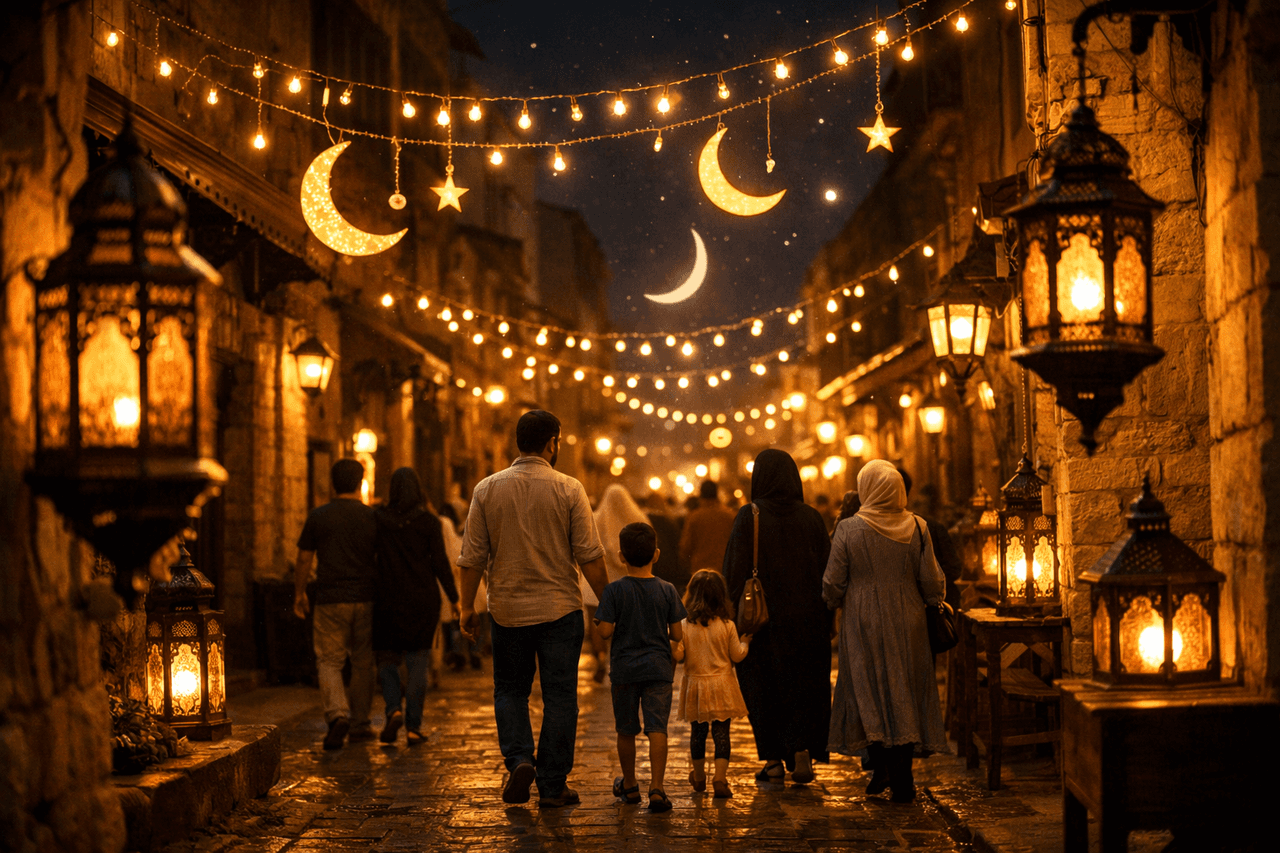
Ramadan Decorations (Generated by Artificial Intelligence)
Of course, there are those who object to everything—and this is no exception. Indeed, let us say this: there is a segment of society that constructs its identity on opposition, resisting nearly everything—even at times its own existence. These objections became particularly visible when the Ministry of National Education decorated schools for Ramadan. In a country where the majority are Muslim, some interpreted the decoration of schools during Ramadan as an act of defiance, believing it contradicted secular values. Some even went so far as to file formal complaints against the Ministry. Naturally, there were also those who praised the Ministry’s initiative. This is another dimension of the issue.
The power of decoration is truly astonishing. A single light, an LED, a simple ornament—sometimes these alone can evoke the feeling that values are being degraded. Clearly, the issue lies not in the objects themselves but in the meanings assigned to them.
So where did this trend of decoration come from? How did it become so widespread and visible? Is it good or bad?
I once came across this question on an internet forum: “Is it permissible to decorate our homes for Ramadan?” The answer was quite clear: it is permissible as long as it does not lead to extravagance. After the debates over whether chewing gum breaks the fast, we now have a fresh and timely question about Ramadan.
I have digressed somewhat. Let us return to the original question: Where did these lights come from?
Could this be the result of pressure? Sometimes people interpret such phenomena as “the outward expression of a repressed psychology.” Had Freud been alive, he might have offered an explanation. Even without Freud, there are those who offer interpretations. For instance, some claim that Muslims, having paid close attention to Christmas decorations, began decorating their homes for Ramadan in response. Thus, Ramadan decorations may have emerged as a kind of counterpoint to Christmas—a kind of “decoration war.”
To me, this second possibility seems more plausible. Consider this: during Christmas time, European cities are ablaze with lights, ornaments, gifts, Santa Clauses, snowmen, the scent of cookies, fireplaces, and colorful shop windows—an almost visual festival. One cannot help but be drawn into this atmosphere. Even those who absurdly think, “Oh my God, civilization!” are swept up in it.
Now consider past Ramadans. A modest family would break their fast at the iftar table with deep spiritual serenity, finding peace in fulfilling their vow to their Lord. Yet this atmosphere was not visible. It offered no scene suitable for sharing on social media. Today, however, even worship is often evaluated through the lens of visibility.
Perhaps this is why we want to say, “We are here too.” As Muslims, we want our own lights, our own ornaments, our own symbols. In a sense, we feel a need to be seen.
But here we must also ask ourselves: Are we trying to fill the emptiness within us with decorations? Are these ornaments part of our effort to rediscover spirituality? Perhaps they are. Everything has been emptied out, and we are trying to fill that void. Yet something always seems cracked; the more we fill it, the more it leaks.
Of course, others may hold the opposite view.
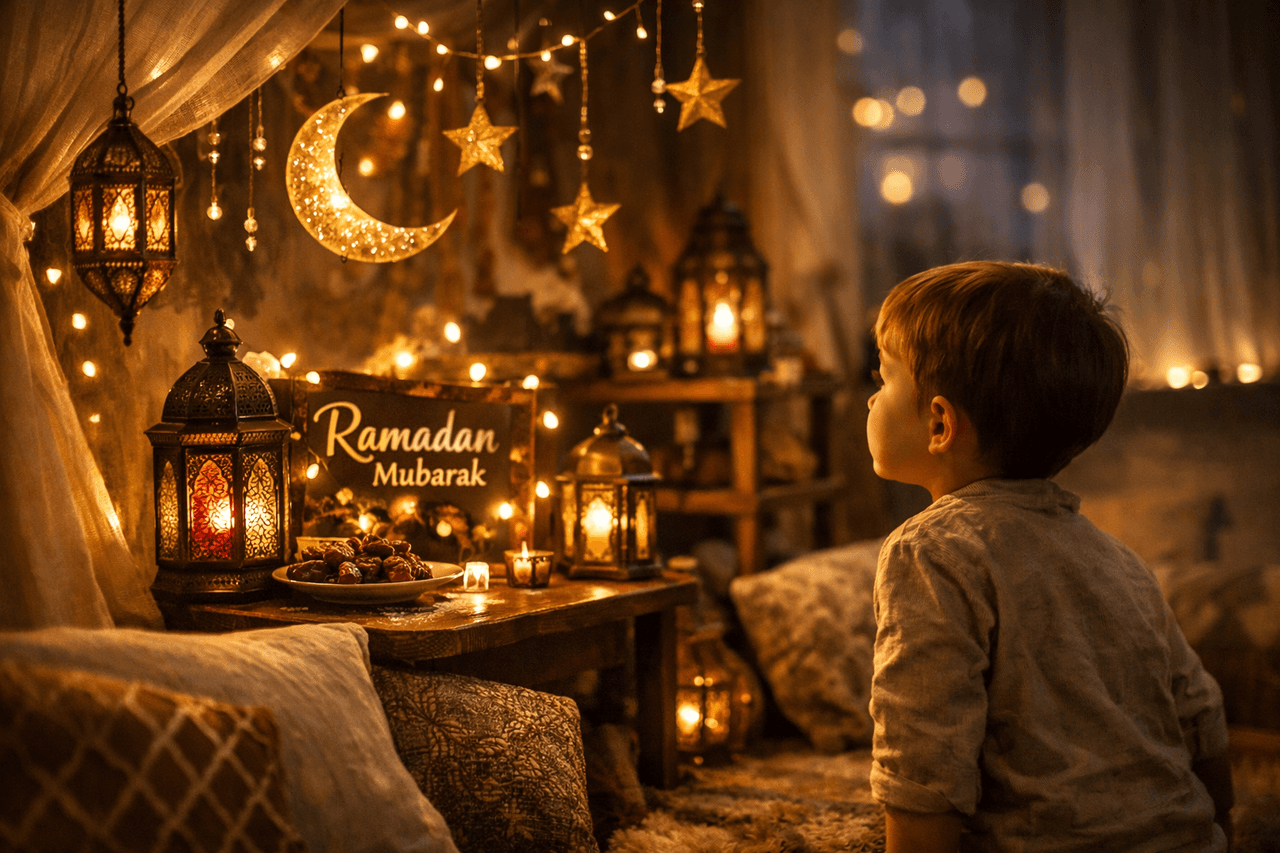
Ramadan Corner (Generated by Artificial Intelligence)
Another dimension involves children. What captures a child’s attention in today’s world? Everything is built around what is visible. For this reason, some parents create small Ramadan corners and decorate their homes to immerse their children in the Ramadan atmosphere. When children see stories, cartoons, and brightly lit streets centered on Christmas, they naturally become drawn to them. Perhaps these decorations are an effort to help children feel Ramadan more intimately.
We have also seen scenes in Palestine. Amid war and destruction, people prepare for Ramadan—decorations hung among ruins, iftar tables set up in rubble. This is, in fact, an act of clinging, a sign of hope.
I also recall a similar scene from my high school days. Israel, as usual, bombarded Palestine during Ramadan. Yet Palestinians still decorated their homes for Ramadan. I do not know whether this was a deeply rooted tradition in Palestine, but in my memory, this was my first powerful image of Ramadan decorations. Perhaps a similar thought emerged in our own society: “If Palestinians are decorating for Ramadan, why shouldn’t we?” Why not?
Another dimension is the world of commerce. Companies, always quick to seize opportunities, have now begun launching Ramadan collections. You have surely seen them in stores. In the past, there were Christmas collections; now there are Ramadan collections too.
Frankly, I do not view this negatively. In fact, I see its spread as, in a way, positive. In an age where everything is visible and meaning is generated through objects, why shouldn’t Ramadan be visible too?
Moreover, Ramadan events are now held in some regions abroad. A non-Muslim mother shared on social media how her child came home from preschool crying, “Mother, why don’t we fast?” Perhaps the time has come for children to pay attention to Ramadan as much as they do to Christmas.
Illuminating the Inner World (Generated by Artificial Intelligence)
Of course, there is also this view: “Rather than spending money on decorations, let us give it to those in need.” I respect this perspective. Yet I think this way: if a person has a budget for decorations, they often also have a budget for charity. I do not find the idea that “I bought decorations, so I couldn’t help” particularly realistic.
Moreover, charity is not limited to money. According to Islam, even a smile can be charity.【1】 The issue is not the scale of the action but the intention behind it. In short, I hope Ramadan decorations illuminate not only our surroundings but also our inner worlds. Yet we must remember that this illumination is possible not merely through objects, but through the heart and sincere intention.
[1]
Tirmidhi, Birr, 36.