

This article was automatically translated from the original Turkish version.
+2 More
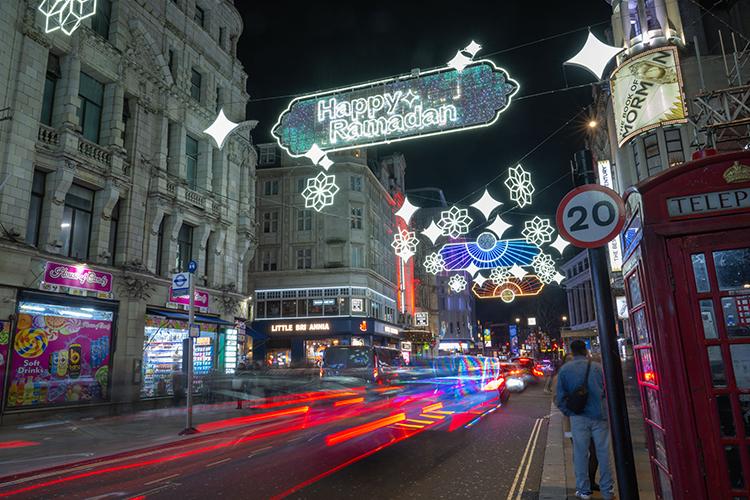
Ramadan Lights London, is an aerial lighting installation displayed publicly along the corridor between Piccadilly Circus and Leicester Square in London’s West End, particularly concentrated around Coventry Street, during the month of Ramadan. Coordinated by the Aziz Foundation and implemented in collaboration with local business and commercial associations with support from the local authority, the initiative functions as a city-wide event aimed at increasing the visibility of Ramadan in the heart of the city.
The 2026 program runs from 13 February to 24 March and is composed of tens of thousands of LED lights. The message content begins each year with the phrase “Happy Ramadan” and transitions to “Happy Eid” on 18 March.【1】 The event is designed not merely as an illumination project but as a public representation framework that emphasizes encounter and coexistence among diverse communities, complemented by elements such as iftar routes, exhibitions, and directional guidance to places of worship.
Ramadan Lights London is a public lighting program featuring overhead light installations along the streets of London’s West End during Ramadan. The lights are arranged along the high-footfall corridor between Piccadilly Circus and Leicester Square, with particular concentration around Coventry Street. This location transforms the event from a community-specific observance into a visible presence that directly intersects with the daily urban experience of all who pass through the area.
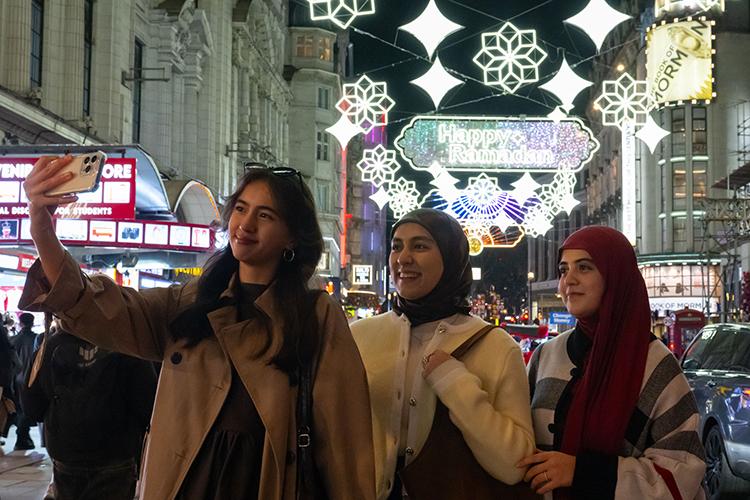
A Scene from Ramadan Lights London (Anadolu Ajansı)
The event is organized by the Aziz Foundation in partnership with the Heart of London Business Alliance (HOLBA) and with support from the City of Westminster.【2】 This structure elevates the project beyond a mere decorative lighting display, transforming it into a program that unites civil society, local business interests, and municipal support to enhance the visibility of Ramadan in the city center. The initiative operates within a “free” and “family-friendly” framework, serving as a public event that integrates Ramadan into urban life and enables visitors from diverse backgrounds to share the same spaces.
The scope extends beyond the lighting itself: the program incorporates complementary elements such as food-focused iftar routes, exhibitions, and directional guidance to places of worship (mosques and prayer spaces). The scale of the lighting installations further defines the program’s reach: over 30,000 LEDs are used in the design, ensuring a powerful visual impact even amid the busy nighttime crowds of the West End.【3】 The 2026 schedule spans 13 February to 24 March, with illumination scheduled to operate consistently during nighttime hours. This continuity transforms Ramadan Lights London from a one-off spectacle into a recurring public program embedded within the city’s nightly rhythm.
Ramadan Lights London began in 2023 with overhead lighting installations introduced in the West End to mark the month of Ramadan.【4】 From its inaugural year, the project adopted the identity of a public initiative aimed at increasing the visibility of Ramadan in the city center, strategically placing its installations along the West End’s most densely trafficked pedestrian corridors to maximize public engagement. The first year’s framework was defined by its design as a sustained urban event spanning the entire Ramadan period, rather than a single-night spectacle.
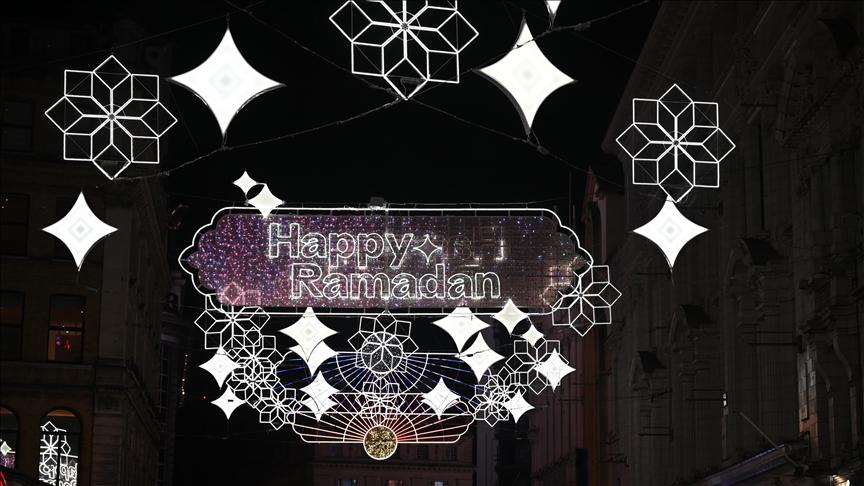
Happy Ramadan Text on Ramadan Lights London (Anadolu Ajansı)
The institutional backbone of the project is formed by the Aziz Foundation. Within this framework, the event has evolved from a cultural visibility initiative into an organized presence within the West End’s public realm, enabled by partnerships with local businesses and support from the municipal authority. The collaboration with the Heart of London Business Alliance (HOLBA) has strengthened the event’s integration with the commercial and public life of the West End, while support from the City of Westminster has solidified the administrative foundation for a sustained public initiative. Thus, the project has become rooted in the logic of a city event co-created by civil society and local stakeholders.
As of 2026, the initiative enters its fourth year. This continuity demonstrates that Ramadan Lights London has moved beyond being a one-time experiment to become a recurring program that seeks to establish a permanent place in the city’s calendar. Over the years, the program’s scope has expanded: while lighting remains the central element, supplementary components that facilitate the experience of Ramadan in the city—such as iftar route suggestions, cultural exhibitions, and directional guidance to places of worship—have become more prominent. This expansion has transformed the event from a mere “street adorned with lights” into a multi-layered public experience of Ramadan across the West End.
The most distinctive feature of Ramadan Lights London is its visibility through overhead lighting installations along the West End’s high-footfall streets. The installations are concentrated around Coventry Street, situated within the busy corridor between Piccadilly Circus and Leicester Square—a zone bustling with pedestrians at all hours. This spatial placement ensures the lights produce a public “overhead canopy” effect, visible not only to a targeted audience but to everyone passing through the area.
The scale of the design is evident in the number of lights used: over 30,000 LEDs are deployed, with some sources rounding the figure to approximately 31,000.【5】 This scale enables the lights to be perceived not only up close but also as a strong visual presence from a distance within the main pedestrian flows of the West End. In terms of design language, geometric patterns dominate, drawing inspiration from the regular, repetitive forms commonly found in Islamic art. Thus, the visual composition is defined not by direct religious symbols but by an aesthetic rooted in rhythm, order, and geometry.
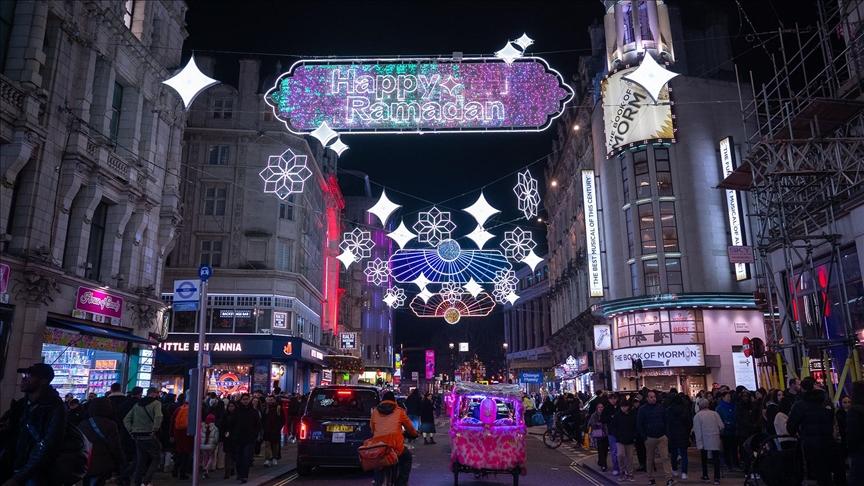
Coventry Street Decorated with Lights (Anadolu Ajansı)
Another defining factor of the project’s time-space impact is the operating hours and schedule. The 2026 program runs from 13 February to 24 March, with illumination active throughout the night over an extended period. While sources vary slightly on exact timing, the general framework begins at 17:00 and continues through the night; some references indicate an end time of 05:00.【6】 This extended nighttime window ensures that the event becomes a continuous urban experience integrated into the West End’s nightly rhythm, rather than a fleeting moment.
Textual content has also become an integral part of the design. The primary message displayed throughout the program is “Happy Ramadan,” which transitions to “Happy Eid” on 18 March and remains until 24 March. Thus, the lights track the rhythm of Ramadan not only through visual motifs but also through textual messaging, gradually shifting emphasis toward the celebration of Eid from the final days of Ramadan. This transformation demonstrates that the design is not static decor but a dynamic narrative that updates according to the calendar and conveys seasonal meaning through text.
While centered on the lighting installations in the West End, Ramadan Lights London operates on the principle of a complementary program designed to facilitate the experience of Ramadan within the city. In this framework, the event generates a broader Ramadan calendar through elements related to food and drink, culture and art, and directional guidance. Thus, the lights no longer serve merely as visual elements but have become the starting point of a “city-wide route” that connects visitors to other points of interest.
One of the most visible components of this integrated program is the Ramadan Delights iftar food trail. The trail highlights businesses in the West End offering special Ramadan menus or iftar experiences, extending the event’s reach from street-level lighting to everyday urban consumption practices. In the 2026 schedule, this route is planned to coincide with the Ramadan period and is structured within a specific timeframe.
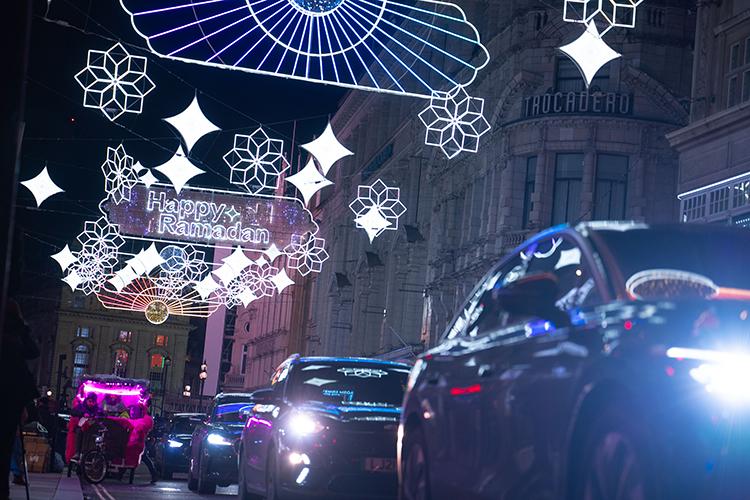
Street Decorated with Ramadan Lights (Anadolu Ajansı)
As a cultural and artistic component, the interfaith art exhibition titled “Shared Light” has become part of the program. This exhibition prevents the event’s public representation from remaining purely decorative; instead, it creates a cultural space where diverse faiths and communities are visibly present. The exhibition is held in a location and timeframe connected to the lighting installations, adding an art-focused layer to the broader set of Ramadan activities in the West End.
Another key element strengthening the program’s practical dimension is its digital guidance components. An interactive map developed as part of the event highlights prayer spaces and other relevant locations in the West End during Ramadan, facilitating public access to essential facilities.【7】 Such tools demonstrate that Ramadan Lights London is more than a passive urban spectacle; it functions as a practical guide for people navigating the city center during Ramadan. Within this integrated framework, the lights serve both as symbolic markers and as the central element linking complementary events, layering the experience of Ramadan across the West End.
Ramadan Lights London has become a powerful public representation initiative due to its visibility in globally recognized urban centers like the West End. By situating the lights along a corridor of high tourism and commercial activity, the project transforms Ramadan from a period confined to specific communities’ worship and family life into a shared urban experience accessible in the city’s common spaces. In this sense, the initiative carries the character of an application that brings the spirit of celebration into the public realm and adds a distinct seasonal layer to the city’s nighttime landscape.
The central theme in the event’s messaging is diversity and coexistence. London Mayor Sadiq Khan frames Ramadan during the opening as “a time of peace and reflection,” and constructs a language of unity that recalls London’s structure as a city that embraces diverse faiths and backgrounds. This discourse positions the public visibility of Ramadan not merely as a matter of cultural richness but as a practice that makes visible the coexistence of different communities within urban life. Khan’s remarks also frame opposition to Muslims (anti-Muslim hatred) as part of this unity narrative.【8】
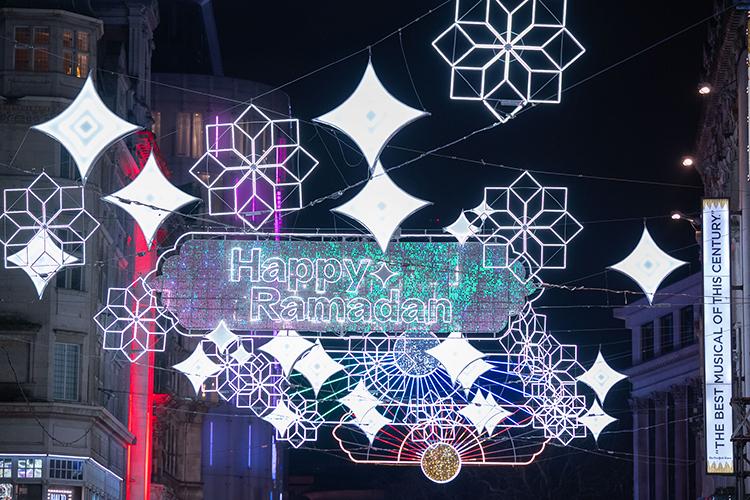
Ramadan Lights in London (Anadolu Ajansı)
A similar framework is emphasized by the organizers. Rahima Aziz, a representative of the Aziz Foundation, frames the placement of the lights in central London as a means of making visible the place of Muslim communities within urban life, and states that the event contributes to challenging prejudice and increasing opportunities for encounter. Within this same framework, the idea has gained strength that the lights are seen daily by thousands of people, generating curiosity and interaction around Ramadan in a densely populated urban setting. Visitor narratives further reinforce this point: tourists from different countries encountering the lights in the West End or children following the messages displayed on the lights demonstrate that the event has become a daily source of public interest and conversation within the city.
This layer of social meaning is further reinforced by the program’s complementary components. The iftar route, exhibitions, and directional tools transform Ramadan from something merely “seen” into something actively “experienced” within the city. Thus, Ramadan Lights London functions as an initiative that unites aesthetic public arrangement with social engagement and representation discourse, aiming to create a collective urban memory of Ramadan within the high-visibility landscape of the West End.
[1]
Gizem Nisa Demir, "London's West End Lights Up for Muslim Holy Month Ramadan as Mayor Calls for Unity," Anadolu Ajansı, access date 19 February 2026, https://www.aa.com.tr/en/europe/london-s-west-end-lights-up-for-muslim-holy-month-ramadan-as-mayor-calls-for-unity/3829771.
[2]
Ramadan Lights, "About," access date 19 February 2026, https://ramadanlightslondon.com/about.
[3]
Aziz Foundation, "Ramadan Lights London," access date 19 February 2026, https://www.azizfoundation.org.uk/ramadan-lights-london/.
[4]
Heart of London Business Alliance (HOLBA), "Ramadan Lights London," access date 19 February 2026, https://holba.london/ramadan-lights-london.
[5]
Zuhal Demirci, "Londra'da dördüncü kez yanan ramazan ışıkları ön yargıların sorgulanmasına katkı sağlıyor," Anadolu Ajansı, access date 19 February 2026, https://www.aa.com.tr/tr/dunya/londra-da-dorduncu-kez-yanan-ramazan-isiklari-on-yargilarin-sorgulanmasina-katki-sagliyor/3834439.
[6]
Leicester Square London, "Ramadan Lights Are Set to Dazzle the West End for Its Fourth Year," access date 19 February 2026, https://leicestersquare.london/updates/ramadan-lights-are-set-to-dazzle-the-west-end-for-its-fourth-year.
[7]
Heart of London Business Alliance (HOLBA), "Ramadan Lights London," access date 19 February 2026, https://holba.london/ramadan-lights-london.
[8]
Gizem Nisa Demir, "London's West End Lights Up for Muslim Holy Month Ramadan as Mayor Calls for Unity," Anadolu Ajansı, access date 19 February 2026, https://www.aa.com.tr/en/europe/london-s-west-end-lights-up-for-muslim-holy-month-ramadan-as-mayor-calls-for-unity/3829771.


No Discussion Added Yet
Start discussion for "London Ramadan Lights" article
Definition and Scope
History and Institutional Development (2023–2026)
Design, Location, and Technical Features
Program Components and Companion Events
Social Meaning, Public Representation, and Discourse