Bu içerik Türkçe olarak yazılmış olup yapay zeka ile otomatik olarak İngilizceye çevrilmiştir.
Klipsbuck (Oreotragus oreotragus) is a small antelope species belonging to the family Bovidae, order Artiodactyla, and class Mammalia, endemic to Africa.
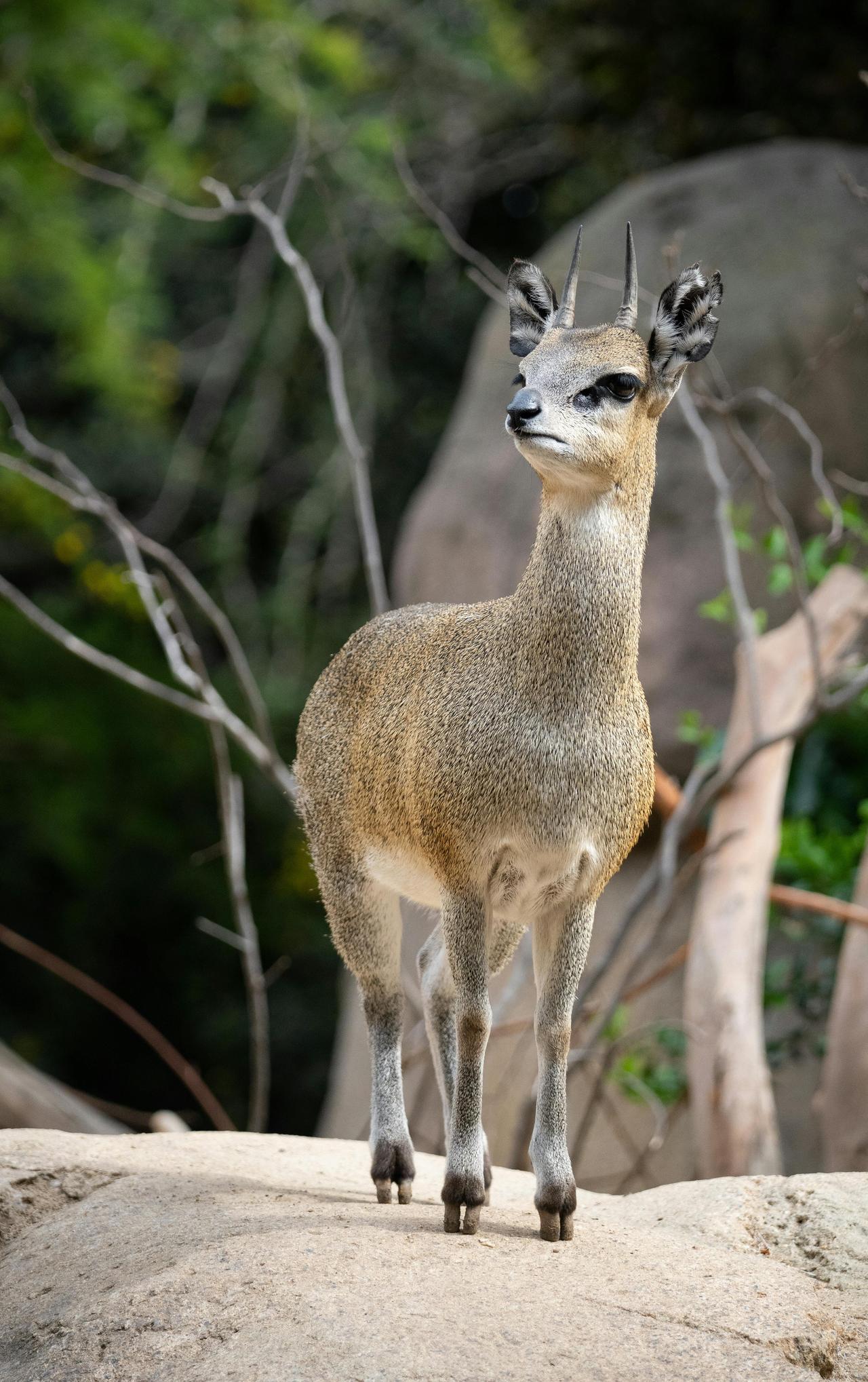
Klipsbuck are stocky and robust animals with a shoulder height ranging from 43 to 51 cm and a total body length of 75 to 115 cm. They weigh between 8 and 18 kg, with females (average 13.2 kg) typically heavier than males (average 10.6 kg). They possess relatively large hind legs and a short neck and body in proportion to their overall size.
Their coat consists of hollow and brittle hairs that protect the animal from extreme heat by reflecting radiant heat and providing insulation, while also offering resistance to injury. Coat color varies by subspecies but is generally speckled (mottled) in shades of yellow, brown, gray, and olive green. The belly, chin, and inner ears are pale white.
The most distinctive feature of the klipsbuck is its hooves. The terminal joints of the toes are rotated so that the animal walks almost on its toes. These small, cylindrical hooves create a slight suction effect on rocky surfaces, providing exceptional grip and balanced movement, enabling the animal to leap nimbly onto platforms no larger than a silver dollar.
Horns are typically short, straight, and pointed. In southern African populations, only males possess horns, whereas in eastern African subspecies such as those in Kenya and Tanzania, both males and females may have horns. Horns reach adult size at 17 to 18 months and average 10 cm in length.
The distribution of klipsbuck is patchy due to their specialized habitat requirements. Their range extends from the highlands of northeastern Sudan, Eritrea, Somalia, and Ethiopia through eastern and southern Africa, including Namibia and Angola. Their habitat is strictly limited to rocky terrain, including “kopjes” (small rock outcrops rising from savannas), rocky hills, passes, and even mountain slopes reaching up to 4,000 meters in elevation. They may travel up to 10 km across flat ground to reach another rocky outcrop.
Klipsbuck are territorial animals that live in monogamous pairs or small family groups consisting of one male, one female, and a single yearling offspring. The average group size is approximately 2.6 individuals, with average home ranges of about 0.081 km². Home ranges are smaller in areas with higher rainfall and denser vegetation.
These animals are most active during the early morning and late afternoon. They spend the hottest parts of the day resting in the shade to avoid predators and cool down. When the weather is cool, they may remain active throughout the day.
Communication relies heavily on scent and sound. They mark their territory using secretions from preorbital glands located at the corners of each eye and by depositing dung piles. These scent marks last about a week and are regularly refreshed. When detecting a predator, they emit a high-pitched, trumpet-like whistle through their nostrils that can be heard up to 0.7 km away as an alarm call.
Klipsbuck exhibit high vigilance toward predators. Their initial response to a predatory threat is to freeze. If the predator continues to approach, they issue an alarm call and flee toward higher rocky terrain. Their main predators include leopards, caracals, jackals, and eagles.
Klipsbuck are primarily browsers, feeding on fruits and leaves. They spend a significant portion of each day foraging and selectively consume plant parts with high nutritional value. Their narrow mouths support this selective feeding behavior. Fruits and flowers make up about two-thirds of their diet; they do not graze on grasses. Living in arid environments, they consume very little free water, meeting most of their hydration needs through the plants they eat and morning dew.
While feeding, one member of the pair remains alert as a sentinel while the other feeds. The female, due to increased energy demands during lactation, typically leads the group to feeding areas.
Klipsbuck are monogamous. The gestation period lasts approximately six months, and females usually give birth to a single offspring every 16 months. Newborns, weighing about 1 kg, remain hidden in rock crevices for the first two to three months. They are weaned at 4 to 5 months and reach sexual maturity at around 7 months. Females may remain in the family group for up to 10 to 11 months, while male offspring leave earlier, around 6 months of age, to establish new territories. In captivity, they have been recorded to live up to 17 years and 10 months.
The klipsbuck is listed as Least Concern (LC) on the International Union for Conservation of Nature (IUCN) Red List. Populations are concentrated in protected areas such as Tsavo, Nyika, Namib-Naukluft, and Matobo National Parks.
Ewacha, Michelle. “Oreotragus oreotragus.” Animal Diversity Web. Accessed October 21, 2025. https://animaldiversity.org/accounts/Oreotragus_oreotragus/.
Moses, Soly. “Hayvan, Ayakta, Memeli, Otobur JPG.” Pexels. Accessed October 21, 2025. https://www.pexels.com/tr-tr/fotograf/hayvan-ayakta-memeli-otobur-11089836/.
San Diego Zoo. "Klipspringer." San Diego Zoo Wildlife Alliance. Accessed October 21, 2025. https://animals.sandiegozoo.org/animals/klipspringer.

Henüz Tartışma Girilmemiştir
"Rock Antelope (Oreotragus oreotragus)" maddesi için tartışma başlatın
Morphological Characteristics
Geographic Range and Habitat
Behavior and Social Life
Diet and Feeding Habits
Reproduction and Lifespan
Conservation Status