
Bu içerik Türkçe olarak yazılmış olup yapay zeka ile otomatik olarak İngilizceye çevrilmiştir.
+2 Daha
Official Name | Republic of Korea | ||||||||
|---|---|---|---|---|---|---|---|---|---|
Form of Government | Unitary constitutional republic governed by a presidential system | ||||||||
Date of Independence | 15 Ağustos 1945 | ||||||||
Capital | Seoul | ||||||||
Head of State | Lee Jae-myung | ||||||||
Official Language | Korean | ||||||||
Common Languages | English Chinese Vietnamese | ||||||||
National Day | August 15 – Gwangbokjeol (Day of the Restoration of Light / Liberation Day) | ||||||||
Area | Approximately 99,720 km² | ||||||||
Total Population | Approximately 51.8 million people | ||||||||
Climate | Generally a temperate zone climate Hot and rainy summers (monsoon-influenced) Cold and dry winters More humid and temperate in the south More continental in the interior | ||||||||
GDP | Approximately $1.8 trillion USD | ||||||||
GDP per Capita | Approximately $35,000 USD | ||||||||
Ethnic Groups | Koreans (≈ %95) Foreign nationals (≈ %5) China Vietnam Thailand Philippines | ||||||||
Religious Affiliation | Those affiliated with no religion (≈ %56) Protestant Christians (≈ %20) Buddhists (≈ %16) Catholics (≈ %8) | ||||||||
Telephone Code | +82 | ||||||||
Internet Domain Code | .kr (Latin alphabet) .한국 (Korean alphabet) | ||||||||
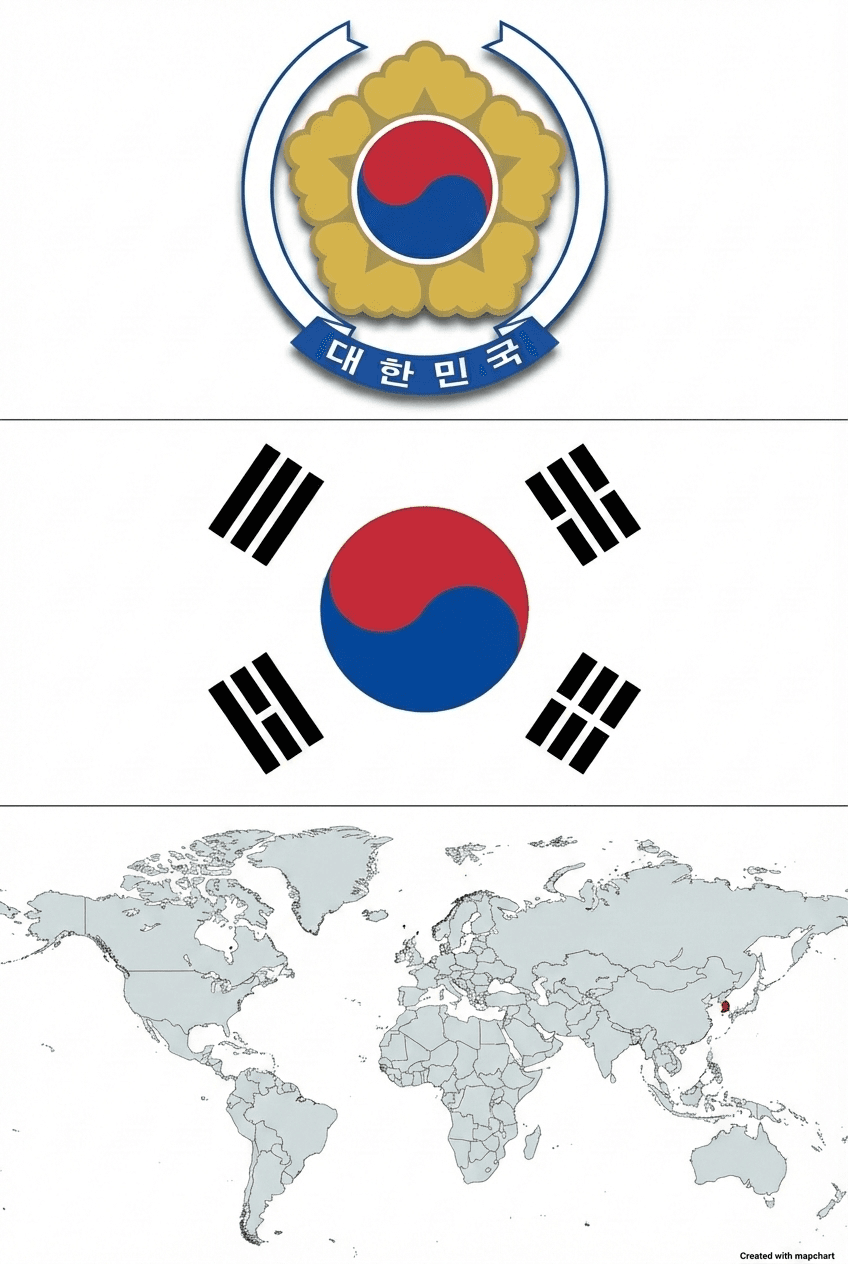
South Korea (Republic of Korea) is a republic located in the southern part of the Korean Peninsula in East Asia, governed by a presidential system, highly industrialized, and with a population of approximately 51.8 million. 【1】The capital of the state is Seoul, which historically served as the center of various dynasties and has today become one of the most populous metropolitan areas in East Asia. The official language is Korean, and the Hangul alphabet used for this language is recognized as one of the modern writing systems due to its phoneme-based structure. The national flag, the Taegeukgi, emphasizes change, harmony, and peace through the taegeuk symbol at its center, representing yin-yang balance, and the surrounding trigrams; the national flower, Mugunghwa (rose of Sharon), symbolizes the people’s ideals of continuity and resilience.

Gate of Gyeongbokgung SarayıFlickr)
The Korean Peninsula is a landmass extending into the eastern edge of the Eurasian continent along the western coast of the Pacific Ocean, largely surrounded by seas. It opens to the East Sea in the east and the Yellow Sea in the west; it is separated from the Japanese islands to the south by the Korea Strait and shares a land border with China and Russia to the north. Its location between approximately 33 and 43 degrees north latitude gives it a temperate climate characterized by hot, rainy summers and cold, relatively dry winters. Over thousands of years, Korea has developed a national identity centered around a common language, culture, and history; this identity has maintained its continuity despite changes in dynasties, regional power balances, and foreign interventions.
In the modern era, following critical events such as Japanese colonial rule, division after World War II, and the Korean War of 1950–1953, the peninsula assumed a divided appearance. The Republic of Korea, established in the southern part of the peninsula after the war, was initially a country with a per capita income below 100 dollars, devastated infrastructure, and severe poverty; within about sixty years, it rose to become one of the world’s leading economic powers. Particularly from the 1960s onward, export-led development strategies, state-directed industrialization policies, and gradual integration into the global economy brought about rapid transformation in the country’s industrial and service sectors.

A Statue of Emperor Sejong (Flickr)
Politically, the Republic of Korea is a republic operating under a presidential system institutionalized by the 1987 Constitution, following a democratization process driven by mass movements after periods of authoritarian rule. The President, serving as both head of state and head of government, is directly elected by popular vote for a single five-year term; the legislative body, the National Assembly, consists of members elected through general elections. Although debates on constitutional matters and occasional calls for amendments continue, the country has been able to navigate serious political crises, including presidential impeachment, within the framework of constitutional procedures.
Socioeconomic indicators demonstrate that the Republic of Korea has achieved the status of a “developed state” half a century after its founding and has developed a highly educated societal structure. The increase in average life expectancy from 52.4 years in 1960 to 81.4 years in 2012, the near-elimination of illiteracy, and the fact that approximately 70 percent of the population pursues higher education are quantitative reflections of this transformation.【2】
The country has implemented policies to strengthen this structure through national health insurance and various social assistance programs; it has also taken steps to partially reduce centralization in public administration by expanding local government autonomy. The global popularity of Korean culture through cinema, television dramas, popular music, and cuisine has become a significant factor in enhancing the country’s soft power capacity.
The historical background of the Republic of Korea rests on a multilayered cultural accumulation extending far beyond the modern state of South Korea to encompass the Korean Peninsula and Manchuria. Traditional chronology traces the origins of Korean history to Gojoseon, a state traditionally said to have been founded in 2333 BCE; this political entity endured for approximately two millennia before fading from the historical record around 108 BCE.
Following Gojoseon, the polities of Buyeo Dongye Okjeo and the Samhan confederacies—comprising Mahan Jinhan and Byeonhan—emerged. This era is known in scholarly literature as the Proto-Three Kingdoms Period. These political entities were distributed across the northern central and southern regions of the Korean Peninsula and Manchuria thereby shaping the early political map of the Korean landscape.

Ancient Korea Map (WorldHistory)
From the 1st century BCE onward the Proto-Three Kingdoms structures gave way to the emergence of Goguryeo Baekje Silla and the Gaya confederation marking the beginning of the Three Kingdoms Period in Korean history. Goguryeo controlled the northern part of the peninsula and Manchuria Baekje dominated the southwestern region and Silla held the southeastern territories. During this period the political geography of Korea expanded to encompass a vast area stretching from Manchuria to the Korea Strait.
In the 7th century Silla successively defeated Goguryeo and Baekje establishing political unity over the interior peninsula from the Daedong River to Wonsan Bay thus giving rise to the Unified Silla state. Toward the end of the same century the Balhae Kingdom emerged on the historical stage in 698 under the leadership of former Goguryeo nobles as a new political power center in Manchuria and the northern peninsula.
In the 10th century the fragmented political landscape following the Three Kingdoms was replaced by the Goryeo Dynasty founded in 918. Goryeo successfully repelled the first invasion by the Khitan-led Qidan forces in 933 and secured control over six coastal prefectures along the eastern seaboard known as Gangdong Yuk Ju. From 1033 onward the Cheolli Jangseong fortification line constructed along the northern border served as a critical defensive barrier defining the boundary between Goryeo and the Khitan/Qidan states thereby extending Goryeo’s northern frontier from Sinuiju in present-day North Korea to the Hamheung region.

Historical Timeline from Antiquity (National Atlas of Korea)
Throughout the Goryeo period and its successor the Joseon period expansionist and frontier security policies were pursued. Fortresses and garrisons established in the Amnokgang (Yalu) and Dumangang (Tumen) river basins effectively established the main contours of the modern Korea-China border.
The Joseon Dynasty founded in 1392 stands out as one of the defining political structures in Korean history due to its longevity and institutional continuity. Throughout its rule centralized authority was supported by a Confucian-inspired bureaucracy a civil service examination system and a hierarchical social organization based on lineage status and gender. The capital Hanseong present-day Seoul was organized into an inner city divided into five districts known as Hanseong 5 Bu surrounded by outer zones called Seongjeosimni. This spatial arrangement embodied the centralized authority of the state and remained intact until the end of the dynasty. By the late 19th century the construction of railways and tramways expanded Seoul’s boundaries and population growth together with new residential areas transformed the capital into the central hub of the modernization process spanning the late Joseon era to the Japanese colonial period.

A Market from the Joseon Period (Flickr)
The Joseon administration continued the northern frontier policy inherited from the preceding Goryeo Dynasty playing an active role in the gradual consolidation of the historical boundaries of the Korean Peninsula. The Goryeo policy of securing northern territories was institutionalized in the 11th century with the construction of the Cheolli Jangseong a 400-kilometer-long defensive wall facing the Khitai-Chidan. This established a clearly defined northern frontier stretching from Sinuiju to Hamheung.
During the Joseon period this boundary was extended further north in the 15th century through the establishment of four fortresses in the Amnokgang (Yalu) basin and six garrisons in the Dumangang (Tumen) basin. These fortifications and garrisons became the practical and administrative anchors of the border with China. This “Four Fortresses and Six Garrisons” system reinforced the Amnokgang and Dumangang axes which today form one of the primary geographical backbones of the border between North Korea and China. The successive expansion and frontier protection policies of Goryeo and Joseon historically solidified the territorial integrity of Korea extending from its southernmost tip to the river line in the north.

A Portrait of King Taejo (Flickr)
The erection of the Baekdusan National Boundary Monument in the 18th century marked a pivotal moment in the formalization of the border between Joseon and the Qing Dynasty. The boundary stone transformed the mountain ridge surrounding the crater lake of Baekdusan into both a natural and political marker of the northeastern frontier. Thus in historical geography Baekdusan came to signify not only the origin point of mountain ranges but also a national symbol and boundary marker. The traditional Korean geographical concept of the Baekdudaegan ridge extending from Baekdusan to Jirisan as the principal watershed dividing the country’s ten major river basins reflects a unique spatial understanding in the Joseon period that integrated frontier and internal geography. This approach conceived the nation’s internal and external boundaries within a unified framework based on the continuity of mountain ranges and the integrity of river basins.
The political and administrative organization of the Joseon Dynasty tied central authority to the periphery through a provincial (do) system spread across the country. Administrative maps from the period show that provinces such as Hamgyeong, Pyeongan, Hwanghae, Gyeongsang, Jeolla, Chungcheong, and Gyeonggi were evenly distributed along the eastern and western coasts, inland plateaus, and mountainous regions, thereby establishing a hierarchical administrative network extending from the capital Seoul to all provinces. When this administrative division merged with a Confucian bureaucratic examination system, it produced a long-lasting political order shaped by the tension between the meritocratic claim of central-peripheral relations and hereditary hierarchy. This framework also reflects in the settlement patterns of social life: in historic villages such as Hahoe and Yangdong that have survived from the Joseon period to the present, the spatial arrangement of noble family residences, educational institutions (seowon), and commoners’ dwellings clearly reveals a spatial order based on social class.

19th Century Seoul Map (Diverse Locations and a Long History)
Joseon’s policy of fortifying the capital and its surroundings generated a continuous defensive architecture aimed at both internal security and external threats. The Namhansanseong fortress near Seoul played a pivotal role in protecting the capital from attacks coming from the east, thanks to its steep topography; during defense campaigns against the Manchu Qing forces, it acquired symbolic importance as a refuge for the king and his court. The Hwaseong Fortress in Suwon was constructed as a fortified structure designed to strengthen the southern defense of Seoul and serve as a military base for the royal guards. Within the capital’s interior, the Changdeokgung Palace’s harmonious layout with its natural surroundings and the designated spaces at Jongmyo for Confucian rituals honoring royal ancestors concretely demonstrate how Joseon’s political order was institutionalized through palace architecture, ritual practices, and Confucian notions of legitimacy.
Viewed within this overall framework, the Joseon Dynasty period can be regarded as the historical phase during which the geographical boundaries of the Korean Peninsula, still valid today, were solidified. The successive northward expansion and border protection policies pursued by Goryeo and Joseon permanently established the northern frontier along the Amnokgang and Dumangang rivers; this boundary was internationally recognized through the Baekdusan boundary monument in the context of relations with the Qing Empire. Historical territorial maps position Joseon as the final dynastic phase immediately preceding the Korean Empire, Japanese colonial administration, and ultimately the Republic of Korea, demonstrating that during this period the geographical unity of the peninsula—from the southern tip to the Amnokgang and Dumangang line—was reinforced at political, administrative, and symbolic levels.
The second half of the 19th century marked the beginning of the dissolution of the Joseon order due to both internal structural problems and external interventions. Korea, long integrated into a China-centered tribute and alliance system, became the focal point of competition among Western powers and Japan in East Asia from the 1860s onward.
During this period, Heungseon Daewongun, who effectively held power within the royal court, took steps toward centralization in taxation and administration; however, he also adopted a stern stance against Christian missionary activities and foreign influence. While this policy of preserving the traditional order strengthened central authority in the short term, it failed to eliminate the structural limitations that ultimately compelled the country to open incrementally under mounting external pressure.

An Image from Inside the Old Palace of Korea (Library of Congress)
Through the 1876 Ganghwa Treaty, Korea entered a regime of “unequal treaties” by opening ports to Japan and granting it privileges in customs, jurisdiction, and other areas. This was followed in the 1880s by similar treaties signed with the United States of America and European states; thus, while Korea gained broader international recognition in formal diplomacy, it became increasingly vulnerable to foreign economic and legal intervention.
During this time, conflicts between reformist and conservative factions within the court led to brief but impactful political crises such as the 1884 Gapsin Coup; the military presence of China and Japan increasingly influenced court politics. The Donghak Rebellion of 1894, which emerged from rural discontent over tax burdens, arbitrary local governance, and resistance to foreign influence, undermined the central government’s social legitimacy and provided a pretext for military intervention by both China and Japan.
Chinese and Japanese forces entering Korea under the pretext of suppressing the Donghak Rebellion soon became embroiled in the First Sino-Japanese War (1894–1895). Japan’s victory in the war and the formal withdrawal of the Qing Dynasty’s claim to “paramount state” status over Korea through the Treaty of Shimonoseki created a turning point in Korea’s international status. This development simultaneously affirmed Korea’s legal status as an independent state and paved the way for de facto Japanese dominance.

One of Seoul's City Gates (Library of Congress)
Under the Gabo Reforms implemented immediately after the war, comprehensive changes were made to the central administration, tax system, judicial organization, and social regulations—including the abolition of social status distinctions and the establishment of a modern bureaucracy. However, these reforms were shaped by external pressures and failed to be implemented consistently due to power struggles within the royal court. The 1895 assassination of Queen Min (Empress Myeongseong), linked to pro-Japanese factions, destabilized court dynamics; King Gojong’s flight to the Russian Legation in 1896, effectively removing himself from the palace, exposed the regime’s fragility.
In this context, after returning to the palace in 1897, Gojong declared Korea an empire with the title “Daehan Jeguk” (Korean Empire), aiming to strengthen the state’s status. The transition to the imperial title sought to underscore the definitive end of the China-centered hierarchical order and to position Korea as an equal sovereign state within the international system.
During the Gwangmu period, various initiatives were implemented, including the modernization of the central bureaucracy, the reorganization of the military with new organizational structures, the construction of railways and telegraph lines, the improvement of urban infrastructure, and the establishment of modern educational institutions. However, these steps followed an inconsistent and uneven course due to limited financial resources, court factional struggles, and especially the interventions of Japan and other foreign powers.

Two Koreans in Seoul at the Beginning of the 20th Century (Library of Congress)
By the beginning of the 20th century, the Korean Empire had become one of the central arenas of competition between Russia and Japan. The Russo-Japanese War of 1904–1905, which unfolded along the Korean and Manchurian axes, further weakened Korea’s geopolitical position. Following Japan’s victory in the war, the resulting agreements designated Korea as Japan’s “sphere of interest”; shortly thereafter, the 1905 Eulsa Treaty effectively placed Korea under Japanese control in matters of foreign relations.
Through this treaty, Korea’s diplomatic authority was largely abolished; a Resident-General office was established in Seoul, laying the institutional foundations of Japanese administration. In 1907, Gojong was forced to abdicate, a significant portion of the Korean military was disbanded, and Japanese civil-military administrators increased their control over the administrative machinery, demonstrating the gradual erosion of the Korean Empire’s de facto sovereignty.
Throughout this process, diplomatic efforts emerged within the royal court, while in the countryside, volunteer armed groups and “patriotic associations” organized various forms of resistance against annexation; however, these efforts remained limited in scope against Japan’s military, financial, and diplomatic superiority.
Finally, with the signing of the annexation treaty in 1910 (Japan–Korea Annexation Treaty), the Korean Empire legally ceased to exist; Korean territory was reorganized under the administrative name “Chōsen” and placed under direct Japanese colonial rule. The period following this point marked a new phase in Korean history, shaped by themes of colonial governance, repression, and resistance.
The Japanese colonial period from 1910 to 1945 was one of the most intense phases in Korean history, characterized by severe political repression, aggressive cultural assimilation campaigns, and the emergence of organized resistance movements. The imperial administration restructured its governance to transform Korea into a source of resources and labor for Japan; local governance, the education system, and the economic structure were all reconfigured to serve this objective.

Korean Peninsula (NASA)
In response, Korean intellectuals, students, workers, and religious communities developed organized resistance movements and raised demands for independence both within Korea and abroad. With Japan’s defeat in World War II in 1945, the Korean Peninsula emerged from approximately thirty-five years of colonial rule; however, it simultaneously entered a new phase of division.
Under postwar arrangements, Korean territory was divided along the 38th parallel and placed under the military administration of the Soviet Union and the United States. From 1945 to 1948, Soviet authorities governed the north and American authorities governed the south; this period laid the groundwork for the eventual emergence of two separate states.

South-North Korea Map (CIA Maps)
In 1948, elections were held under the supervision of the United Nations south of the 38th parallel. The parliament established by these elections adopted a constitution and formed a government, proclaiming the founding of the Republic of Korea (South Korea). In the same year, a separate state structure emerged in the north, resulting in the formation of two distinct regimes on the Korean Peninsula.
Korean War is an armed conflict that emerged in the second half of the 20th century and affected not only the Korean Peninsula but also global politics. The war officially began on 25 June 1950 when Democratic People’s Republic of Korea (North Korea) forces crossed the 38th parallel and launched a comprehensive offensive into the territory of the Republic of Korea (South Korea). It quickly evolved from a civil conflict between the two Koreas into a global proxy war involving a United Nations-led multinational intervention and the participation of the People’s Republic of China. In this regard the Korean War is regarded as the first hot conflict of the Cold War and the first major military manifestation of the US–USSR rivalry.

Infographic on the Korean War (Anadolu Ajansı)
The bipolar world order that emerged after World War II formed the international backdrop to the Korean War. By the war’s end Germany and Japan had been decisively defeated Europe had suffered heavy destruction and in Asia a power vacuum emerged in regions previously under Japanese occupation. The United States sought to establish a system based on liberal democracy and free market economics and supported this goal in Europe through programs such as the Marshall Plan while the USSR expanded its sphere of influence by supporting socialist regimes in Eastern Europe.
The Truman Doctrine of 1947 and the establishment of NATO in 1949 demonstrated that this rivalry had entered a phase of institutionalized bloc alignment. During the same period the establishment of a communist regime under Mao Zedong in China in 1949 strengthened the socialist bloc’s weight in Asia. Together with US influence over Japan and its other allies the Asia-Pacific region became a new front of the Cold War.

A South Korean Girl Carrying Her Brother on Her Back During the Korean War (Flickr)
The foundation for war on the Korean Peninsula was laid with the end of Japanese rule. Japan’s unconditional surrender on 15 August 1945 ended its control over Korea. At Yalta and subsequent meetings it was decided that Korea would be temporarily divided into two occupation zones. Accordingly the area north of the 38th parallel was placed under Soviet control and the area south under American control.
Although initially intended as a temporary arrangement with the expectation that a unified independent Korean state would be established the ideological and strategic interests of the two superpowers prevented this scenario from materializing. In 1948 the Republic of Korea was established in the south and the Democratic People’s Republic of Korea in the north. Both governments claimed legitimacy over the entire peninsula. Increasing border violations propaganda activities and small-scale clashes along the 38th parallel created the conditions for a large-scale war by 1950.
On the morning of 25 June 1950 the Korean People’s Army launched a sudden and comprehensive attack across the 38th parallel into South Korea supported by Soviet-made heavy weapons and armored units. The South Korean army due to numerical inferiority and lack of heavy weapons and air support was quickly forced into retreat. Seoul fell within three days on 28 June. The government of the Republic of Korea withdrew southward and appealed for assistance from the United States and other allies.

A Military Convoy Passing Through a City During the Korean War (Flickr)
The North Korean attack was assessed by the United Nations as an open threat to international peace and security and a violation of its Charter. On 26 June 1950 the Security Council passed a resolution calling for the cessation of the attack and the withdrawal of forces behind the 38th parallel. When this appeal proved ineffective the Council on 27 June called upon member states to provide military assistance to South Korea. The Soviet Union’s boycott of Security Council meetings due to its objection to China’s representation enabled these resolutions to be adopted without veto. On 7 July 1950 it was decided that command of the United Nations forces to be sent to South Korea would be assumed by the United States. Thus a multinational force comprising land air and naval contributions from 16 countries was formed.
In the initial phase of the war North Korean forces continued their rapid advance forcing South Korean and UN troops to retreat into a narrow area around Busan known as the “Busan Perimeter.” This line served as the final defensive barrier preventing the complete occupation of South Korea. The defense of this line with intensive artillery and air support bought time for UN forces to prepare for a counteroffensive. During this period Turkey responded to the UN call by deciding to send a brigade-sized unit and the Turkish Brigade later entered the front as part of the UN forces.
In September 1950 UN forces under the command of General Douglas MacArthur executed the Inchon Landing an amphibious operation that fundamentally altered the course of the war. The assault on the port west of Seoul severed North Korean supply lines the capital was quickly recaptured and a general counteroffensive was launched in conjunction with forces defending the Busan perimeter. Within a short time UN and South Korean forces crossed the 38th parallel advanced northward captured Pyongyang and approached the Yalu River (Amnok River) line at the Chinese border. At this stage the scenario of the complete collapse of the North Korean regime and the unification of the peninsula under South Korean control became a serious possibility.

While the War in Seoul Continues, U.S. Officers Study Maps and Communicate via Radio (Flickr)
The advance of United Nations forces to the Chinese border was perceived by the People’s Republic of China as a direct security threat. The Beijing regime believing that a change of regime in Korea would endanger its own security in the future secretly deployed a large force under the name “People’s Volunteer Army” to North Korea. The Chinese offensives beginning in late October 1950 and early November 1950 caught UN forces unprepared. Particularly due to the harsh winter conditions these operations forced UN troops into retreat. Seoul fell for the second time in early 1951 and the front line shifted southward again.
China’s entry into the war transformed the nature of the conflict. Now, not only were the Korean parties directly engaged, but also UN forces under U.S. leadership faced off directly against the People’s Republic of China; the Soviet Union became an indirect participant by providing arms and logistical support to the North without sending troops. This situation positioned the Korean War as a classic proxy war of the Cold War. In U.S. domestic politics, President Truman’s rejection of General MacArthur’s proposal to expand the war into Chinese territory and his subsequent dismissal of MacArthur generated significant debate regarding civil-military relations and the limits of warfare.
From early 1951 onward, large-scale offensives gave way to a static, trench-based warfare system; the front line re-stabilized around the 38th parallel. This period was characterized by limited offensives concentrated on specific hills and strategic positions, artillery bombardments, trench warfare, and reconnaissance operations. While there were no major shifts in the front line from a military standpoint, both sides faced heavy human losses and exhausting logistical costs. Millions of civilians were displaced, cities changed hands multiple times, and infrastructure was largely destroyed.
The prolonged war and static front-line stalemate pushed both sides toward a diplomatic solution. Armistice negotiations began in Panmunjom in July 1951; however, the talks lasted nearly as long as the war itself. Issues such as the repatriation of prisoners of war, the detailed demarcation of the new boundary, and the mechanisms of supervision and monitoring became points of deadlock. Particularly, the question of whether prisoners should be repatriated by force or according to their own wishes created a prolonged dispute between the parties. Nevertheless, the military and political costs of over three years of fighting made an armistice increasingly inevitable.

Soldiers Taking Cover Behind a Siper from a Dropped Air Bomb (Library of Congress)
On 27 July 1953, the Armistice Agreement signed in Panmunjom ended active hostilities and established a Demilitarized Zone (DMZ) approximately 240 kilometers long and 4 kilometers wide, based on the de facto front line. This line continues to serve as the de facto border between the Republic of Korea and the Democratic People’s Republic of Korea today. Importantly, the 1953 agreement was not a peace treaty but merely an armistice; therefore, the state of war has not legally ended on the Korean Peninsula.
From the perspective of the Republic of Korea, the Korean War produced multifaceted consequences. Population losses, infrastructure destruction, and displacement processes defined the framework of the postwar reconstruction period. South Korea based its security largely on bilateral defense agreements with the United States and the presence of American troops on the peninsula, shaping its defense and foreign policy doctrines around this alliance. Economically, postwar foreign aid programs and planned development policies laid the groundwork for the rapid industrialization process later known as the “Miracle on the Han River.”
On the international level, the Korean War marked the first major crisis in which the United Nations effectively implemented its collective security mechanism, served as a turning point in the growing importance of NATO and other security organizations, and was recorded as the military instrument of the “containment policy” aimed at limiting the spread of communism in Asia. The war, in which many countries including Türkiye contributed land, air, and naval forces, permanently influenced the foreign policy orientations and alliance preferences of these states. Political and social ties between the Republic of Korea and the countries that sent troops to the war were strengthened in the postwar period on the basis of “war brotherhood”; South Korea’s contemporary foreign relations and security perceptions remain closely linked to this historical framework.
In the postwar period, the domestic politics of the Republic of Korea followed a process shaped by authoritarian tendencies balanced by a growing social opposition. The First Republic, established in 1948, was characterized by a strong presidential system and a political structure dominated by a single party. The first general election was held only south of the 38th parallel; thus, parliamentary institutions emerged within the context of a de facto divided peninsula.
During this period, although the legislature had the constitutional authority to elect the president and vice president, political competition was primarily centered around the executive branch. Electoral fraud and authoritarian governance in 1960 triggered widespread student and public demonstrations; this movement culminated in the mass protests known as the April Revolution, which brought an end to the First Republic.
The military coup carried out in 1961 under the leadership of General Park Chung-hee directly intervened in the political process following the brief experiment of the Second Republic; ordinary political activities were suspended and a military administration period lasting approximately two and a half years began. The new constitution drafted during this period and approved by referendum in 1962 established a strong presidential system in which the president was elected by popular vote, thus marking the beginning of the Third Republic.
The provision allowing the president to serve a maximum of two terms quickly became a source of controversy; after the 1967 elections the Park administration sought to extend its term through constitutional amendments. The financing of election campaigns interference of public officials in electoral processes and voter intimidation were notable features of this period.

The Year Yuşin Died: Korean Streets (Jeon Min Jo)
In 1972 Park Chung-hee declared martial law dissolved the National Assembly and a new regime emerged following the adoption of the Yushin Constitution. Under the Yushin system the president effectively gained indefinite power through indirect election mechanisms; he was granted the authority to appoint one third of the legislature select senior judges and exercise emergency powers thereby concentrating legislative executive and judicial authority largely in the presidency.
During this period freedom of expression the right to assemble and the right to organize were significantly restricted; however opposition from various segments of society particularly students workers and urban middle classes grew increasingly strong. The assassination of Park Chung-hee by a close associate in 1979 abruptly ended the Yushin regime; yet this event signaled not a democratic transition but the precursor to a new military intervention.
In the uncertainty following Park’s death a military group led by Chun Doo-hwan staged another coup and reasserted control over the political process thus initiating the Fifth Republic. During this period the constitution was revised again; it provided for the indirect election of the president for a single seven-year term. Although some formal adjustments were made most of the authoritarian mechanisms inherited from the Yushin era were preserved.
Political parties operated largely under the centralized control of the ruling regime including satellite opposition parties established by the government. Simultaneously the violent crackdown on social movements in Gwangju and widespread human rights violations became one of the pivotal turning points that fueled the democratization movement in subsequent years.

1987 Demonstrations (Jeon-Min Jo)
Throughout the 1980s students labor unions religious groups and various civil society organizations formed increasingly broad coalitions around the demand for democratization. The significant parliamentary representation achieved by candidates supported by strong opposition leaders in the 1985 general elections marked a turning point in the political balance.
The death of a university student under torture in 1987 brought the growing demand for democracy into sharper focus; as a result of the nationwide mass protests of June 1987 known as the Democratization Uprising the government was compelled to issue the June 29 Declaration which promised direct presidential elections and comprehensive constitutional reform. In the election held later that year the ruling candidate Roh Tae-woo won the presidency due to the fragmentation of votes among the two main opposition leaders; yet this process ensured the implementation of a new constitutional order even under the oversight of a military-originated leadership.
The 1987 Constitution became the foundational legal framework for South Korea’s transition from an authoritarian developmental state to a constitutional democracy based on elected governments. Drafted amid intense mass protests common demands from opposition parties and internal regime negotiations the constitution provided for the direct popular election of the president for a single five-year term. While preserving the powers of the executive branch it aimed to strengthen checks and balances on the legislature and judiciary.
In this framework institutions such as the Constitutional Court the National Human Rights Commission independent electoral oversight bodies and the restoration of local autonomous administrations played a crucial role in redefining the structure of the state. Particularly the Constitutional Court which began operations in 1988 became one of the institutional pillars of the new era by exercising powers to review the constitutionality of laws adjudicate individual petitions regarding fundamental rights violations dissolve political parties and conduct impeachment proceedings against senior state officials.

2008 All Korean State Presidents (Flickr)
In the post-1987 period political competition shifted from the previous axis of “military rule versus democratic opposition movements” to a multi-party structure broadly defined by “conservative” and “progressive” blocs. Throughout the 1990s military-originated politicians and former leaders of opposition movements competed within the same political arena while major party mergers regional voting bases and internal party factionalism frequently led to restructuring.
The 1997 Asian financial crisis marked a turning point accelerating market-oriented reforms and financial restructuring in economic policy. Agreements with international financial institutions left lasting impacts on the labor market social policy and corporate structures. The Sunshine Policy initiated in 1998 which prioritized mutual engagement humanitarian aid and summit diplomacy with North Korea enabled state-level talks between the two Koreas in the early 2000s adding a new dimension to the security equation on the peninsula.

A Recent Photograph of Seoul (Flickr)
By the 21st century, South Korean politics is characterized by a structure in which the preservation of the constitutional framework coexists with intense political polarization. Corruption investigations targeting the president and government officials, along with impeachment processes that failed in 2004 and culminated in the removal of Park Geun-hye between 2016 and 2017, have brought into view the Constitutional Court’s oversight function over the executive branch. During the same period, mass demonstrations concentrated especially in major cities demonstrated that peaceful protest had become an established form of political expression; street mobilization had become as influential a factor in shaping the political agenda as election results.
Generational value differences, regional voting patterns, debates over gender, and divergent expectations regarding economic inequality have emerged as the primary axes defining party competition in the 2020s. Thus, the institutional framework established by the 1987 Constitution continues to shape a dynamic political landscape intertwined with the legacy of military rule, rapid economic transformation, security challenges on the Korean Peninsula, and social mobility.
The official national anthem of the Republic of Korea is “Aegukga.” In Korean, the term “aegukga” generally means a song expressing love for the homeland; over time, this general expression has become specifically identified with the national anthem of the Republic of Korea. Today, when “Aegukga” is mentioned, it most often refers to the official anthem of the Republic of Korea, although historically the same term was used for various patriotic songs composed in different periods on the Korean Peninsula.
During the late Joseon period’s “awakening” and reform years, particularly from the 1890s onward, numerous patriotic songs emerged with the aim of mobilizing the public around modernization, independence, and national consciousness. The inaugural issues of the Dongnip Sinmun (The Independent) newspaper, first published in 1896, included various national song lyrics, although the melodies with which these lyrics were sung were not always clearly documented.
Records indicate that in 1902 a march titled “Daehan Jeguk Aegukga” was composed and performed at state ceremonies during the Korean Empire by a Western-style military band.【3】 The lyrics of the current Republic of Korea national anthem are believed to have been written around 1907, with the intent of strengthening the spirit of independence, patriotism, and loyalty amid the external interventions and pressures the country faced at the time.
The lyrics of “Aegukga” were initially set to various melodies by different composers and gradually evolved into the present form of four stanzas with a recurring chorus. For a long period, the anthem was sung to the tune of the Scottish folk song “Auld Lang Syne.” Thus, from the early 20th century until the end of World War II, the widely used form of the national anthem in Korea combined Korean lyrics with a melody of Western folk origin. Sources mention both Yun Ch’i-ho and An Chang-ho as possible authors of the lyrics; it is understood that the text may be attributed to one or both figures, but no single authorship has gained universal acceptance.
During the 1920s and 1930s, as Japanese colonial rule intensified pressure on national symbols, patriotic anthems became increasingly politicized. In this context, Ahn Eak-tai, a Korean composer educated abroad, found it inappropriate that Korea’s national anthem relied on a foreign melody; in 1935 he adapted the final section of his symphonic work “Symphonic Fantasy Korea” as an original melody for “Aegukga.” The provisional government of the Republic of Korea adopted Ahn’s composition as the national anthem, thereby integrating it into the political and cultural symbols of the Korean independence movement. However, this new melody was for a long time primarily recognized among overseas political circles and the Korean diaspora; in Korea itself, the practice of singing the lyrics to the “Auld Lang Syne” tune continued significantly until the late 1940s.
National Anthem of Korea (VocalNationalAnthems)
With the end of Japanese rule in 1945 and the founding of the Republic of Korea in 1948, the form and official status of the national anthem were redefined. Following the proclamation of the Republic of Korea on 15 August 1948, the lyrics of “Aegukga” set to Ahn Eak-tai’s melody began to be performed at official state ceremonies and were gradually included in school textbooks. Thus, the anthem was embraced both through state rituals of the newly established republic and through the education system, rapidly becoming the de facto and de jure national anthem of the Republic of Korea. During the same period, the Democratic People’s Republic of Korea (North Korea) adopted a separate national anthem also titled “Aegukga,” but with different lyrics and melody; this situation underscores how the term “Aegukga” reflects the historical and symbolic continuity across the Korean Peninsula, even as its content diverged.
The current version of “Aegukga” consists of four stanzas, each followed by a recurring chorus. The first stanza opens with mythological and futuristic imagery—such as the seas of the East drying up and Mount Baekdu eroding away—highlighting these two geographical features as symbols of the peninsula’s enduring existence and historical boundaries. It then continues with a prayer addressed to God to protect and watch over the nation; in this way, the stanza unites geographical symbols with a plea for divine protection. The refrain’s phrase “magnificent rivers and mountains stretching for three thousand ri” reflects a traditional conception of distance that emphasizes the vastness and continuity of the nation’s territory; the reference to the national flower, Mugunghwa, aims to reinforce the themes of resilience and permanence through the image of the “everlasting flower.”
In the second stanza, a pine tree at the foot of Namsan Mountain near Seoul is depicted as a figure that maintains its position despite wind and frost, resembling one clad in armor. This metaphor symbolizes the resolve and resilience of individuals and society in the face of changing circumstances. The third stanza conveys an undivided, steadfast, and loyal mindset through the image of a clear, cloudless autumn sky and a bright moon; the sky and moon serve as poetic devices representing individual and collective consciousness. The fourth stanza unites the previous themes by calling for unwavering loyalty to the homeland, whether in sorrow or joy, “with this spirit and this mind”; thus, the poetic structure expresses patriotism, fidelity, and a shared sense of destiny as a unified whole. The Turkish translation of the Aegukga is as follows:
1. Until the waters of the East Sea recede and Baekdusan Mountain erodes away, may God protect and spare our nation; Long live Korea.
2. Just as the pine tree on the summit of the nearby mountain stands firm against wind and frost, unyielding as if armored, so too shall our unshakable spirit remain.
3. The autumn sky is vast and empty, high and cloudless; the bright moon is our undivided and faithful heart.
4. With this spirit and this mind, give your full loyalty to the love of your homeland, whether in pain or in joy.
Refrain: For three thousand ri, majestic rivers and mountains stretch wide, covered in mugunghwa blossoms. The noble Korean people remain faithful to the great Korean path!
The “Aegukga” is one of the fundamental national symbols of the Republic of Korea, used in official state ceremonies, national holidays, specific school events, and international platforms including sporting events. When considered alongside the Taegeukgi (national flag) and the mugunghwa (national flower), the anthem expresses the musical dimension of the symbolic framework constituting the national identity of the Republic of Korea. By combining geographical references, historical boundaries, religious elements, and natural imagery, a text-music composition has emerged that emphasizes both the country’s physical landscape and its associated historical memory. In this regard, the “Aegukga” is regarded as a symbolic text closely linked to the political fractures, colonial experience, and independence struggle that shaped the modern statehood of the Republic of Korea.
The Taegeukgi, the national flag of the Republic of Korea, has been one of the primary symbols of state sovereignty and national identity since the late 19th century. The idea of creating a modern national flag emerged during the negotiation of the 1882 Korea–United States Treaty; the question of what flag to use at the signing ceremony highlighted the need for a visual symbol to represent the state’s recognition in international relations. Although no definitive record exists of the flag’s design used at the signing ceremony, assessments suggest that the Korean banner depicted in the U.S. Navy’s Bureau of Navigation publication Flags of Maritime Nations, which resurfaced in 2004, resembles this earliest known example.
The diary of Park Yeong-hyo, appointed as “Special Envoy with Full Powers” by King Gojong in 1882 and sent to Japan, is one of the key references regarding the early formation of the Taegeukgi. In this diary, Park records designing a flag for use aboard the ship during his journey to Japan in September 1882, featuring a central taegeuk (a red-and-blue circle symbolizing the harmony of opposing principles) surrounded by four trigrams (괘, gwae).【4】 This design proposed a configuration of four trigrams, distinct from earlier eight-trigram arrangements, and approached the current composition. According to Park’s reports, this flag was put into practical use beginning on 25 September 1882 and was reported to the royal court on 3 October 1882.
On 6 March 1883, a royal decree issued by King Gojong officially proclaimed this design—featuring a central taegeuk circle surrounded by four trigrams—as the national flag, and it became the official symbol of the state under the name Taegeukgi. However, at this stage, detailed standards regarding proportions, the size of the taegeuk circle, the precise placement of the trigrams, and line thicknesses were not established, resulting in formal variations among Taegeukgi examples used by different institutions and individuals.
Throughout the Japanese colonial period (1910–1945), the Taegeukgi continued to be used by independence movements and provisional governance structures as a symbol of Korean national identity and resistance. On 29 June 1942, the Provisional Government of Korea published a flag style guide aiming to standardize the production of the Taegeukgi among the diaspora and resistance circles; however, due to occupation conditions and communication restrictions, this guide reached only limited segments of the population on the Korean Peninsula.

Flag of South Korea (Kore İç İşleri ve Güvenlik Bakanlığı)
Following Japan’s surrender on 15 August 1945 and Korea’s liberation, the Taegeukgi became identified in the collective memory of the Korean people with liberation and rebirth; its status as the national flag was formally solidified with the founding of the Republic of Korea on 15 August 1948. The republican government quickly recognized the need for uniformity in the flag’s design; in January 1949, the National Flag Revision Committee was established, and on 15 October 1949, it announced the “Guidelines for the Manufacture of the National Flag,” specifying the measurements, proportions, and layout of the Taegeukgi. In the subsequent period, more detailed technical standards were developed regarding color scales (the shades of red and blue), the white background, flag proportions (such as the 2:3 ratio), and the placement of the trigrams.
By the 21st century, the legal framework governing the use and protection of the Taegeukgi had been systematized through a series of legal and administrative regulations. In January 2007, the “Law on the National Flag of the Republic of Korea” came into effect, followed in July 2007 by its implementing regulations and in September 2009 by the “Regulation on the Hoisting Management and Promotion of the National Flag” issued by the Prime Minister.
These regulations define the principles for using the flag in official institutions schools public ceremonies and special occasions identify acts considered disrespectful to the flag and outline how public awareness and promotional activities should be conducted. The national flag’s social visibility increases notably on specific commemorative and celebratory days such as Independence Movement Day March 1 Liberation Day August 15 and National Flag Day. Educational activities explaining the meaning of the Taegeukgi are organized in schools and public institutions.
The Taegeukgi consists of a white field a central red and blue taegeuk circle and four black trigrams placed at the corners geon gon gam ri – 건 곤 감 리. The flag’s fundamental elements are not merely a visual arrangement but a symbolic embodiment of historical Korean cosmology natural philosophy and social values.
When considered together these elements emphasize the harmonious unity of dualistic concepts such as heaven and earth fire and water yin and yang motion and stillness. The placement of the central taegeuk circle and the corner trigrams suggests the idea of a perpetual balance at the center of the universe while implying the ordered patterns of directions seasons and natural phenomena surrounding it.
During the Republic era the Taegeukgi has transcended its role as merely an official symbol displayed on government buildings. It has become a visible identity symbol in everyday life through practices such as lowering the flag to half-mast on national days of mourning its use in sporting events its display in school ceremonies and its presence at diplomatic missions abroad. Throughout the historical sequence from the Korean War 1950–1953 to economic development and democratization periods the flag has come to occupy a place in collective memory as a symbol associated with resistance reconstruction and political transformation.
South Korea is a country occupying the southern portion of the Korean Peninsula, characterized by mountainous masses interspersed with narrow valleys and coastal plains. While the entire peninsula covers approximately 223,000 km², the official area of the Republic of Korea (South Korea) is listed as 99,720 km² in statistical records; other sources round this figure to 100,000 km².【5】 Approximately two-thirds of the country’s topography consists of mountainous terrain; settlement, agriculture, and industrial activities are concentrated primarily in river valleys and the western and southern coastal plains.

Geography of South Korea (CIA Factbook)
South Korea shares a land border with North Korea along the Korean Demilitarized Zone (DMZ), a militarily fortified buffer zone approximately 4 km wide that separates the Republic of Korea from the Democratic People’s Republic of Korea. To the east lies the East Sea (known in Korean as Donghae), to the west the Yellow Sea, and to the south the Korea Strait and the East China Sea. Its maritime neighbors are the People’s Republic of China to the west and Japan to the east and southeast. In addition to the mainland, the country’s territory includes numerous islands, most notably Jeju Island, Ulleungdo and its surrounding islets, and many coastal islands in the Yellow Sea.
South Korea lies between 33° and 38° north latitude and 124° and 131° east longitude, placing it within both the temperate zone and the East Asian monsoon system. Its northern land border follows the de facto line of the DMZ, reflecting the political division of the Korean Peninsula. Although officially demilitarized, this boundary is considered one of the most heavily militarized in the world due to intense surveillance and military fortifications.

Korea and Its Neighbors (Flickr)
To the west, South Korea shares maritime jurisdiction boundaries with the People’s Republic of China across the Yellow Sea. To the east, it shares maritime boundaries with Japan across the East Sea, and to the south, it shares maritime borders and exclusive economic zones with Japan and partially with China through the Korea Strait and the East China Sea. In addition to its mainland coastline, the country has a highly indented shoreline composed of thousands of small islands and islets; this geography has fostered concentrated fishing, maritime transport, and port activities, particularly along the western and southern coasts.
The Korean Peninsula is generally mountainous, and within South Korea this topography is dominated by a series of mountain ranges extending in a northeast-southwest direction. The main mountain chain, known as the Baekdudaegan, originates from the high plateaus of northern Korea and splits into numerous subsidiary ranges as it extends southward; among these, the Taebaeksan range runs along the eastern coast, while the Sobaeksan and Noryeongsan ranges lie in the interior.

Namsan Dağı (CIA Factbook)
On the mainland, Jirisan, with an elevation exceeding 1,915 meters, is one of the most prominent peaks; additionally, Hallasan on Jeju Island, a volcanic peak reaching 1,950 meters, is recognized as the highest point in the country.【6】
Valleys nestled between mountain masses and the low-lying plains along the western and southern coasts constitute the country’s primary agricultural and settlement areas. Erosion basins formed on granite bedrock have gradually widened over time into broad-based valleys and plains, which today are the most intensively cultivated regions, especially for rice production. The Hangang River basin, which hosts the Seoul metropolitan area, and the Nakdonggang Delta in the southeast near Busan are strategically important for both agricultural activity and urban and industrial development.
South Korea’s hydrography is defined by numerous short rivers flowing east to west and several major rivers that originate in the interior and extend toward the western and southern coasts. The Han River forms a broad basin in the northwest of the country, flows through Seoul, and empties into the Yellow Sea; historically, it has been one of the main arteries connecting the interior with the coast. The Nakdong River rises in the mountainous southern interior and reaches the Korea Strait through a wide delta near Busan; the Geum, Yeongsan, and Seomjin rivers create significant alluvial plains along the western and southwestern coasts.

Han River Mouth (CIA Factbook)
Although natural lakes are limited in number, the country has numerous reservoirs built for irrigation, drinking water supply, and flood control. Extensive estuaries, wetlands, and tidal flats—particularly the tidal plains along the western coast—form important wetland systems that support ecological diversity and coastal fisheries.
South Korea lies generally within the temperate monsoon climate zone. Winters are dominated by cold, dry northwesterly winds associated with the Siberian high-pressure system; summers are characterized by hot, humid air masses from the Pacific. This seasonality results in cold and relatively dry winters and hot, rainy summers. Spring and autumn are shorter, milder transitional seasons in terms of temperature and precipitation. The summer rains (changma), which occur from late June to mid-July, provide a significant portion of the annual rainfall and are critical for agricultural activity.

The summit of Seoraksan National Park in Korea, Daecheongbong (CIA Factbook)
Temperature and precipitation vary both along the north-south axis and between coastal and interior regions. Winters are milder and summers longer and more humid in the south and along the coast; interior and highland areas experience colder winters with more frequent snowfall. Long-term data indicate an upward trend in annual average temperatures since the end of the 20th century, along with seasonal shifts in precipitation patterns.
Vegetation reflects the combined influence of climate and topography. Forests cover approximately 63 percent of South Korea’s land area, placing the country among the most forested nations. According to 2010 data, 63.2 percent of the country’s total area of 100,266 square kilometers is forested.【7】As a result of reforestation programs implemented on degraded slopes during the mid-20th century, bare rock and degraded forest areas in many regions have been replaced by mixed deciduous and coniferous forests. Lowland areas feature agricultural fields, rice paddies, and settlements; coastal zones include tidal flats, salt marshes, and coastal wetlands as additional elements of the vegetation mosaic.
Although the Korean Peninsula possesses a geologically diverse array of mineral resources, a significant portion of these are limited in economic viability. Various metallic (such as iron and certain rare metals) and non-metallic (such as limestone and feldspar) minerals have been identified across different regions of the peninsula; however, reserve sizes, ore grades, and geographic conditions make the intensive exploitation of some of these resources challenging today.

Biryong (Flying Dragon) Falls in South Korea's Seoraksan National Park (CIA Factbook)
Resources derived from natural vegetation have historically been important as fuelwood, forest products, and medicinal plants used in traditional medicine. In the modern era, forests have gained prominence for their roles in water production, erosion control, recreation, and carbon sequestration. Tidal flats and estuaries along the coast are primary natural resource areas for fisheries and shellfish production, while alluvial plains in the interior serve as key areas for agricultural production—particularly of rice, vegetables, and fruits.
South Korea is a country with limited fossil fuel reserves and relies heavily on imports to meet the majority of its primary energy needs. National and international energy statistics show that dependence on imported primary energy sources such as oil, coal, and natural gas exceeds 90 percent.【8】 Electricity generation is dominated by thermal power plants (coal and liquefied natural gas) and nuclear power plants; hydropower and new and renewable energy sources such as wind, solar, and biomass account for a smaller share of total production. Power generation facilities are concentrated along the western and southern coasts, near major ports and industrial centers, due to their requirements for cooling water and fuel supply.
Despite the challenging mountainous topography, the country’s transportation system comprises an advanced network of road, rail, air, and maritime links connecting densely populated corridors. The highway network includes multiple routes linking the capital region to major cities across the north–south and east–west axes, with the Gyeongbu Highway being the primary corridor between Seoul and Busan. Highways traverse mountain ranges via tunnels and viaducts, following river valleys and coastal plains. The high-speed rail network (KTX and connecting lines) has shortened domestic travel times and strengthened regional development corridors by connecting Seoul to metropolitan centers such as Busan, Gwangju, and Mokpo.

Seoul's Metro Network (Flickr)
Maritime transport holds strategic importance due to South Korea’s geographic location. Busan Port, one of the largest container ports in East Asia, handles a significant portion of the country’s foreign trade, while ports such as Incheon, Gwangyang (Yeosu), Ulsan, and Masan serve as key gateways for both industrial goods and energy raw materials. In aviation, Incheon International Airport near Seoul functions as a regional hub, while Gimpo, Gimhae (Busan), Jeju, and other regional airports serve as vital nodes for domestic and short-haul international flights. Thus, the transportation and logistics infrastructure, vital for an economy dependent on energy imports and export-oriented growth, has transformed the country’s geographic position into a global maritime and air transport crossroads.
The Republic of Korea is classified among industrialized economies based on its gross domestic product (GDP) levels, trade volume, and per capita income indicators as of the early 2020s. According to data from the OECD and international financial institutions, the country’s GDP stands at approximately USD 1.83 trillion at current prices, or 2.3 quadrillion won in national currency. The five-year average real growth rate is around 2.4 percent, and per capita income falls within the “high income” category according to World Bank classifications.【9】

Busan Gwangyang Container Port (DVIDS)
Price stability and monetary policy data indicate that annual consumer price inflation stood at approximately 3 percent as of mid-2024. The central bank’s policy interest rate is around 3.5 percent.【10】 The unemployment rate is below 3 percent, and the employment rate exceeds 62 percent.【11】 More than 50 percent of the population aged 25 to 64 holds a tertiary education degree, indicating that a significant portion of the labor force has completed post-secondary education.【12】
In terms of external balance, the shares of goods and services exports and imports in GDP are each approximately 45 percent, highlighting the economy’s high degree of integration into global trade. The current account balance as a share of GDP is positive, ranging between 1 and 1.5 percent, and the net international investment position is positive, reflecting the country’s general trend toward a net creditor position in its external economic relations.【13】
Agriculture, forestry, and fishing, which traditionally held a major place on the Korean Peninsula, have declined in their share of national income since the second half of the 20th century. In the 1950s, the primary sector accounted for nearly 40 percent of national income, but due to rapid industrialization, urbanization, and structural transformation, this share fell below 3 percent by the 2000s. According to recent data, the contribution of agriculture, forestry, and fishing to GDP is approximately 1.8 percent.【14】

Mandarin Orchards Located South of Jeju Island (Flickr)
This transformation has also been reflected in the employment structure. The rural population has decreased, and the share of workers in agriculture within the total labor force has declined; the nature of agricultural production has changed alongside mechanization, input use, and shifts in landholding sizes. Government policies continue to support agricultural production around the goals of food security, rural income levels, and environmental sustainability. Rice, vegetable and fruit production, coastal fishing, and aquaculture remain key components of primary sector activities.
The industrial sector has played a decisive role in the country’s economic growth process since the 1960s. In the 1950s, manufacturing accounted for around 12 percent of GDP; by the 2000s, this share approached 27 percent, and in the 2010s, manufacturing’s contribution remained above 24 percent.【15】 Heavy and chemical industries, including steel, shipbuilding, automobiles, petrochemicals, and information and communication technologies, emerged as leading production sectors during this period.

Pohang Port and Iron and Steel Facility (NASA)
Electronic components, particularly memory chips, flat-panel displays, televisions, and other consumer electronics, as well as ships and automobiles, hold a large share in both production volume and export composition. Korean-based companies have high market shares globally in semiconductors, display technologies, and shipbuilding. The fact that research and development expenditures account for approximately 5 percent of GDP demonstrates the significant role of technology-intensive activities in the industrial structure.
In the advanced stage of economic structural transformation, the services sector has become the largest sector in terms of both production and employment. As agriculture’s share declined and industry reached a certain weight, service areas such as banking and finance, insurance, logistics, information and communication, education, health care, culture, and tourism expanded steadily. By the mid-2010s, the services sector’s share of GDP exceeded 60 percent, and its share in employment surpassed this level as well.【16】

Myeongdong Shopping District (Flickr)
The financial system is a key component of this services structure. Seoul functions as a regional financial center in terms of banking and capital markets. Banks, insurance companies, and securities markets serve as fundamental institutional structures for channeling domestic savings into the economy and accessing international capital flows.
In recent years, mobile banking, electronic payment systems, and financial technology startups have diversified the delivery of financial services. Information and communication technology-based services also constitute a broad subsector within services, driven by both domestic demand and export-oriented activities; ICT product exports reached $144 billion in 2023.【17】
The growth model of the Korean economy is closely linked to foreign trade. The shares of goods and services exports and imports in GDP are each approximately 45 percent, indicating a highly open economy.【18】
Analyzing the export composition, machinery and electronic products account for approximately 41.5 percent of total merchandise exports; transportation equipment such as automobiles and ships account for 14 percent; and chemical products account for about 10 percent.【19】 In imports, fuels (oil, natural gas, coal) constitute approximately 30 percent of total imports, machinery and electronic products 27 percent, and chemical products about 9 percent.【20】
Geographically, China, the United States, Japan, Singapore, Vietnam, and European Union countries are the main trading partners. Exports to China rose from $3.8 billion in 1989 (6 percent of total exports) to $173.6 billion in 2013, exceeding one-third of total exports. During the same period, exports to Vietnam also increased in tandem with Korean companies’ production and investment activities in that country.【21】

Busan Container Port (Flickr)
Historically, the trade balance showed occasional deficits in the 1980s and early 1990s; however, from the mid-1990s onward, an export-led growth model generated sustained trade surpluses. The average annual trade surplus between 2001 and 2013 was $22.3 billion, reaching $44 billion in 2013. Since the early 2020s, Korea has ranked among the world’s top ten exporting countries; in the first three quarters of 2024, total exports exceeded $500 billion.【22】
Among exported goods, semiconductors, flat-panel displays, automobiles, ships, petrochemical products, and lithium-ion batteries stand out. The production and export performance of these products reflect Korea’s position within global value chains.
The Republic of Korea is an economy that both attracts foreign direct investment (FDI) and makes investments abroad. Financial liberalization and outward-opening policies implemented since the late 1980s, alongside structural reforms following the 1997–1998 Asian Financial Crisis, have established a market-oriented framework for economic policy. Free trade agreements, participation in international economic organizations, and legal frameworks regulating investment climate play a significant role in external economic policy.
During the 2020–2024 period, the services sector has become the dominant recipient of FDI in Korea. The share of services in total FDI rose from approximately 54 percent in 2020 to 69 percent in 2024, while the manufacturing sector’s share has remained between 36 and 42 percent. 【24】 Financial services, insurance, logistics, information technology, professional services and R&D activities are key subsectors attracting investment. Japan, China, the United States, Singapore and several European Union countries (notably the Netherlands and Germany) are the leading source countries of investment.

A Trade Delegation Arriving in Süleymaniye CamiiFlickr)
Korean outward direct investment is also significant. Since the mid-2010s, approximately 36 percent of outward FDI has been directed toward manufacturing. Production of electronic components, computers, radios, televisions and communication equipment accounts for about one-third of manufacturing-related FDI, while motor vehicles, trailers and semi-trailers production contributes approximately 14 percent. 【25】 Geographically, China and the United States are the top destinations; Vietnam, India and Central European countries are other major targets for production and assembly investments.
R&D expenditure as a share of GDP stands at approximately 5 percent, placing Korea among the highest in the OECD. Numerous support programs administered by central and local governments target small and medium-sized enterprises (SMEs). These programs focus on digital transformation, export readiness, access to finance, modernization of production processes and scaling up operations, and have seen increases in both number and funding throughout the 2010s.【26】
Taken together, these indicators show that the Republic of Korea’s economy has, since the first quarter of the 21st century, developed a structure heavily oriented toward industry and services, with intense interaction through international trade and investment flows.
According to the 2024 Population and Housing Census, the population of the Republic of Korea is approximately 51.8 million. Nearly 49.8 million are Korean citizens, and about 2 million are foreign nationals, representing a foreign population share of approximately 3.9 percent. Total households number 23.7 million, with average household size declining to 2.19 persons; single-person households account for 36.1 percent, and households with one or two persons combined exceed 65 percent. 【27】

Korean Population Distribution (CIA Factbook)
The spatial distribution of the population shows a pronounced central concentration. According to national statistics, the Seoul Metropolitan Area, encompassing Seoul, Incheon and Gyeonggi-do, houses nearly half of the country’s population; this share was around 49 percent in 2010. In contrast, Gangwon-do, Jeju, Honam and Chungcheong regions have relatively low population densities. Internal migration toward suburban areas surrounding the capital, especially Gyeonggi-do, over the past two decades has increased both total population and the number of school-age children in these regions.
Population decline and aging are more pronounced in rural areas, creating a distinct policy agenda concerning the sustainability of local services and infrastructure planning. Rural population decline directly affects economies of scale in public services, particularly education and healthcare, as well as school and hospital capacity, transportation infrastructure and local government fiscal structures.
The population is predominantly of Korean origin. Foreign nationals and multicultural households are primarily concentrated in the capital region and industrial urban centers such as Gyeonggi-do and the Gyeongsang metropolitan areas. According to 2024 data, the number of multicultural households is approximately 439,000, accounting for about 1.9 percent of total households. These households include various categories such as foreign nationals, individuals who migrated through marriage, and naturalized citizens.【28】
The increase in multicultural households has brought issues such as language support programs in education policies, integration training, and cultural diversity initiatives in school curricula to the forefront. In particular, support programs targeting multilingual student populations in elementary and middle schools in the capital region are treated as a distinct priority by local governments and educational authorities.
The religious landscape has undergone long-term changes. Census data from 2005 indicated that approximately 52.9 percent of the population identified with a religious tradition, of which Christianity (combined Protestant and Catholic) accounted for about 29.2 percent and Buddhism for about 22.8 percent. The same data revealed a high proportion of individuals who did not associate themselves with any religion, a trend that has been increasing especially among younger generations.【29】

A Buddhist Temple in Korea (Flickr)
Alongside religious institutions, the Confucian heritage continues to influence social norms, family relationships, and educational values despite lacking official religious status. Its impact is evident in areas such as familial hierarchy, respect for elders, the emphasis placed on academic achievement, and public ethics.
The age structure clearly reflects a rapid aging trend. According to 2024 data, the population aged 0–14 constitutes approximately 10.5 percent, those aged 15–64 about 70 percent, and those aged 65 and over approximately 19.5 percent. The “aging index” (the ratio of the population aged 65+ to that aged 0–14) has reached 186.7, indicating that the elderly population is nearly twice the size of the child population. The combination of low fertility and rising life expectancy projects that, in the medium to long term, the total population will decline and the proportion of elderly individuals will continue to rise.
The demographic transition is particularly evident in the shrinking child population. According to OECD data, the number of children aged 0–4 declined by 40 percent between 2013 and 2023, and a further 6 percent decline is projected for the period 2023–2033. This trend signals the persistence of declining fertility and affects medium-term planning across multiple sectors, from education to the labor market.【30】
In terms of migration dynamics, internal migration is directed toward the capital region and industrial centers, while international migration is primarily driven by foreign labor and marriage-based settlement. Internal migration has increased the population of suburban areas around the capital while contributing to higher proportions of elderly residents in rural regions. This dynamic plays a decisive role in both regional inequalities and the service delivery capacity of local administrations.
In Korea’s education system, literacy levels are exceptionally high by quantitative indicators. The broad scope of compulsory education and widespread access to educational institutions have nearly universalized basic literacy. When considered alongside the high proportions of the population holding upper secondary and tertiary education qualifications, this reflects the inclusiveness of the education system.
According to OECD’s Education at a Glance 2025 country note, as of 2024, the proportion of the population aged 25–34 without an upper secondary education qualification is just 1 percent, the lowest in the OECD. The proportion of tertiary education graduates in the same age group stands at 71 percent, significantly above the OECD average of 48 percent.【31】

Korean Education System (Flickr)
The average wage gap between tertiary education graduates and those with only upper secondary education is approximately 31 percent. While access to tertiary education among young adults continues to rise, the proportion holding master’s or doctoral degrees remains limited, at around 3 percent in the 25–34 age group.
Skill levels among the adult population provide insights into the qualitative dimensions of educational expansion. According to the OECD’s Survey of Adult Skills (PIAAC), approximately 33 percent of adults aged 25–64 score at literacy level 1 or below, a rate above the OECD average.【32】
Average literacy scores have declined between 2014 and 2023 for both tertiary and lower-than-upper-secondary-educated adults. This suggests that as educational attainment increases, the distribution of skills has widened, underscoring the growing importance of lifelong learning policies.
The Korean education system is based on a 6–3–3 structure comprising six years of primary school, three years of lower secondary school, and three years of upper secondary school. Primary and lower secondary education are compulsory within a nine-year framework; upper secondary education includes both general and vocational high schools. After high school, a multi-tiered higher education system includes two-year vocational colleges, four-year universities, and graduate programs.
According to national education statistics, transition rates from primary to lower secondary school and from lower secondary to upper secondary school have remained above 95 percent for many years, while transition rates to higher education have shown steady growth since the 1980s. In the 1980s, the rate of entry into undergraduate programs was around 30 percent; by the 2000s and beyond, this figure approached 70 percent, making undergraduate education a widely accessible level of education.
Data from 2014 indicate that the majority of school-aged students in the country are concentrated in urban centers and their surrounding suburbs; this trend increases operational costs for schools in rural areas with low student populations and contributes to regional disparities in teacher-student ratios.【33】

1964 in Korea, a High School (Flickr)
Participation in education is not limited to the formal school system. A significant proportion of students at the lower secondary and upper secondary levels attend supplementary educational institutions such as private academies and study centers after regular school hours. This sector has evolved into an independent industry that supports preparation for university entrance exams and recruitment exams for public officials and major corporations. As a result, intense academic competition and extended hours of study exist outside the official school system.
During compulsory education, the mandatory instructional time is 655 hours per year in primary school and 842 hours per year in lower secondary school; these figures are below the OECD average. In contrast, students’ out-of-school study hours are high, leading to an overall increase in total study time. The average class size at the primary level decreased to 21.6 students as of 2023, a reduction of approximately 2.4 students since 2013. These indicators demonstrate that declining fertility rates and shrinking student populations are directly affecting school organization and resource allocation.【34】
In conclusion, demographic trends in the Republic of Korea—including population aging, shrinking child populations and household sizes, and the rise of multicultural households—alongside educational indicators such as high completion rates, widespread higher education, and disparities in skill levels, form a mutually reinforcing framework. The transformation of population structure has a decisive impact on the scale and geographic distribution of educational institutions as well as on curriculum design, skill objectives, and adult education policies.
The cultural structure of Korean society has historically been shaped by Confucian hierarchy, family relationships, and an emphasis on education. The family serves as the fundamental unit of socio-economic solidarity and intergenerational cultural transmission. Traditional forms of address within the family, expressions of respect varying by age and status, and the distinction between informal and formal language in daily communication reflect how social hierarchy is embedded in everyday interaction.
Seasonal cycles, official holidays, and traditional festivals structure the cultural calendar. Seollal (Lunar New Year) and Chuseok (Autumn Harvest Festival), celebrated according to the lunar calendar, are the principal traditional holidays marked by family visits, ancestral rites, and the preparation of special meals. During these occasions, the use of traditional clothing hanbok increases; although modern attire is preferred in daily life, hanbok continues to serve as a symbolic element of identity during ceremonies and commemorative events.

Korean Group at the Traditional Shitennōji Wasso Festival Celebrated in Japan (Flickr)
High population density in urban areas has promoted apartment-style housing and a city life centered on public transportation. In major cities such as Seoul, intensive use of metro and bus networks is a key feature of daily mobility. The daily rhythm centered on work and school organizes leisure time around shopping malls, parks, cultural centers, and cafes.
Korean culture exhibits a structure in which local traditions and modern urban culture are deeply intertwined. Regional distinctions across the peninsula—north-south and coastal-inland divisions—have produced variations in dialects, culinary practices, and local festivals. Regional dialects and culinary traditions from areas such as Gyeongsang, Jeolla, Chungcheong, and Gangwon have become recognized cultural elements at the national level.
On the international stage, Korean popular culture has undergone a process of global expansion since the early 21st century, known as the “Hallyu” (Korean Wave). K-pop music, Korean television dramas (K-drama), films, and online content have reached wide audiences globally, particularly in East and Southeast Asia. This phenomenon has transformed the entertainment sector into a major cultural industry within the country, driven by music companies, drama and film producers, online platforms, and fan communities.

Ssireum (Korean Wrestling) Image (Korean Cultural Centre)
Taekwondo, a martial art of Korean origin, is positioned both as a sport and as a cultural heritage element. Institutionalized globally through international federations and competitions, taekwondo also serves as a cultural representation of Korea on the international stage.
Traditional music (gugak), pansori (narrative-singing tradition), masked dances, and folk performances are supported by festivals, performing arts institutions, and educational programs, enabling modern and traditional forms of expression to coexist within the same cultural sphere.
Korean literature possesses a multilayered tradition spanning from the classical to the modern era. During the Joseon period, historical texts, poetry, and essays composed in Classical Chinese (hanmun), alongside native-language poetic forms such as hyangga and sijo, formed the foundational elements of a literary tradition closely tied to the court and scholarly circles. In the 18th and 19th centuries, folk narratives became widespread, particularly in the form of long-metered stories (soseol) and texts linked to oral storytelling traditions, which explored moral and social themes.
At the beginning of the 20th century, the colonial period transformed literature both in content and form. Under Japanese colonial rule, modern genres such as the novel and poetry gained prominence, addressing themes of identity, modernization, colonialism, and resistance. After 1945, experiences of division, war, and rapid industrialization led to frequent exploration of topics such as internal migration, urbanization, class disparities, and authoritarian politics in novels and short stories. From the 1980s onward, the democratization process brought greater diversity to literature, with increased attention to individual experience, women’s narratives, generational conflicts, and globalization.
In the contemporary era, alongside printed forms such as novels, poetry, and essays, web novels and illustrated online narratives—for example, in the webtoon format—have become significant subgenres of literature. A portion of these texts engage with visual culture through adaptations into television series and films. The literary field exhibits fluidity between major publishing houses and literary journals on one side and popular genres on the other; university departments, creative writing programs, and translation initiatives also enable national literature to circulate internationally.
The performing arts constitute a field where traditional performance forms coexist with modern and popular genres. Traditional music (gugak) encompasses vocal and instrumental genres performed with stringed instruments such as the kayagum and wind instruments such as the piri. The narrative-song tradition of pansori stands out as a performance in which a single narrator conveys an extended story through song, spoken dialogue, and gesture; in the modern era, it has been reinterpreted through stage productions as well as film and television adaptations. Masked dances and folk performances continue to connect traditional rituals with contemporary culture through presentations at regional festivals and cultural centers.
In the realm of modern performing arts, theater, musicals, and contemporary dance companies are primarily active in Seoul and other major metropolitan centers. Alongside state-supported national stages, private theaters and smaller venues program both classical plays and works by contemporary Korean playwrights.
Popular music and performance arts have gained global visibility since the early 21st century as part of the “Hallyu” (Korean Wave) phenomenon.

A Scene from a K-Pop Concert (Flickr)
K-pop groups form a major segment of the music industry through their intense choreography, visual stage design, and fan communities cultivated via digital platforms. Television dramas (K-dramas) and online content platforms have strengthened the transitional space between performing arts and screen culture; the connections among drama, music, and tourism have contributed to specific filming locations becoming cultural tourism destinations.
Taekwondo, while originating as a martial art, also generates a performance dimension through ceremonies, demonstration teams, and international competitions. National and international championships, opening ceremonies, and special exhibitions position taekwondo as both a sport and a cultural representation.
In the field of visual arts, historical tradition and contemporary production are deeply intertwined. The traditional Korean painting tradition—including minhwa and court painting—produced compositions rich in both aesthetic and moral content, through depictions of nature, calligraphic-textual hybrids, and scenes of daily life. Ink and brush techniques positioned calligraphy at the intersection of literary and visual culture; the high value placed on calligraphy became an integral part of education and bureaucratic tradition.
Ceramic and porcelain production, particularly during the Joseon period, established a standardized aesthetic for state rituals and everyday objects through white porcelain. Today, traditional ceramic and craft production continues under the umbrella of cultural heritage, sustained through local markets as well as museums and exhibitions.

Pavilion by The Lake Tablosu - Joseon Dynasty (Metropolitan Museum)
In contemporary art, painting, sculpture, installation, media art, and photography are organized around galleries, art biennales, and museums in Seoul and other major cities. Museums supported by state and local governments, alongside private galleries, implement mixed programs showcasing works by both Korean and international artists. Public art initiatives in urban spaces—including murals and thematic cultural streets—enhance the visibility of visual arts within everyday city life.
Online content production, graphic design, and illustrated narrative forms—particularly the webtoon format—have created new intersections between visual arts and the publishing and entertainment industries. These productions have become one of the primary source materials circulating throughout the cultural industries, often adapted into television series and films.
Korean cuisine is organized around a meal structure centered on rice, vegetables, fermented products, and soups or stews. Kimchi, a fundamental side dish consumed nearly with every meal, is prepared by fermenting various vegetables, primarily cabbage. Traditional meals are characterized by multi-course tables featuring rice (bap), soup or stew dishes, and a wide array of side dishes (banchan).
Key dishes of Korean cuisine include bibimbap (a mixed dish of various vegetables, meat, and egg served over rice), bulgogi (marinated thin-sliced meat), jjigae-style stews (such as doenjang-jjigae and kimchi-jjigae), and seafood. Regional variations are evident: the Jeolla region is known for its diversity of side dishes, coastal areas emphasize fish and seafood, and Jeju Island features widespread consumption of seaweed and marine products.

A Table Representing Korean Culinary Culture (Flickr)
Special dishes prepared for traditional holidays and rituals form the ceremonial dimension of the cuisine. During Seollal, rice cake soup (tteokguk) is central to the family table, while during Chuseok, rice cakes (songpyeon) and various meat and vegetable dishes take pride of place. Memorial tables prepared in honor of ancestors are arranged according to a specific hierarchy and spatial layout, a practice that maintains continuity as both a ritual tradition and a component of cultural memory.
The opening of Korean restaurants both within and outside the country has contributed to the international visibility of its cuisine. A culinary tradition that highlights fermented products, vegetable-based dishes, and spicy flavors is integral not only to daily eating habits but also to special occasions such as holidays, weddings, memorials, and ancestral rites. Thus, Korean cuisine has become an element that represents both the everyday life of the local population and the domains of cultural diplomacy and tourism.
Within the borders of the Republic of Korea, numerous cultural and natural heritage sites are inscribed on the UNESCO World Heritage List. These sites are geographically distributed primarily across the central region around Seoul, as well as Gyeongsangbuk-do, Jeollabuk-do, Jeollanam-do, Gyeongsangnam-do, Incheon, and Jeju Special Self-Governing Province.
In the capital region, the Changdeokgung Palace Complex, Jongmyo Shrine, and the Royal Tombs of the Joseon Dynasty are located. Hwaseong Fortress (Suwon) and Namhansanseong, near Seoul, are two military heritage sites connected to the historical defense system of the capital. In Gyeongsangbuk-do, the Seokguram Grotto and Bulguksa Temple, along with the Gyeongju Historic Areas, provide examples of early Buddhist architecture and urban planning, situated in the former capital of the Silla Kingdom.

Changdeokgung Sarayı (Flickr)
As examples of rural settlement patterns, the historic villages of Hahoe in Andong and Yangdong in Gyeongju illustrate the spatial organization, residential architecture, and social stratification of aristocratic families during the Joseon period. The Gochang, Hwasun, and Ganghwa Dolmen Sites are among the areas documenting prehistoric stone monuments and Bronze Age burial traditions.
In Jeju Special Self-Governing Province, the “Jeju Volcanic Island and Lava Tubes” constitute the sole natural World Heritage site, comprising the Hallasan Natural Reserve, the Geomunoreum Lava Tube System, and the Seongsan Ilchulbong Tuff Cone. This unified area represents a geological diversity encompassing crater structures, parasitic cones, lava tubes, and coastal formations.
Beyond UNESCO-designated areas, numerous historical buildings, fortresses, palaces and archaeological sites are scattered across the country. The Gyeongbokgung and Changdeokgung palaces and other palace complexes located in Seoul’s historic center embody the spatial organization of Joseon-era palace architecture, administration, ceremonies and royal life.
Among military defense structures, the fortresses around Ganghwa and Gaeseong form part of the historical defensive belt to the west and north of the capital. Hwaseong Fortress in Gyeonggi-do and Namhansanseong in Gwangju served defensive functions to the south and east of the capital and exemplify the integration of topography with military strategy.

Jongmyo Tapınağı (Flickr)
The Daereungwon tumulus fields in Gyeongju reveal Silla-period burial traditions through royal and aristocratic tomb structures. The Seokguram Grotto and Bulguksa Temple contain significant examples of early Buddhist art, featuring stone carvings, Buddhist architectural elements and spatial arrangements. In villages such as Hahoe and Yangdong near Andong and Gyeongju, residential types, educational institutions like seowon, and domestic layouts provide physical traces of Joseon-era rural elite life.
Cities such as Gyeongju, Andong and Jeonju are major centers of cultural heritage tourism, characterized by preserved historical urban fabrics, temples and village settlements. In these cities, historical street layouts, traditional residences, markets and local festivals draw attention as elements reflecting the historical continuity of the settlements.
Korea hosts a large number of museums, art galleries and cultural centers at national, regional and local levels. The National Museum in Seoul is one of the principal institutions that bring together archaeological artifacts, artistic objects and ethnographic collections related to the nation’s history. National museums of contemporary art, private galleries and public culture-art centers also accommodate modern and contemporary productions alongside historical collections.
Regional and city museums organize permanent and temporary exhibitions on local history, industry, maritime affairs, agriculture and regional culture, making visible the spatial diversity of cultural heritage. Statistics on cultural infrastructure show a general increase in the number of public libraries, museums, art galleries and culture-art centers between 2005 and 2013, indicating that public investment has supported access to cultural activities across different regions.

A Square from the National Museum of Korea (Flickr)
Festivals are also a vital component of cultural life. Over a thousand local festivals are held annually across the country, with themes drawn from local cuisine, performing arts, historical events or natural features. The Ministry of Culture, Sports and Tourism classifies certain festivals each year as “representative” or “recommended,” thereby providing a framework to guide local governments in tourism promotion and cultural programming.
Major cities such as Seoul, Busan, Incheon, Daegu and Gwangju serve as primary cultural attractions for both domestic and international tourism, offering museums, cultural institutions, performance venues, large-scale festivals and convention centers. Jeju Island is a region where nature-based tourism as well as culture and convention tourism are actively pursued, linked to its status as a natural heritage site.
The Korean tourism sector exhibits a multidimensional structure in terms of both international visitors and domestic travel. International tourists primarily originate from East Asia, Southeast Asia and North America. Japan, the People’s Republic of China, Taiwan, Hong Kong and Southeast Asian countries constitute major groups in terms of total visitor numbers. Visitors from North America particularly the United States and Canada, various European countries and the Middle East also form key components of the tourism profile.
In terms of spatial distribution, the Seoul metropolitan area, Gyeonggi region and Jeju Island are the most popular destinations for international visitors. Seoul functions as a major hub for business, cultural and shopping visits due to its urban fabric that integrates historical palace complexes, Jongmyo Shrine, Bukchon and similar traditional neighborhoods, museums, examples of contemporary architecture, shopping districts and popular culture venues.

A Visual from Jeju Island (Flickr)
Jeju Island is a frequently visited destination for coastal recreation and nature-based tourism, owing to its volcanic landscape, coastal areas and protected natural environment. Port cities such as Busan and Incheon are significant in the context of cruise tourism, maritime tourism and short-term city visits.
Domestic tourism shows mobility from major cities to coastal areas, mountainous regions and thermal facilities during weekends and short holidays. The extensive rail and road networks enable short-term travel between regional tourism centers. Local festivals, agro-tourism practices such as harvest and seasonal festivals, traditional markets and rural accommodation options are integral components of domestic tourism activities.
During the COVID-19 pandemic, travel restrictions and quarantine measures led to sharp declines in international visitor numbers, marking a distinct break in tourism trends. Following the gradual reopening of borders, a renewed upward trend has emerged in both foreign visitor numbers and domestic tourism mobility.
As of 2023, the direct contribution of travel and tourism activities to the Republic of Korea’s GDP is approximately 3.8 percent; these activities generated an economic value of 84.7 trillion won in the same year. Tourism is a significant sector in the Republic of Korea’s economy, particularly in terms of the services sector, regional development, and foreign exchange inflows. It generates multiplier effects through transportation, accommodation, food and beverage, retail, entertainment, and cultural industries; tourism-related employment in major cities such as Seoul, Busan, Incheon, Daegu, Gwangju, and Jeju is a key component of local economies.
Official tourism statistics are primarily produced by the Ministry of Culture, Sports and Tourism and the Korea Tourism Organization. Data on border entry and exit figures, passport controls, air and maritime transport records, and information collected from accommodation establishments are compiled into annual and periodic reports. These statistics track visitor numbers, length of stay, per capita expenditure, and the distribution of spending across categories such as accommodation, food and beverage, shopping, cultural activities, and transportation.
Assessments of tourism’s share in the economy consider both direct tourism expenditures and indirect effects across related sectors. For coastal areas, island communities, and specific inland regions, tourism is one of the main activities contributing significantly to local income and employment. In addition, business and conference tourism, cultural events, and educational travel also hold a visible share in the services balance.
Tourism policies are based on plans and strategy documents developed by the Ministry of Culture, Sports and Tourism and the Korea Tourism Organization. These documents set objectives including enhancing destination diversity, reducing regional imbalances, integrating sustainability principles into tourism practices, preserving cultural heritage sites, and improving visitor experiences. In recent years, one of the emphasized priorities has been strengthening data-driven decision-making processes in tourism.
In this context, in 2021 the Korea Tourism Organization established the Korea Tourism Data Lab, a data platform. The platform functions as a digital infrastructure that integrates public and private sector datasets related to tourism. Official tourism statistics, mobile location data, credit card transaction records, accommodation reservation systems, transportation data, and field observations from local governments are consolidated under a single framework and can be analyzed at various spatial scales.
Indicators and map-based visualizations produced by the Data Lab are used in decision-making processes such as pedestrian and vehicle traffic management in major cities, public transit frequency adjustments, planning of tour bus parking areas, and calibration of service capacity according to visitor density. Local governments use these reports to forecast expected visitor volumes during specific festivals and events, and to plan security, sanitation, healthcare, and transportation measures accordingly.
Credit card spending and business-based data enable the segmentation of visitor expenditures by activity type. This allows identification of which types of businesses are preferred in coastal towns, rural destinations, or urban centers, as well as average spending levels and seasonal variations. This information serves as a reference for support programs targeting small and medium-sized tourism enterprises, the identification of new investment areas, and the integration of local products into tourism offerings.
The Data Lab is also used as a capacity-building tool to enhance data literacy. Training programs, online courses, and workshops are organized for public officials, local tourism organizations, researchers, and industry representatives, covering topics such as spatial analysis, indicator interpretation, and data visualization. Competitions and practical examples that encourage local governments and entrepreneurs to develop data-driven tourism projects are part of the process of grounding tourism policies in empirical evidence.
Digital applications represent another component that enables the deployment of Data Lab insights on the ground. Local governments and destination management organizations use this data to develop digital visitor passes, route-planning apps, thematic walking and cultural trails, multilingual information systems, and targeted promotional campaigns. As a result, tourism policy has evolved into a data-driven structure that can be continuously updated through spatial analysis and digital tools.
Since the proclamation of the Republic of Korea in 1948, its foreign policy and security architecture have been shaped by the division of the Korean Peninsula and the context of the Cold War. Shortly after its founding, South Korea established close ties with the United States and received military and political support within the framework of United Nations forces during the Korean War (1950–1953). A permanent alliance framework was established with the 1953 Defense Agreement, which became the central pillar of South Korea’s security structure.

In 1953, the United Nations, China, and North Korean officials signed the Panmunjom Armistice (USA Department of War)
Throughout the Cold War, foreign policy priorities were intertwined with perceptions of military threats from North Korea, domestic regime stability, and economic development goals. Beginning in the 1960s, the export-led development strategy strengthened the economic dimension of foreign policy; diplomatic openings became linked to efforts to identify new markets and investment opportunities. During this period, South Korea’s alliance with the United States and its position within the regional security order constrained its diplomatic maneuverability but simultaneously provided the external support necessary for economic development.
From the late 1980s and early 1990s onward, the process of democratization and the end of the Cold War triggered a gradual transformation in the tradition of foreign policy. South Korea moved beyond being solely a security-oriented ally and began pursuing a broader diplomatic agenda grounded in its economic capacity and membership in international organizations. During this period, the discourse of South Korea as a “middle power” emerged, emphasizing multilateral diplomacy, development cooperation, and participation in global governance processes.
Several key turning points stand out in the history of South Korea’s foreign policy and security:
In the domain of security, compulsory military service, the large personnel strength of the regular armed forces comprising land, air, and naval units, and defense plans adapted to the divided nature of the peninsula remain fundamental structural elements. Cooperative defense arrangements with the United States are continuously updated to coordinate conventional and nuclear deterrence capabilities.
South Korea–United States relations have been defining since the founding of the Republic of Korea in the fields of security and politics. The United States’ role within the United Nations Command during the Korean War and the 1953 Mutual Defense Treaty established the foundation of the alliance between the two countries. U.S. military forces stationed on South Korean soil and joint command structures are fundamental elements of deterrence and defense planning.
Even after the Cold War the alliance has persisted as part of the military balance on the peninsula and the security order of Northeast Asia. In the 2000s counterterrorism regional crises and international peace operations were added to the agenda. Economically bilateral trade and investment relations have been institutionalized through the Free Trade Agreement (KORUS FTA) and intensive cooperation mechanisms have been developed in areas such as technology defense industry energy and services.
While issues such as the location of bases the sharing of defense costs and domestic public debates have at times affected the alliance relationship the nuclear and ballistic missile programs of North Korea continue to ensure the continuity of security coordination between the two countries.
Diplomatic relations between China and South Korea were formally established in 1992. Since then China has become one of South Korea’s primary trade partners with mutual dependence increasing notably in industrial production and supply chains.
In terms of security China holds a central position in the regional equation as North Korea’s closest external partner. South Korea seeks to maintain its alliance with the United States while simultaneously avoiding negative impacts on its economic ties with China.
Diplomatic tensions arising from the deployment of U.S. missile defense systems such as THAAD in South Korea have illustrated the limits of this balancing act. Nevertheless China and South Korea cooperate in various areas within regional multilateral platforms such as ASEAN Plus Three and the East Asia Summit.
South Korea–Japan relations carry a historical burden due to the colonial period from 1910 to 1945. Diplomatic relations were normalized through the 1965 Agreement on Basic Relations which established a framework for economic cooperation. Over time trade and investment flows have increased and Japan has become one of South Korea’s major trade partners.
Conversely periodic tensions have arisen between the two countries over historical legacy territorial disputes and compensation issues. Textbooks symbolic visits and the legal status of specific disputes frequently become subjects of public debate.
In the security domain both countries maintain alliances with the United States and are pursuing trilateral coordination in response to North Korea’s nuclear and ballistic missile programs. Thus historical and political disagreements coexist alongside the necessity for security cooperation within the same bilateral relationship.
Relations with the Soviet Union were limited and based on ideological opposition throughout the Cold War. Since the early 1990s diplomatic relations with the Russian Federation have normalized with increased engagement in energy transportation corridors industrial cooperation and regional security.
As Russia is a significant actor in Northeast Asia in both security and energy terms South Korea seeks to develop its relations with Russia through energy supply rail and port projects transportation corridors across Siberia and multilateral security dialogues. However relations with North Korea and great power competition remain factors that constrain the scope and pace of this bilateral relationship.
South Korea’s relations with Europe are primarily based on multifaceted cooperation with the European Union and its member states. The entry into force of the free trade agreement signed with the EU has boosted trade volume and enabled comprehensive arrangements in areas such as standards, investments, and services trade. Relations with Germany, France, the United Kingdom, and other European countries have diversified to include industry, technology, education, cultural exchange programs, and the defense industry.
Relations with European states are also conducted through shared positions on issues such as climate change, development cooperation, human rights, and global governance. South Korea participates regularly in dialogue mechanisms with the EU in these areas and supports similar agendas in multilateral platforms.
South Korea’s relations with Türkiye trace their origins to the Korean War. In accordance with a decision of the Turkish government on 18 July 1950, a Turkish military contingent joined the United Nations Forces in the Korean War; this experience established a historical bond between the two countries. Diplomatic relations were formally established in 1957.
Economic and trade relations have been framed over time by various agreements. The Agreement on the Promotion of Trade and Economic and Technical Cooperation signed on 5 May 1977, the Agreement for the Avoidance of Double Taxation signed on 24 December 1983, and the Agreement on the Mutual Promotion and Protection of Investments signed on 14 May 1991 have strengthened the institutional foundation of bilateral relations.
In the 2000s, free trade arrangements came to the forefront. The Framework Agreement Establishing a Free Trade Area was signed on 1 August 2012; the Agreement on Trade in Goods entered into force on 1 May 2013; the Investment Agreement and the Agreement on Trade in Services, signed on 26 February 2015, entered into force on 1 August 2018. Thus, a comprehensive free trade regime has been established in the areas of trade, investment, and services.

A Frame from the Türkiye-South Korea Talks on the Establishment of a Nuclear Power Plant (Anadolu Ajansı)
Türkiye imports from South Korea primarily electronic devices, motor vehicles, machinery, and mechanical equipment, while exporting pharmaceutical products, liquefied hydrocarbon gases, vehicle components, certain food products, and mining products.
South Korean capital-based companies have made various investments in Türkiye, particularly in the automotive, electronics, mining, tourism, and manufacturing sectors; projects by companies such as Hyundai, LG, Daewoo, KT&G, and POSCO have stood out in bilateral economic relations. In the energy sector, memoranda of understanding have been signed between KEPCO and Turkish entities regarding nuclear energy projects in Türkiye; arrangements have also been made for cooperation in contractorship and infrastructure projects in third countries.
Reports from the Seoul Embassy’s Trade Attaché and activities of the Türkiye–South Korea Business Council are the main platforms for institutional monitoring of bilateral relations. Since 1989, the Business Council has organized business forums and sectoral meetings during high-level visits, facilitating the resolution of trade and investment-related issues through relevant institutions. In tourism, the number of visitors from South Korea to Türkiye has increased, and mutual cultural exchange continues through media, television series, and popular culture.
South Korea is a state that actively utilizes its membership in multilateral organizations to pursue its foreign policy and security agenda. Since joining the United Nations in 1991, it has actively participated in the work of the UN General Assembly and the Security Council; in 1996, it became a member of the Organisation for Economic Co-operation and Development (OECD), thereby joining the group of industrialized nations. Membership in the World Trade Organization (WTO), alongside its network of free trade agreements, forms one of the key frameworks shaping the country’s trade regime.

G20 Summit in South Korea (Flickr)
South Korea is also a member of the G20 platform and participates in discussions on global economic governance, financial stability, development, and climate policy. In the Asia-Pacific region, frameworks such as the Asia-Pacific Economic Cooperation (APEC), ASEAN+3, and the East Asia Summit enable South Korea to advance its regional economic and security agenda through multilateral platforms.
In addition, the MIKTA initiative—comprising Mexico, Indonesia, South Korea, Türkiye, and Australia—has emerged as a consultative and coordination platform aimed at enabling middle-sized economies to act in a coordinated manner in global governance. South Korea also participates in various development banks, environmental and climate-focused organizations, and international bodies dedicated to peace and security.
The armed forces of the Republic of Korea consist of three main components: the Army, Navy and Air Force. The Army is the largest branch and comprises approximately 365,000 personnel. Its inventory includes 2,236 main battle tanks around 58,880 armored vehicles and infantry fighting vehicles 3,270 self-propelled howitzers 4,400 towed artillery systems and 426 multiple rocket launcher systems. The organizational structure is centered around armored and mechanized infantry divisions artillery brigades special forces and airborne elements. These units are deployed in layered defense belts along the border with North Korea.

From the Korea–United States Joint Exercise (Flickr)
The Navy operates with approximately 70,000 personnel in the East Sea the Yellow Sea and the Korea Strait. The fleet comprises 227 platforms including 13 destroyers 17 frigates 5 corvettes 22 submarines 35 patrol vessels and 14 mine warfare vessels. Additionally there are two large amphibious/helicopter carriers capable of deploying helicopters. Busan Jinhae Mokpo and Jeju serve as the navy’s primary bases and are used to control sea lanes and coastal waters.
The Air Force and naval aviation together operate 1,592 aircraft. This total includes 315 fighter aircraft 98 attack aircraft 41 transport aircraft 318 trainer aircraft 36 special mission aircraft and 4 tanker aircraft. Rotary-wing assets consist of 807 helicopters of which 111 are attack helicopters. The Air Force has a personnel strength of approximately 65,000. Air bases are distributed across the country and together with radar networks and ground-based air defense systems form a multi-layered air defense architecture.【35】
Korea’s defense industry has developed domestic production capabilities in land systems artillery systems shipbuilding and aviation. Main battle tanks self-propelled howitzers infantry fighting vehicles and multiple rocket launcher systems are produced by national firms and are used both to meet domestic requirements and for export.
The shipbuilding sector plays a key role in the design and construction of destroyers frigates submarines and amphibious platforms. In aviation training aircraft and light attack aircraft programs as well as helicopter modernization initiatives are underway. Joint development projects and licensed production arrangements continue to promote technology transfer and increased use of indigenous subsystems.
The country’s population is slightly over 52 million with approximately 26 million individuals falling within the military-age workforce. Around 21.3 million are considered “fit for service” and more than 400,000 individuals reach military age each year. Total military personnel number approximately 3.82 million of whom 600,000 serve in active forces 3.1 million are in reserve status and 120,000 serve in official paramilitary structures. Conscription serves as the primary source of personnel especially for the male population and is supported by long-term reserve obligations that underpin mobilization plans.【36】
Defense expenditures stand at approximately USD 46.3 billion. This amount is planned within the context of perceived security threats and alliance obligations against an economy with a purchasing power parity of USD 2.6 trillion.

During the Exercise, the Korean Tank Brigade (Flickr)
Foreign exchange and gold reserves total approximately USD 420 billion while external debt stands at USD 503.5 billion. Defense investments are shaped through military modernization defense industry projects and personnel expenditures.
The land transportation network consists of approximately 100,428 kilometers of road and 3,979 kilometers of railway. The length of available inland waterways is about 1,600 kilometers. The country has 89 airports and 15 ports or maritime commercial terminals; a merchant fleet of 2,149 vessels serves as the primary mode of maritime transport. Within the working population, a labor force of 29.6 million people constitutes a potential resource for both civilian economic activity and mobilization planning.【37】

From the Korean Army Exercises (Flickr)
In the energy sector, crude oil production stands at 38,000 barrels per year while consumption is approximately 2.45 million barrels; no proven oil reserves have been identified. Natural gas production amounts to 55.1 million cubic meters, while consumption reaches 59.48 billion cubic meters, with proven reserves estimated at around 7.08 billion cubic meters. Coal production is 15.6 million tons, consumption is 136.4 million tons, and proven coal reserves are approximately 326 million tons. This profile indicates that a significant portion of defense logistics is planned with reliance on imported energy sources.【38】
The operational history of the Republic of Korea Armed Forces was shaped by the Korean War of 1950–1953. During this period, the armed forces conducted defensive and counteroffensive operations under the United Nations Command against attacks from the north. The war effectively ended with the 1953 Panmunjom Armistice Agreement, although no formal peace treaty was signed. Following the armistice, a Demilitarized Zone (DMZ) was established between North Korea and South Korea; ground forces and fire support elements were deployed along this line within a defensive posture.

A Visual from the Korean Navy (Flickr)

Korean Soldiers During Training (Flickr)
During the Cold War, the military focused primarily on peninsula defense and participated in joint exercises with the United States. In the 1960s and 1970s, Korean units took part in the Vietnam War, particularly in ground operations and coastal security missions. In the post–Cold War era, the armed forces provided logistical support and non-combat roles in conflicts such as the First Gulf War and the Iraq War; one example is the Zaytun Division deployed in northern Iraq.
Since the 2000s, the Republic of Korea Armed Forces have increasingly participated in United Nations peacekeeping operations and multinational mission forces. They have undertaken peacekeeping, reconstruction, and engineering tasks in regions such as Lebanon, East Timor, South Sudan, and Haiti.【39】 A permanent naval unit, the Cheonghae Unit, has been deployed for operations against piracy in the Gulf of Aden and off the coast of Somalia, carrying out escort and protection duties for commercial vessels.【40】
Recent operational priorities can be summarized as maintaining deterrence on the Korean Peninsula, enhancing defense capabilities against ballistic missile and weapons of mass destruction threats, developing capabilities in cybersecurity and space domains, and preserving joint operational capabilities within alliance frameworks. The armed forces continue planning activities directed toward both national defense scenarios and selected external operations.
Atlı, Altay. *Türkiye ve Güney Kore Kan Kardeşliğini Daha Güçlü Bir Ekonomik Ortaklığa Dönüştürmek İçin Öneriler.* Istanbul: Dış Ekonomik İlişkiler Kurulu (DEİK). Accessed November 28, 2025.https://www.deik.org.tr/uploads/guney-kore-raporu-2.pdf
Barth, Daniel, Marte Ericsson Ryste, and Geir Helgesen. “Sør-Korea.” *Store norske leksikon.* Accessed November 28, 2025.https://snl.no/S%C3%B8r-Korea
Buzo, Adrian. *The Making of Modern Korea.* London and New York: Routledge. Accessed November 28, 2025.http://ndl.ethernet.edu.et/bitstream/123456789/2723/1/45.pdf.pdf
Central Intelligence Agency (CIA). "Korea, South Factsheet." The World Factbook. Accessed November 28, 2025.https://www.cia.gov/the-world-factbook/countries/korea-south/factsheets/.
Central Intelligence Agency (CIA). “Korea Gangwha Do Han River.” The World Factbook. Accessed November 28, 2025.https://www.cia.gov/the-world-factbook/static/a26bea88f384afa591d7afe9374c21be/Korea_Gangwha_Do_Han_River_DPRK2.JPG.
Central Intelligence Agency (CIA). “Korea Namsan.” The World Factbook. Accessed November 28, 2025.https://www.cia.gov/the-world-factbook/static/c65a816d3e9a734d60ecb0c250179842/Korea_Namsan_Mtn.JPG.
Central Intelligence Agency (CIA). “Korea Seorak Mountains.” The World Factbook. Accessed November 28, 2025.https://www.cia.gov/the-world-factbook/static/1aef1933fe0037b7dc9eb495f6d96639/Korea_Seorak_Mountains9.JPG.
Central Intelligence Agency (CIA). “Korea Seorak Mountains.” The World Factbook. Accessed November 28, 2025.https://www.cia.gov/the-world-factbook/static/540d8849d6e22a58ce5bd976272ed07c/Korea_Seorak_Mountains4.JPG.
Central Intelligence Agency (CIA). “South Korea Administrative.” The World Factbook. Accessed November 28, 2025.https://www.cia.gov/static/242fe306c06640dd52bcf19e555966b3/SouthKorea_Administrative.jpg.
Central Intelligence Agency (CIA). “South Korea: Map.” The World Factbook. Accessed November 28, 2025.https://www.cia.gov/the-world-factbook/countries/korea-south/map/.
CountryReports. "Korea, South – Economy." CountryReports. Accessed November 28, 2025.https://www.countryreports.org/country/koreasouth/economy.htm.
CountryReports. "Korea, South – Geography." CountryReports. Accessed November 28, 2025.https://www.countryreports.org/country/koreasouth/geography.htm.
CountryReports. "Korea, South – Government and Politics." CountryReports. Accessed November 28, 2025.https://www.countryreports.org/country/koreasouth/government.htm.
CountryReports. "Korea, South – National Symbols." CountryReports. Accessed November 28, 2025.https://www.countryreports.org/country/koreasouth/nationalsymbols.htm.
CountryReports. "Korea, South – Overview." CountryReports. Accessed November 28, 2025.https://www.countryreports.org/country/KoreaSouth.htm.
CountryReports. "Korea, South – Population and Demographics." Accessed November 28, 2025.https://www.countryreports.org/country/koreasouth/population.htm.
Cumings, Bruce. *Korea’s Place in the Sun: A Modern History.* New York: W. W. Norton & Company, 2005. Accessed November 28, 2025.https://archive.org/details/KoreasPlaceInTheSunBruceCumings
Defense Visual Information Distribution Service. “Guang Yang Port.” DVIDS. Accessed November 28, 2025.https://www.dvidshub.net/image/1190935/mefex-2014.
Durant, M. Sarah, and others. “Diverse Locations and a Long History: Historical Context for Urban Leopards (Panthera pardus) in the Early Anthropocene From Seoul, Korea.” *Frontiers in Conservation Science.* Accessed November 28, 2025.https://www.researchgate.net/publication/356208602_Diverse_Locations_and_a_Long_History_Historical_Context_for_Urban_Leopards_Panthera_pardus_in_the_Early_Anthropocene_From_Seoul_Korea.
Dış Ekonomik İlişkiler Kurulu (DEİK). *Güney Kore Ülke Bülteni (2011).* Istanbul: Dış Ekonomik İlişkiler Kurulu, 2011. Accessed November 28, 2025.https://www.deik.org.tr/ulke-bultenleri-guney-kore-ulke-bulteni
Dış Ekonomik İlişkiler Kurulu (DEİK). *Güney Kore Ülke Bülteni (2014).* Istanbul: Dış Ekonomik İlişkiler Kurulu, 2014. Accessed November 28, 2025.https://www.deik.org.tr/uploads/kore-ulke-bulteni-2014.pdf
Food and Agriculture Organization of the United Nations (FAO). *AQUASTAT Country Profile – Democratic People's Republic of Korea.* Rome: Food and Agriculture Organization of the United Nations, 2011. Accessed November 28, 2025.https://openknowledge.fao.org/server/api/core/bitstreams/b3696064-d3b2-43a1-b1b7-5fbc1f176a45/content.
Girginer, Mahmut. *Kore Savaşı ve Türkiye'nin Kuzey Atlantik Antlaşması'na Kabulündeki Etkisi*. Master's thesis, İstanbul Gedik Üniversitesi, Lisansüstü Eğitim Enstitüsü, Siyaset Bilimi ve Kamu Yönetimi Tezli Yüksek Lisans Programı, 2024. Accessed November 28, 2025.https://tez.yok.gov.tr/UlusalTezMerkezi/TezGoster?key=usXiZIM9Lp0wk-YzRoaT-11mATXMFEDnFpmPHQc58GnI68NGowMqRSjQ_kDpokjc
Global Firepower. "2025 South Korea Military Strength." Global Firepower. Accessed November 28, 2025.https://www.globalfirepower.com/country-military-strength-detail.php?country_id=South-Korea.
Government of the Republic of Korea. *2024 Progress Report of the ROK’s Indo-Pacific Strategy.* Seoul: Government of the Republic of Korea, 2024. Accessed November 28, 2025.https://www.mofa.go.kr/cntntsDown.do?path=www&physic=2024%20Progress%20Report%20of%20the%20ROK%27s%20Indo-Pacific%20Strategy.pdf&real=2024%20Progress%20Report%20of%20the%20ROK%27s%20Indo-Pacific%20Strategy.pdf
Guineapig33. “The gates of Gyeongbokgung Palace.” Flickr. Accessed November 28, 2025.https://www.flickr.com/photos/gunman47/49764437247/in/photostream/.
Gül, Emre. *Periyodik İstihbarat Raporları Çerçevesinde Kore Savaşı’nda Türk Silahlı Kuvvetleri*. Master's thesis, Tokat Gaziosmanpaşa Üniversitesi, Lisansüstü Eğitim Enstitüsü, Tarih Anabilim Dalı, 2024. Accessed November 28, 2025.https://tez.yok.gov.tr/UlusalTezMerkezi/TezGoster?key=UjlM15wKZGQW6TLC0pvCt6a7wosvd9tmkHy0BBn5hs2gKuMFRzWSyWJZlb1RrqjF
Han, JeongHun, Ramon Pacheco Pardo, and Youngho Cho, eds. *The Oxford Handbook of South Korean Politics*. Oxford: Oxford University Press, 2023. Accessed November 28, 2025.https://doi.org/10.1093/oxfordhb/9780192894045.001.0001
Hedberg, Abigail. “Kpop Concert 2023.” Flickr. Accessed November 28, 2025.https://www.flickr.com/photos/199935754@N07/53499472584/.
International Energy Agency (IEA). “Korea – Electricity.” IEA – Countries & Regions. Accessed November 28, 2025.https://www.iea.org/countries/korea/electricity.
International Energy Agency (IEA). “Korea – Energy Mix.” IEA – Countries & Regions. Accessed November 28, 2025.https://www.iea.org/countries/korea/energy-mix.
International Monetary Fund (IMF). “Republic of Korea and the IMF.” International Monetary Fund. Accessed November 28, 2025.https://www.imf.org/en/countries/kor#ataglance.
Jamiefrater. “Korean BBQ with Side Dishes.” Flickr. Accessed November 28, 2025.https://www.flickr.com/photos/jfrater/5741623653/in/album-72157625803106143.
Jang, Cheol-wun. *Assessment of the Possibility of North Korea’s Military Provocations against South Korea.* CO 24-02. Seoul: Korea Institute for National Unification (KINU). Accessed November 28, 2025.https://repo.kinu.or.kr/bitstream/2015.oak/15125/1/CO24-02%20%28%EC%98%81%EB%AC%B8%20%EC%B5%9C%EC%A2%85%EB%B3%B8%29.pdf
Jean-Pierre Dalbéra. “Conteneurs sur le port de Busan.” Flickr. Accessed November 28, 2025.https://www.flickr.com/photos/dalbera/49023154553/.
Jeong, Ji-hwan. *South Korea’s Multifaceted Response to China’s Goal of Reunification With Taiwan.* JCSP 50 – Exercise Solo Flight. Toronto: Canadian Forces College, 2024. Accessed November 28, 2025.https://www.cfc.forces.gc.ca/259/290/950/305/Jeong.pdf
Kim, Jungsoo. “Success without Design: Hallyu, Korean Wave and Its Implications for Cultural Policy.” *The Korean Journal of Policy Studies* 31, no. 3 (December 2016). Accessed November 28, 2025.https://www.researchgate.net/publication/355308260_Success_without_Design_Hallyu_Korean_Wave_and_Its_Implications_for_Cultural_Policy
Korea Trade-Investment Promotion Agency. *Korea Market Day. KOTRA.* Accessed November 28, 2025.https://vm.ee/sites/default/files/documents/2025-10/KOTRA%20presentation_2025%20Korea%20Market%20Day.pdf.
Korean Cultural Centre. "Traditional Arts." Accessed November 28, 2025.https://kccuk.org.uk/en/about-korea/culture-and-arts/traditional-arts/.
Kurtuluş, Rıza, and Hee Soo (Cemil) Lee. “Kore Cumhuriyeti.” Diyanet İslâm Ansiklopedisi. Accessed November 28, 2025.https://islamansiklopedisi.org.tr/kore-cumhuriyeti.
Laurie Nevay. “Seoul at Night.” Flickr. Accessed November 28, 2025.https://www.flickr.com/photos/laurienevay/27667209002/in/photolist-J9RFjS-Gm7k3h-FRWCJC-GbV6z7-G8iXNU-FDTco5-G1P5CQ-G2AJKv-FVJ6ic-G2yREM-G2vi8t-G2vvvp-F59WpJ-FVmRtF-F3EuuD-FVAXuq-FS2nSV-F3BQu4-FXSvha-F1yasK-ES4SPQ-EShyVX-Zn3L4R-EGqsWg-FQFjh5-FSFhBD-FoUw56-FmBfd3-Gbn2g7-CWjWfY-BnWrPm-ASy4x9-A9rsxH-yUyPqY-tcgFsJ-t9zeiV-sMM294-tEsRAj-Qbdn3p-r9BbG7-rJmxoW-BnWpQ1-BiJumE-APACBg-A7cSvp-J8tVWw-J8tWru-yGvEzB-ykrSBR-yLh1xN/.
Lee, Joyce. “South Korea to Become 4th-Largest Global Defence Power, President Lee Says.” *Reuters*. Accessed November 28, 2025.https://www.reuters.com/world/asia-pacific/south-korea-seeks-become-4th-largest-global-defence-power-president-lee-says-2025-10-20/.
Library of Congress. “Korea - Old palace.” Prints & Photographs Online Catalog. Accessed November 28, 2025.https://www.loc.gov/pictures/item/2023641138/resource/
Library of Congress. “Korea - Seoul - Y.M.C.A. boys.” Prints & Photographs Online Catalog. Accessed November 28, 2025.https://www.loc.gov/pictures/resource/cph.3b26961/
Library of Congress. “Korea - Seoul city gates.” Prints & Photographs Online Catalog. Accessed November 28, 2025.https://www.loc.gov/pictures/item/2023641127/resource/.
Library of Congress. “Korean Conflict. Men of the 3rd Battalion, 34th Infantry Regiment, 35th Infantry Division, covering up behind rocks to shield themselves from exploding mortar shells, near the Hantan River in central Korea.” Prints & Photographs Online Catalog. Accessed November 28, 2025.https://www.loc.gov/resource/cph.3b19774/.
M-louis. “Mai-hime.” Flickr. Accessed November 28, 2025.https://www.flickr.com/photos/m-louis/293188321/.
Mark, D. “Myeong-dong Night Market.” Flickr. Accessed November 28, 2025.https://www.flickr.com/photos/md111/47056824432/.
Min Lee. “The Great King Sejong (세종대왕), inventor of Korean alphabet and many other goodies.” Flickr. Accessed November 28, 2025.https://www.flickr.com/photos/mlee/4129848171/in/photostream/.
Ministry of Data and Statistics (MODS). “2023 Population and Housing Census (Register-based Census).” *Basın bülteni.* Accessed November 28, 2025.https://mods.go.kr/board.es?mid=a20108010000&bid=11747&act=view&list_no=432395.
Ministry of Data and Statistics (MODS). “2024 Population and Housing Census (Register-based Census).” *Basın bülteni.* Accessed November 28, 2025.https://mods.go.kr/boardDownload.es?bid=11747&list_no=439064&seq=1.
Ministry of Economy and Finance, Republic of Korea. “Open Fiscal Data.” OpenFiscalData. Accessed November 28, 2025.https://www.openfiscaldata.go.kr/op/en/index.
Ministry of Education, Republic of Korea. “Statistics – Overview.” *Ministry of Education – Statistics & Documents.* Accessed November 28, 2025.https://english.moe.go.kr/sub/infoRenewal.do?m=050101&page=050101&s=english.
Ministry of Foreign Affairs of the Republic of Turkey. "South Korea – Country Profile." Ministry of Foreign Affairs of the Republic of Turkey Official Website. Accessed November 28, 2025.https://www.mfa.gov.tr/guney-kore-kunyesi.tr.mfa.
Ministry of Foreign Affairs of the Republic of Turkey. "The Economy of South Korea." Ministry of Foreign Affairs of the Republic of Turkey Official Website. Accessed November 28, 2025.https://www.mfa.gov.tr/guney-kore_ekonomisi.tr.mfa.
Ministry of Foreign Affairs of the Republic of Turkey. "Turkey – South Korea Political Relations." Ministry of Foreign Affairs of the Republic of Turkey Official Website. Accessed November 28, 2025.https://www.mfa.gov.tr/turkiye-guney-kore-siyasi-iliskileri.tr.mfa.
Ministry of Foreign Affairs of the Republic of Türkiye. "Political Overview of South Korea." Ministry of Foreign Affairs of the Republic of Türkiye Official Website. Accessed November 28, 2025.https://www.mfa.gov.tr/guney-kore-siyasi-gorunumu.tr.mfa.
Ministry of Foreign Affairs, Republic of Korea. “Overview.” Ministry of Foreign Affairs, Republic of Korea. Accessed November 28, 2025.https://www.mofa.go.kr/eng/wpge/m_5648/contents.do.
Ministry of the Interior and Safety, Republic of Korea. “The National Anthem – Aegukga.” Ministry of the Interior and Safety. Accessed November 28, 2025.https://www.mois.go.kr/eng/sub/a03/nationalSymbol_2/screen.do.
Ministry of the Interior and Safety, Republic of Korea. “The National Flag – Taegeukgi.” Ministry of the Interior and Safety. Accessed November 28, 2025.https://www.mois.go.kr/eng/sub/a03/nationalSymbol/screen.do.
Morning Calm Weekly Newspaper. “Korean War - 111-SC-355216 Co. A, 32nd RCT, 7th Division.” Flickr. Accessed November 28, 2025.https://www.flickr.com/photos/imcomkorea/3199204086/.
Morning Calm Weekly Newspaper. “Korean War - HD-SN-99-03144.” Flickr. Accessed November 28, 2025.https://www.flickr.com/photos/imcomkorea/2919551783/in/set-72157607808414225/.
National Aeronautics and Space Administration (NASA). “Korean Peninsula.” NASA Visible Earth. Accessed November 28, 2025.https://visibleearth.nasa.gov/images/54693/korean-peninsula/54695l.
National Aeronautics and Space Administration (NASA). “Pohang, South Korea.” NASA Earth Observatory. Accessed November 28, 2025.https://earthobservatory.nasa.gov/images/39547/pohang-south-korea.
National Geographic Information Institute (NGII). "Coloring Map." *The National Atlas of Korea: Comprehensive Edition.* Accessed November 28, 2025.http://nationalatlas.ngii.go.kr/pages/download.php?dir=/nationalatlas/us_hi/pdf&file=hi-6(148-172)_comprehensive.pdf.
National Geographic Information Institute (NGII). *The National Atlas of Korea: Comprehensive Edition.* Accessed November 28, 2025.http://nationalatlas.ngii.go.kr/pages/download.php?dir=/nationalatlas/us_hi/pdf&file=hi-0(1-21)_comprehensive.pdf.
National Geographic Information Institute (NGII). “Challenges and Responses.” *The National Atlas of Korea.* Accessed November 28, 2025.http://nationalatlas.ngii.go.kr/pages/download.php?dir=/nationalatlas/us_c/pdf&file=ch-4(54-69)_children.pdf.
National Geographic Information Institute (NGII). “Environment, Ecology, and Protection.” *The National Atlas of Korea: Comprehensive Edition.* Accessed November 28, 2025.http://nationalatlas.ngii.go.kr/pages/download.php?dir=/nationalatlas/us_hi/pdf&file=hi-4(116-137)_comprehensive.pdf.
National Geographic Information Institute (NGII). “Global Connections.” The National Atlas of Korea. Accessed November 28, 2025.http://nationalatlas.ngii.go.kr/pages/download.php?dir=/nationalatlas/us_c/pdf&file=ch-5(70-83)_children.pdf.
National Geographic Information Institute (NGII). “Global Korea.” *The National Atlas of Korea: Comprehensive Edition.* Accessed November 28, 2025.http://nationalatlas.ngii.go.kr/pages/download.php?dir=/nationalatlas/us_hi/pdf&file=hi-5_(138-147)_comprehensive.pdf.
National Geographic Information Institute (NGII). “Human Activities.” *The National Atlas of Korea: Comprehensive Edition.* Accessed November 28, 2025.http://nationalatlas.ngii.go.kr/pages/download.php?dir=/nationalatlas/us_hi/pdf&file=hi-3(068-115)_comprehensive.pdf.
National Geographic Information Institute (NGII). “Korea in Context.” *The National Atlas of Korea.* Accessed November 28, 2025.http://nationalatlas.ngii.go.kr/pages/download.php?dir=/nationalatlas/us_c/pdf&file=ch-1(10-17)_children.pdf.
National Geographic Information Institute (NGII). “Korea: A Story in Maps.” *The National Atlas of Korea.* Accessed November 28, 2025.http://nationalatlas.ngii.go.kr/pages/download.php?dir=/nationalatlas/us_c/pdf&file=ch-6(84-108)_children.pdf.
National Geographic Information Institute (NGII). “Natural Setting.” The National Atlas of Korea. Accessed November 28, 2025.http://nationalatlas.ngii.go.kr/pages/download.php?dir=/nationalatlas/us_c/pdf&file=ch-2(018-037)_children.pdf.
National Geographic Information Institute (NGII). “People and Culture.” The National Atlas of Korea. Accessed November 28, 2025.http://nationalatlas.ngii.go.kr/pages/download.php?dir=/nationalatlas/us_c/pdf&file=ch-3(038-053)_children.pdf.
National Geographic Information Institute (NGII). “Physical Setting and Climate Change Patterns.” The National Atlas of Korea: Comprehensive Edition. Accessed November 28, 2025.http://nationalatlas.ngii.go.kr/pages/download.php?dir=/nationalatlas/us_hi/pdf&file=hi-2(042-067)_comprehensive.pdf.
National Geographic Information Institute (NGII). “The Korean Peninsula and Its Nations.” *The National Atlas of Korea: Comprehensive Edition.* Accessed November 28, 2025.http://nationalatlas.ngii.go.kr/pages/download.php?dir=/nationalatlas/us_hi/pdf&file=hi-1(22-41)_comprehensive.pdf.
National Geographic Information Institute. “Territorial History of Korea.” NGII. Accessed November 28, 2025.http://nationalatlas.ngii.go.kr/pages/page_1267.php#prettyPhoto.
National Museum of Korean History. "Jeon Minjo Donation Photo Exhibition - The Photos Told Everything." Accessed November 28, 2025.https://archive.much.go.kr/archive/publicationRead/InfoDetailInqire.do?publicationId=PLCT_0000000072&pmcd=PTB&pageIndex=1.
Organisation for Economic Co-operation and Development (OECD). *Education at a Glance 2025: Korea.* Accessed November 28, 2025.https://www.oecd.org/content/dam/oecd/en/publications/reports/2025/09/education-at-a-glance-2025-country-notes_9749f4ff/korea_2b3410a2/252c9ed2-en.pdf.
Organisation for Economic Co-operation and Development (OECD). *OECD Economic Surveys: Korea 2024.* Paris: OECD Publishing, 2024. Accessed November 28, 2025.https://doi.org/10.1787/c243e16a-en
Organisation for Economic Co-operation and Development (OECD). *Society at a Glance 2024 – Country Notes: Korea*. Accessed November 28, 2025.https://www.oecd.org/content/dam/oecd/en/publications/reports/2024/06/society-at-a-glance-2024-country-notes_d98f4d80/korea_5c43a214/eca0a44d-en.pdf.
Organisation for Economic Co-operation and Development (OECD). *The Korea Tourism Data Lab.* Accessed November 28, 2025.https://www.oecd.org/content/dam/oecd/en/publications/reports/2025/06/using-alternative-data-sources-and-tools-to-measure-and-monitor-tourism-case-studies_3508b538/the-korea-tourism-data-lab_01ee60bf/1b634f3f-en.pdf.
Palomäki, Maija. *Birthing Babies for National Defense: The Securitization of Falling Fertility Rates in South Korea.* Master's thesis, Lund University, Centre for East and South-East Asian Studies, 2024. Accessed November 28, 2025.https://lup.lub.lu.se/luur/download?func=downloadFile&recordOId=9168270&fileOId=9168271
Parisa. “Tangerine Farm.” Flickr. Accessed November 28, 2025.https://www.flickr.com/photos/asirap/4140455501/in/photostream/.
Pingnews. “Public Domain: Korean War (111-SC-355236 DOD/NARA).” Flickr. Accessed November 28, 2025.https://www.flickr.com/photos/pingnews/1859438689.
Province of British Columbia. “Trade Mission delegation in South Korea.” Flickr. Accessed November 28, 2025.https://www.flickr.com/photos/bcgovphotos/15120740374/.
Republic of Korea Armed Forces. “11사단 중대전투훈련 2.” Flickr. Accessed November 28, 2025.https://www.flickr.com/photos/kormnd/25093454211/.
Republic of Korea Armed Forces. “11사단 중대전투훈련 5.” Flickr. Accessed November 28, 2025.https://www.flickr.com/photos/kormnd/24819024139/.
Republic of Korea Armed Forces. “FL한미연합 도하훈련.” Flickr. Accessed November 28, 2025.https://www.flickr.com/photos/kormnd/25883230012/.
Republic of Korea Armed Forces. “김천함 서울함 전역식.” Flickr. Accessed November 28, 2025.https://www.flickr.com/photos/kormnd/24093261466/.
Republic of Korea Armed Forces. “특전사동계전술훈련.” Flickr. Accessed November 28, 2025.https://www.flickr.com/photos/kormnd/25068395972/.
Republic of Korea Ministry of the Interior and Safety. “The National Emblem - Nara Munjang.” MOİS. Accessed November 28, 2025.https://www.mois.go.kr/eng/sub/a03/nationalSymbol/screen.do.
Republic of Korea. “Art of Early Joseon: Masterpieces from the 15th and 16th Century.” Flickr. Accessed November 28, 2025.https://www.flickr.com/photos/koreanet/54595115291/in/album-72177720326907240.
Republic of Korea. “Changdeokgung Palace Snow.” Flickr. Accessed November 28, 2025.https://www.flickr.com/photos/koreanet/16051782226.
Republic of Korea. “Education system of Republic of Korea.” Flickr. Accessed November 28, 2025.https://www.flickr.com/photos/koreanet/4261849132/in/photostream/.
Republic of Korea. “G20 Summit Session 3.” Flickr. Accessed November 28, 2025.https://www.flickr.com/photos/koreanet/53183829036.
Republic of Korea. “Jeju Island.” Flickr. Accessed November 28, 2025.https://www.flickr.com/photos/koreanet/5983290258.
Republic of Korea. “Jongmyo Shrine Sanmangjeon.” Flickr. Accessed November 28, 2025.https://www.flickr.com/photos/koreanet/16099631834.
Republic of Korea. “Map of Korea.” Flickr. Accessed November 28, 2025.https://www.flickr.com/photos/koreanet/4258302543.
Republic of Korea. “Peddler merchants of Joseon Dynasty.” Flickr. Accessed November 28, 2025.https://www.flickr.com/photos/koreanet/4476034074/.
Republic of Korea. “Presidents of the Republic Of Korea.” Flickr. Accessed November 28, 2025.https://www.flickr.com/photos/koreanet/4261836786/in/photostream/.
Republic of Korea. “Seoul Subway map (English).” Flickr. Accessed November 28, 2025.https://www.flickr.com/photos/koreanet/4259059378/in/photostream/
Revere, Evans J. R., Kuyoun Chung, Ryan Hass, and Chaesung Chun. “How Will South Korea Navigate US–China Competition in 2025?” Brookings Institution. Accessed November 28, 2025.https://www.brookings.edu/articles/how-will-south-korea-navigate-us-china-competition-in-2025/.
Rita Willaert. “Portrait of King Taejo Lee Seonggye.” Flickr. Accessed November 28, 2025.https://www.flickr.com/photos/rietje/14329271146.
Samoje. "Pavilion by the Lake." The Metropolitan Museum of Art. Accessed November 28, 2025.https://www.metmuseum.org/art/collection/search/40429.
Santos, Brandon L. *South Korean Nationalism and the Legacy of Park Chung Hee: How Nationalism Shaped Park’s Agendas and the Future Korean Sociopolitical Landscape.* Master's thesis, Chadron State College, MAE – History Program. Accessed November 28, 2025.https://digitalcommons.unl.edu/cgi/viewcontent.cgi?params=/context/chadron/article/1000/&path_info=Brandon_Santos_Thesis.pdf.
Shim, Doobo. “Asian Popular Culture and Korean Wave.” *Asian Communication Research* 12, no. 2. Accessed November 28, 2025.https://www.researchgate.net/publication/294103910_Asian_Popular_Culture_and_Korean_Wave.
Tunç, İrfan. *Kore Savaşı’nda Kunuri Muharebelerinin Askerî Harekât Prensipleri Açısından Değerlendirilmesi*. Master's thesis, National Defense University,Alparslan Savunma Sciences Institute, Department of Military History, 2019. Accessed November 28, 2025.https://tez.yok.gov.tr/UlusalTezMerkezi/TezGoster?key=T1mWGp9MngYYkCSgiJvtVj5yu2aKbUPRC1ipVuLYivG7shQb5BvvjT7SOaFdUvMv
United Nations Photo. “Business Education in Korea.” Flickr. Accessed November 28, 2025.https://www.flickr.com/photos/un_photo/18958880923.
United States Department of War. “Armistice Signing.” War.gov. Accessed November 28, 2025.https://www.war.gov/Multimedia/Photos/igphoto/2002464342/
Vocal National Anthems. "Aegukga" South Korea National Anthem English lyrics. YouTube. Accessed November 28, 2025.https://www.youtube.com/watch?v=CceXXXubvdE&list=RDCceXXXubvdE&start_radio=1.
Wabinski, Florence. “South Korea’s New Southern Policy: An Indo-Pacific Strategy in Disguise.” *The Indo-Pacific: What Strategy vis-à-vis China?* Observatory Indo-Pacific, PSIA – Sciences Po Paris, May 2022. Accessed November 28, 2025.https://www.sciencespo.fr/observatory-indo-pacific/files/essays//Florence-Wabinski-South-Koreas-Indo-Pacific-strategy-in-disguise-.pdf
World History Encyclopedia. “Three Kingdoms of Korea (Map).” WHE. Accessed November 28, 2025.https://www.worldhistory.org/image/5790/three-kingdoms-of-korea-map/.
World Population Review. "South Korea Cities by Population 2025." World Population Review. Accessed November 28, 2025.https://worldpopulationreview.com/cities/south-korea.
Xiquinhosilva. “Seonamsa.” Flickr. Accessed November 28, 2025.https://www.flickr.com/photos/7138083@N04/54145136904/
Yener, Burcu. *Türk Basınında Kore Savaşı ve Türkiye*. Master's thesis, Hatay MustafaKemal Üniversitesi, Institute of Social Sciences, Department of History, 2019. Accessed November 28, 2025.https://tez.yok.gov.tr/UlusalTezMerkezi/TezGoster?key=Mir2lXQK1dkmQ9Ige3PZbmaaUXXQ99LTkbJmH5WMMnCd_dG2ekik4tVUwNhp28lo
Yormaz, Merve Yıldızalp., Dinçer, Sümeyye Dilara, and Can Efesoy. “Cumhurbaşkanı Erdoğan: nükleer güç santrali kurulması konusunda Güney Kore ile görüşmelerimiz sürüyor.” Accessed November 28, 2025.https://www.aa.com.tr/tr/gundem/cumhurbaskani-erdogan-nukleer-guc-santrali-kurulmasi-konusunda-guney-kore-ile-gorusmelerimiz-suruyor/3752708.
Yılmaz, Mehmet Şah. “74 yıldır barış anlaşması olmayan savaş: Kore Savaşı.” Anadolu Ajansı. Accessed November 28, 2025.https://www.aa.com.tr/tr/gundem/74-yildir-baris-anlasmasi-olmayan-savas-kore-savasi/3286746.
İşçimen, Alper. *Kore Savaşı’na Gönderilen İlk Birliklerin Türkiye’deki Lojistik Tertiplenmeleri*. Master's thesis, National Defense University,Alparslan Savunma Sciences Institute, Department of Military History, 2021. Accessed November 28, 2025.https://tez.yok.gov.tr/UlusalTezMerkezi/TezGoster?key=fl0Kw4p1rmMDotyKRdYv1LgHOqAjzzZ-sF-L8OFHIQEuHbXFNJDgYUpA4QfWpDyh
[1]
CountryReports. "Korea, South – Population and Demographics." CountryReports. Accessed November 28, 2025.https://www.countryreports.org/country/koreasouth/population.htm. CIA, Nüfusu 52.81 milyon olarak verir fakat bu 2024'e yönelik tahmini veridir, mevcut durumu yansıtmaz.
[2]
National Geographic Information Institute (NGII). “The Korean Peninsula and Its Nations.” *The National Atlas of Korea: Comprehensive Edition.* Accessed November 28, 2025.http://nationalatlas.ngii.go.kr/pages/download.php?dir=/nationalatlas/us_hi/pdf&file=hi-1(22-41)_comprehensive.pdf.
[3]
Ministry of the Interior and Safety, Republic of Korea. “The National Anthem – Aegukga.” Ministry of the Interior and Safety. Accessed November 28, 2025.https://www.mois.go.kr/eng/sub/a03/nationalSymbol_2/screen.do.
[4]
Ministry of the Interior and Safety, Republic of Korea. “The National Flag – Taegeukgi.” Ministry of the Interior and Safety. Accessed November 28, 2025.https://www.mois.go.kr/eng/sub/a03/nationalSymbol/screen.do.
[5]
Central Intelligence Agency (CIA). “Korea, South Factsheet.” The World Factbook. Accessed November 28, 2025.
[6]
CountryReports. "Korea, South – Geography." Accessed November 28, 2025.https://www.countryreports.org/country/koreasouth/geography.htm.
[7]
National Geographic Information Institute (NGII). “Physical Setting and Climate Change Patterns.” The National Atlas of Korea: Comprehensive Edition. Accessed November 28, 2025.http://nationalatlas.ngii.go.kr/pages/download.php?dir=/nationalatlas/us_hi/pdf&file=hi-2(042-067)_comprehensive.pdf.
[8]
Organisation for Economic Co-operation and Development (OECD). *OECD Economic Surveys: Korea 2024.* Paris: OECD Publishing, 2024. Accessed November 28, 2025.
[9]
Organisation for Economic Co-operation and Development (OECD). *OECD Economic Surveys: Korea 2024.* Paris: OECD Publishing, 2024. Accessed November 28, 2025.
[10]
Organisation for Economic Co-operation and Development (OECD). *OECD Economic Surveys: Korea 2024.* Paris: OECD Publishing, 2024. Accessed November 28, 2025.
[11]
International Monetary Fund (IMF). “Republic of Korea and the IMF.” International Monetary Fund. Accessed November 28, 2025.https://www.imf.org/en/countries/kor#ataglance.
[12]
Organisation for Economic Co-operation and Development (OECD). *Education at a Glance 2025: Korea.* Accessed November 28, 2025.
[13]
International Monetary Fund (IMF). “Republic of Korea and the IMF.” International Monetary Fund. Accessed November 28, 2025.https://www.imf.org/en/countries/kor#ataglance.
[14]
Buzo, Adrian. *The Making of Modern Korea.* London and New York: Routledge. Accessed November 28, 2025.
[15]
Buzo, Adrian. *The Making of Modern Korea.* London and New York: Routledge. Accessed November 28, 2025.
[16]
National Geographic Information Institute (NGII). “Human Activities.” *The National Atlas of Korea: Comprehensive Edition.* Accessed November 28, 2025.
[17]
Korea Trade-Investment Promotion Agency. *Korea Market Day. KOTRA.* Accessed November 28, 2025.
[18]
Organisation for Economic Co-operation and Development (OECD). *OECD Economic Surveys: Korea 2024.* Paris: OECD Publishing, 2024. Accessed November 28, 2025.
[19]
Dış Ekonomik İlişkiler Kurulu (DEİK). *Güney Kore Ülke Bülteni (2014).* Istanbul: Dış Ekonomik İlişkiler Kurulu, 2014. Accessed November 28, 2025.
[20]
CountryReports. "Korea, South – Economy." CountryReports. Accessed November 28, 2025.https://www.countryreports.org/country/koreasouth/economy.htm.
[21]
National Geographic Information Institute (NGII). “Human Activities.” *The National Atlas of Korea: Comprehensive Edition.* Accessed November 28, 2025.
[22]
National Geographic Information Institute (NGII). “Global Korea.” *The National Atlas of Korea: Comprehensive Edition.* Accessed November 28, 2025.http://nationalatlas.ngii.go.kr/pages/download.php?dir=/nationalatlas/us_hi/pdf&file=hi-5_(138-147)_comprehensive.pdf.
[24]
Korea Trade-Investment Promotion Agency. *Korea Market Day. KOTRA.* Accessed November 28, 2025.
[25]
Organisation for Economic Co-operation and Development (OECD). *OECD Economic Surveys: Korea 2024.* Paris: OECD Publishing, 2024. Accessed November 28, 2025.
[26]
Organisation for Economic Co-operation and Development (OECD). *OECD Economic Surveys: Korea 2024.* Paris: OECD Publishing, 2024. Accessed November 28, 2025.
[27]
Ministry of Data and Statistics (MODS). “2024 Population and Housing Census (Register-based Census).” *Basın bülteni.* Accessed November 28, 2025.https://mods.go.kr/boardDownload.es?bid=11747&list_no=439064&seq=1.
[28]
Ministry of Data and Statistics (MODS). “2024 Population and Housing Census (Register-based Census).” *Basın bülteni.* Accessed November 28, 2025.https://mods.go.kr/boardDownload.es?bid=11747&list_no=439064&seq=1.
[29]
Kurtuluş, Rıza, and Hee Soo (Cemil) Lee. “Kore Cumhuriyeti.” *Diyanet İslâm Ansiklopedisi.* Accessed November 28, 2025.https://islamansiklopedisi.org.tr/kore-cumhuriyeti.
[30]
Organisation for Economic Co-operation and Development (OECD). *Society at a Glance 2024 – Country Notes: Korea*. Accessed November 28, 2025.https://www.oecd.org/content/dam/oecd/en/publications/reports/2024/06/society-at-a-glance-2024-country-notes_d98f4d80/korea_5c43a214/eca0a44d-en.pdf.
[31]
Organisation for Economic Co-operation and Development (OECD). *Education at a Glance 2025: Korea.* Accessed November 28, 2025.
[32]
Organisation for Economic Co-operation and Development (OECD). *Education at a Glance 2025: Korea.* Accessed November 28, 2025.
[33]
Dış Ekonomik İlişkiler Kurulu (DEİK). *Güney Kore Ülke Bülteni (2014).* Istanbul: Dış Ekonomik İlişkiler Kurulu, 2014. Accessed November 28, 2025.
[34]
Organisation for Economic Co-operation and Development (OECD). *Education at a Glance 2025: Korea.* Accessed November 28, 2025.
[35]
Global Firepower. "2025 South Korea Military Strength." Global Firepower. Accessed November 28, 2025.
[36]
Global Firepower. "2025 South Korea Military Strength." Global Firepower. Accessed November 28, 2025.
[37]
National Geographic Information Institute (NGII). “Human Activities.” *The National Atlas of Korea: Comprehensive Edition.* Accessed November 28, 2025.
[38]
Central Intelligence Agency (CIA). "Korea, South Factsheet." The World Factbook. Accessed November 28, 2025.
[39]
Government of the Republic of Korea. *2024 Progress Report of the ROK’s Indo-Pacific Strategy.* Seoul: Government of the Republic of Korea, 2024. Accessed November 28, 2025.
[40]
Central Intelligence Agency (CIA). “Korea, South Factsheet.” The World Factbook. Accessed November 28, 2025.


Official Name | Republic of Korea | ||||||||
|---|---|---|---|---|---|---|---|---|---|
Form of Government | Unitary constitutional republic governed by a presidential system | ||||||||
Date of Independence | 15 Ağustos 1945 | ||||||||
Capital | Seoul | ||||||||
Head of State | Lee Jae-myung | ||||||||
Official Language | Korean | ||||||||
Common Languages | English Chinese Vietnamese | ||||||||
National Day | August 15 – Gwangbokjeol (Day of the Restoration of Light / Liberation Day) | ||||||||
Area | Approximately 99,720 km² | ||||||||
Total Population | Approximately 51.8 million people | ||||||||
Climate | Generally a temperate zone climate Hot and rainy summers (monsoon-influenced) Cold and dry winters More humid and temperate in the south More continental in the interior | ||||||||
GDP | Approximately $1.8 trillion USD | ||||||||
GDP per Capita | Approximately $35,000 USD | ||||||||
Ethnic Groups | Koreans (≈ %95) Foreign nationals (≈ %5) China Vietnam Thailand Philippines | ||||||||
Religious Affiliation | Those affiliated with no religion (≈ %56) Protestant Christians (≈ %20) Buddhists (≈ %16) Catholics (≈ %8) | ||||||||
Telephone Code | +82 | ||||||||
Internet Domain Code | .kr (Latin alphabet) .한국 (Korean alphabet) | ||||||||
Henüz Tartışma Girilmemiştir
"South Korea (Republic of Korea)" maddesi için tartışma başlatın
History
Ancient Period and the Three Kingdoms
Medieval Period: The Goryeo Dynasty and Northern Frontiers
Early Modern Period: The Joseon Dynasty (1392–19th Century)
Modern Period and the Korean Empire (Daehan Jeguk)
Japanese Colonial Administration (1910–1945)
After World War II
Division and the Establishment of Two States (1945–1948)
Korean War (1950–1953)
The First Republic After the War and Political Crises
Military Intervention Developmental State and Yushin System
Fifth Republic and Democratization Process
From the 1987 Constitution to the Present
National Anthem (Aegukga)
Flag (Taegeukgi)
Symbolism and Design Elements
Geography
Location (Borders and Neighbors)
Landforms
Mountains
Plains and Valleys
Rivers and Lakes
Climate and Vegetation
Natural Resources
Energy and Transportation Infrastructure
Energy
Transportation Infrastructure
Economy
Key Economic Indicators
Sectoral Distribution
Agriculture and Livestock
Industry
Services and Financial System
Foreign Trade
Foreign Investment and Business Environment
Demography and Education
Key Demographic Indicators
Population Distribution and Urbanization
Ethnic Structure
Religious Distribution
Migration and Population Decline
Education
Literacy Rate
Educational Institutions
Culture
Literature
Performing Arts
Visual Arts
Cuisine Culture
Tourism
Tourist Regions and Attractions
UNESCO World Heritage Sites
Historical Cities, Structures and Archaeological Sites
Museums and Cultural Institutions
Tourism Policy
Profile of Tourists Visiting Korea
The Share of Tourism in the Economy
Foreign Policy and Security
From Foundation to the Present
Tradition of Foreign Policy
Key Turning Points
Bilateral Relations
United States
People’s Republic of China
Japan
Russian Federation
European States
Türkiye
International Organizations
Military and Military Capacity
Land Air and Naval Elements
Defense Industry – Personnel Status – Defense Budget and Logistics Infrastructure
Defense Industry
Personnel Status
Defense Budget
Logistical Infrastructure
Operational History