

Bu içerik Türkçe olarak yazılmış olup yapay zeka ile otomatik olarak İngilizceye çevrilmiştir.
Teleüt Turks are a small but deeply rooted Turkic people, currently residing primarily in the Kemerovo region of the Russian Federation, as well as in the Altai Krai and the Altai Republic. Their population is steadily declining, and they are engaged in a struggle to preserve their cultural identity. Today, this community numbers approximately 2,500 to 3,000 individuals and has undergone numerous political and sociological transformations throughout history within the harsh geography of Siberia.
Video on Teleüt Music (Pierre in Russia)
The name Teleüt derives from forms such as "Tölös" or "Töliş" used in the VI–VIII centuries to denote tribes under the Göktürk Khaganate. In Chinese sources, this people appear as T’ie-lo or T’ieh-lê. Over time, this ethnonym became the name of a community closely related to the Telengits and belonging to the southern Altai group. The names Teleüt, Telengit, Teles, and Töliş have been used interchangeably; scholars believe these variants emerged through the addition of Mongolic plural suffixes to the root "Tele."
The geographical area inhabited by today’s Teleüt people has historically been a zone of interaction among various Turkic and Mongolic nomadic groups from the Central Asian steppes. Over a long historical period, the Teleüt people have been influenced by the Göktürk legacy, the Dzungar regime, Tsarist Russia, and the Soviet Union. These historical layers have played a decisive role in shaping both their ethnic identity and the transformation of their language.
Today, the Teleüt people continue to live in a limited geographical area, primarily in the basins of the Big and Little Bachat rivers in the Belovo region. Their native language, Teleüt, is classified by UNESCO and Ethnologue as "critically endangered" and is spoken only to a limited extent among the elderly. This situation indicates not only the risk of language loss but also the potential disappearance of an ancient cultural memory.

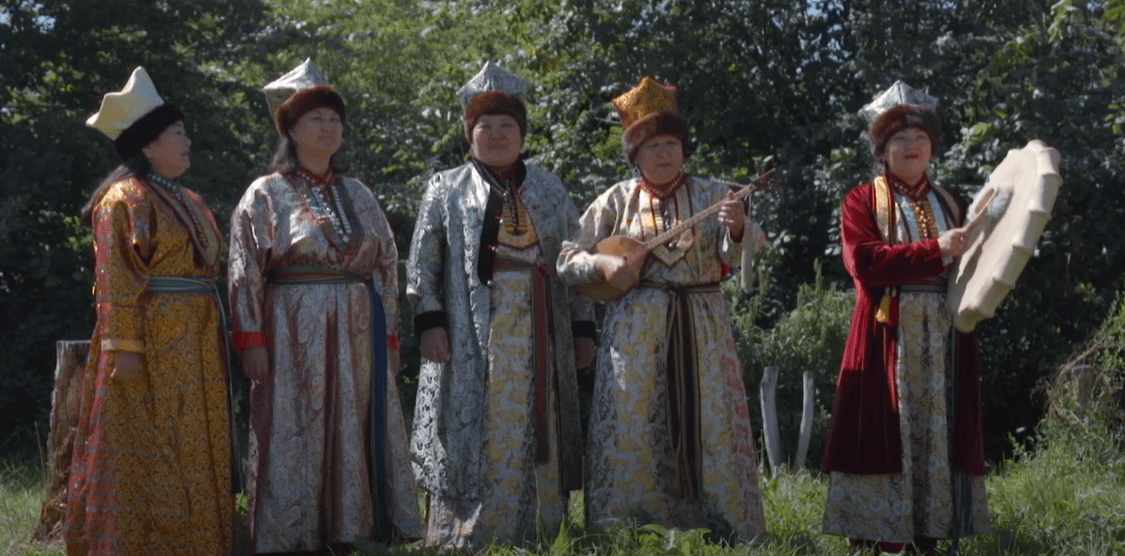
Teleüt Turks in Traditional Attire (Pierre in Russia)
The origins of the Teleüt people are traced to the Göktürk Khaganate, which ruled Central Asia between the VI and VIII centuries. They are considered descendants of a Turkic tribe known as Tölös (or Töliş, Teles) that practiced pastoralism during this period. In Chinese sources, these tribes appear as T’ie-lo or T’ieh-lê and formed an important component of the Göktürk political and cultural structure.
The Teleüt people also share close kinship ties with southern Altai groups such as the Telengits (Chu-kiji). Throughout history, they preserved their name in various forms. Terms such as Telengit, Teleüt, and Teles, formed with Mongolic plural suffixes, reflect the ethnic and cultural continuity of this group.

A Teleüt Woman (Pierre in Russia)
In the late sixteenth and early seventeenth centuries, the Teleüt people led a nomadic life along the banks of the Irtysh steppes and rivers such as the Inya, Aley, and Charish, tributaries of the Ob River. During this period, they were known in the Chüngaria region as "Telengut" and came under the influence of the Dzungar Khanate.
However, between 1658 and 1665, they began settling in what is now the Kemerovo region. This marked the beginning of their transition from nomadism to sedentary life. This change brought profound transformations not only in their way of life but also in language, culture, and social organization.
From the early seventeenth century onward, the expansion of Russian Cossacks into Siberia caused dramatic changes in the lives of many indigenous peoples, including the Teleüt. In Russian sources, the Teleüt were referred to as White Kalmyks (Ak Kalmyks) and were often mentioned alongside certain Mongolic tribes (Choros, Durmet, Tumat, etc.), with whom they experienced partial ethnic fusion.
At this time, the Teleüt population numbered approximately 4,000 tents. While the total indigenous population of Siberia was only around 50,000, thousands of Russian settlers arrived, established new towns, and transformed Siberia into a colony and place of exile for Tsarist Russia.
During the Soviet Union in the twentieth century, state policies promoting a single language and single identity systematically suppressed the languages and identities of non-Russian peoples. The Teleüt were deeply affected by this process; they were denied the opportunity to use their native language as a written medium and were forced to adopt Russian as the sole language of education. By the generations after 1970, active use of Teleüt had largely disappeared.
Video on Teleüt Culture (Pierre in Russia)
After the collapse of the Soviet Union, particularly during the glasnost and perestroika periods, the Teleüt people took some steps toward rebuilding their identity. These included efforts to reteach the Teleüt language, publish dictionaries and literary texts, and establish cultural associations. Nevertheless, significant linguistic and cultural losses remain, and the majority of the population preserves their ethnic identity only at a symbolic level.
Today, the Teleüt Turks primarily reside in the Russian Federation’s Siberian region, especially in villages located in the basins of the Big Bachat and Little Bachat rivers (known in Teleüt as Payat) within the Belovo district of Kemerovo Oblast. In addition, small Teleüt communities exist in the village of Teleüt in the Novokuznetsk district, as well as in the Zarinsk district of Altai Krai and the Mayminsk and Şebalinsk regions of the Altai Republic.
This region is geographically and climatically harsh, characterized by forested areas, mountainous terrain, and a cold climate. The dispersed settlement pattern of the Teleüt has led to fragmentation and regional variations in the transmission of their language and culture.
The Teleüt people identify ethnically as part of the Altai peoples and strive to preserve this identity. However, serious fragmentation in ethnic representation has occurred. Especially among younger generations, identity is increasingly defined through broader categories such as "Russian citizen" or "Siberian," while Teleüt identity persists only symbolically.
Historical interactions, intermarriages, and shared living spaces with neighboring groups—particularly Russians, Telengits, and Mongolic communities—have created cultural and social diversity among today’s Teleüt. This has become one of the main causes of linguistic and cultural assimilation over time.
Teleüt Turkic is a dialect within Altay Turkic and is more narrowly classified as part of the Southern Altay dialect group. Wilhelm Radloff, who conducted one of the first comprehensive classifications of the language, included Teleüt within the group of Altay Kalmyks and recognized it as a significant variant of Altay Turkic.
Linguistically, Teleüt exhibits similarities with Kipchak Turkic and Old Kyrgyz Turkic in phonology and morphology, while also maintaining strong connections with Old Turkish. Particularly in sound changes and structural suffixes, it preserves traces of many ancient Turkic dialects.
In terms of vocabulary, Teleüt overlaps significantly with Old Turkish, Middle Turkish, and Altay Turkic. Comparative studies have determined that a substantial portion of its vocabulary has Old Turkish origins.
Phonetically, phenomena such as vowel reduction, vowel rounding, and consonant deletion are common.
Additionally, Teleüt contains rare structural features such as vowel derivation and consonant gemination.
Morphologically, the use of derivational suffixes to form verbs from nouns and nouns from verbs is highly developed, and many historical Turkish suffixes remain active in Teleüt. This enhances the linguistic importance of the Teleüt dialect within the history of the Turkic languages.
Teleüt has never been established as an independent written language. Consequently, it has never been used in education, media, or official correspondence and has instead been integrated into the standardized written form of Altay Turkic. However, during this process, many unique features of Teleüt were overlooked.
Under Soviet assimilation policies, Russian was designated as the sole language of instruction; Teleüt was not taught in schools. As a result, the language continued to be used only among older generations and in symbolic contexts such as holidays and ceremonies.
Teleüt is classified as "critically endangered" in international databases such as UNESCO’s Atlas of Endangered Languages and Ethnologue. The number of active speakers is limited to only a few hundred individuals, most of whom are elderly.
Key factors contributing to the language’s endangerment include:
Revitalization efforts for Teleüt have largely remained at the civil society level and within symbolic boundaries, struggling to extend into broader domains such as schools, media, and digital platforms.
Throughout history, the Teleüt people adhered to traditional belief systems centered on shamanism, ancestor worship, and nature veneration. Mountains, rivers, and trees were regarded as sacred; they believed communication with spirits occurred through shamans (kam). During the Soviet period, repression of such beliefs led to a significant decline in religious practices.
Today, Russian Orthodoxy is widespread among the Teleüt. However, this religious identity has developed more as a result of ethnic and social adaptation than genuine belief. For many individuals, religious affiliation is symbolic and coexists with traditional elements. In particular, the elderly continue to uphold older belief practices during holidays and rituals.
Teleüt society has a patrilineal family structure. In traditional life, extended families, division of labor, and intergenerational solidarity were central. Women played active roles both within the household and in economic life.
The rise in mixed marriages has increased the influence of Russian culture and made it more difficult to transmit Teleüt identity to children. In rural families, transmission of language and traditional practices remains relatively stronger.
Historically, the Teleüt embraced a collective way of life. Traditional practices such as neighborly cooperation, communal labor (imece), and collective decision-making persisted for many years. However, urbanization and individualization have weakened this structure.
Today, traditional community organizations in Teleüt villages continue to exist only to a limited extent. Ceremonies such as religious holidays, funerals, and weddings function as moments for the reassertion of collective belonging.
During the Soviet period, the Teleüt were integrated into the Russian-language education system. Instruction in their native language was not provided. Today, Teleüt children continue to receive education exclusively in Russian, contributing to the breakdown of intergenerational language transmission.
While literacy rates among individuals over 15 are relatively high, literacy in the native language is virtually nonexistent.
Civil society organizations and local associations (such as the Ene Bayat Association) have recently initiated efforts to teach Teleüt; however, due to the lack of lasting institutional support, these initiatives have had limited impact.
The Teleüt community has developed a rich oral tradition. As with many peoples whose written language was either undeveloped or suppressed by dominant language policies, folktales, epics, proverbs, songs, and prayers have served as the primary means of intergenerational transmission. These cultural products were traditionally recited during religious ceremonies, social celebrations, and daily life.
Texts collected by Radloff in the nineteenth century demonstrate that the Teleüt possessed a rich oral literature. These texts emphasize themes such as love of nature, ancestor worship, heroism, and mystical motifs.
One of the symbolic figures of Teleüt written literature is undoubtedly Nikolay V. Kalişev. A prominent intellectual who emerged after the Soviet era, Kalişev addressed Teleüt identity, the bond with nature, historical memory, and the tragedies experienced by his people in his poetry. He drew attention through his careful attention to preserving the local language and blending traditional themes with modern sensibilities.
Common themes in Kalişev’s poetry include:
These poems are valuable as modern examples of Teleüt literature, both in content and form. Kalişev views language not merely as a tool of communication but as a carrier of cultural resistance and memory.
After the collapse of the Soviet Union, the Teleüt turned their attention to their language and culture, resulting in various publications:
However, the reach of these publications has remained limited; they have failed to effectively reach younger generations or establish a sustained reading culture. Most publications have remained at a symbolic level and have not been sustainable due to a lack of institutional support and dissemination.
Teleüt is classified by international language monitoring institutions as "critically endangered." Organizations such as UNESCO’s Atlas of Endangered Languages and Ethnologue consider Teleüt to be under serious threat due to its low number of speakers and its failure to be transmitted to new generations.
The main reasons for this critical endangerment are:
The number of bilingual individuals in the Teleüt community is steadily decreasing, while monolingual Russian speakers are increasing. This process is known in literature as "language shift." Younger generations prefer Russian exclusively in communication, education, work, and technology. Teleüt is used only among older individuals and primarily in symbolic contexts such as rituals and holidays. Additionally, the absence of Teleüt from digital media and its lack of representation in the media render the language invisible and render it functionally irrelevant to younger generations.
Over the past thirty years, some initiatives have been undertaken to revitalize Teleüt:
However, these efforts have largely remained at a symbolic level and have failed to reach the broader population due to the absence of state support.
Attempts to introduce Teleüt as an elective subject in schools have failed due to a lack of sufficient teachers, teaching materials, and institutional motivation. Although some individual teachers contribute voluntarily, the sustainability of these efforts remains questionable.
Attitudes toward Teleüt vary within the community. While the elderly view the language as an essential element of identity, among the youth a disconnect is observed between language use and ethnic identity. The notion that "knowing the native language is not a condition of identity" is becoming increasingly widespread.
This situation indicates a process in which not only the language but also ethnic identity itself is becoming symbolic. Therefore, the preservation of Teleüt must be addressed as a policy of cultural sustainability.
Cengiz, Mikail. *Tehlikedeki Dil Olgusu: Teleütçe Örneklemi*. PhD thesis, Hacettepe Üniversitesi, 2016. Accessed August 6, 2025. https://tez.yok.gov.tr/UlusalTezMerkezi/TezGoster?key=DPTyuy3wRPq_qvCPSqUB62BYtlK4_ofbO59i8JxE5ge6x0Jbuckc-xqB--ZtTIX5
Kiper, Gizem. *Teleüt Ağzının Eski Türkçeye Göre Söz Varlığı*. Master's thesis, Sivas Cumhuriyet Üniversitesi, 2025. Accessed August 6, 2025. https://tez.yok.gov.tr/UlusalTezMerkezi/TezGoster?key=E_eEUHQic_C-LvhxNQn1W79oUDuD8DFHuBYHeiOwH1_dfvglt-8RrJHdxT4QOQGM
Küçükballı, Fatih Numan. “Ata Yurdumuzun Kadîm Bekçileri: Altay Türkleri.” *Türk Ekini*, no. 22 (2021): 22–24. Accessed August 6, 2025. https://dergipark.org.tr/en/pub/turkek/issue/55572/760622
Pierre in Russia Youtube Kanalı. "The TELEUTS - ethnic minority from Siberia, shamanism, coal mines / Cultures of Russia." Accessed August 6, 2025. https://www.youtube.com/watch?v=0rjPUIBRHuM
Pierre in Russia Youtube Kanalı. "The Teleut Music - jew’s harp and disco, topshur, throat singing / Cultures of Russia." Accessed August 6, 2025. https://www.youtube.com/watch?v=2kQXoKq3gc4
Sairi, Nikolay V. Kalişev. *Teleüt Şairi Nikolay V. Kalişev ve Şiirleri*. Derleyen: Şükrü Haluk Akalın. Türk Dil Kurumu Yayınları. Accessed August 6, 2025. https://www.academia.edu/download/99455869/Teleut_Sairi_N_Kalisev_1999_08_09_Akalin.pdf

Henüz Tartışma Girilmemiştir
"Teleut Turks" maddesi için tartışma başlatın
Ethnic Origins and Historical Process
Tölös and the Göktürk Legacy
From Nomadism to Sedentism
Russian Conquest and Assimilation
Soviet Era and Identity Erosion
Contemporary Identity Search
Geographical Settlement
Ethnic Structure and Distribution
Teleüt Language
Position within Altay Turkic
Features of Teleüt
Written Language and Standardization Issues
Teleüt in Danger
Sociocultural Structure
Religious Life
Family Structure
Social Life and Community Relations
Educational Status
Literature and Folklore
Oral Culture and Narratives
Teleüt Poet Nikolay V. Kalişev
Publishing Activities and Cultural Revitalization
The Endangered Status of Teleüt
Level of Endangerment and International Classifications
Language Shift and Monolingual Pressure
Revitalization Efforts
Societal Attitudes and the Language-Identity Link