


Bu içerik Türkçe olarak yazılmış olup yapay zeka ile otomatik olarak İngilizceye çevrilmiştir.

Many students have formulated this sentence: “I work better already on the last night.” Is that truly the case? Or is this just a cleverly packaged version of procrastination? The tendency to leave studying until the last night appears on the surface to be a time management issue. Yet beneath it often lie anxiety, perfectionism, fear of failure, and the pursuit of short-term relief.
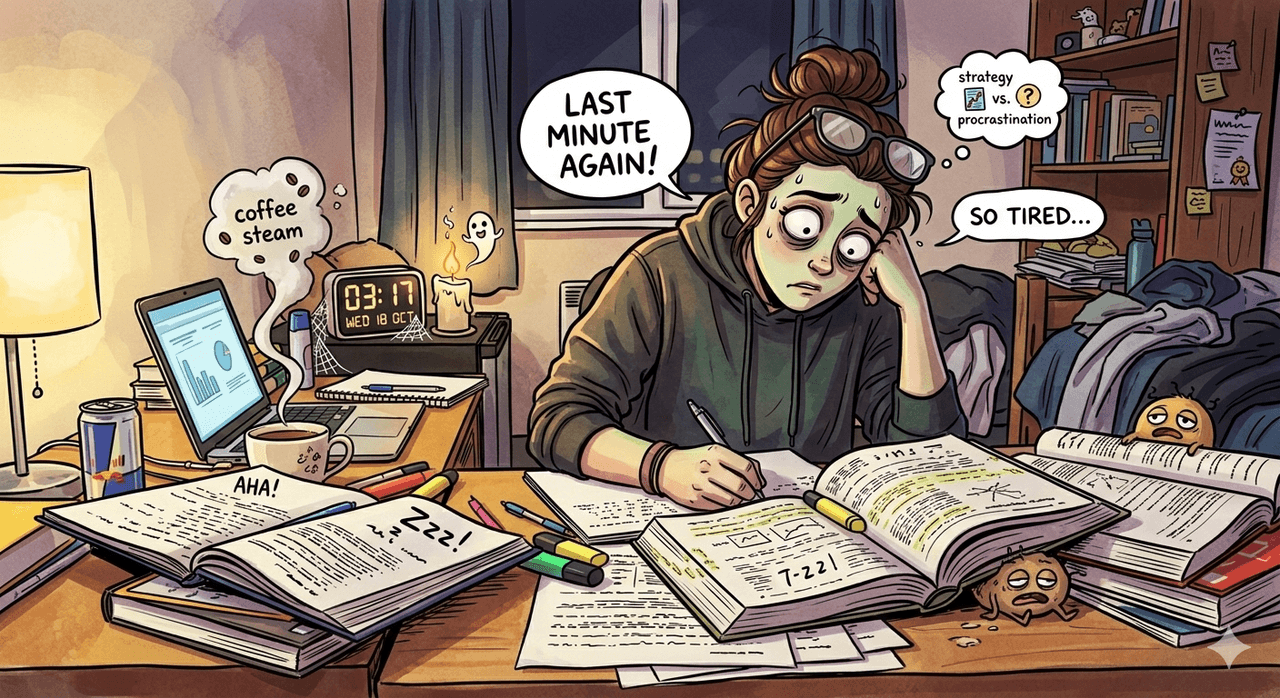
Study Tendency (Generated by Artificial Intelligence)
Procrastination provides short-term relief. As long as you do not start studying, you avoid confronting failure. The thought “I have not tried yet” is less threatening than “I failed.” The brain registers this relief as a reward. When studying occurs on the last night, adrenaline rises. Time pressure feels as if it enhances focus. This reinforces the belief “I perform better under pressure.” Yet what often happens is this: panic creates temporary intensity, but learning quality declines. The fundamental reason this behavior persists is that short-term relief feels stronger than long-term harm.
Viewing this tendency merely as “lack of discipline” is superficial. Underlying it are usually these dynamics:
“What if I cannot do it perfectly?” This thought makes starting difficult. The person sets high standards, but as those standards grow larger in their mind, taking action becomes harder.
Not starting means not testing one’s performance. Thus, the person avoids confronting their own capabilities.
When it is unclear how much to study or where to begin, the brain perceives the task as a threat.
The subject may feel boring, difficult, or anxiety-inducing, pushing the person toward screens, social media, or other distractions.
The human brain underestimates future demands. “I’ll get to it anyway” ignores the actual time required.
It may salvage a grade in the short term. In the long term, these outcomes occur:
The most critical point is this: Consistently studying on the last night cultivates a habit of crisis management, not learning.
Time pressure narrows attention. This can create short-term intensity in some individuals. However, neuroscience research shows that high stress negatively affects complex learning and long-term memory. Thus, pressure does not always enhance performance. Especially in analytical thinking and conceptual learning, stress causes performance to decline once it passes a certain threshold.
The hard truth is this: Waiting for motivation does not work. Starting generates motivation.
Instead of “I will finish the entire topic,” try:
“I will just look at this heading for 20 minutes.”
The brain does not perceive small goals as threats.
Same desk, same time, same small preparation. Routine reduces the burden of decision-making.
Define clear blocks such as 25 minutes of work followed by 5 minutes of rest. This lowers the mental barrier to starting.
Do not aim for perfect learning in the first round. The first goal is simply to make contact with the material. Details come in the second round.
Mark the topics you have studied. The brain wants to continue once it sees progress.
Simple interventions such as placing your phone in another room or turning off notifications significantly improve focus.
If procrastination is persistent, ask yourself this question:
“Am I avoiding the subject, or am I avoiding the feelings associated with it?”
Sometimes the subject is not difficult; what is difficult is the belief about yourself. Thoughts like “I cannot do it,” “I will never catch up,” “I am already too late” determine behavior.
At this point, you need a clearer inner voice:
“Starting late is bad, but not starting at all is worse.”
If procrastination has become chronic and spread to many areas of daily life, and is accompanied by intense anxiety, attention difficulties, or low motivation, professional support can be helpful. Especially in cases of attention deficit, depression, or high anxiety, this behavior can be more resistant to change.
Leaving studying until the last night is often not laziness but a strategy of delaying anxiety. Yet this strategy comes at a long-term cost. To break the cycle, you do not need grand motivation—you need small, clear starts.
Why Does This Behavior Repeat?
The Real Cause Is Not Laziness
1) Perfectionism
2) Fear of Failure
3) Ambiguity of the Task
4) Emotional Avoidance
5) Misjudgment of Time
The Cost of Last-Minute Studying
How True Is the Belief “I Perform Better Under Pressure”?
How Can This Cycle Be Broken?
1) Break the Task into Smaller Parts
2) Create a Starting Ritual
3) Use Time Blocks
4) Start Imperfectly
5) Create Visible Progress
6) Reduce Environmental Distractions
Do Not Ignore the Emotional Side