
Bu içerik Türkçe olarak yazılmış olup yapay zeka ile otomatik olarak İngilizceye çevrilmiştir.
Arabic is a civilization language that has left indelible marks on world languages by serving not merely as a religious textual language but as the universal vehicle of science, philosophy, art, and trade throughout the Middle Ages. Beginning in the 7th century, with the expansion of Islamic civilization across a vast geographical area, this language profoundly influenced the vocabularies, conceptual frameworks, and even grammatical structures of local languages. Particularly through translation activities centered at the Beytü’l-Hikme in Baghdad and the scientific legacy of Al-Andalus, Arabic was elevated to the status of a global academic language rivalling, and in many fields surpassing, Latin and Greek. Today, thousands of words of Arabic origin still in use across languages from Spanish to Turkish, from French to Persian, attest that this language was not merely a means of communication but also a historical bridge for the transmission of knowledge. Arabic’s foundational influence has shaped the modern terminology of languages from different language families and played a leading role in naming humanity’s shared heritage. This linguistic influence took root not through military conquests but through intellectual and cultural superiority.
Arabic’s central position, gained through the spread of Islam, initiated a structural transformation in the languages of Turkic and Persian communities upon their adoption of this religion. Persian adopted the Arabic alphabet and its terminology, reconstructing its literary identity through this new synthesis; Turkish, beginning especially in the Karakhanid period, opened its doors to Arabic’s rich conceptual world. This interaction went far beyond lexical exchange, fundamentally altering the syntax and literary aesthetics of both Turkish and Persian.
Especially during the Ottoman period, this influence reached its peak: law, philosophy, governance, and education were entirely constructed using Arabic-derived concepts. This enabled Turkish to attain an unprecedented capacity for generating abstract thought and philosophical depth. Positioned as an “upper language” or “language of science,” Arabic served as a source from which local languages drew to strengthen their own modern identities. Alongside Persian loanwords entering Turkish, a semantic network and shared intellectual world of rare historical parallelism emerged among these three languages.
The interaction between Western languages and Arabic was largely shaped by the eight-century-long Umayyad rule in the Iberian Peninsula and the contacts during the Crusades. Spanish and Portuguese are the languages most intensely affected by this interaction, with approximately eight percent of modern Spanish vocabulary consisting of Arabic-origin words. Hundreds of terms in Spanish beginning with the prefix “al-” — such as alcalde, algodón, and alfombra — are considered the most concrete evidence of Arabic’s direct and structural influence on these languages.
Languages such as French and English were influenced by Arabic through scientific translations and trade routes, particularly adopting fundamental terms in astronomy, chemistry, and mathematics such as “alcohol,” algebra, and “zenith.” During the Dark Ages of medieval Europe, this flow of knowledge, transmitted via Arabic works translated into Latin, completely renewed the Western intellectual world. This linguistic legacy served as a crucial catalyst, providing European languages with the scientific and technical conceptual framework needed to transition into the Renaissance.
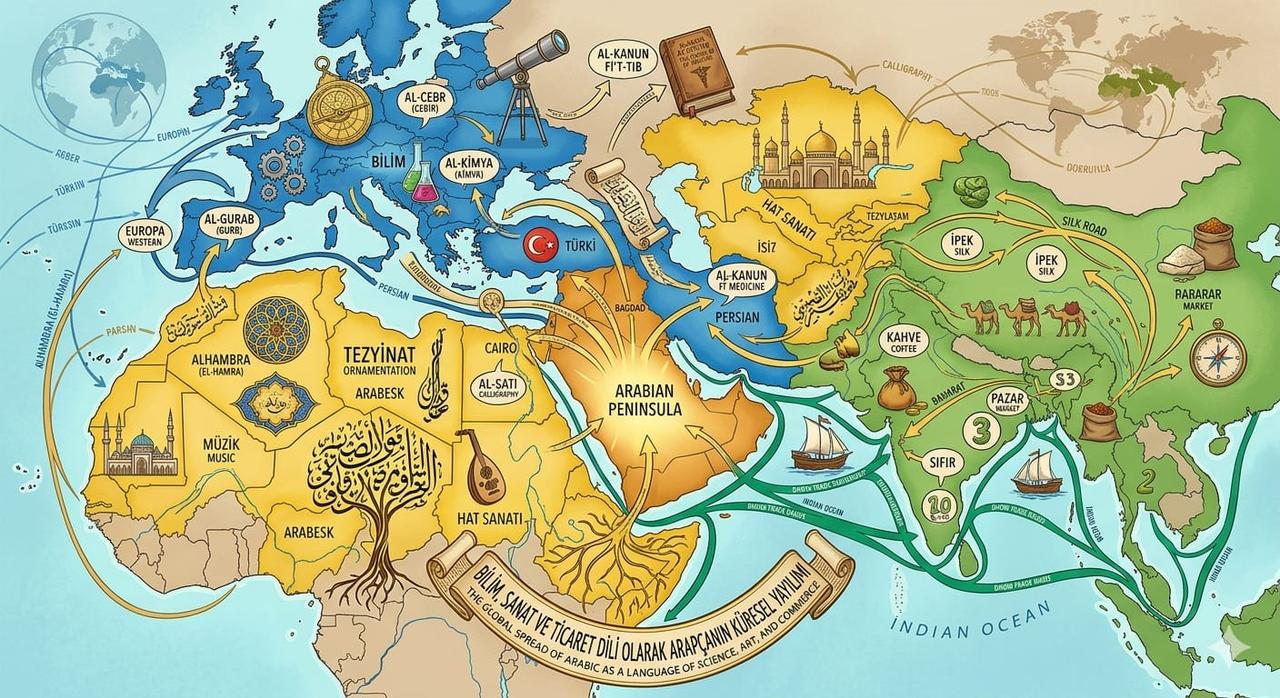
The Global Spread of Arabic as a Language of Science, Art, and Trade (Generated by Artificial Intelligence.)
Arabic’s most enduring influence lies in its role in defining the universal codes of numerical sciences such as mathematics and astronomy. The global dissemination of the Indian numeral system via Arabic and the incorporation of the concept of “zero” (sifr) transformed how modern calculation methods are named across world languages. The term “algorithm” derives from the name of al-Khwarizmi, and the word “algebra” (al-jabr) is directly of Arabic origin, affirming this language’s foundational authority in numerical sciences. The fact that the majority of star names used in celestial mapping remain Arabic demonstrates the universal scope of this influence.
Through maritime and trade networks, strategic terms such as “admiral,” “magazine,” and “tariff” became embedded in the shared vocabularies of all languages around the Mediterranean. The centuries-long teaching of works by geniuses such as Ibn Sina in European universities ensured that numerous anatomical and pharmacological terms were inherited by world languages via Arabic. This terminological export demonstrates that Arabic was not merely a language of rhetoric but a systematic language carrying the universal codes of rational thought.
Arabic’s influence on world languages extends beyond historical lexical exchange; it constitutes a profound transmission of mindset that established the terminological infrastructure of modern thought. Despite contemporary efforts to simplify languages, the unshakable presence of Arabic-origin elements in scientific formulas and philosophically rich terminology preserves the semantic power of this language. Arabic continues to fulfill its historical mission as a “carrier language,” preserved in the deep layers of world languages and representing the unbroken cultural bonds between diverse regions.
Aydın, Mustafa. “Arap Dili.” İstanbul Aydın Üniversitesi Eğitim Fakültesi Dergisi, (2018) 4(1), 1–18. Accessed March 25, 2026. https://dergipark.org.tr/tr/pub/iauefd/article/532054?issue_id=43523
Morad, Hasan, and Charif Murad. “Arapçanın Evrensel Bir Dil Olmasında Kur’ân-ı Kerîm’in Rolü.” Aydın Arapça Araştırmaları Dergisi 6, no. 1 (2025): 87–119. Accessed March 26, 2026. https://dergipark.org.tr/tr/pub/ayad/article/1675643
Sevdi, Ali. “Arapçanın Dünya Dilleri Arasındaki Statüsü ve Onu Güçlü Kılan Etkenler Üzerine Bazı Mülahazala.” Anemon Muş Alparslan Üniversitesi Sosyal Bilimler Dergisi, (2023) 11(3), 673-688. https://dergipark.org.tr/tr/pub/anemon/article/1311621
Yaqoob, Luay Hatem. “Diller Arası Etkileşim: Arapça Ve Türkçe Örneği.” Karadeniz Uluslararası Bilimsel Dergi, no. 1 (2021): 296–310. Accessed March 25, 2026. https://dergipark.org.tr/tr/pub/kdeniz/article/954118?issue_id=64945
Linguistic Transformation within the Islamic Civilization Sphere
Ottoman Turkish and the Capacity for Abstract Thought
The Al-Andalus Bridge and Its Impact on Spanish
Arabic Roots in European Scientific Terminology
Global Dominance in Mathematics and Astronomyt
Concept Transfer via Maritime and Trade Routes
Enduring Traces in Modern Languages