


Bu içerik Türkçe olarak yazılmış olup yapay zeka ile otomatik olarak İngilizceye çevrilmiştir.
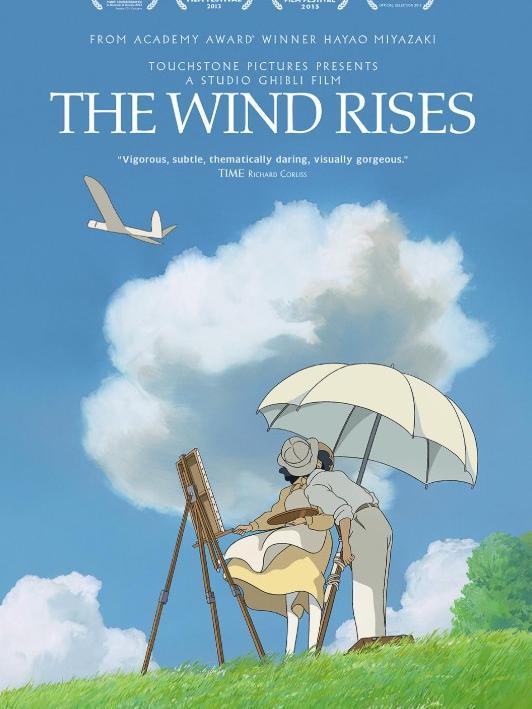
The Wind Rises (Japanese: Kaze Tachinu) is a narrative situated at the intersection of personal dreams, technical idealism, and historical tragedy. Inspired by the life of aircraft engineer Jiro Horikoshi and pivotal moments in modern Japanese history, the film does not merely present a biographical story; it constructs a multi-layered exploration of the boundaries of aesthetic creation, ethical responsibility, love, death, and the nature of time. Its narrative structure, which intertwines reality with the imaginary, establishes the film as a defining example in the director’s cinematic oeuvre, both formally and thematically.

The Wind Rises (IMDb)
The film centers on the inner journey of young Jiro Horikoshi, whose childhood dream of flight is thwarted by severe myopia. He channels his passion for aviation into engineering. His metaphorical dialogues with the Italian aircraft designer Caproni, encountered in dreams, serve both as a source of inspiration and a moral compass. As the narrative spans from the 1920s to the 1940s, it portrays Japan’s modernization process against the backdrop of earthquakes, economic crises, and military preparations. Jiro’s aircraft design work at Mitsubishi gradually shifts toward military applications. The film presents the tension between Jiro’s pursuit of technical beauty and its eventual militarized use as a structural conflict. His relationship with Nahoko Satomi introduces an emotional counterpoint to this technical and historical axis. Nahoko’s tuberculosis symbolizes the fragility of love and the transience of life. In the film’s conclusion, although Jiro achieves technical success, he endures a profound loss on a human and ethical level. The final dream sequence with Caproni reveals this conflict as an internal reckoning.
As the central figure, Jiro embodies the fusion of technical idealism and aesthetic aspiration. The fact that the aircraft he designs are ultimately used for destruction transforms him into a character caught between beauty and ruin, dream and responsibility.

Jiro Horikoshi sketching (The Wind Rises)
Nahoko is portrayed as a fragile and poetic presence in Jiro’s life. Despite her tuberculosis, she chooses to marry Jiro and remain with him, demonstrating personal resolve and self-sacrifice. Her character is structured as an embodiment of the aesthetic boundary between life and death.

Nahoko Satomi (The Wind Rises)
Appearing in dream sequences, Caproni represents creative imagination while simultaneously reminding Jiro of ethical responsibility. His statement, “Aircraft are beautiful dreams, but dreams carry madness,” forms the core of Jiro’s internal conflict throughout the film.

Giovanni Battista Caproni (1886–1957) (The Wind Rises)
In the film, aeronautical engineering is not merely a backdrop but a foundational element of the narrative. The detailed depiction of aircraft assembly reflects deep attention and reverence for the technological process. Technical details—such as rivet connections, stress distributions, and structural joints—are rendered with precision through the language of animation. In flight sequences, aerodynamic effects, landing gear positioning, and fuselage-air interactions are portrayed in a way that bridges technical accuracy with aesthetic design. These scenes do not simply convey technical information; they also reflect the intellectual dimension behind flight and the emotional weight tied to the design process.
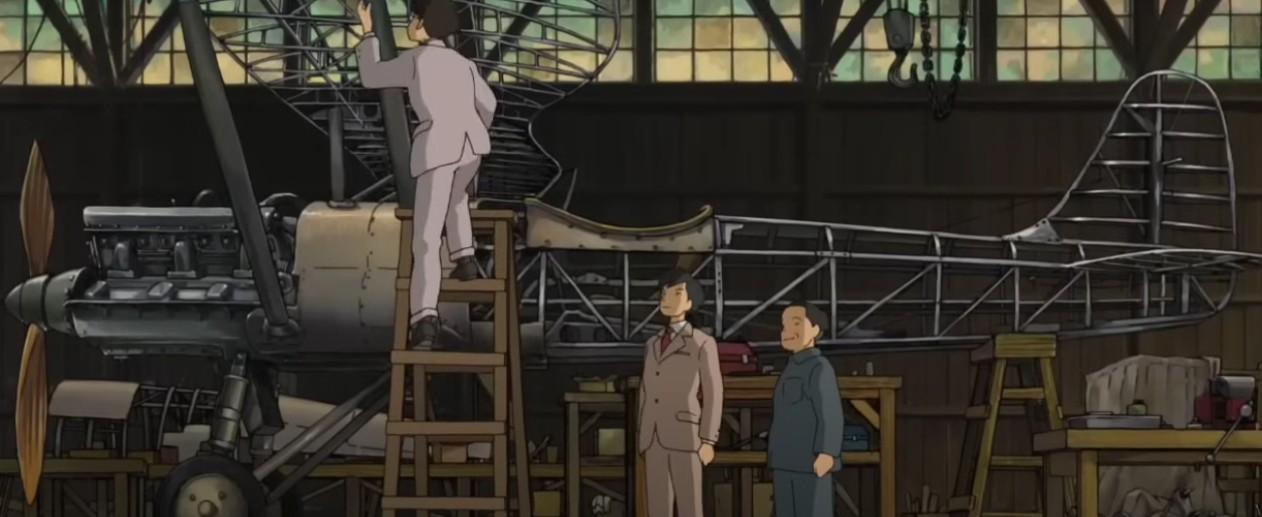
Most realistic depiction of aircraft internal structure(The Wind Rises)
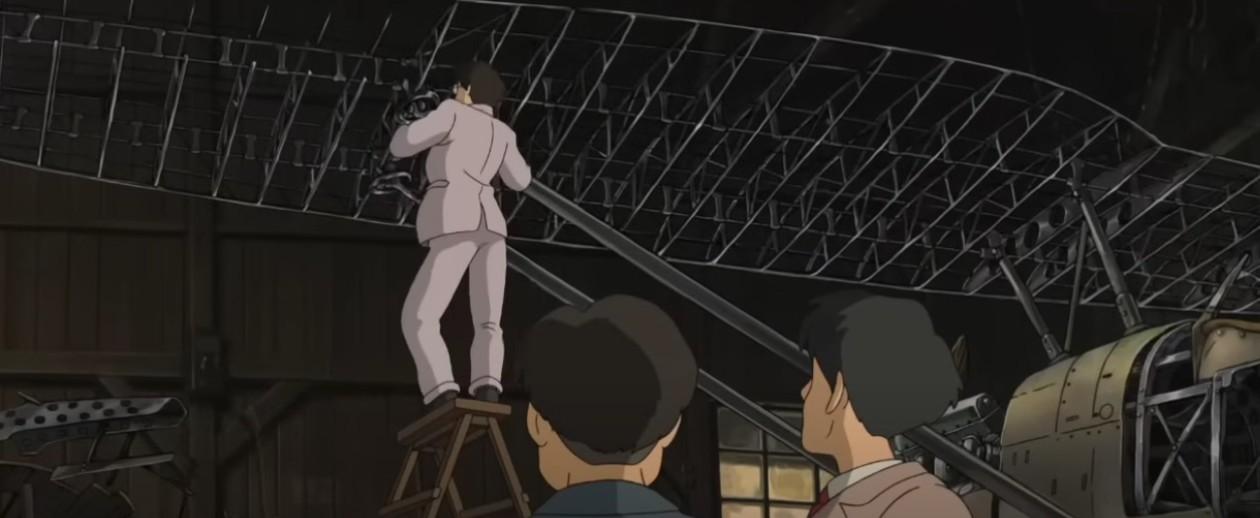
Internal wing structure(The Wind Rises)

Technical representation of structural connection elements(The Wind Rises))

Aircraft shell design is shaped by aerodynamic considerations.(The Wind Rises)
The theme of “dreaming” in the film functions both as a personal ideal and as a social dilemma. Jiro’s passion for flight gradually becomes enlisted in the service of wartime technology. This contradiction compels not only the character but also the viewer to enter an ethical process of questioning. The coincidence between Nahoko’s death and the first flight of Jiro’s aircraft offers a critical space for reflection on the cost of creation.
While time in the film progresses linearly, dream sequences and internal scenes disrupt this linearity. Past, present, and imaginary time are fluidly interwoven across scenes. Spaces are not only physical contexts but also carry symbolic meaning. Train stations, mountain towns, sanatoriums, and post-earthquake cityscapes are constructed as spatial manifestations of historical transformation and emotional fracture. Particularly, the dream sequences with Caproni exemplify metaphysical realms where time and space are suspended. These segments visually and narratively highlight the protagonist’s inner journey.

The Great Kanto Earthquake of September 1, 1923, measuring approximately 7.9 on the Richter scale, devastated a vast region including Tokyo and Yokohama, causing immense loss of life and property in Japanese history.(The Wind Rises)
The film is designed with a color palette close to pastel tones. Natural elements—particularly the sky, wind, clouds, and water—are animated to reflect the characters’ psychological states. Aircraft are rendered with technical precision, while backgrounds are depicted more abstractly and fluidly. This contrast visually articulates the ideological tensions embedded in the film. Silence, minimal gestures, and glances emerge as primary narrative tools for conveying emotional states. In the earthquake sequences, formal distortions and the structural transformation of sound are employed to foreground the psychological impact rather than the physical event.

The full spectrum of nature’s colors in Miyazaki’s animations(The Wind Rises)
The film’s score was composed by Joe Hisaishi, who has long collaborated with Hayao Miyazaki. In this work, Hisaishi’s musical language is simpler and bears clearer traces of Western classical music than in his previous compositions. Piano and string instruments dominate, with melodies chosen to support the emotional tone of scenes and reflect the characters’ inner states. Particularly in sequences depicting Nahoko’s illness, music becomes an expressive medium surpassing verbal narration. Silence and ambient sounds also function as narrative elements. In dream and nature scenes, only bird calls, wind rustling, or mechanical sounds are heard. During the earthquake scene, the shaking is represented not by natural sounds but by a metallic creaking. This choice constitutes an aesthetic strategy that prioritizes the psychological impact over the physical reality of the event.

Joe Hisaishi (nytimes)

Henüz Tartışma Girilmemiştir
"The Wind Rises (Film)" maddesi için tartışma başlatın
Plot and Narrative Structure
Characters
Jiro Horikoshi
Nahoko Satomi
Caproni
Themes
Engineering
Dream
Construction of Time and Space
Visual Language and Aesthetic Choices
Music