

Bu içerik Türkçe olarak yazılmış olup yapay zeka ile otomatik olarak İngilizceye çevrilmiştir.
+1 Daha
Announcement Date | 26 September 1932 | ||||||||
|---|---|---|---|---|---|---|---|---|---|
Announcement Place | Istanbul, Dolmabahçe Sarayı Muayede Salonu | ||||||||
Offeror | Halit Fahri (Ozansoy) | ||||||||
Accepting Party | Adopted by unanimous vote at the Kurultay | ||||||||
Turkish Language Day is a holiday observed since 26 September 1932, commemorating the opening day of the First Turkish Language Congress held at Dolmabahçe Palace. The choice of 26 September for the congress’s opening and the decision to elevate language studies to the social plane led to the adoption of the day as “Language Day.”

A Photograph from the Turkish Language Congress (AA)
The proposal to declare the day a holiday was made during the congress proceedings by Halit Fahri (Ozansoy). The suggestion to celebrate 26 September as “Language Day” was adopted unanimously. Thus, 26 September was formally and publicly introduced as “Language Day.”
Its institutional foundation was quickly codified in the 1933 Regulations of the Society for the Study of the Turkish Language, which mandated that 26 September be celebrated annually as Language Day, marking the day the First Congress convened. When the society’s name changed to the Turkish Language Association in 1936, the status of 26 September was preserved under the heading “Institutional Holiday Days.”
In practice, the holiday has been observed since its first year through conferences, radio broadcasts, poetry recitals, and other events organized under the leadership of the Turkish Language Association (formerly the Society for the Study of the Turkish Language) and the nationwide network of People’s Houses. Starting in 1934, these celebrations were integrated into a more structured program and widely disseminated through the press and radio.
Today, 26 September continues to be marked by congresses and events organized by the Turkish Language Association, emphasizing the richness of the Turkish language and its central role in the Republic’s language policies.
In the Republic of Türkiye’s cultural modernization path, language was regarded as a foundational element of national identity. Through constitutional and educational reforms, the language domain was placed at the center of state policy. The state officially adopted Turkish as its language, unity in education was achieved through the Unification of Education Law, and the alphabet reform was implemented on 1 November 1928.
Institutional preparations in the field of language began in 1928. On 23 May 1928, a Cabinet decision established a Language Committee within the Ministry of National Education to oversee the preparation and implementation of the new alphabet. The committee began its work with discussions on the new script.
Under Atatürk’s guidance, the goal of institutionalization was defined as “revealing the intrinsic beauty and richness of Turkish” and elevating it to a level commensurate with its value among world languages. In pursuit of this aim, the Society for the Study of the Turkish Language was established on 12 July 1932. Its areas of activity were defined to include dictionaries, terminology, grammar, etymology, and linguistic research.
A guiding program for the society’s work was prepared, and the institutional framework was concretized through the First Turkish Language Congress, held from 26 September to 5 October 1932 at the Muayede Salon of Dolmabahçe Palace in Istanbul. The congress opened in the Muayede Salon; a president and vice presidents were elected; the society’s regulations were adopted; and authoritative committees, administrators, and a work program were established.
The institutionalization was formalized in the 1933 regulations, which mandated that 26 September be celebrated annually as Language Day, marking the day the First Turkish Language Congress convened. With the new regulations adopted on 31 August 1936, the society’s name was changed to the Turkish Language Association, and the status of 26 September was preserved under the heading “Institutional Holiday Days.”
In the implementation phase, language work followed a phased course. Between 1932 and 1934, a nationwide campaign was launched to find Turkish equivalents for Arabic and Persian words. Between 1934 and 1936, collected data were reviewed. Between 1936 and 1938, excessive purism was abandoned in favor of normal linguistic work. During this period, the First Congress was recognized as having established the foundational program guiding subsequent efforts.
The First Turkish Language Congress convened from 26 September to 5 October 1932 at the Muayede Salon of Dolmabahçe Palace in Istanbul to determine the main program for Turkish language studies. It is recorded that the opening session on 26 September at 14:00 was delivered by Samih Rifat Bey, President of the Society for the Study of the Turkish Language; that the sessions lasted nine days; and that President Atatürk attended the proceedings.
Kâzım (Özalp) Pasha, President of the Grand National Assembly, was elected president of the congress; Reşit Galip, Minister of National Education, and Samih Rifat Bey were elected vice presidents. Thus, the proceedings were conducted under this leadership structure.
The agenda was systematized into seven points aimed at transforming Turkish into a national language capable of meeting all needs. Goals included comparative linguistic studies, historical grammar, dictionary and grammar work based on dialectal collections, gathering and translating Turkish language publications from within and outside the country, publishing research in a journal, and ensuring coverage of language matters in the press.
Twenty papers were presented during the congress. In addition to invited linguists, prominent figures from literature and the press—including Abdülhak Hâmit, Sami Paşazade, Halit Ziya, Cenap Şahabettin, Hüseyin Cahit, Hüseyin Rahmi, Mehmed Emin, Ahmet Hâşim, Ahmet Rasim, Falih Rıfkı, and Yunus Nadi—were present.
In institutional terms, the congress adopted the regulations of the Society for the Study of the Turkish Language, defined its authoritative committees and working procedures, and thereby established the administrative and organizational framework for language work.
The congress was assessed as having established a guiding program for language studies that directed subsequent implementation phases.
During the first session of the ninth sitting of the First Turkish Language Congress (5 October 1932, 14:00), Halit Fahri (Ozansoy) proposed the establishment of 26 September as “Language Day.” The proposal was presented as follows:
“26 September… is truly a national holiday and a renaissance… But let us officially recognize today as a holiday in our schools. Let us tell our children that it is the day of liberation from language; let us use lessons drawn from history to illustrate this. The spirit of the youth, which will be anchored in this ideal, will form the cornerstone of the language revolution. I therefore propose that 26 September be officially recognized as Language Day. I wish to emphasize that the language revolution is necessary. We see every day how Turkish is wounded abroad—not by corrupted words or phrases, but by faulty sentence structures and poorly written signs on walls. To correct these signs civilly and to ensure that citizens, unaware of their error, abandon this bad habit, we must insist that signs and notices be written in pure Turkish. To instill this spirit in the youth, I propose that 26 September be officially recognized as a national language day, celebrated in all our regions and at all People’s Houses.”
During the debates, it was argued that the declaration of a holiday was intended as a symbolic gesture within the congress’s own organization and did not require legal status. At the second session of the same day at 15:45, the proposal was deemed appropriate by the Congress Committee. Without a formal vote, President Kâzım Pasha adopted the decision that “26 September… shall be recognized as a holiday for the purposes of the congress and celebrated through conferences and similar events.” Thus, 26 September was formally incorporated into public and official life as “Language Day,” with unanimous support.
The regulatory basis for this decision was provided by the 1933 regulations, which mandated that 26 September be celebrated annually as Language Day, marking the day the First Congress convened. In the 1936 revision, the institution’s name was changed to the Turkish Language Association, and the status of 26 September was preserved under the heading “Institutional Holiday Days.” Thus, despite subsequent amendments to regulations and statutes, the date of 26 September has remained consistently observed.
Following the decision, the celebration was institutionalized nationwide through the People’s Houses. Ceremonies featuring conferences, poetry, and radio broadcasts were organized according to centrally issued programs. The press and media were assigned the task of broadening public participation in the commemorations.
It is noted that the first celebration in 1933 was held internally within the institution and was subdued. From 1934 onward, celebrations were organized centrally through the People’s Houses according to a structured program. It was decided that ceremonies would be held under the supervision of the language-history-literature branches of People’s House centers and district branches, articles would be published in provincial newspapers, and broadcasts would be transmitted from the Ankara and Istanbul radio stations.
Guidelines sent to People’s Houses required that poems and speeches delivered during ceremonies be prepared in “as pure, simple, beautiful, and comprehensible Turkish as possible.” Themes were to emphasize the antiquity and breadth of Turkish cultural heritage. Speech and poetry texts were to be submitted to the institution’s headquarters, and synchronization with radio broadcasts was to be ensured. The same guidelines anticipated that meetings held at People’s Houses in areas with radio centers would be broadcast live and that national newspapers would publish articles highlighting the significance of the day.
The implementation of celebrations through People’s Houses was linked to their founding mission and the 1932 “People’s Houses Regulations,” which emphasized social mobilization and the goal of cultivating “new citizens.” In line with their responsibility for organizing public demonstrations during national holidays, Language Day was observed with content aligned to the central program but adapted to local contexts.
In practice, conferences, poetry recitals, folk music concerts, and radio broadcasts were combined. This was especially evident in 1936, as reflected in national newspaper front pages, and ceremonies were carried out according to programs issued to People’s Houses.
In Amasya, the 1935 celebrations followed the People’s House plan, featuring a speech by the governor, a talk by the People’s House language-history-literature branch, and student poetry readings. In 1936, the program was expanded to include lectures on the uniqueness of our language, an explanation of the Sun Language Theory, and special public invitations.
Similarly, in Zonguldak (1936), radio broadcast times across the city were synchronized with those of Ankara and Istanbul. A meeting was held in the People’s House hall, followed by marches, speeches, and poems. At 18:00, a “major speech” was broadcast over the radio, as reported.
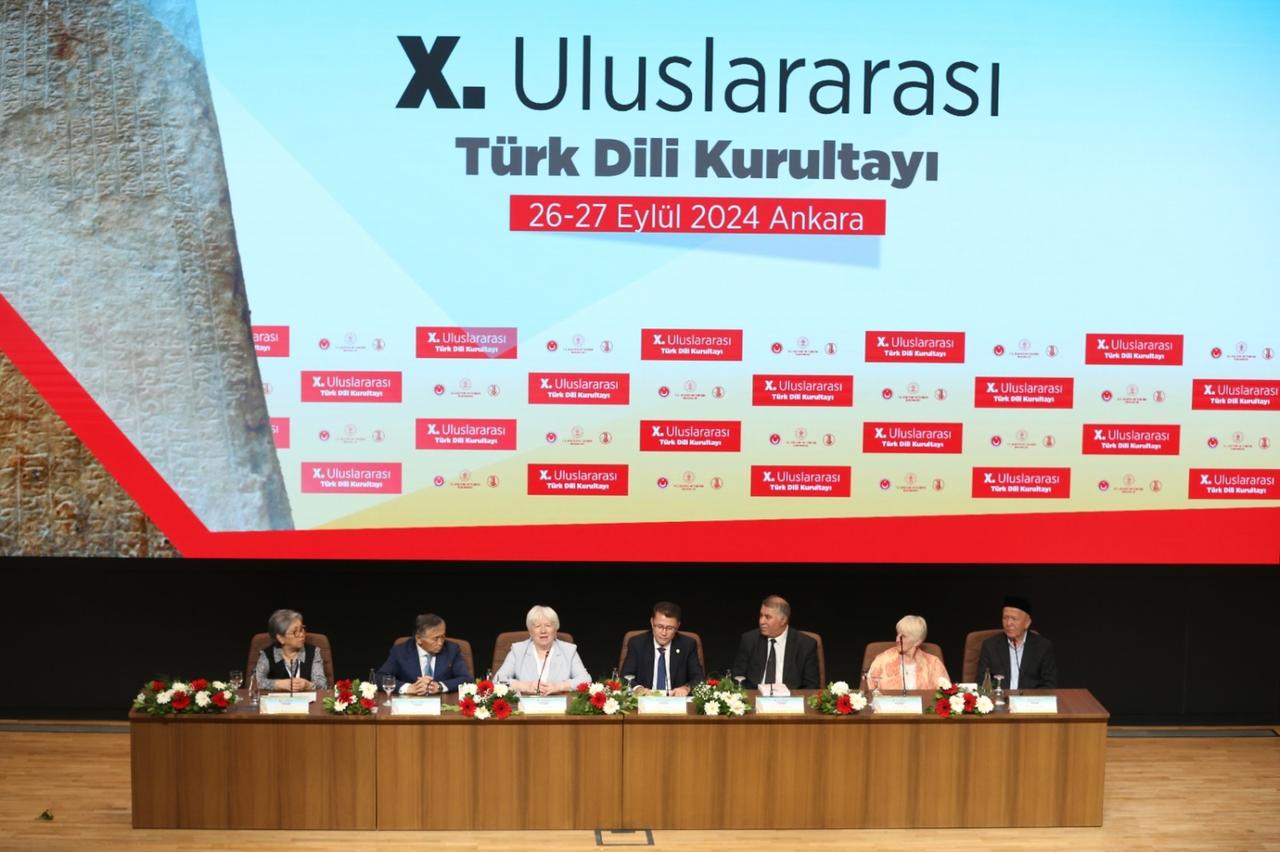
26 September, Turkish Language Day, continues to be observed today through congresses, panels, and various cultural events organized by the Turkish Language Association. The Tenth International Turkish Language Congress, held at the TDK’s new service building on 26–27 September 2024, is a recent example of this continuity. Additionally, the TDK plans to award the “Unity in Language, Thought, and Work: Turkish World Literature Awards” on 26 September 2025, marking the 93rd anniversary of the holiday, in a formal ceremony.

Tenth International Turkish Language Congress (AA)
Anadolu Ajansı. "88 yıl önce bugün ilan edilen bayram: Türk Dil Bayramı" Accessed September 26, 2025. https://www.aa.com.tr/tr/kultur-sanat/88-yil-once-bugun-ilan-edilen-bayram-turk-dil-bayrami/1986313
Anadolu Ajansı. "TDK, 'Dilde, Fikirde, İşte Birlik Türk Dünyası Edebiyat Ödülleri'ni 26 Eylül'de verecek.' Accessed September 26, 2025. https://www.aa.com.tr/tr/egitim/tdk-dilde-fikirde-iste-birlik-turk-dunyasi-edebiyat-odullerini-26-eylulde-verecek/3674905
Bilbey, Simge. “X. Uluslararası Türk Dili Kurultayı’nın Ardından.” Bürküt Türk Dünyası Dergisi 3, no. 2 (2024): 204–211. Accessed September 26, 2025. https://dergipark.org.tr/tr/pub/burkut/issue/88712/1624263
Kendirci, Mehmet. “Cumhuriyet’in Yüzyılı ve 26 Eylül Türk Dil Bayramı.” Mülkiye Dergisi 47, no. 5 (2023): 175–210. Accessed September 26, 2025. https://www.researchgate.net/publication/381663268_Cumhuriyet'in_Yuzyili_ve_26_Eylul_Turk_Dil_Bayrami
Özüçetin, Yaşar, Bülent Kara, and Mahmut Bolat. “Bazı İl ve İlçelerde Halkevi Bünyesinde Muhtelif Dil Bayramı Kutlamaları.” The Journal of Academic Social Science Studies 61 (2017): 251–275. Accessed September 26, 2025. https://jasstudies.com/DergiTamDetay.aspx?ID=7357
İleri, Turgut. “26 Eylül Gününün Dil Bayramı Olarak Kabulü ve Amasya’da Dil Bayramı Kutlamaları (1935–1936).” Recep Tayyip Erdoğan Üniversitesi Sosyal Bilimler Dergisi 12, no. 1 (2025): 43–55. Accessed September 26, 2025. https://dergipark.org.tr/en/pub/rteusbe/issue/93356/1674383


Announcement Date | 26 September 1932 | ||||||||
|---|---|---|---|---|---|---|---|---|---|
Announcement Place | Istanbul, Dolmabahçe Sarayı Muayede Salonu | ||||||||
Offeror | Halit Fahri (Ozansoy) | ||||||||
Accepting Party | Adopted by unanimous vote at the Kurultay | ||||||||
Henüz Tartışma Girilmemiştir
"Turkish Language Day (September 26, 1932)" maddesi için tartışma başlatın
Historical Background
First Turkish Language Congress (26 September–5 October 1932)
Adoption of 26 September as Language Day
Commemoration Practices
Turkish Language Day Today