

Bu içerik Türkçe olarak yazılmış olup yapay zeka ile otomatik olarak İngilizceye çevrilmiştir.
+1 Daha
Density(Text) | ~0.28 g/cm³ | ||||||||
|---|---|---|---|---|---|---|---|---|---|
Type(s) | Hot Saturn-type gas giant exoplanet | ||||||||
Name(s) | WASP-96b | ||||||||
Planet Type | Puffy gas giant | ||||||||
Orbital Period | 425 Earth days 3 | ||||||||
Distance | 150 light years 1 | ||||||||
Radius | 1.2 ± 0.06 R♃ | ||||||||
Mass | 0.48 ± 0.03 M♃ | ||||||||
Distance from Star | 0.0453 AU | ||||||||
Discovery Project | Wide Angle Search for Planets | ||||||||
Discovery Year | 2013 | ||||||||
Constellation | Anka (Phoenix) | ||||||||
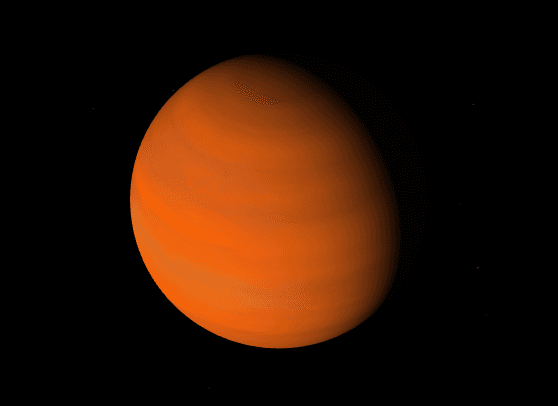
WASP-96b is a gas giant exoplanet of the “hot Saturn” type, located approximately 1,150 light years from the Solar System in the direction of the Phoenix constellation. It orbits very close to its host star, WASP-96. The planet gained worldwide recognition for being among the first scientific datasets released after the activation of the James Webb Space Telescope (JWST), which included its atmospheric spectrum. Observations have provided definitive evidence of water vapor as well as haze and cloud layers in its atmosphere.

WASP-96b (NASA)
WASP-96b was discovered in 2013 using data collected by the WASP-South observatory as part of the Wide Angle Search for Planets (WASP) project. The scientific paper announcing this discovery was published in 2014. The planet was detected using the transit method, which measures the small, regular dips in a star’s brightness caused by a planet passing in front of it. This method allowed scientists to directly determine WASP-96b’s radius and orbital period.
WASP-96 is a yellow dwarf star of spectral class G8, similar to the Sun. Its mass has been measured at approximately 1.06 times that of the Sun (1.06 ± 0.08 M☉), and its radius at about 1.05 times the solar radius (1.05 ± 0.05 R☉). Its surface temperature is approximately 5,540 Kelvin, very close to the Sun’s 5,778 K. The star is estimated to be about 6 billion years old. Its metallicity ([Fe/H]) is comparable to that of the Sun, indicating a chemical composition largely similar to our star.
WASP-96b is classified as a “hot Saturn” or “puffy gas giant” exoplanet. Its mass is about 48 percent that of Jupiter (0.48 ± 0.03 M♃), less than half of Jupiter’s mass. However, its radius is approximately 20 percent larger than Jupiter’s (1.2 ± 0.06 R♃). When considered together, these two parameters indicate that the planet has an extremely low density.
Its average density is about 0.28 grams per cubic centimeter. This is roughly one-quarter the density of water (1 g/cm³) and less than half the average density of Saturn (0.687 g/cm³). WASP-96b’s “puffy” structure is thought to result from intense stellar irradiation due to its close proximity to its host star, causing thermal expansion of its atmosphere.
WASP-96b completes one full orbit around its host star in a very short time—approximately 3.425 Earth days. Its average distance from the star, or semi-major axis, is only 0.0453 astronomical units (AU). This distance is about one-tenth of the distance between the Sun and Mercury.
This extremely close orbit results in a very high surface temperature. Calculations that do not account for atmospheric redistribution or reflectivity (albedo) estimate WASP-96b’s equilibrium temperature to be approximately 1,285 Kelvin (about 1,012 °C).
The most notable feature of WASP-96b is that its atmosphere has been studied in detail by the James Webb Space Telescope (JWST). On 12 July 2022, NASA publicly released the first full-color scientific images and spectroscopic data from JWST, which included WASP-96b’s atmospheric transmission spectrum.
These observations were made using the Near-Infrared Imager and Slitless Spectrograph (NIRISS) instrument aboard JWST. In transmission spectroscopy, the wavelengths of starlight that are absorbed as it passes through the planet’s atmosphere during transit are analyzed. Different molecules in the atmosphere absorb light at specific wavelengths, creating dark lines or dips in the spectrum. The spectrum obtained by JWST revealed the following key findings:
NASA. "NASA’s Webb Reveals Steamy Atmosphere of Distant Planet in Detail." Accessed July 19, 2025. https://www.nasa.gov/image-feature/goddard/2022/nasa-s-webb-reveals-steamy-atmosphere-of-distant-planet-in-detail.
NASA. "WASP-96 b." *NASA Science: Exoplanet Catalog*. Accessed July 20, 2025. https://science.nasa.gov/exoplanet-catalog/wasp-96-b/.
The JWST Transiting Exoplanet Community Early Release Science Team. "Identification of Carbon Dioxide in an Exoplanet Atmosphere." *Nature* 614 (February 2023): 649–652. Accessed July 19, 2025. https://www.nature.com/articles/s41586-022-05269-w.

Density(Text) | ~0.28 g/cm³ | ||||||||
|---|---|---|---|---|---|---|---|---|---|
Type(s) | Hot Saturn-type gas giant exoplanet | ||||||||
Name(s) | WASP-96b | ||||||||
Planet Type | Puffy gas giant | ||||||||
Orbital Period | 425 Earth days 3 | ||||||||
Distance | 150 light years 1 | ||||||||
Radius | 1.2 ± 0.06 R♃ | ||||||||
Mass | 0.48 ± 0.03 M♃ | ||||||||
Distance from Star | 0.0453 AU | ||||||||
Discovery Project | Wide Angle Search for Planets | ||||||||
Discovery Year | 2013 | ||||||||
Constellation | Anka (Phoenix) | ||||||||
Henüz Tartışma Girilmemiştir
"WASP-96b" maddesi için tartışma başlatın
Discovery
Host Star: WASP-96
Physical Characteristics
Orbit and Temperature
Atmospheric Structure and Composition