


Michael Faraday
Early Life and Education
Michael Faraday was born in London in 1791. His family was poor, and he could not attend school for long. However, his curiosity about books was immense.
As a young boy, Faraday worked as an apprentice bookbinder. While repairing books, he began reading them himself. He especially loved books on science! He wanted to learn everything about chemistry, electricity, and magnets. One day, he attended a lecture by the renowned scientist Humphry Davy. After the lecture, he bravely sent Davy his detailed notes and expressed his desire to assist him in his laboratory.
This bold step changed his life!
Davy took Faraday on as an assistant. Faraday then began conducting experiments. At the time, electricity was a poorly understood phenomenon. Faraday discovered that electricity could flow through wires and interact with magnets. He designed the first electric motor and the earliest version of a generator. He found ways to produce electricity!
But Faraday did not limit himself to scientific discoveries. He also greatly enjoyed explaining science to children and the public. He performed experiments and taught about electricity and chemistry during events known as the Christmas Lectures.
He never attended university, yet he became a professor. He was not wealthy, but he earned great respect in the scientific community. His honesty, curiosity, and hard work made him a role model for everyone.
Michael Faraday died in 1867. Yet today, electric vehicles, generators, and motors still operate based on his ideas!

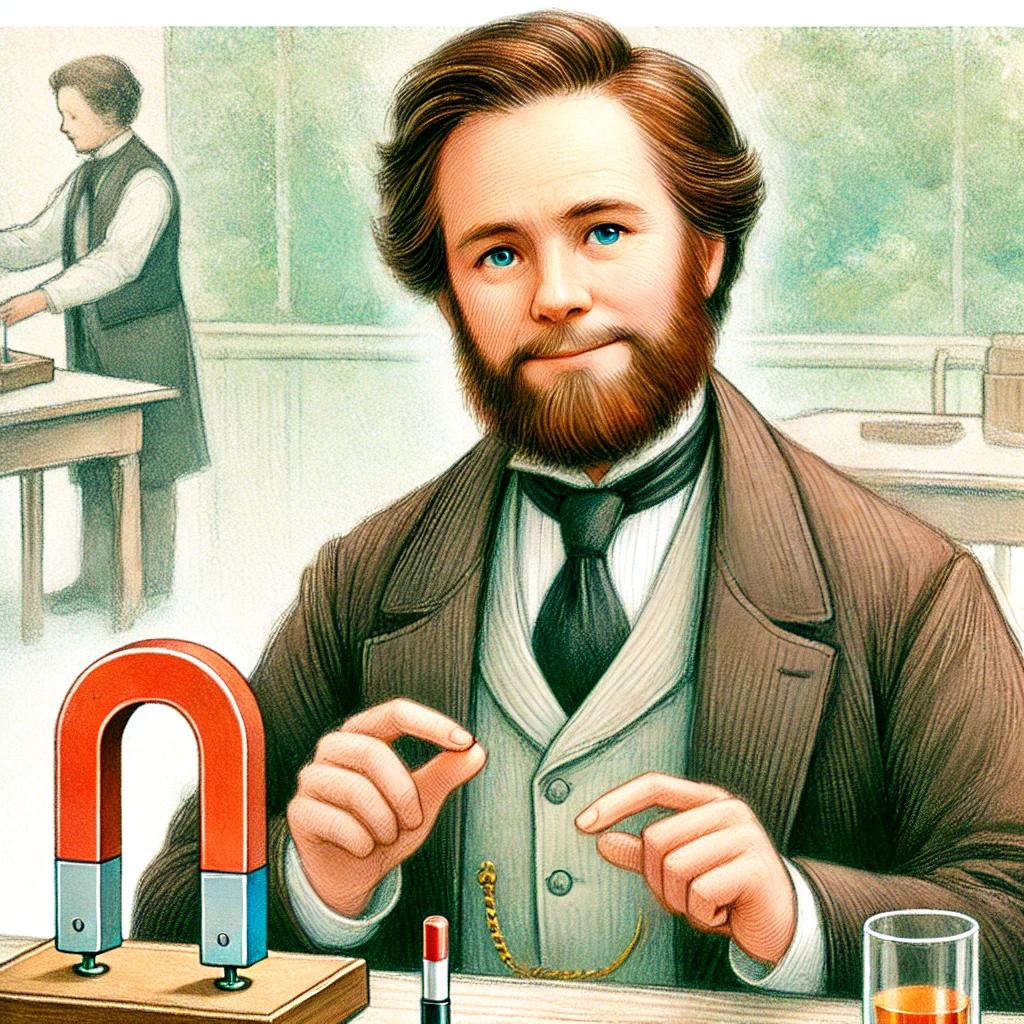
Michael Faraday (generated by artificial intelligence).
Contributions to Science
Faraday conducted groundbreaking experiments on electricity and magnetism.
- He laid the foundations of the electric motor.
- He discovered the concept of electromagnetic induction.
- He is considered the father of the first generators.
Thanks to him, producing and using electricity became possible. Despite never attending university, he won the admiration of all through his contributions to science.

Faraday’s Experiment (generated by artificial intelligence).
Passion for Communicating Science
Faraday loved not only conducting experiments but also explaining science to people.
Through the Christmas Lectures at the Royal Institution, he demonstrated experiments to children and the public.
He became the pioneer of what we now call popular science communication.
Some Major Works
- Experimental Researches in Electricity (Experimental Researches in Electricity)
- The Chemical History of a Candle (The Chemical History of a Candle)
- Lectures on the Forces of Matter (Lectures on the Forces of Matter)
Fields of Work
- Electricity
- Magnetism
- Chemistry
- Physics
- Scientific communication