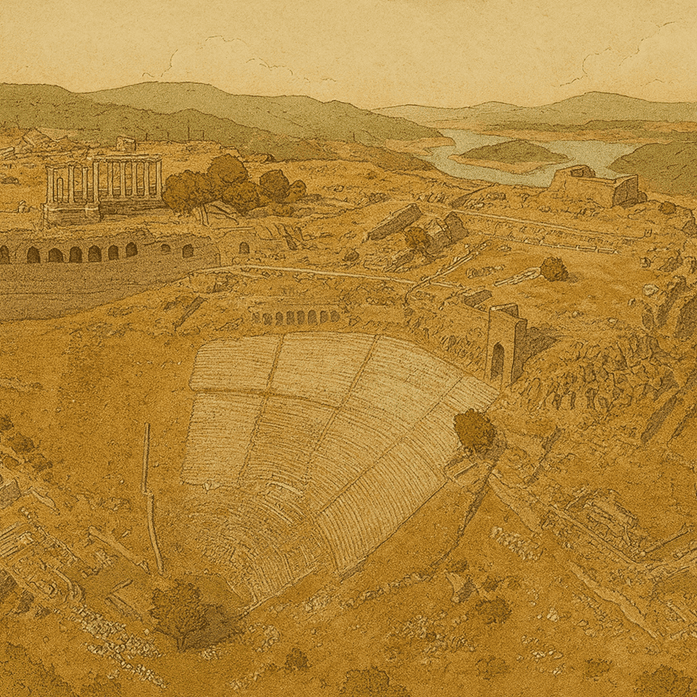




Pergamon (Bergama)
One of the most magnificent cities of the ancient world, Pergamon is located today in the Bergama district of İzmir. Built on a hill dominating the fertile Bakırçay Plain of the Aegean Region, this city became one of the major centers of science, art, architecture, and medicine for thousands of years.

Pergamon (Turkish Museums)
As the capital of the Hellenistic Attalid Dynasty in the 3rd century BCE, Pergamon left its mark on history through the invention of parchment, its renowned library of 200,000 parchment scrolls, the magnificent Altar of Zeus, the steepest ancient theater in the world, and the Asklepion, a major health center. It was inscribed on the UNESCO World Heritage List in 2014.
Akropolis – The City of Kings and Scholars
As a terraced settlement, Pergamon was built on a series of terraces. The Kale Tepe (Akropolis) was the highest point of the city and consisted of three main areas:
Upper City: The royal palaces, temples (Athena, Trajan), cisterns, and the famous library of 200,000 parchment scrolls were located here. This area was reserved for kings, commanders, religious figures, and scholars.
Middle City: Temples, gymnasia (sports and educational buildings), sacred precincts (Hera, Demeter), and public gathering spaces were accessible to the general population.
Lower City: The Lower Agora, shops, and residential buildings served the daily needs of the populace.
Altar of Zeus: Constructed during the reign of Eumenes II to commemorate victory over the Galatians, it was adorned with masterpieces of the Pergamon Sculpture School.

(Generated by Artificial Intelligence)
Asklepion – The Healing Center of the Ancient World
Asklepion was a renowned health center dating back to the 4th century BCE and reaching its peak during the Roman period. Dedicated to the god of healing, Asclepius, the site featured:
A theater for 3,500 spectators, a library, treatment rooms, sacred springs, and baths.
Treatment methods included hypnosis, water and mud baths, herbal remedies, dietary regimens, and massage.
The physician Galen conducted groundbreaking medical research here that shaped the course of medical history.
Red Courtyard (Basilica) – Temple Dedicated to Egyptian Deities
Built during the 2nd century CE under the Roman Emperor Hadrian, the Red Courtyard was a massive temple constructed of brick. Originally dedicated to the Egyptian deities Serapis and Isis, it was later converted into a church during the Byzantine period. Beneath the structure lay hidden passages and staircases.

(Generated by Artificial Intelligence)
The Legacy of Pergamon
Pergamon offers a multi-layered cultural landscape shaped by Hellenistic, Roman, and Byzantine architecture. The city holds a unique place in human history through its achievements in ancient engineering, its pioneering contributions to medicine and science, and its artistic masterpieces.