

This article was automatically translated from the original Turkish version.
+1 More
Rakım | 331 | ||||||||
|---|---|---|---|---|---|---|---|---|---|
Kaymakam | Avni ORAL | ||||||||
Beldiye Başkanı | Tanju Çelik | ||||||||
Yüz Ölçümü | 1722 | ||||||||
Bergama is a district in the northwestern part of the Aegean Region of Türkiye, subordinate to İzmir Province. Located in the Bakırçay Basin, it is bordered by Kınık and Soma to the east, Dikili and Ayvalık to the west, Aliağa to the south, and Balıkesir and Manisa provinces to the north. Bergama is situated 107 km from the center of İzmir and, with an area of 1,720 km², is the largest district in İzmir by land area.
Geographically, Bergama lies between the Madra Mountains (1,051 m) to the north and the Yunt Mountains (1,344 m) to the south, at the center of the Bakırçay Plain. The elevation of the district center is 68 meters, while the Acropolis stands at 331 meters. The Bakırçay River, which flows through the district, is 120 km long and is fed by Glenbe, Aksu, Yağcılı, Menteşe, İlya, and other smaller streams.
The district has a Mediterranean climate with hot, dry summers and mild, rainy winters. The difference between daytime and nighttime temperatures ranges between 15 and 20 degrees Celsius, and northerly winds are influential throughout the year.

Bergama (İzmir KTB)
According to 2009 data, the total population of Bergama is 100,802. Of this, 58,570 reside in the district center and 42,232 in villages and towns. As of 2018, the district population was recorded at 103,185. Under Law No. 6360, which came into effect in 2014, villages and towns were converted into neighborhoods, bringing the total number of neighborhoods to 137.
The economy of Bergama is largely based on agriculture and animal husbandry. The fertile Bakırçay Plain produces cotton, tobacco, tomatoes, olives, maize and wheat, while pine nuts from the Kozak Plateau serve as an important source of income. Beekeeping is widespread particularly in the mountain villages. Agriculture-based industry is developing, and carpet weaving and kilim production remain traditional crafts.
The district is also rich in mining resources. Granite, marble, gold, perlite and stone quarries operate in the region. Natural thermal springs and spas offer potential for health tourism.
Bergama has 53 primary schools, 13 secondary education institutions and one vocational college. As of 2009, there were 910 teachers and 17,097 students in the district. Under public education programs, 1,970 participants receive instruction in six classrooms with five teachers. Health services are provided by one state hospital, 11 health centers, 14 health houses and various other units.
Known in antiquity as Pergamon, the settlement’s history extends back to the Early Bronze Age (3000 BCE). The region was first inhabited by the Pelasgians and Luwians. The word “Perg” means fortress and “uma” means people. During the Hellenization process, the name evolved into Pergamon, while the modern name Bergama more closely reflects this original form.
In 301 BCE, the city was captured by Lysimachus and handed over to his commander Philetaerus. The Kingdom of Pergamon, which began with Philetaerus’s declaration of independence in 282 BCE, lasted approximately 150 years. During this period, significant advancements were made in culture, architecture and sculpture. Following the will of Attalus III, the city was bequeathed to Rome in 133 BCE and became the capital of the Roman province of Asia.
In 716 CE, the city suffered Arab raids. After Osman Gazi’s victory in 1301, it came under the control of the Karesi dynasty and passed to Ottoman rule in 1317. During the 14th and 15th centuries, the city expanded beyond its citadel and grew toward the flat plain.
The ancient settlement atop Kale Dağı is one of the most important examples of Hellenistic urban planning. Structures here include the Altar of Zeus, the Temple of Athena, a library housing 200,000 scrolls, the ancient theater, the Temple of Trajan, the Heroon and the Gymnasion.
One of the leading health centers of antiquity, the Asklepion employed methods such as hypnosis, mud baths and water therapies. The site includes a library, a theater, an underground tunnel, sacred water sources and the Temple of Asklepios.
Bergama (İzmir KTB)
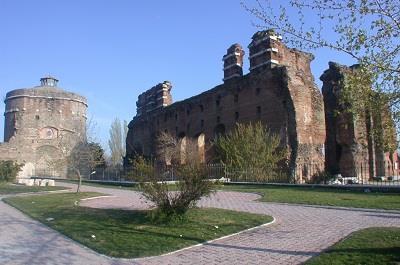
Constructed in the 2nd century CE, likely during the reign of Emperor Hadrian, the Basilica was originally dedicated to Egyptian deities and later converted into a Christian church during the Early Byzantine period. It is recognized as one of the Seven Churches of Asia.
Founded in the Hellenistic period, Allianoi emerged as a health center renowned for its thermal waters and hydrotherapy treatments. It reached its peak during the reign of Roman Emperor Hadrian, and numerous artifacts have been uncovered through excavations.
Bergama contains numerous structures dating from the Ottoman and Beylik periods. These include the Ulu Cami (1399), Kurşunlu Cami (1439), Tabaklar Hamamı (pre-1842), Hacı Hekim Hamamı, Küplü Hamam (1427), Çukurhan, Taşhan (1432), Bedesten and various mosques.
In 2014, Bergama was inscribed on the UNESCO World Heritage List as the “Bergama Multi-Layered Cultural Landscape.” The site comprises nine components including Pergamon, the Sanctuary of Cybele, various tumuli and cult areas. This layered structure integrates Hellenistic urban planning with Roman and Byzantine remains and Ottoman layers, preserving traces of cultural continuity.
Bergama is listed in Turkey’s National Inventory of Intangible Cultural Heritage for its traditions including the “International Bergama Fair,” “Çeyiz Serme,” “Sünnet Yatağı,” “Karatabakçılık,” “Sepet Yapımı,” “Telkırma” and “Klarnet Çalma.”
The Bergama Museum, Türkiye’s first archaeological museum, is located in the district center and houses an extensive collection of artifacts. Major tourist attractions in the district include the Acropolis, Asklepion, Red Courtyard, Kleopatra Thermal Baths and the Kozak Plateau. Geothermal resources and medicinal waters also offer potential for health tourism.
Asklepieion ancient site. Photograph. İzmir Provincial Directorate of Culture and Tourism. Accessed August 14, 2026. URL: https://izmir.ktb.gov.tr/Resim/202049,asklepion-1jpg.png?0
Bergama Ancient Theatre. Photograph. İzmir Provincial Directorate of Culture and Tourism. Accessed August 14, 2026. URL: https://izmir.ktb.gov.tr/Resim/202022,bergamajpg.png?0
Bergama Belediyesi. "Bergama Hakkında." Bergama Belediyesi. Accessed August 14, 2026. https://bergama.bel.tr/bergama/bergama-hakkinda/.
T.C. İzmir Valiliği. "Bergama." İzmir Valiliği Resmi Web Sitesi. Accessed August 14, 2026. http://www.izmir.gov.tr/bergama.
İzmir Provincial Directorate of Culture and Tourism. "Bergama." *Republic of Turkey Ministry of Culture and Tourism İzmir Provincial Directorate of Culture and Tourism*. Accessed August 14, 2026. https://izmir.ktb.gov.tr/TR-77442/bergama.html.
Rakım | 331 | ||||||||
|---|---|---|---|---|---|---|---|---|---|
Kaymakam | Avni ORAL | ||||||||
Beldiye Başkanı | Tanju Çelik | ||||||||
Yüz Ölçümü | 1722 | ||||||||
Population and Administrative Structure
Economy
Education and Health
History
Ancient and Historical Sites
Acropolis
Asklepion
Basilica (Red Courtyard)
Allianoi
Turkish-Islamic Structures
UNESCO World Heritage Status
Intangible Cultural Heritage
Culture and Tourism