



South Korea
Capital and Major Cities
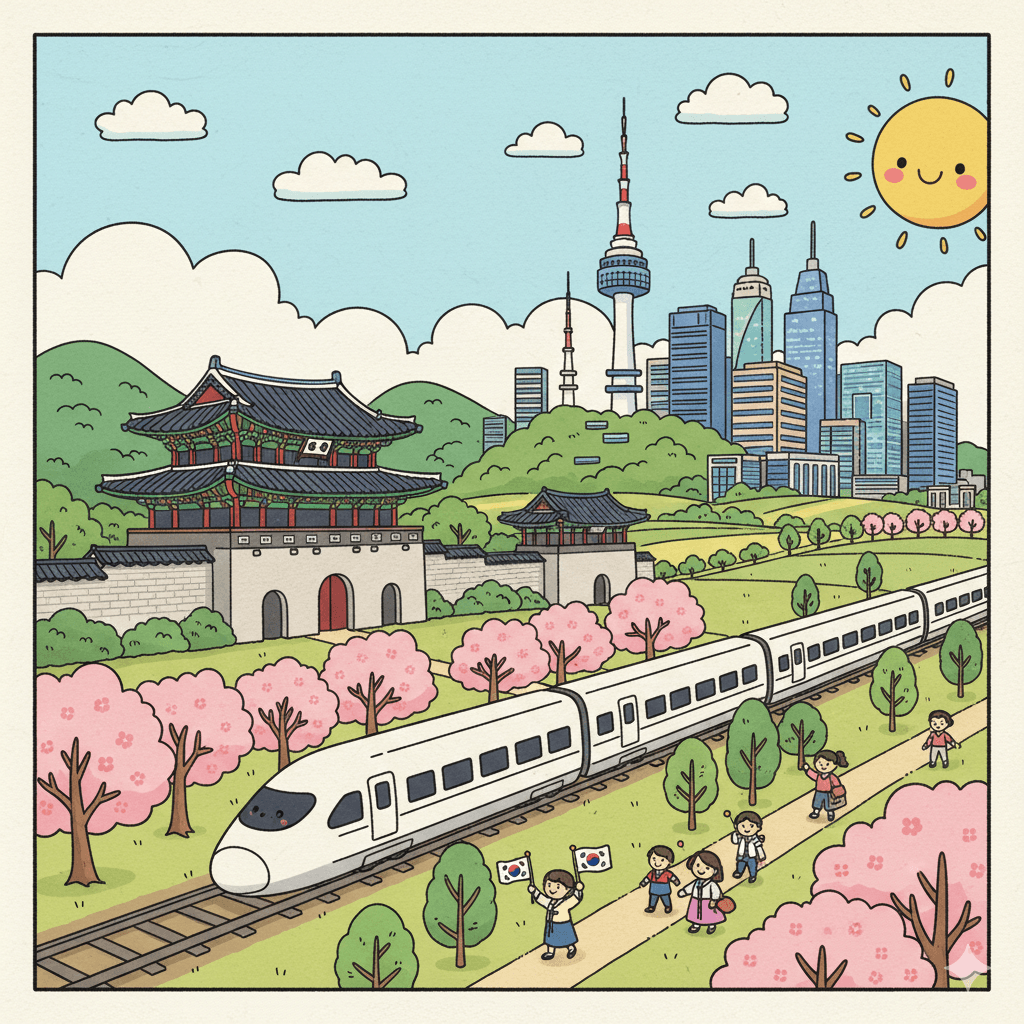
The capital of South Korea is Seoul. This city is the largest and most important center of the country, housing both historic palaces and towering skyscrapers. Outside the capital, other major cities include Busan, a major port city, and Incheon, a commercial hub with an international airport. South Korea has a total of seven metropolitan municipalities.

(Generated by artificial intelligence) Seoul
Language and Flag
The official language of the country is Korean.
The flag of South Korea is called Taegeukgi. The flag consists of three main elements:
- White Background: Represents the Korean people’s love of peace and purity.
- Central Circle (Taegeuk): Composed of red and blue, it symbolizes balance and harmony in the universe. Red represents Yang, the positive energy, while blue represents Yin, the negative energy.
- Four Corners (Trigrams): The three-line black groups in each corner (trigrams) represent the four fundamental natural elements—sky, earth, water, and fire—and signify the movement and harmony of the universe.

(Generated by artificial intelligence)
South Korean Culture
Korean culture has preserved its millennia-old traditions while rapidly modernizing.
Traditional Culture: Korea is a country with four distinct seasons and unique natural beauty. Traditional clothing, lifestyle, and folk elements—such as folktales and handicrafts—are preserved and exhibited by institutions like the Korean National Folklore Museum.
Korean Wave (Hallyu): Through significant state investment in cultural industries, South Korea has gained global recognition through music (K-Pop), television dramas, and films (K-Drama). This global phenomenon is known as Hallyu, or the Korean Wave.
South Korean Cuisine
The foundation of Korean cuisine is rice, and Koreans today still prefer rice over bread at meals. Additionally, the high consumption of fermented foods in Korean dishes provides healthy nutrients that support digestion. Koreans favor these traditional meals, rich in vegetables and spices, for maintaining good health.
Korean cuisine features a wide variety of dishes. Kimchi is one of the most famous and indispensable dishes. Made from fermented vegetables—usually spicy napa cabbage—it is served alongside nearly every meal. Other beloved main dishes include Bibimbap (mixed rice) and Bulgogi (marinated grilled meat).
Korean meals are typically served with a variety of small side dishes known as Banchan, creating a presentation that appeals to both the eye and the palate.

(Generated by artificial intelligence)
Technology
South Korea is a global power in industries such as electronics, telecommunications, automobile manufacturing, and shipbuilding. The country plays a significant role in global industry and trade.
Modern History
Korea experienced a major war in the mid-20th century (the Korean War) and was divided into two states. Since then, South Korea has undergone rapid economic development (industrialization) and has become one of the world’s advanced economies in a short time.
Natural and Historical Attractions
South Korea has numerous sites listed on the UNESCO World Heritage List, renowned for both their natural beauty and historical significance.
- UNESCO Cultural Heritage Sites: These include palaces from ancient kingdoms, royal tombs from the Joseon Dynasty, and Buddhist temples (for example: Haeinsa Temple).
- Natural Attractions: Jeju Island in the south of the country is included in the natural heritage list for its volcanic formations and lava tubes.

(Generated by artificial intelligence) Gyeongbokgung Palace
Relations with Türkiye
Türkiye and South Korea regard each other as “sister countries” due to the strong bonds formed during the Korean War. Türkiye supported South Korea by participating in the Korean War, which began in 1950. This support established a special friendship that extends beyond diplomatic relations.