




The Mysterious World of Mummies
Have you ever wondered about the mummies you’ve seen in films or documentaries—those ancient figures gazing at us as if time had stood still for thousands of years? Now we will uncover the secrets of these mysterious “mummies”!
⏳The Ancient History of Mummification
Mummification is the process of preserving a deceased person’s body so that it does not decay and can remain intact for many years. When did this idea first emerge?

A typical day in Ancient Egypt (Image generated by artificial intelligence).
When thinking of mummification, Ancient Egypt immediately comes to mind. The ancient Egyptians believed in life after death—the afterlife. For them, it was essential that the body remain intact so the soul could return to it and live again in the next world. Therefore, they carefully mummified their kings (pharaohs) and other important individuals.
In fact, mummification could occur naturally even before humans learned how to do it intentionally! In very dry or extremely cold environments, and even in marshlands, bodies could dry out naturally and remain preserved for thousands of years.
⛰️Mummification in Anatolia Too!
Mummification was not exclusive to the Egyptians; examples have also been found in Anatolia—the region where Türkiye is located today. For instance, some individuals from the 14th century during the Ilkhanid period in Amasya were also mummified. This demonstrates that mummification was practiced for different reasons at different times and places.
🔍Why Was It Done?
The primary reason for mummification was religious belief. People believed that the better preserved the body of their loved ones, the better their existence would be in the afterlife.
🕯️Preparation for the Afterlife: Especially among the Egyptians, it was believed that the soul needed to return to the body to begin a new life, so the body had to remain perfectly intact.
🌱Desire for Immortality: In a sense, they sought to achieve immortality by preserving the body.

The mummification process (Image generated by artificial intelligence).
🧐How Was Mummification Performed?
In Ancient Egypt, the process could take up to 70 days. Let’s briefly examine the steps involved:
1️⃣Removal of Internal Organs: First, organs prone to rapid decay—such as the lungs, stomach, and intestines—were removed. The heart was usually left in place because the Egyptians believed it played a crucial role in the judgment of the afterlife. The removed organs were stored in special containers called canopic jars.
2️⃣Drying: The body was covered with natron, a special salt, and left for several days until it was completely desiccated.
3️⃣Wrapping: The dried body was anointed with fragrant oils and then wrapped in layers of linen bandages. The mummy, now ready for its eternal journey, was ceremonially laid to rest.

Steps of mummification in sequence (Image generated by artificial intelligence).
🔬Scientists Studying the Mummies
Mummies are not only of interest to historians but also to many other scientific disciplines. Here are some of the fields working to uncover the secrets of mummies:
✏️Archaeology: The study of ancient civilizations, artifacts, and ways of life. Archaeologists investigate where and how mummies were found, as well as the objects buried with them.
✏️History: The study of past events and people. Historians research the identity of the mummified individual, the time period in which they lived, and their social status.
✏️Anthropology: The study of human beings, their cultures, and development. Anthropologists gain insights into the lifestyle of people from that era by examining the physical characteristics of the mummy.
✏️Biochemistry (Chemistry): The study of chemical processes in the body. Researchers analyze how salts and chemicals—such as natron—used during mummification preserved the body.
🌍The Role and Significance of Mummies Today
Today, mummies have become a focus of modern medicine and other scientific fields. Using technologies such as X-rays and MRI scans, mummies are examined in great detail, allowing researchers to learn about health conditions of the time. Mummies displayed in museums around the world welcome millions of visitors each year.
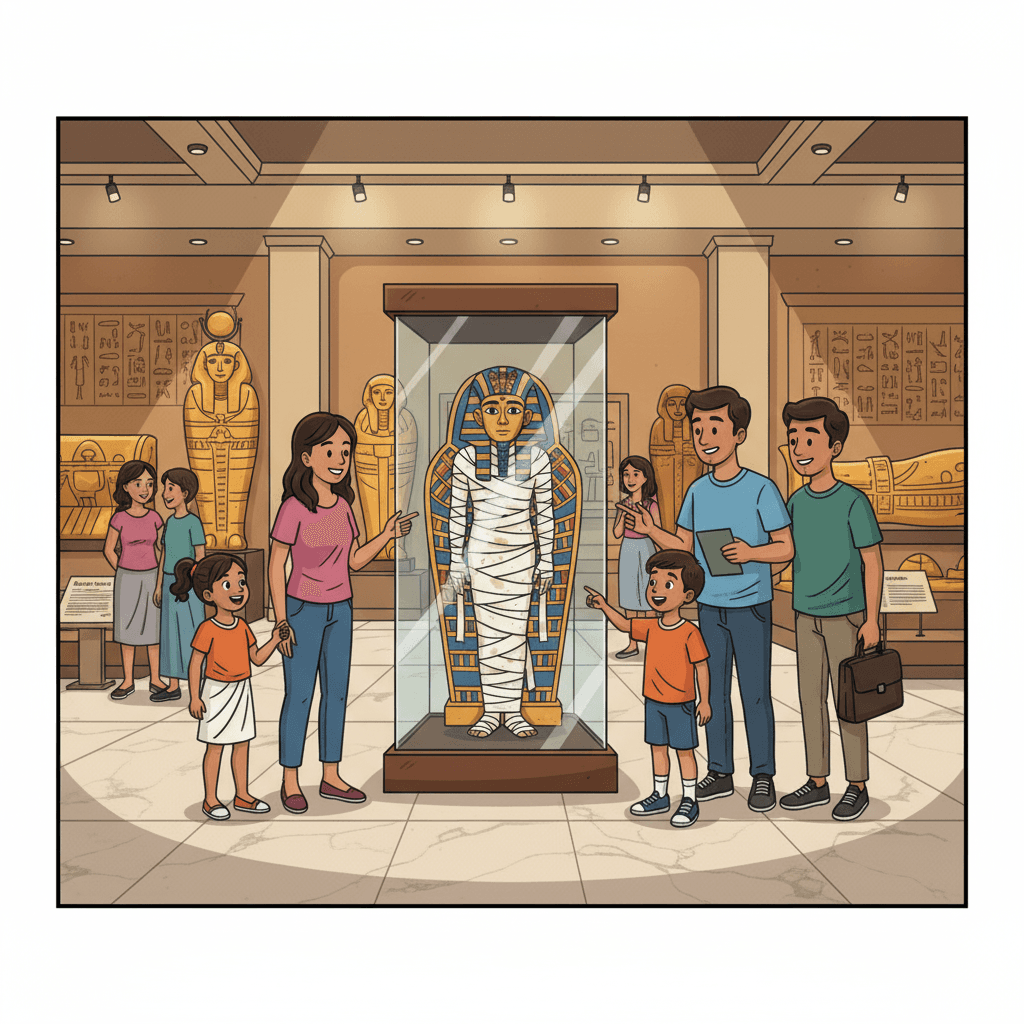
Visitors viewing mummies in a museum (Image generated by artificial intelligence).
While mummification is no longer performed for religious reasons, mummies act like time machines, revealing to us what life was like thousands of years ago!