


This article was automatically translated from the original Turkish version.
If in 1961 you had been asked to board a narrow capsule strapped to the tip of a rocket with questionable safety, entrusted entirely to automated systems, would you have accepted? At a time when it was still unknown whether the human body could survive in space, undertaking this journey—whose return was far from guaranteed—required immense courage. Yet Yuri Gagarin answered this question without hesitation with a “yes,” and aboard the Vostok 1 spacecraft, he became the first human to enter space, entering orbit around Earth.
Yuri Gagarin of the Soviet Union became the first human to enter space by orbiting Earth aboard the Vostok 1 spacecraft. His flight, lasting a total of 108 minutes, consisted of a single circuit around the planet at a speed of 27,400 kilometers per hour.【1】 Gagarin’s journey was vastly different from the familiar images of modern spaceflight. He entered space not as a “pilot” but as a “passenger,” confined within a capsule barely two meters in diameter.【2】 Since the effects of microgravity on the human body were unknown, control of Vostok 1 was largely managed by ground control stations and a computer program.【3】 Gagarin was not even expected to intervene with the control systems during flight.
Yuri Gagarin: The First Human in Space (NASA Video)
One of the most distinctive aspects of Gagarin’s flight was the level of uncertainty surrounding the mission. Today, spaceflights are conducted with countless simulations, advanced safety protocols, and decades of experience. In 1961, however, the situation was entirely different. No definitive answers existed to questions such as how the human body would respond to prolonged weightlessness, whether consciousness could be maintained, or if psychological control was even possible. For this reason, Gagarin was also the subject of a living scientific experiment.
The technical uncertainties were not surprising when considering the history of the Vostok program. A significant portion of the tests conducted before the program’s launch ended in failure. Earlier missions had used dummies and dogs; some spacecraft failed to return from orbit, while others were deliberately destroyed to prevent Soviet technology from falling into foreign hands. As a result, Gagarin’s mission was viewed as an extremely dangerous experiment fraught with high uncertainty and limited chances of rescue. Indeed, engineer Boris Chertok of the era explicitly stated that Vostok would never have been approved under today’s safety standards.【4】
The return posed risks as great as the launch. Vostok 1 entered orbit at a higher altitude than planned. Had the braking system failed, Gagarin would have been forced to wait for the spacecraft to naturally descend. Although the capsule carried a life support system capable of sustaining him for more than a week, such a delay could have been fatal. Fortunately, the brakes activated and the reentry process began. But now, the cables connecting the capsule to the service module failed to separate; the spacecraft began spinning uncontrollably, temperatures rose to dangerous levels, and Gagarin neared loss of consciousness. In his own words, “I was inside a cloud of flame heading toward Earth.”【5】

The First Human in Space Yuri Gagarin (Anadolu Ajansı)
Despite all these risks, the mission was successfully completed. Before the capsule hit the ground, Gagarin ejected from the spacecraft using his ejection seat and landed by parachute near the Volga River. This detail did not conform to the definition of a spaceflight at the time by the International Aeronautical Federation (FAI), which required the astronaut to land inside the vehicle. Although Soviet officials initially withheld this information, the FAI later officially recognized Gagarin’s flight and revised its definition to emphasize “the safe return of the pilot.”【6】 Thus, this 108-minute journey was recorded in history as the first human spaceflight, beyond any technical debate.
Interestingly, despite being the first human in space, Gagarin’s flight was long considered technically “controversial.” It was claimed to violate FAI rules because he did not land with the spacecraft; however, this situation prompted a reevaluation of spaceflight definitions. Thus, Gagarin’s mission did not merely represent a first—it also contributed to shaping space law and international standards.
With this flight, the Soviet Union also gained psychological superiority in the space race. Gagarin’s safe return, at a time when the United States had not yet achieved a manned orbital flight, elevated the global prestige of the Soviet space program to its peak. This success seriously shifted the balance of power on the science and technology front of the Cold War and helped transform space into a new arena for military and ideological competition.
After the flight, Gagarin instantly became one of the most famous people in the world. His life, beginning as the son of a rural family, transformed him into a global symbol. Extensive visits, ceremonies, and intense public attention nearly erased his private life. Yet Gagarin met this attention with a sense of duty and did not reject it. Due to his status as a national hero, he was forbidden from flying in space again; however, he took on roles in cosmonaut training and pursued education in aerospace engineering.【7】
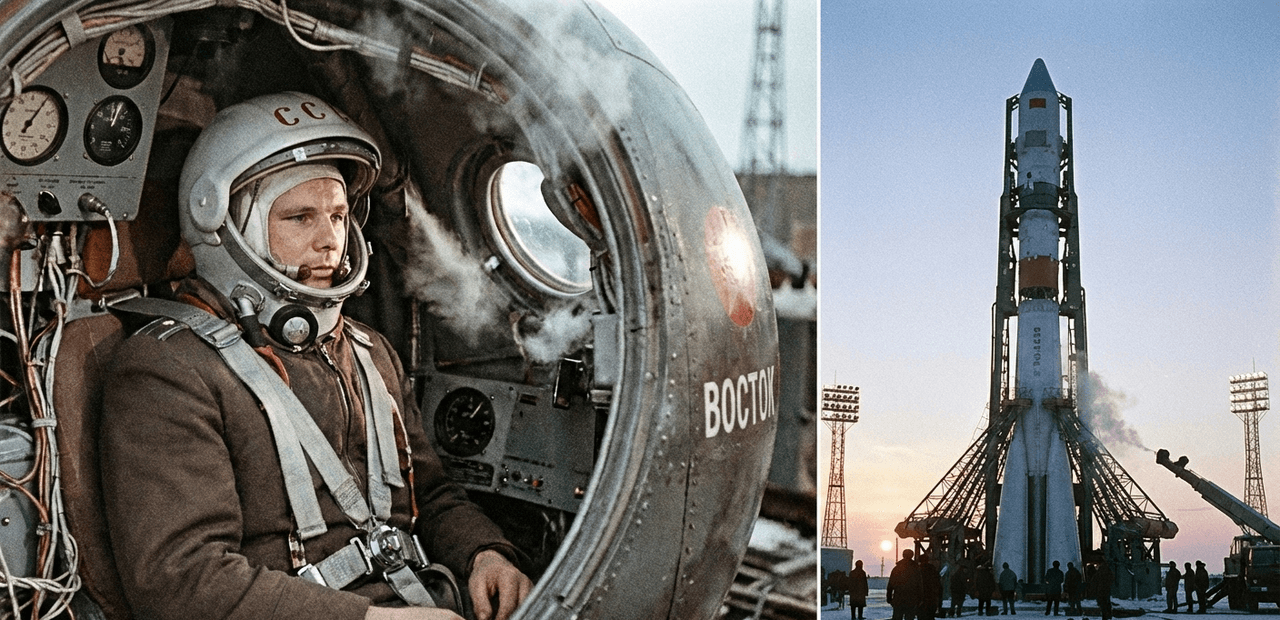
The First Human in Space: Yuri Gagarin (Generated by Artificial Intelligence)
From a scientific perspective, the Vostok 1 mission left a contradictory legacy in the history of aerospace engineering. On one hand, this flight was carried out using an extremely primitive and risky vehicle filled with safety flaws that would be unacceptable today. On the other hand, the data collected definitively proved that human spaceflight was possible: humans could survive in microgravity, complete an orbital flight, and maintain communication with Earth. Answers to these three fundamental questions opened the way for all subsequent human space missions.
Gagarin’s flight also created a cultural turning point that fundamentally changed humanity’s view of space. Previously the subject of myths, science fiction, and theoretical calculations, space had now been experienced firsthand by a human being. The view of Earth that Gagarin saw through the small window of his capsule revealed how fragile and holistic our planet truly was. His awe at Earth’s blue hue and the shadows of clouds demonstrated that space was not merely a domain to be conquered, but a perspective that redefined humanity’s understanding of itself.
This flight also prompted reflection on humanity’s position in relation to technology. Vostok 1 was largely controlled by automated systems; Gagarin’s intervention in the control mechanisms was almost unnecessary. This raised the question at the heart of human spaceflight: was it the “human” or the “machine” that mattered? Paradoxically, the first human spaceflight also revealed how limited the human role in space might be. Nevertheless, the presence of a human during moments of risk defined the mission’s meaning and symbolic value.
The success of Vostok 1 enabled the Soviet space program to pursue more ambitious goals. Subsequent manned missions focused on longer stays in space, carrying multiple crew members, and maneuverability in orbit. Yet every one of these advances became possible only by passing through the door Gagarin had opened. His flight brought to the forefront not only the technical but also the ethical and human dimensions of human space programs: How much risk to human life is acceptable in the face of uncertainty? What is the acceptable threshold of danger in the pursuit of scientific progress?
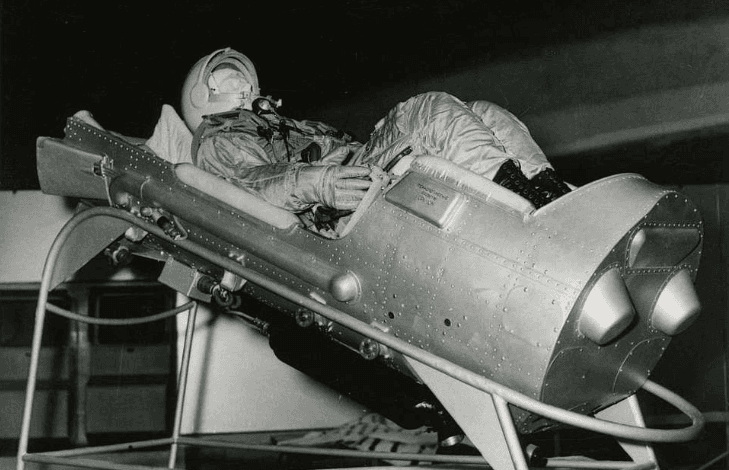
Yuri Gagarin and the Vostok 1 Spacecraft (Picryl)
These questions, despite the decades that have passed, remain relevant. Today, space agencies plan safer and more sustainable missions, yet space remains a high-risk environment. The fact that even experienced cosmonauts and astronauts describe spaceflight as “terrifying” underscores this reality. In this context, Gagarin’s flight is not merely a tale of past heroism; it is also the starting point of the sense of responsibility underlying modern space endeavors.
Years later, evaluations by cosmonauts who followed him further highlight the magnitude of Gagarin’s courage. Experienced astronauts have openly stated that, with today’s technical knowledge, they would not have accepted to fly under those conditions, emphasizing that Gagarin may not have even been fully aware of all the risks.【8】
Gagarin’s legacy has also been kept alive through symbolic gestures. The first humans to set foot on the Moon, Neil Armstrong and Buzz Aldrin, left a medal belonging to Gagarin on the lunar surface, one of the most powerful symbols of this shared memory in space history.【9】 This act, despite the ideological rivalry of the space race, was a quiet acknowledgment that humanity’s journey into space was a collective endeavor.
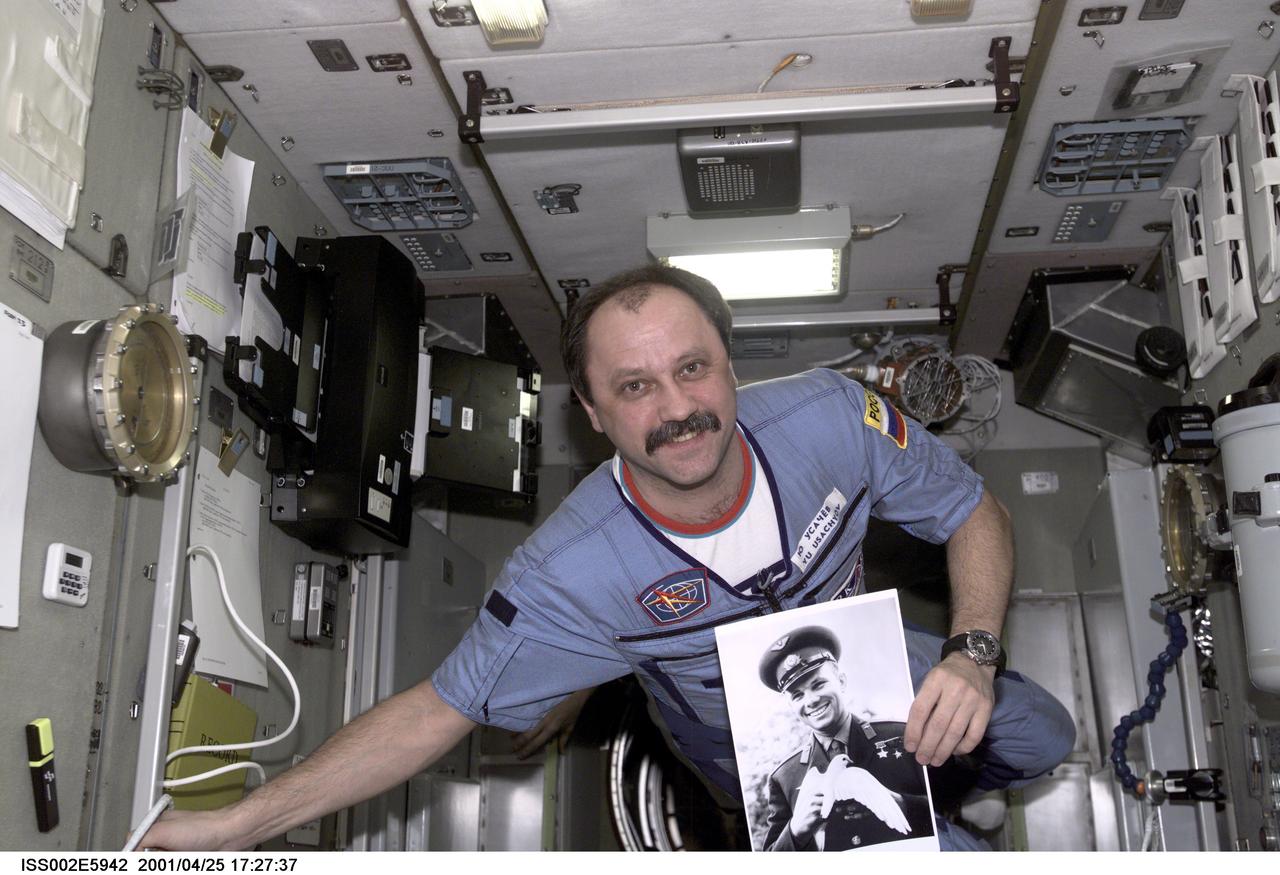
Yury V. Usachev Holding a Photo of Gagarin in the Zvezda Service Module on the Anniversary of the First Human in Space (Flickr)
Yuri Gagarin died in 1968 at the age of just 34 during a training flight.【10】 Yet despite his short life, he left an indelible mark on human history. His 108-minute journey marked the crossing of a symbolic threshold that redefined the limits of humanity.
Today, astronauts spending months aboard space stations, planned manned missions to Mars, and deep space projects all owe their origins to this 108-minute orbital experiment. Yuri Gagarin’s flight aboard Vostok 1 continues to hold its place in space history as the moment when science was boldly tested, uncertainty was accepted, and humanity began to question its place in the universe.
Looking back today, the flight that took place on April 12, 1961, represented far more than a single success. Yuri Gagarin’s 108-minute journey is etched in history as the moment when humanity’s curiosity, fear, and courage became tangible. The first human step in space became the precursor to all future exploration; that single orbit around Earth permanently altered the course of humanity’s relationship with the cosmos.
Anadolu Ajansı. "İnsanoğlunun uzay macerası 67 yıl önce başladı." Accessed December 31, 2025.https://www.aa.com.tr/tr/bilim-teknoloji/insanoglunun-uzay-macerasi-67-yil-once-basladi/3120974
BBC News Türkçe. "Yuri Gagarin, 63 yıl önce ilk insanlı uzay uçuşunu hangi şartlar altında gerçekleştirdi?." BBC. Accessed December 31, 2025.https://www.bbc.com/turkce/haberler-dunya-56716051
Collection - Yuri Gagarin. "Katapultstol från rymsfarkosten Vostok." Picryl. Accessed December 31, 2025.https://picryl.com/media/katapultstol-fran-rymsfarkosten-vostok-881150
Kemerkaya, Nazlı. "Yuri Gagarin." *KÜRE Ansiklopedi.* Accessed December 31, 2025.https://kureansiklopedi.com/tr/detay/yuri-gagarin-2
NASA Johnson. "ISS002-E-5942 (25 Nisan 2001)." Flickr. Accessed December 31, 2025.https://www.flickr.com/photos/nasa2explore/9495224111/in/photostream/
NASA. "April 1961 – First Human Entered Space." nasa.gov. Accessed December 31, 2025.
NASA. "Yuri Gagarin: First Human in Space." YouTube Video. Date Published May 20, 2013. Accessed December 31, 2025.https://www.youtube.com/watch?v=DULAzpmmJkg
Space Center Houston. "Mission Monday: Five fast facts about the first person in space." spacecenter.org. Accessed December 31, 2025.https://spacecenter.org/mission-monday-five-fast-facts-about-the-first-person-in-space/
İTU Pictures. "Yuri Gagarin orbited Earth in 1961." Flickr. Accessed December 31, 2025.https://www.flickr.com/photos/itupictures/16042132243/in/photostream/
[1]
"April 1961 – First Human Entered Space," nasa.gov, erişim 31 Aralık 2025, https://www.nasa.gov/image-article/april-1961-first-human-entered-space/
[2]
"Yuri Gagarin, 63 yıl önce ilk insanlı uzay uçuşunu hangi şartlar altında gerçekleştirdi?." BBC, erişim 31 Aralık 2025, https://www.bbc.com/turkce/haberler-dunya-56716051
[3]
"April 1961 – First Human Entered Space," nasa.gov, erişim 31 Aralık 2025,
[4]
"Yuri Gagarin, 63 yıl önce ilk insanlı uzay uçuşunu hangi şartlar altında gerçekleştirdi?" BBC, erişim 31 Aralık 2025,
[5]
"Yuri Gagarin, 63 yıl önce ilk insanlı uzay uçuşunu hangi şartlar altında gerçekleştirdi?" BBC, erişim 31 Aralık 2025,
[6]
"Yuri Gagarin, 63 yıl önce ilk insanlı uzay uçuşunu hangi şartlar altında gerçekleştirdi?" BBC, erişim 31 Aralık 2025,
[7]
"Yuri Gagarin, 63 yıl önce ilk insanlı uzay uçuşunu hangi şartlar altında gerçekleştirdi?" BBC, erişim 31 Aralık 2025,
[8]
"Yuri Gagarin, 63 yıl önce ilk insanlı uzay uçuşunu hangi şartlar altında gerçekleştirdi?" BBC, erişim 31 Aralık 2025,
[9]
"Mission Monday: Five fast facts about the first person in space," spacecenter.org, erişim 31 Aralık 2025, https://spacecenter.org/mission-monday-five-fast-facts-about-the-first-person-in-space/
[10]
"Yuri Gagarin, 63 yıl önce ilk insanlı uzay uçuşunu hangi şartlar altında gerçekleştirdi?" BBC, erişim 31 Aralık 2025,