


This article was automatically translated from the original Turkish version.
1814 London Beer Flood (generated by Artificial Intelligence.)
Location | London St Giles Horse Shoe Brewery | ||||||||
|---|---|---|---|---|---|---|---|---|---|
Economic Loss | 23,000 pounds | ||||||||
Legal Consequence | The company was acquitted by a decision of Act of God | ||||||||
Loss of Life | 8 official deaths | ||||||||
Event Type | Industrial Accident | ||||||||
History | 17 October 1814, Monday | ||||||||
1814 London Beer Flood was an industrial accident that occurred on 17 October 1814 at the Horse Shoe Brewery owned by Meux and Company in the St Giles district of London. A pressure-induced rupture of one of the iron hoops on a 6.7-metre-high porter beer cask triggered a chain reaction, releasing approximately 1.5 million litres of beer in a 4.5-metre-high wave that flooded the streets. The lack of drainage in the narrow alleys caused the “beer tsunami” to rapidly fill basements and collapse walls, resulting in the deaths of eight people due to drowning or being buried under debris.
The Horse Shoe Brewery, owned by Meux and Company, was located in the heart of St Giles Rookery, one of London’s poorest and most overcrowded districts in the 19th century, surrounded by narrow streets and densely packed housing. Porter beer casks had become a symbol of prestige among London brewers, reaching enormous sizes; the main cask responsible for the disaster stood approximately 6.7 metres (22 feet) tall and was constructed with iron hoops to contain the pressure【1】.
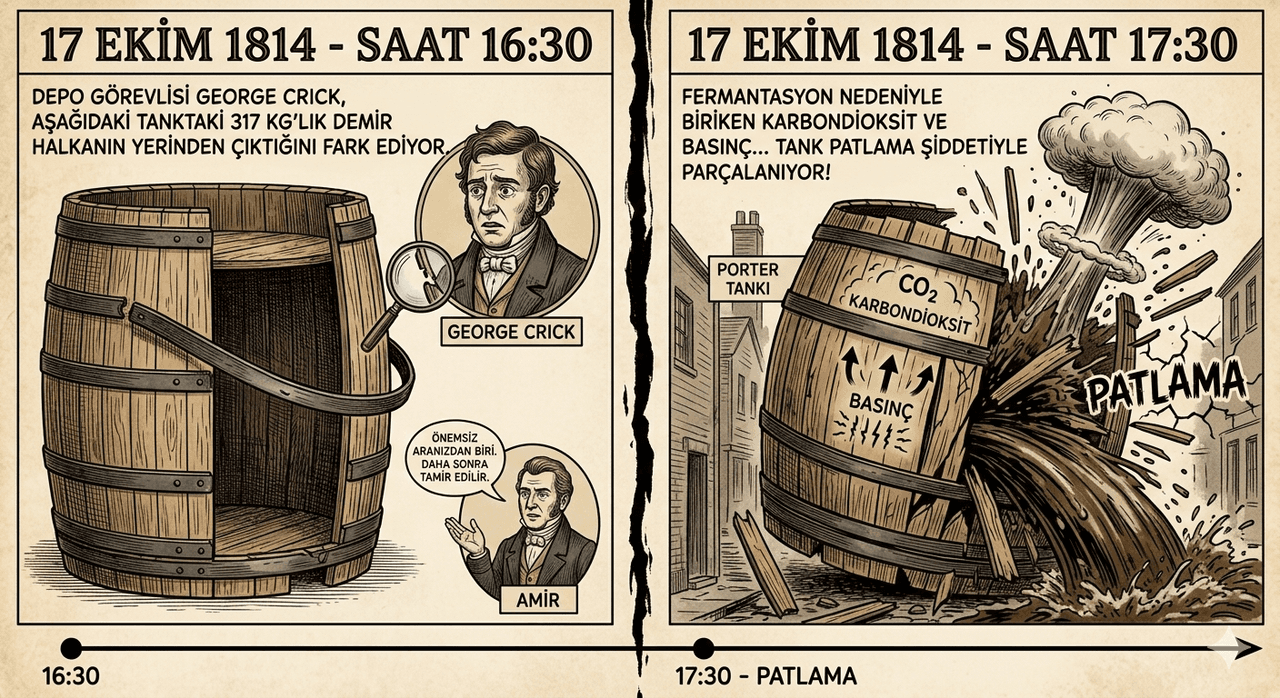
On 17 October 1814 at 16:30, warehouse keeper George Crick noticed that a 144-kilogram (317-pound) iron hoop had come loose. However, since similar incidents had occurred before, his supervisor dismissed it as a minor fault to be repaired later, setting the stage for the disaster【2】. The beer inside the cask was still undergoing fermentation, producing accumulated carbon dioxide gas and liquid pressure that increased the strain on the weakened hoops, causing the cask to rupture with explosive force at 17:30.
The released energy demolished the brewery’s brick walls, while the pressurized liquid burst open the valves of adjacent casks, shattering them and creating a domino effect. A mass of approximately 1.5 million (320,000 gallons) litres of beer transformed into a tsunami【3】. The narrow, undrained streets of St Giles acted as natural channels, directing the flood directly into basements and poorly constructed homes, causing fatalities.

A Visual Depiction of the 1814 London Beer Flood (Generated by Artificial Intelligence)
At approximately 17:30 on Monday, 17 October 1814, the final iron hoops on the porter cask at the Horse Shoe Brewery gave way under pressure, triggering one of the most tragic industrial accidents in London’s history.
The shockwave and physical force of this initial rupture dislodged valves and shattered the bodies of other casks within the brewery, initiating a chain reaction. A volume of beer exceeding 1.2 million (320,000 gallons) litres burst through the brewery’s rear wall and surged into the street【4】. This “beer tsunami,” reaching a height of about 4.5 metres, flowed into the narrow, steep, and undrained streets of St Giles, sweeping away everything in its path and completely filling the basements of fragile buildings on George Street and New Street within seconds【5】.
In a basement on New Street, Anne Saville and four other mourners attending an Irish-style wake for a two-year-old child who had died the previous day were unable to escape as the room rapidly filled with beer and drowned. In a similar incident, Mary Banfield and her four-year-old daughter Hannah were killed when the wave partially collapsed their home and flooded it while they were drinking tea. Eleanor Cooper, who was working outside the brewery and was buried under debris when the wall of the Tavistock Arms pub collapsed, became the eighth recorded victim【6】. In the aftermath, the impoverished residents of St Giles Rookery pooled their pennies and shillings to cover funeral expenses for the victims【7】.
Socially, the event generated controversial claims and urban transformation. Some reports claimed that hundreds of people gathered buckets and containers to collect “free” beer during the disaster, with some even drinking directly from the streets, though these accounts are considered exaggerated【8】. Nevertheless, unconfirmed reports emerged days later of a ninth victim dying from acute alcohol poisoning【9】. Watchmen attempted to profit from the disaster by charging curious onlookers entry fees to view the wreckage, while the fermented beer smell lingered in the streets for months【10】.
Following the disaster, a coroner’s jury convened in a St Giles workhouse and, after hearing witness testimonies and technical reports, classified the incident as “Act of God,” a legal term equivalent to modern “force majeure”【11】. This ruling meant that although the loosened hoop had been previously observed, the event was deemed an unavoidable accident, absolving the company of any liability to compensate victims’ families or face criminal penalties. Although the decision was widely perceived as unjust due to the victims’ poverty and lack of legal representation, the company was legally exonerated of all responsibility【12】.
Economically, the disaster pushed Meux and Company to the brink of bankruptcy. The company suffered direct losses of approximately £23,000 due to the spilled beer and destroyed facilities【13】. However, the company’s lobbying efforts prompted the British Parliament to intervene in support of the brewing industry. Parliament decided to refund the company for the excise tax already paid on the beer that had been destroyed before sale. Combined with an additional £7,250 in compensation for lost casks and damages, the company was able to recover financially, contrary to public perception, thanks to state support【14】.

A Visual Depiction of Changes Following the 1814 London Beer Flood (Generated by Artificial Intelligence)
The 1814 London Beer Flood became a turning point that prompted scrutiny of engineering and safety standards in the British brewing industry. Following the disaster, the structural risks posed by wooden fermentation casks were widely acknowledged, leading to a technological shift in which wooden casks were gradually replaced with safer concrete-lined tanks【15】.
The Horse Shoe Brewery recovered financially and continued operations until 1921, but was completely demolished in 1922. The site was later developed into the Dominion Theatre, one of the prominent buildings in London’s West End today【16】.
Today, the event is remembered as part of London’s industrial heritage. Local pub communities and beer historians keep the memory alive by producing special brews on the anniversary to honour the victims【17】. More than two centuries later, this “beer tsunami” in the streets of St Giles remains one of the most vivid records of the uncontrolled power of industrialisation and its social costs.
Johnson, Ben. "The London Beer Flood of 1814." Historic-UK.com. Accessed March 4, 2026. https://www.historic-uk.com/HistoryUK/HistoryofBritain/The-London-Beer-Flood-of-1814/
The History Press. "The London Beer Flood." TheHistoryPress.co.uk. Accessed March 4, 2026. https://thehistorypress.co.uk/article/the-london-beer-flood/
[1]
Ben Johnson, “The London Beer Flood of 1814.” Historic-UK.com, Erişim tarihi 4 Mart 2026. https://www.historic-uk.com/HistoryUK/HistoryofBritain/The-London-Beer-Flood-of-1814/.
[2]
The History Press, “The London Beer Flood.” TheHistoryPress.co.uk, Erişim tarihi 4 Mart 2026. https://thehistorypress.co.uk/article/the-london-beer-flood/.
[3]
Ben Johnson, “The London Beer Flood of 1814.” Historic-UK.com, Erişim tarihi 4 Mart 2026. https://www.historic-uk.com/HistoryUK/HistoryofBritain/The-London-Beer-Flood-of-1814/.
[4]
Ben Johnson, “The London Beer Flood of 1814.” Historic-UK.com, Erişim tarihi 4 Mart 2026. https://www.historic-uk.com/HistoryUK/HistoryofBritain/The-London-Beer-Flood-of-1814/.
[5]
Ben Johnson, “The London Beer Flood of 1814.” Historic-UK.com, Erişim tarihi 4 Mart 2026. https://www.historic-uk.com/HistoryUK/HistoryofBritain/The-London-Beer-Flood-of-1814/.
[6]
Ben Johnson, “The London Beer Flood of 1814.” Historic-UK.com, Erişim tarihi 4 Mart 2026. https://www.historic-uk.com/HistoryUK/HistoryofBritain/The-London-Beer-Flood-of-1814/.
[7]
The History Press, “The London Beer Flood.” TheHistoryPress.co.uk, Erişim tarihi 4 Mart 2026. https://thehistorypress.co.uk/article/the-london-beer-flood/.
[8]
The History Press, “The London Beer Flood.” TheHistoryPress.co.uk, Erişim tarihi 4 Mart 2026. https://thehistorypress.co.uk/article/the-london-beer-flood/.
[9]
Ben Johnson, “The London Beer Flood of 1814.” Historic-UK.com, Erişim tarihi 4 Mart 2026. https://www.historic-uk.com/HistoryUK/HistoryofBritain/The-London-Beer-Flood-of-1814/.
[10]
The History Press, “The London Beer Flood.” TheHistoryPress.co.uk, Erişim tarihi 4 Mart 2026. https://thehistorypress.co.uk/article/the-london-beer-flood/.
[11]
The History Press, “The London Beer Flood.” TheHistoryPress.co.uk, Erişim tarihi 4 Mart 2026. https://thehistorypress.co.uk/article/the-london-beer-flood/.
[12]
The History Press, “The London Beer Flood.” TheHistoryPress.co.uk, Erişim tarihi 4 Mart 2026. https://thehistorypress.co.uk/article/the-london-beer-flood/.
[13]
The History Press, “The London Beer Flood.” TheHistoryPress.co.uk, Erişim tarihi 4 Mart 2026. https://thehistorypress.co.uk/article/the-london-beer-flood/.
[14]
Ben Johnson, “The London Beer Flood of 1814.” Historic-UK.com, Erişim tarihi 4 Mart 2026. https://www.historic-uk.com/HistoryUK/HistoryofBritain/The-London-Beer-Flood-of-1814/.
[15]
Ben Johnson, “The London Beer Flood of 1814.” Historic-UK.com, Erişim tarihi 4 Mart 2026. https://www.historic-uk.com/HistoryUK/HistoryofBritain/The-London-Beer-Flood-of-1814/.
[16]
Ben Johnson, “The London Beer Flood of 1814.” Historic-UK.com, Erişim tarihi 4 Mart 2026. https://www.historic-uk.com/HistoryUK/HistoryofBritain/The-London-Beer-Flood-of-1814/.
[17]
The History Press, “The London Beer Flood.” TheHistoryPress.co.uk, Erişim tarihi 4 Mart 2026. https://thehistorypress.co.uk/article/the-london-beer-flood/.

1814 London Beer Flood (generated by Artificial Intelligence.)
Location | London St Giles Horse Shoe Brewery | ||||||||
|---|---|---|---|---|---|---|---|---|---|
Economic Loss | 23,000 pounds | ||||||||
Legal Consequence | The company was acquitted by a decision of Act of God | ||||||||
Loss of Life | 8 official deaths | ||||||||
Event Type | Industrial Accident | ||||||||
History | 17 October 1814, Monday | ||||||||
No Discussion Added Yet
Start discussion for "1814 London Beer Flood" article
Background and Technical Causes
Course of the Disaster and Casualties
Social Impact
Legal Proceedings and Economic Consequences
Historical Legacy and Transformation