

This article was automatically translated from the original Turkish version.
Founding of the Republic of Azerbaijan | 1991 | ||||||||
|---|---|---|---|---|---|---|---|---|---|
Country Area | 86,600 km² | ||||||||
Country Population | 10 Million | ||||||||
Gross Domestic Product Per Capita / National Income Per Capita | $72.6 Billion / $5,734 | ||||||||
Parties | Republic of Azerbaijan, Republic of Armenia | ||||||||
History | 27 September 2020 – 10 November 2020 | ||||||||
Second Nagorno-Karabakh War (Operation Single Homeland) is a military operation launched by Azerbaijan to reclaim its territories under occupation. It began on the morning of 27 September with a large-scale attack by the Armenian army against Azerbaijani positions and settlements. This conflict erupted as a result of ongoing tensions in the region following the First Nagorno-Karabakh War between 1988 and 1994. In response to Armenia’s attacks, the Azerbaijani armed forces launched a comprehensive counteroffensive aimed primarily at reclaiming the occupied territories surrounding Nagorno-Karabakh.
During the 44-day war, Azerbaijan declared that the conflict was conducted within the framework of its “right to legitimate self-defense”, asserting under international law that Nagorno-Karabakh and surrounding areas are recognized as Azerbaijani territory. Armenia, by contrast, defended the right of Karabakh Armenians to “self-determination,” but this claim was not accepted by the international community.
The war ended on 10 November 2020 with a ceasefire agreement mediated by Russia, following Azerbaijan’s recapture of the strategically significant city of Shusha. This agreement, known as the Trilateral Statement (10 November 2020), required Armenia to withdraw from the occupied territories of Aghdam, Kelbajar and Lachin; a temporary Russian peacekeeping force was deployed in the region. Article 9 of the statement stipulated the opening of the Zangezur corridor between Azerbaijan and Nakhchivan.

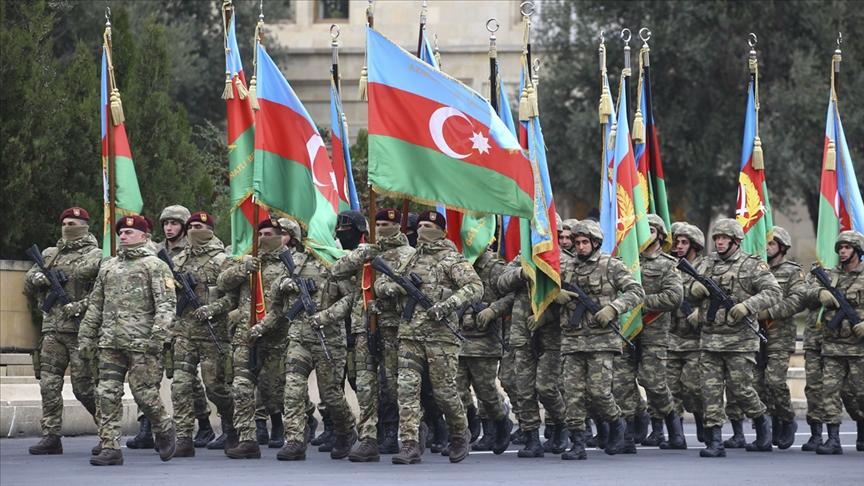
The Second Nagorno-Karabakh War concluded on 10 November 2020 with Azerbaijan’s large-scale recovery of its occupied territories (AA)
The Azerbaijan Democratic Republic, established in 1991, was incorporated into the territory of the Soviet Union in 1920. With the dissolution of the Soviet Union in 1991, Azerbaijan regained its independence. In 1992, the Karabakh Republic declared its independence through a referendum attended solely by ethnic Armenians. However, no country recognized the independence of the Nagorno-Karabakh Republic. Officially part of Azerbaijan, the region region and seven surrounding city were occupied by Armenia during the First Karabakh War. Following the occupation, the Nagorno-Karabakh issue emerged between two state. The problems in this region, which covers 20 percent of Azerbaijani territory, became influential factors in Azerbaijan’s foreign policy. Since 1992, the Nagorno-Karabakh dispute between Azerbaijan and Armenia gained a new dimension in 2020 with Azerbaijan’s military operation in the region war.
In response, Azerbaijan launched a counteroffensive and declared martial law and partial mobilization.
Azerbaijani forces achieved rapid advances, particularly along the southern front. The cities of Jabrayil, Fuzuli, Zangilan and Qubadli, along with numerous villages, were brought under control within a short time. The intensive use of unmanned aerial vehicles and precision-guided munitions neutralized Armenian defensive lines.
While limited clashes occurred on the northern front, the decisive strategic breakthrough was achieved through a encirclement maneuver from the south. By the end of October, the Azerbaijani army approached the southern end of the Lachin corridor, threatening the region’s connection to the outside world.
The turning point of the war was the Battle of Shusha in November 2020. The capture of Shusha, following an infantry assault by special units across rugged terrain, proved decisive both militarily and morally. With the fall of Shusha, Armenian military resistance collapsed, and the capital Stepanakert came under direct threat.
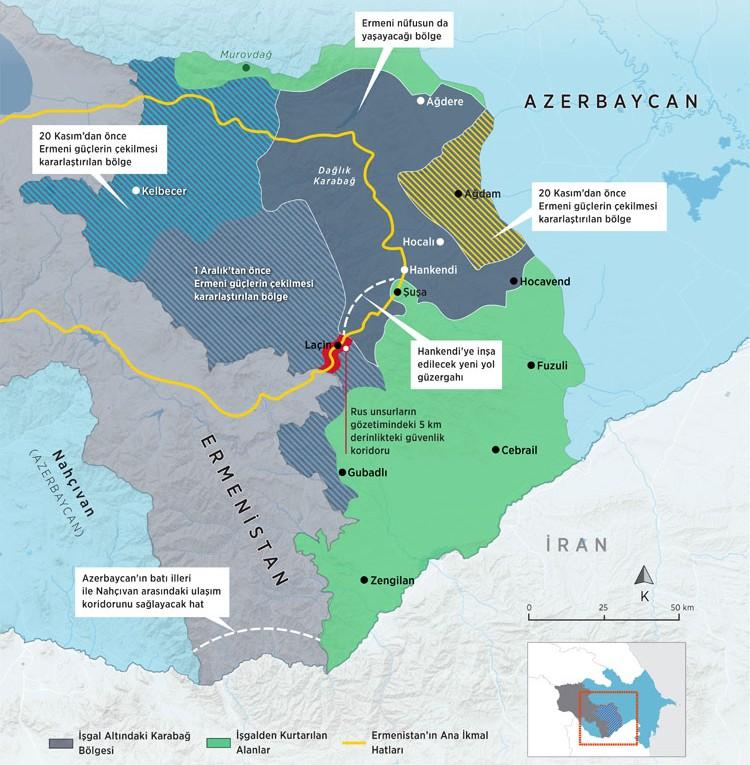
Political Map Resulting from the Second Nagorno-Karabakh War (AA)
The Second Nagorno-Karabakh War, which began on 27 September 2020, lasted 44 days and ended on 10 November 2020 with Azerbaijan’s victory. Analysis of Azerbaijan’s inventory reveals the use of two distinct types of unmanned aerial vehicles on the battlefield. One is the Israeli-made Kamikaze IAI Harop kamikaze drone. However, when reviewing general reports, Turkish-made Bayraktar TB2 unmanned aerial vehicles—used for target identification, surveillance, reconnaissance and battlefield role adaptation—are highlighted as the most significant. These systems were used to locate targets, while the none drones engaged them.
Reports indicate that the unmanned aerial vehicles supplied by Turkey to its ally Azerbaijan played a decisive role in the region and contributed significantly to Azerbaijan’s victory. During the war, Azerbaijani President Ilham Aliyev, in an interview with France 24, responded to the journalist’s question “How many Turkish drones do you have?” with a smile: “We have enough,” thereby bringing the issue to global attention. In the continuation of the interview, he stated that Turkish drones had created a decisive impact on the battlefield and had destroyed Armenian military equipment worth one billion dollars.【1】


Share from the Ministry of Defense of Türkiye on X Platform
It is evident that the Ministry publicly released images of convoys and military equipment destroyed by unmanned aerial vehicles during the war.【2】 According to an assessment published in Forbes, as of 27 September 2020, the start of the war, 200 tank and armored vehicle, 300 unarmored vehicles, radar systems and missile launch systems were destroyed. The destruction of such a large amount of equipment and materiel within 44 days of conflict underscores how unmanned aerial vehicles have fundamentally transformed traditional warfare structures.【3】
In his statement, Ilham Aliyev mentioned the destruction of Armenian equipment including approximately 250 tanks, 50 infantry fighting vehicles, four Russian-made S-300 missile defense systems, 198 trucks and 17 motorized artillery units.【4】Additionally, ORYX published a article estimating losses for both Azerbaijan and Armenia. Upon reviewing the article, it is evident that numerous destroyed pieces of equipment were eliminated by the Turkish-made Bayraktar TB2.【5】 According to records, 185 T-72 tanks; 90 armored fighting vehicles; 182 top; 73 multiple rocket launchers; 26 ground-to-air missile systems including the Tor system and five S-300s; 14 radar or signal jammers; one WATER-25 combat aircraft; four unmanned aerial vehicles; and 451 military vehicles were destroyed.【6】 In its report, “Sputnik Azerbaijan” summarized Armenia’s losses as follows.
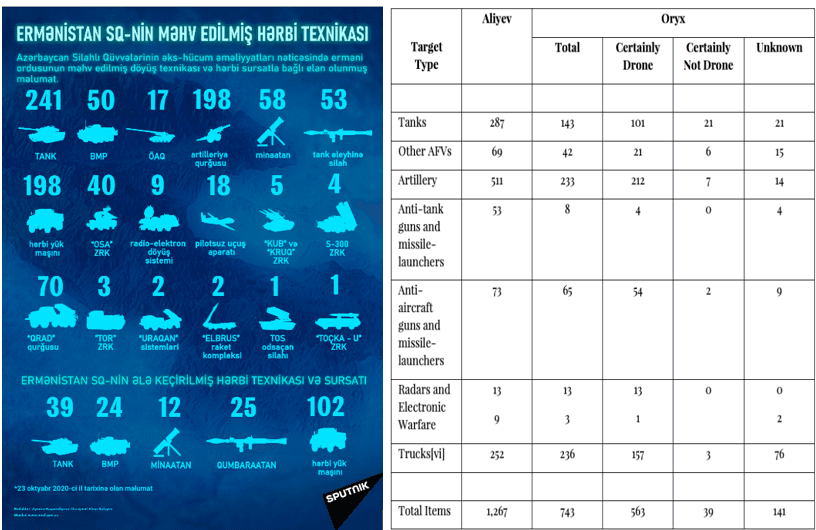
2. Vehicles Used in the Karabakh Operation
According to Zhirayr Amirkhanyan, Head of the Planning Unit of Armenia’s Defense Policy, Azerbaijan held a technological advantage over Armenia during the conflict, and especially the unmanned aerial vehicles deployed on the battlefield played a significant role in the initial losses suffered by Armenian equipment.【7】 【8】【9】 Against Armenia’s aging Russian-made equipment, Azerbaijan’s Turkish-made unmanned aerial vehicles and other IAI Harop kamikaze drones gradually eliminated the Armenian forces.【10】
Thanks to the Bayraktar TB2 drones acquired from Türkiye, Azerbaijan used them as active against tanks and ground-to-air missile systems on the opposing front. They destroyed numerous enemy positions and played a decisive lock in securing Azerbaijan’s advantage.【11】
In a report published by CSIS【12】 by Shaan Shaikh and Wes Rumbaugh, it is stated that unmanned aerial vehicles are changing the rules of the game. When examining the overall structure of warfare, the advancement of unmanned aerial vehicle technology raises the question of whether the era of tanks is nearing its end. The high performance demonstrated by unmanned aerial vehicles on the battlefield has shown that it was nearly impossible for Karabakh’s air defense systems to effectively counter them.【13】
During the war, the prominence of UAV and SUAV systems stemmed from their exceptional performance in attack missions. Among the equipment destroyed by these systems on the battlefield, the “Ballistic Missile Launch Vehicle” is particularly emphasized. This event has been recorded as the first documented instance of a UAV successfully destroying a ballistic missile.
When examining the Second Nagorno-Karabakh War, it is evident that Azerbaijan possessed more advanced military equipment than its adversaries. Sources indicate that the air defense systems in the Nagorno-Karabakh region were weaker than those in Armenia proper. Due to the lack of a robust radar infrastructure in the older systems, they were unable to detect unmanned aerial vehicles flying in the region.【14】
The presence of unmanned aerial vehicles on the battlefield has introduced a new military doctrine. Their cost-effectiveness and superior battlefield performance have demonstrated a paradigm shift in modern warfare perceptions.
Thanks to its outstanding performance in the Second Nagorno-Karabakh War, unmanned aerial vehicles have altered global perceptions of conventional warfare. The conflict has demonstrated how even a country with underdeveloped air defenses can gain a decisive advantage through unmanned aerial vehicle technology. The primary source of Azerbaijan’s victory in the Second Nagorno-Karabakh War lies in its unmanned aerial vehicle systems. Indeed, after the war, Gustav Gressel, a member of the Council on Foreign Relations, warned that any army lacking defenses against UAV systems would face a situation as dire as that suffered by the Armenian forces.【15】
Upon reviewing the articles, Turkish unmanned aerial vehicles are described as transformative on the battlefield. An article published by The Jamestown Foundation states: “Turkey’s UAV momentum is now being transferred to Azerbaijan and becoming a tactical game changer in Karabakh. From a defense economy perspective, Baykar’s Bayraktar TB2 is carving out a strong in the Azerbaijani arms market, previously dominated by Israel.”
Altınalan, H. 2. Karabağ Muharebesi Sürecinde Fransız Medyası. Uluslararası Beşeri Bilimler ve Eğitim Dergisi, 9(19), 49–68. Accessed September 25, 2025. https://doi.org/10.59304/ijhe.1273098
Anadolu Ajansı. "Azerbaycan ve Ermenistan Dağlık Karabağ'da anlaşmaya vardı." Accessed September 25, 2025. https://www.aa.com.tr/tr/azerbaycan-cephe-hatti/azerbaycan-ve-ermenistan-daglik-karabagda-anlasmaya-vardi/2037860
Anadolu Ajansı. "Karabağ Zaferinin Anatomisi." Accessed September 25, 2025. https://www.aa.com.tr/tr/analiz/karabag-zaferinin-anatomisi/2073631
Anadolu Ajansı. Azerbaycan ordusu, Dağlık Karabağ'daki savaşta 2 bin 783 şehit verdi. Accessed September 25, 2025. https://www.aa.com.tr/tr/azerbaycan-cephe-hatti/azerbaycan-ordusu-daglik-karabagdaki-savasta-2-bin-783-sehit-verdi/2064295
Gurbanov, Rauf. “Military Operations in the Second Karabakh War: Azerbaijan’s Strategy, Russia’s Stance and Türkiye’s Role.” *Russian Studies Journal* 2023. https://dergipark.org.tr/en/download/article-file/4592798
Günay, Halil. “Birinci ve İkinci Dağlık Karabağ Savaşı Karşılaştırmalı Analiz: Türkiye’nin Rolü ve Etkisi Üzerine Bir Değerlendirme.” *Uluslararası Akademi Dergisi* 3, no. 1 (2024) https://www.akademi.org.tr/uploads/akademi.org.tr/files/halil-gunay.pdf
Office of the Prosecutor General of the Republic of Azerbaijan. “44 Gün Sürən Vətən Müharibəsi (II Qarabağ Müharibəsi).” Accessed September 25, 2025. https://genprosecutor.gov.az/en/page/azerbaycan/i-ve-ii-qarabag-muharibesi/44-gun-suren-veten-muharibesi-ii-qarabag-muharibesi
Pirinççi, Ferhat. “Karabağ’da Son Perde.” SETA. Accessed September 25, 2025. https://www.setav.org/karabagda-son-perde
Vandenberghe, Mariam. *An International Law Analysis of the 2020 Nagorno-Karabakh War: Events during the 2020 War and Their Grey Zones.* Master's thesis, Ghent University, 2023. https://libstore.ugent.be/fulltxt/RUG01/003/116/836/RUG01-003116836_2023_0001_AC.pdf
İbrahimli, Aytaj. *The Analysis of the Second Karabakh War from the Perspective of Just War Theory.* Master's thesis, Khazar University, 2021. https://www.proquest.com/openview/367bf3567c95cb83235db1845878eadb/1?pq-origsite=gscholar&cbl=2026366&diss=y
[1]
Insight Turkey. (2020). The Role of Turkish Drones in Azerbaijan
[2]
Ministry of Defence of the Republic of Azerbaijan. (n.d.). News. Access address: https://mod.gov.az/en/news-791/?&pagen=390.
[3]
Forbes. (2020, October 7). What Does Open-Source Evidence Tell Us About the Nagorno-Karabakh War? Access URL: https://www.forbes.com/sites/forbestechcouncil/2020/10/07/what-open-source-evidence-tells-us-about-the-nagorno-karabakh-war/.
[4]
Trend News Agency. (2020). Azerbaijan President Ilham Aliyev: “We never deliberately targeted civilians”. Access address: https://www.trend.az/azerbaijan/politics/3320558.html.
[5]
Oryx Blog. (2020). The Fight for Nagorno-Karabakh. Access address: https://www.oryxspioenkop.com/2020/09/the-fight-for-nagorno-karabakh.html.
[6]
The Washington Post. (2020, November 11). Nagorno-Karabakh war reveals new role for drones in modern combat. Access date: https://www.washingtonpost.com/world/europe/nagorno-karabkah-drones-azerbaijan-aremenia/2020/11/11/441bcbd2-193d-11eb-8bda-814ca56e138b_story.html.
[7]
The Washington Post. (2020, November 11). Nagorno-Karabakh war reveals new role for drones in modern combat. Accessible at: https://www.washingtonpost.com/world/europe/nagorno-karabkah-drones-azerbaijan-aremenia/2020/11/11/441bcbd2-193d-11eb-8bda-814ca56e138b_story.html.
[8]
Military Strategy Magazine. (n.d.). Drones in the Nagorno-Karabakh War: Analyzing the Data. Access address: https://www.militarystrategymagazine.com/article/drones-in-the-nagorno-karabakh-war-analyzing-the-data/#:~:text=These%20drones%20were%20made%20of,up%20to%208%20kilometers%20away.
[9]
SETAV. (n.d.). Karabağ Zaferinin Anatomisi. Access address: https://www.setav.org/avrupa-arastirmalari/karabag-zaferinin-anatomisi.
[10]
Insight Turkey. (2020). The Role of Turkish Drones in Azerbaijan
[11]
DergiPark. (n.d.). The Role of Unmanned Aerial Vehicles in the Battlefield and Türkiye’s Unmanned Aerial Vehicles Strategy. Access address: https://dergipark.org.tr/en/download/article-file/3660984#:~:text=Bu%20insans%C4%B1z%20hava%20ara%C3%A7lar%C4%B1%2C%20sava%C5%9F,%C3%BCst%C3%BCnl%C3%BC%C4%9F%C3%BC%20elinde%20bulundurmas%C4%B1nda%20katk%C4%B1%20sa%C4%9Flam%C4%B1%C5%9Ft%C4%B1r.
[12]
Center for Strategic and International Studies (CSIS). (2020). Air and Missile War in Nagorno-Karabakh: Lessons for Future Strike and Defense. Access address: https://www.csis.org/analysis/air-and-missile-war-nagorno-karabakh-lessons-future-strike-and-defense.
[13]
The Washington Post. (2020, November 11). Nagorno-Karabakh war reveals new role for drones in modern combat. Access date: https://www.washingtonpost.com/world/europe/nagorno-karabkah-drones-azerbaijan-aremenia/2020/11/11/441bcbd2-193d-11eb-8bda-814ca56e138b_story.html
[14]
BBC Turkish. (2020, October 5). Azerbaijan:
[15]
European Council on Foreign Relations (ECFR). (2020, November 23). Military Lessons from Nagorno-Karabakh: Reason for Europe to Worry. Access address: https://ecfr.eu/article/military-lessons-from-nagorno-karabakh-reason-for-europe-to-worry/.

Founding of the Republic of Azerbaijan | 1991 | ||||||||
|---|---|---|---|---|---|---|---|---|---|
Country Area | 86,600 km² | ||||||||
Country Population | 10 Million | ||||||||
Gross Domestic Product Per Capita / National Income Per Capita | $72.6 Billion / $5,734 | ||||||||
Parties | Republic of Azerbaijan, Republic of Armenia | ||||||||
History | 27 September 2020 – 10 November 2020 | ||||||||
No Discussion Added Yet
Start discussion for "2. The Role of Unmanned Aerial Vehicles in the Mountainous Karabakh War" article
Political Background
Causes of the War
Course of the War
Role of Unmanned Aerial Vehicles
Analysis of the War