

 Recently Added:
This article was automatically translated from the original Turkish version.
Typhoon Kalmaegi (2025) was a severe tropical storm that formed in the Pacific Ocean in November and affected the Philippines and Vietnam. Known in the Philippines as "Tino," the typhoon caused 232 deaths, left 102 people missing, and injured 523 others. Approximately 3.3 million people were affected, with 134,949 homes damaged and 20,510 homes destroyed. On 6 November 2025, the typhoon made landfall over the South China Sea in Vietnam, where it resulted in 5 deaths, 7 injuries, and left 1.28 million households without electricity. Across Vietnam, more than 2.3 million people were affected by the storm.
Cars swept along streets in the Philippines after Typhoon Kalmaegi, 5 November 2025 – (Associated Press)
On 3 November 2025, as Typhoon Kalmaegi approached the Philippines, meteorological agencies issued warnings to tens of thousands of residents in coastal towns and islands along the eastern coast. It was reported that the typhoon would generate waves up to 10 feet (approximately 3 meters) high and winds blowing at 150 km/h.
Areas at highest risk included the towns of Guiuan and Salcedo (Eastern Samar), and Mercedes (Camarines Norte). Over 70,000 people were evacuated and housed in sturdy structures such as schools and public buildings. Fishing vessels were banned from setting sail, ferry and passenger transport services were temporarily suspended, and more than 3,500 passengers and drivers were stranded in over 100 ports. The National Disaster Risk Reduction and Management Council (NDRRMC) announced that 387,000 people had been relocated to safe areas and that 186 domestic flights had been canceled.

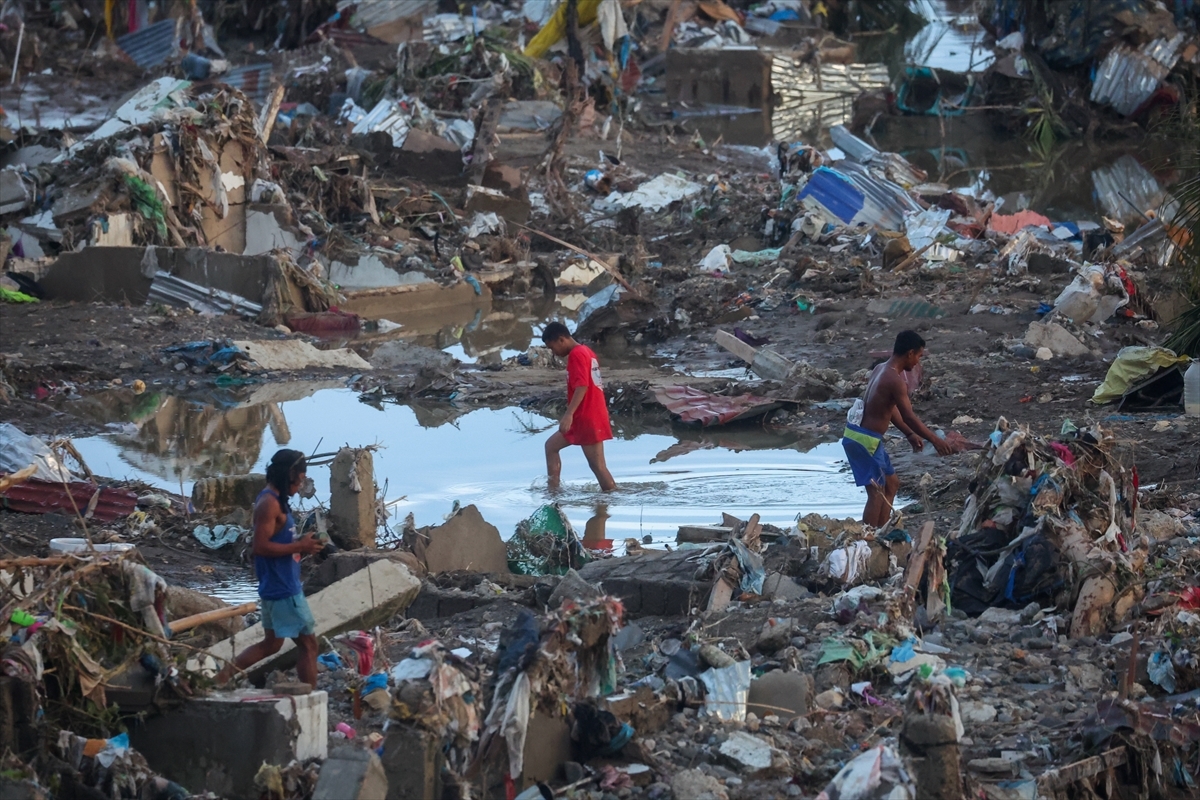
Effects of Typhoon Kalmaegi in the Philippines, 6 November 2025 – (Anadolu Ajansı)
Early on the morning of 4 November 2025, Typhoon Kalmaegi made two landfalls in the Visayas region: first in Southern Leyte, then in Cebu. During this time, the typhoon tore off roofs, downed power poles, uprooted trees, and triggered river floods. Roads across Central Visayas were covered in mud, and some towns were completely submerged. In the cities of Talisay and Mandaue, hundreds of homes were destroyed by flooding, and the Mananga River overflowed, burying settlements under sludge. In Cebu City and surrounding areas, vehicles were swept away by floodwaters, and streets were filled with debris and rubble. In the town of Tungkil, rainfall accumulation within 24 hours exceeded the monthly average. Roads in affected areas were closed due to flooding and landslides, and power outages occurred in several rural municipalities.

Effects of Typhoon Kalmaegi in the Philippines, 5 November 2025 – (Anadolu Ajansı)
According to official Philippine data, in the initial phase of the typhoon, 114 people died, 127 were reported missing, and 82 were injured. The majority of fatalities resulted from drowning incidents in Cebu and surrounding areas. In the province of Negros Occidental, 62 people died, and in Cebu, 71 people lost their lives. By 7 November 2025, the death toll had risen to 188 and the number of missing persons to 135. As of 9 November, the NDRRMC reported 224 deaths and 109 missing persons. The number of injured was recorded at 526. By 11 November, the number of fatalities was updated to 232, the number of missing persons to 112, and the number of injured to 523.
A total of more than 3 million people were directly affected by the typhoon, and 946,660 families suffered losses. Approximately 560,000 people were evacuated, with 450,000 placed in emergency shelters.
Typhoon Kalmaegi caused widespread destruction, particularly in the regions of Cebu, Negros, Agusan del Sur, Capiz, and Leyte. According to national data, 74,781 structures were damaged, of which 264 were completely destroyed. 9,500 homes were partially or fully destroyed, and infrastructure including bridges, roads, and drainage systems sustained damage. Power line failures left 1.6 million people without electricity. 11 boats sank, and several port and coastal towns became inaccessible. Additionally, during rescue operations, a Philippine Air Force helicopter crashed in the Agusan del Sur region, killing 6 soldiers. New data from 11 November confirmed that 134,949 homes were damaged, 20,510 homes were destroyed, and agricultural and infrastructure facilities suffered significant damage.

Effects of Typhoon Kalmaegi in the Philippines, 5 November 2025 – (Anadolu Ajansı)
On the morning of 6 November 2025, President Ferdinand Marcos Jr. declared a “state of calamity” nationwide. Marcos stated that this decision would enable the rapid deployment of relief funds and prevent price hikes of essential goods.
Effects of Typhoon Kalmaegi in the Philippines, 5 November 2025 – (Associated Press)
The Philippine government deployed military units to assist in rescue and relief operations. President Marcos visited the affected areas of Cebu and Negros, distributing food, health, and hygiene kits to disaster victims and visiting aid camps accompanied by medical teams. Authorities identified debris clearance and locating missing persons as top priorities. Civil Defense official Raffy Alejandro stated that the greatest challenge was clearing debris and emphasized the need to reopen roads to reach the missing and advance relief efforts.

Effects of Typhoon Kalmaegi in the Philippines, 5 November 2025 – (Anadolu Ajansı)
After departing the Philippines, Typhoon Kalmaegi moved across the South China Sea, where it re-intensified. According to measurements by the Vietnam National Center for Hydro-Meteorological Forecasting (NCHMF) on the morning of 5 November, the typhoon’s center was located 390 kilometers off Quy Nhon, moving at a speed of 166 km/h, with gusts reaching up to 220 km/h. The same report indicated that the typhoon was advancing northwestward at 30 km/h and heading toward the provinces of Quang Ngai, Gia Lai, and Dak Lak.
On the morning of 6 November 2025, the National Center for Hydro-Meteorological Forecasting announced that the typhoon’s center was located 310 kilometers east-southeast of Quy Nhon with winds blowing at 150–166 km/h, classified as Level 14 (Category 4). Later that evening, it was forecast that the typhoon would make landfall along the Quang Ngai–Gia Lai line, with wind speeds expected to drop to 133 km/h, though its impact would be felt over a wide area.

Damage caused by Typhoon Kalmaegi in Vietnam, 9 November 2025 – (Anadolu Agency)
The Vietnamese government implemented extensive measures in response to the approaching typhoon. State agencies deployed 268,000 military personnel and rescue staff to coastal areas and evacuated 9,000 people from high-risk zones. The National Meteorological Center warned that regions from Quang Tri to Dak Lak could experience waves up to 5–10 meters high and a sea level rise of 0.4–0.8 meters.
Medium and highland areas, particularly in the provinces of Quang Ngai, Gia Lai, and Dak Lak, were expected to face winds of 8 to 14 on the Beaufort scale, with rainfall amounts reaching up to 600 mm in some locations. Deputy Prime Minister Tran Hong Ha described the typhoon as “urgent and dangerous” and instructed local authorities to implement evacuation plans immediately.
Large-scale measures were also taken in air transport. Vietnam Airlines canceled or rescheduled over 50 flights on 6–7 November. Flights on the routes Ho Chi Minh City–Phu Cat, Hanoi–Phu Cat, Tan Son Nhat–Chu Lai, Tan Son Nhat–Pleiku, Hanoi–Buon Ma Thuot, and Hue were moved to earlier times or delayed. These adjustments were made due to forecasts suggesting the typhoon would make landfall approximately four hours earlier than expected. Additionally, VASCO Airlines canceled all flights on the Tan Son Nhat–Lien Khuong route.

Damage caused by Typhoon Kalmaegi in Vietnam, 8 November 2025 – (Anadolu Agency)
Typhoon Kalmaegi made landfall along the Quang Ngai–Gia Lai line on the evening of 6 November 2025. Upon landfall, the typhoon destroyed the roofs of 3,000 homes, leveled 57 houses, sank 11 vessels, and toppled power poles. According to data from the Vietnam News Agency, storms and floods triggered by the typhoon resulted in five fatalities and seven injuries. 1.28 million households experienced power outages, with some communities enduring full-day blackouts. Railway lines in Quang Ngai province were damaged, temporarily disrupting traffic and communication infrastructure. Coastal cities experienced violent winds, massive waves, and mudslides.

Power outages in Vietnam caused by Typhoon Kalmaegi, 9 November 2025 – (Anadolu Agency)
The typhoon threatened coffee-producing regions in Vietnam’s Central Highlands, though it was reported that trees in Gia Lai and Dak Lak suffered minimal damage. However, shrimp farms sustained major losses. Nguyen Dinh Sa, a shrimp producer in Gia Lai, stated that the typhoon destroyed approximately 6 tons of shrimp stock, submerged his two-story storage facility, and caused losses of about 1 billion dong (approximately USD 38,000).
The typhoon also caused 244 homes to be completely destroyed, 17,562 homes to lose their roofs, 21 vessels to sink, and 44 vessels to be damaged. Approximately 2.3 million people across Vietnam were affected by the typhoon, with 398,000 people relocated to evacuation centers.
The Vietnamese government mobilized military and civilian rescue units in a coordinated manner. 268,000 soldiers, coast guard personnel, firefighting teams, and Red Cross volunteers were deployed to the central regions of the country. State television broadcast a statement by Tran Hong Ha that “alarms have been issued at all levels,” urging residents to evacuate coastal areas. By the morning of 7 November 2025, the typhoon had reached the border with Laos and weakened into a tropical depression. Later that evening, it moved toward northeastern Thailand and transformed into a rain system, prompting warnings of heavy rainfall and flood risks across the region.

Typhoon Kalmaegi formed in the Pacific Ocean in November 2025 and affected the Philippines and Vietnam. Known in the Philippines as "Tino," the typhoon caused 232 deaths, 112 missing persons, and 523 injuries. Approximately 1.4 million people were evacuated, 134,949 homes were damaged, and 20,510 homes were destroyed. On 6 November 2025, the typhoon made landfall in Vietnam over the South China Sea, resulting in 5 fatalities, 7 injuries, and 1.28 million households left without electricity.
No Discussion Added Yet
Start discussion for "2025 Kalmaegi Typhoon" article
November 6, 2025
Impacts in the Philippines
November 6, 2025
Deaths, Missing Persons, and Injuries
November 6, 2025
Impacts in Vietnam