

This article was automatically translated from the original Turkish version.
+1 More
The 2025 Nobel Prize in Chemistry has been awarded to Susumu Kitagawa from Japan, Richard Robson from Australia, and Omar M. Yaghi from the United States for their work in the development of metal–organic frameworks (MOFs).
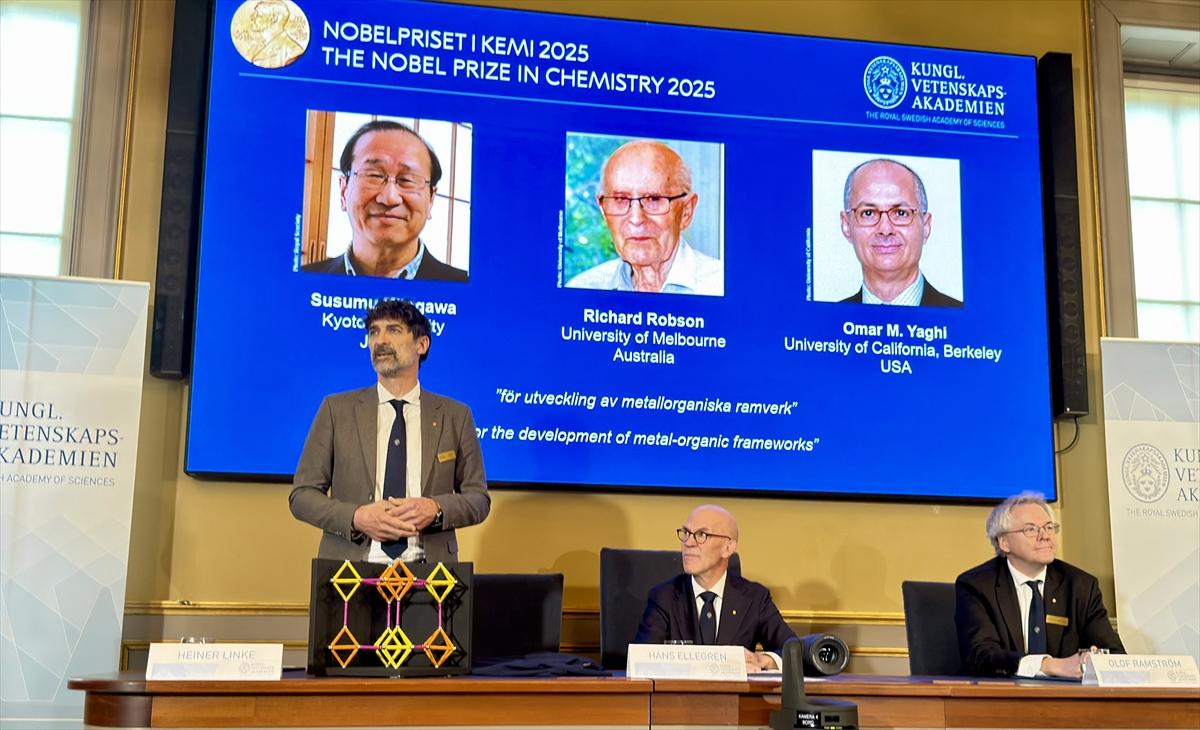
Announcement of the 2025 Nobel Prize in Chemistry laureates at the press conference held at the Royal Swedish Academy of Sciences, 8 October 2025 (Anadolu Agency)
The award was announced on 8 October 2025 in Stockholm at a press conference organized by the Royal Swedish Academy of Sciences. According to the Academy’s statement, the prize recognizes the development of a new molecular architecture that enables the creation of porous structures described as “chemical rooms for molecules.” The monetary value of the prize is set at 11 million Swedish kronor and has been equally shared among the three scientists.
These structures are materials in which metal ions act as cornerstones connected by organic linker molecules to form crystals with large internal voids. The porous crystals allow gases and chemicals to pass through these voids. Such structures can be applied in various fields including water harvesting from desert air, carbon dioxide capture, storage of toxic gases, and catalysis of chemical reactions.
The development of metal–organic frameworks began in 1989 when Richard Robson attempted to exploit the properties of atoms in novel ways. Robson combined positively charged copper ions with a four-armed molecule to produce a chemically ordered crystalline structure. However, this crystal was unstable and collapsed easily.
Overcoming this problem became possible through independent research conducted by Susumu Kitagawa and Omar Yaghi between 1992 and 2003. Kitagawa demonstrated that these structures could be made flexible and that gases could pass through them. Yaghi produced a more stable MOF and showed that its properties could be rationally tailored using design principles.
Since these discoveries, chemists have developed tens of thousands of different MOF variants. Some of these materials hold potential to address major environmental and industrial challenges facing humanity. Applications include the separation of persistent chemicals (PFAS) from water sources, degradation of pharmaceutical residues, and carbon capture technologies.
Metal–organic frameworks are porous structures described as “as small as a handbag but with an extremely large internal volume.” Nobel Committee member Olof Ramström has compared these structures to Hermione’s bag in the Harry Potter novels, because even a small amount of this material contains an enormous surface area. A MOF crystal the size of a sugar cube can possess a surface area equivalent to that of a football field.
These materials are applied in carbon capture technologies, particularly in industries with high carbon emissions such as cement production. They are also used to extract water from humid air in arid regions and to store toxic gases. At the Nobel press conference, Kitagawa stated his goal is to “capture air and separate it to convert CO₂, oxygen or water into useful materials using renewable energy.”
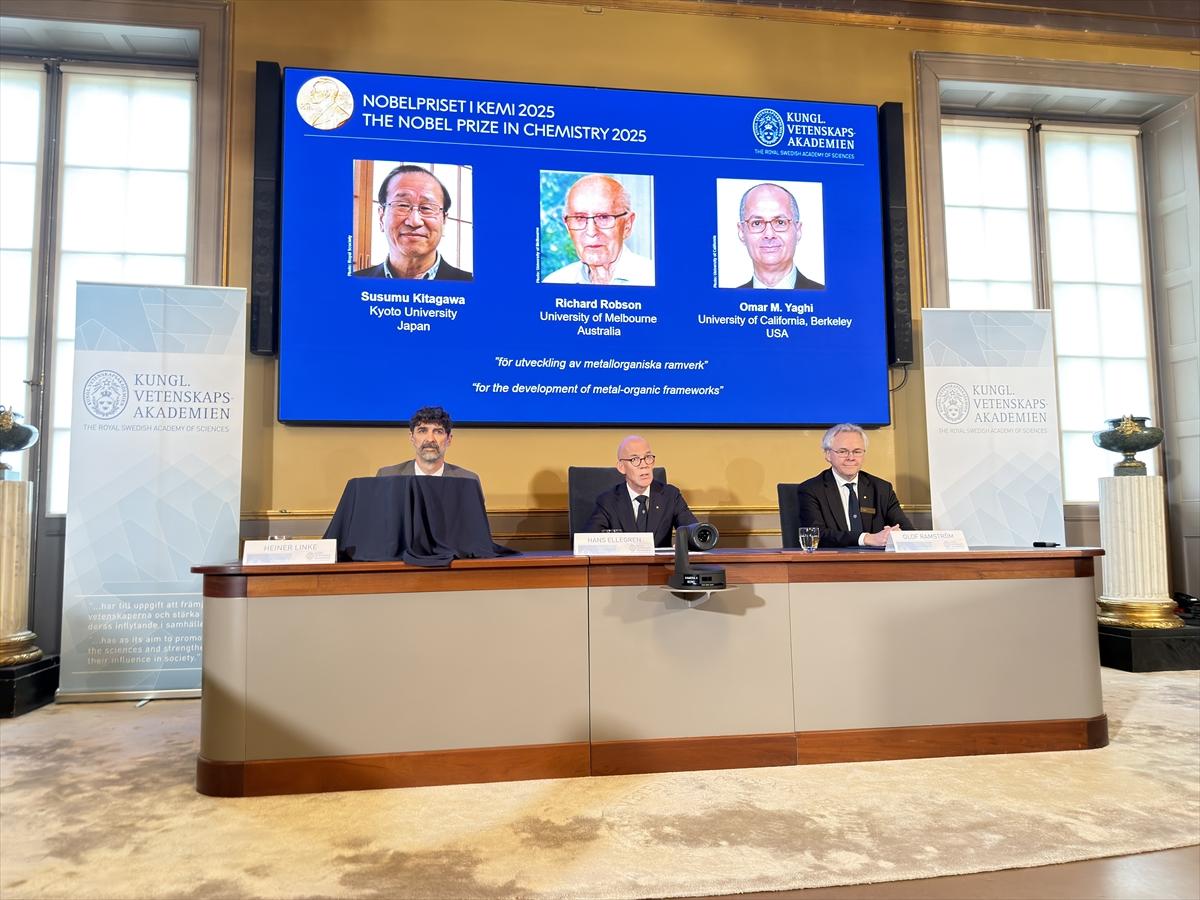
Announcement of the 2025 Nobel Prize in Chemistry laureates at the press conference held at the Royal Swedish Academy of Sciences, 8 October 2025 (Anadolu Agency)
Susumu Kitagawa was born in 1951 in Kyoto, Japan. He received his PhD in hydrocarbon chemistry from Kyoto University in 1979. In 1992 he became a professor of inorganic chemistry at Tokyo Metropolitan University and in 1998 was appointed professor of synthetic and biological chemistry at Kyoto University. In 2007 he became one of the founding members of the Institute for Integrated Cell–Material Sciences and served as its deputy director.
Richard Robson was born in 1937 in Glusburn, England. He received his chemistry education at the University of Oxford and conducted postdoctoral research at the California Institute of Technology and Stanford University. Since 1966 he has been a professor of chemistry at the University of Melbourne in Australia.
Omar M. Yaghi was born in 1965 in Amman, Jordan, to a Palestinian refugee family. He completed his PhD in chemistry at the University of Illinois Urbana–Champaign and conducted postdoctoral research at Harvard University. He is currently a professor at the University of California, Berkeley. He is also the founding director of the Berkeley Global Science Institute, which aims to establish research centers in developing countries.
Al Jazeera. “Chemistry Nobel Prize awarded to trio in field of metal organic frameworks.” Al Jazeera. Accessed October 9, 2025. https://www.aljazeera.com/news/2025/10/8/nobel-prize-in-chemistry-awarded.
Anadolu Ajansı. “2025 Nobel Kimya Ödülünün Sahipleri Belli Oldu.” Accessed October 9, 2025. https://www.aa.com.tr/tr/bilim-teknoloji/2025-nobel-kimya-odulunun-sahipleri-belli-oldu/3711169#.
Nobel Prize. "Nobel Prize in Chemistry 2025." The Nobel Prize Official Website. Accessed October 9, 2025. https://www.nobelprize.org/prizes/chemistry/2025/summary/.
Nobel Prize. “Press Release: The Nobel Prize in Chemistry 2025.” *The Nobel Prize Official Website*. Accessed October 9, 2025. https://www.nobelprize.org/prizes/chemistry/2025/press-release/.
Reuters. “Trio win Nobel chemistry prize for work on 'Hermione's handbag' materials.” Accessed October 9, 2025. https://www.reuters.com/science/kitagawa-robson-yaghi-win-2025-nobel-prize-chemistry-2025-10-08/.

No Discussion Added Yet
Start discussion for "2025 Nobel Prize in Chemistry" article
Scientific Contributions and Historical Development
Properties and Applications of Metal–Organic Frameworks
Biographies of the Laureates