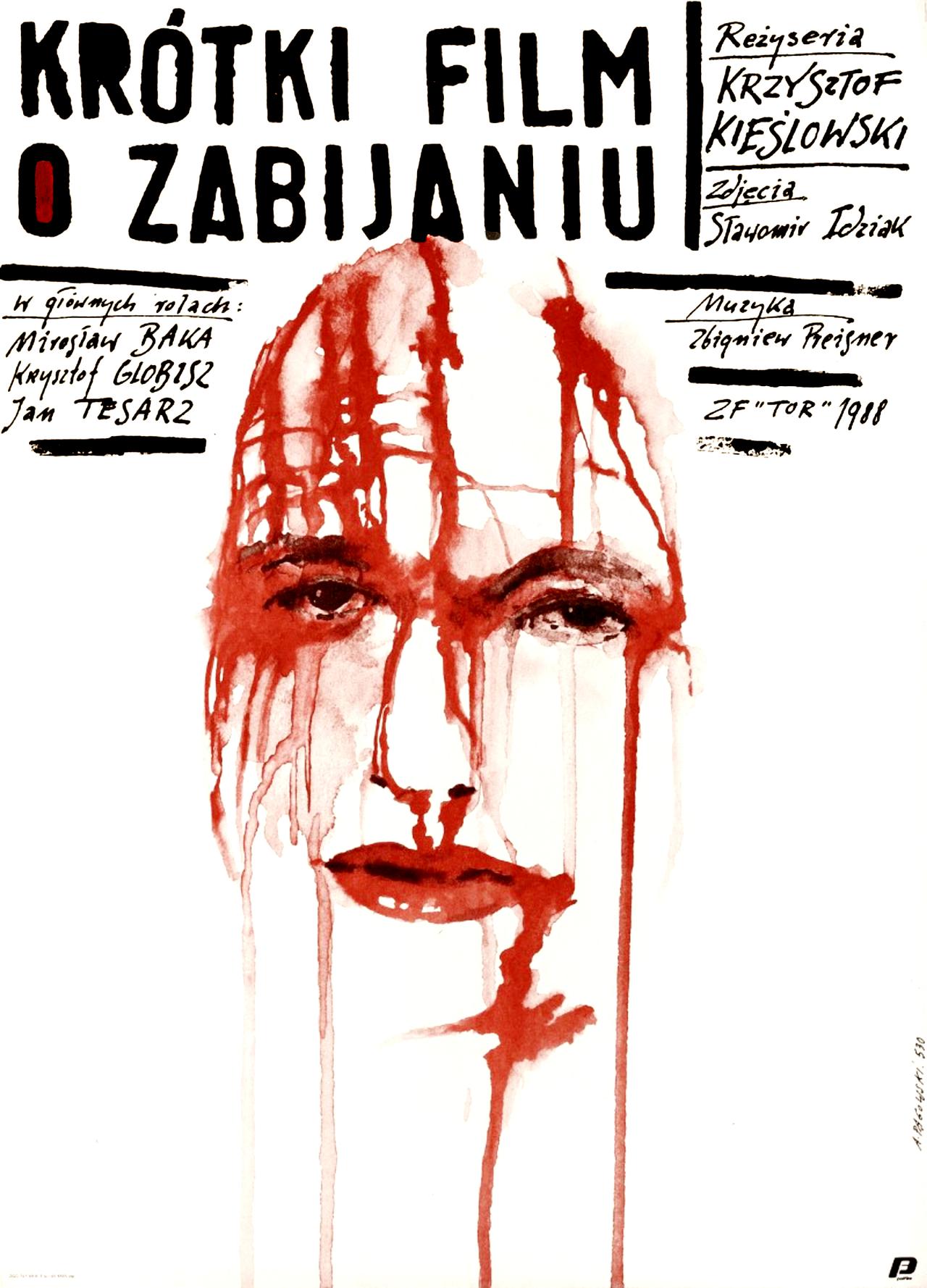


This article was automatically translated from the original Turkish version.
Original Name(s) | A Short Film About Killing | ||||||||
|---|---|---|---|---|---|---|---|---|---|
English Name | A Short Film About Killing | ||||||||
Type(s) | Drama Crime | ||||||||
Country / Year | Poland / 1988 | ||||||||
Director(s) | Krzysztof Kieślowski | ||||||||
Screenplay(s) | Krzysztof Kieślowski Krzysztof Piesiewicz | ||||||||
Main Cast | Jacek Łazar – Mirosław Baka, Piotr Balicki – Krzysztof Globisz, Waldemar Rekowski – Jan Tesarz, Commission Chairman – Zbigniew Zapasiewicz, Boy – Artur Barciś, Dorota – Krystyna Janda | ||||||||
Music(s) | Zbigniew Preisner | ||||||||
Cinematography | Sławomir Idziak | ||||||||
Duration | 84 min | ||||||||
Notable Achievements | 1988 Cannes Film Festival Jury Prize and FIPRESCI Prize, significant festival selections in Europe and North America during 1988–1989, renewed visibility in the 2020s in classics/special programs | ||||||||
A Short Film About Killing is a feature-length film that examines the relationship between crime and punishment along the axis of individual experience and state punitive power, capturing the late atmosphere of modern Polish society. The narrative explores the symmetries and disparities between the act of murder and its judicial execution. Rather than relying on high tempo, the film foregrounds moments of decision, silence, and delayed reactions. Thus, the representation of violence is grounded not in direct visual rhetoric but in the pressure exerted by gaze, duration, and space. The film’s genesis lies in the director’s expansion of a narrative framework originally conceived for a broader television series into cinematic language. This expansion aims to consolidate and organize emotional and intellectual intensity within the same textual framework.
More than arriving at a persuasive moral conclusion, the film interrogates how systematic violence and individual crime can be represented. The fissures opened by the two acts of “killing”—individual murder and state-executed execution—become visible through the emotional equilibrium of the witnessing characters. The camera’s scale and movement constraints carry tension without amplifying it; this choice ensures the viewer remains “within” the scene. Music and ambient sound are used sparingly to create dramatic emphasis without obscuring the ethical debate. Time follows a linear flow, yet meaning is generated not only by the sequence of events but also by the resonances between scenes. Through all these choices, the film offers a model for how the boundary between action and punishment can be constructed in cinema.
The story begins with a young man, aimlessly wandering, murdering a taxi driver, followed by his arrest and trial. A young lawyer who takes on the defense comes to understand the workings of the justice system and the reality of execution through direct personal experience. Rather than drawing a clear line between the crime’s before and after, the narrative intensifies moments of decision to reveal the psychological and ethical dimensions of the act. The dissonance between characters’ actions and words renders visible the fragility of social fabric. The trial process layers the “legal right” against the “moral right.” Thus, the narrative achieves a structure that does not produce a single thesis but opens space for the viewer’s own evaluation.
The structure emerged from expanding a television episode into a feature-length film; the additional time introduced on top of the original version aims to heighten the weight of the courtroom and execution sequences. In this way, two distinct acts of “killing”—individual murder and state-sanctioned execution—are measured on the same scale. The narrative prioritizes internal scene continuity over fragmenting moments of action. The camera balances close-ups of faces and hands with the emptiness of spaces to externalize the characters’ inner confinement. Dialogue does not explain but points to the voids left by what is shown. The ending does not conclude with a definitive verdict; the ethical debate remains open-ended.
In the visual design, the direction of light and color tones determine emotional weight; especially in outdoor settings, cold and dirty hues intensify the scenes’ bleakness. Camera usage is restrained: fixed frames and short pans are preferred. This choice positions the viewer as an external witness to the events. Music is used sparingly; ambient sounds and silence are intended to carry dramatic impact. The editing rhythm emphasizes the accumulation of tension within scenes rather than rapid cuts.
The cinematography team plays a decisive role; the consistency of the visual language continuously reinforces the resonance between the bleakness of spaces and the characters’ inner worlds. Art direction and costume preserve the harsh texture of everyday life, illustrating how the events seep into ordinary existence. The sound design creates a distinct pressure through mechanical hums, urban noise, and the echoes of institutional spaces. All these elements construct crime not merely as an “event” but as an atmosphere.

Jacek Łazar as Mirosław Baka – MUBI
Mirosław Baka (Jacek Łazar) embodies the alienation born of aimless drifting and the numb logic that leads to violent action. Baka’s nearly expressionless gaze conveys the sense of emptiness that weakens the character’s connection to the world. Krzysztof Globisz (Piotr Balicki) interprets the tension between idealism and the institutional language of law; the cracks in his defense strategy appear in small hesitations. Jan Tesarz (Waldemar Rekowski) highlights vulnerability within ordinariness and underscores the randomness of crime and the humanity of the victim. Zbigniew Zapasiewicz (Chairman of the Commission) represents the institutional face of the narrative through the formality and distance of judicial language. Brief appearances by Artur Barciś (Rapaz) and Krystyna Janda (Dorota) complete the social texture surrounding the main plot. Ensemble acting remains understated throughout, preserving the ethical distance of the scenes.
Key contributions from the supporting team include Zbigniew Preisner (music) and Sławomir Idziak (cinematography). Music does not emphasize emotion but infiltrates the scene, working in tandem with silence. The visual language unites the dirty textures of spaces with the tension on faces within the same frame. Ryszard Chutkowski (producer) provides the administrative backbone that ensures the continuity of the production.
Critical readings focus on the film’s juxtaposition of two forms of violence—individual murder and state execution—on the same scale. This parallelism produces a structure that resists reduction to a single judgment but leaves the ethical weight of the scenes to the viewer. The representation of violence is built not through visual shock but through the pressure of time and space. The camera records action without aestheticizing it; the rhythm seeks to amplify the unease generated by remaining within the scene. Close-ups reveal the tension accumulating on faces and hands.
Academic commentary notes that the film’s expansion from a television short to a feature-length format significantly deepens the intellectual intensity of the courtroom-execution axis. The two faces of the act of “killing” are organized within the narrative like a mirror system. The balance between music and silence aims to convey the raw impact of the scene without exaggerating emotional direction. The dirty, muted tones of the visual texture enable a metaphorical reading of social decay. Thus, the film positions itself at the center of the debate on representation and responsibility, both formally and thematically. Its reappearance in contemporary programs suggests the continued relevance of this debate.
1988 – Cannes Film Festival
1988 – Munich Film Festival
1988 – Locarno Film Festival
1988 – Toronto Film Festival
1989 – Rotterdam Film Festival
1989 – São Paulo Film Festival
1989 – New York Film Festival
2022 – Guadalajara Film Festival
2023 – Ghent Film Festival
Beyazperde. "A Short Film About Killing." Beyazperde. Accessed October 11, 2025. https://www.beyazperde.com/filmler/film-119644/.
Beyazperde. “A Short Film About Killing – Oyuncular.” Beyazperde. Accessed October 11, 2025. https://www.beyazperde.com/filmler/film-119644/oyuncular/.
IMDb. "A Short Film About Killing." IMDb. Accessed October 11, 2025. https://www.imdb.com/title/tt0095468/.
IMDb. “A Short Film About Killing – Awards.” IMDb. Accessed October 11, 2025. https://www.imdb.com/title/tt0095468/awards/?ref_=tt_ov_at_op_awd.
IMDb. “A Short Film About Killing – Filming Locations.” Accessed October 11, 2025. https://www.imdb.com/title/tt0095468/locations/?ref_=tt_ov_at_dt_flmg.
IMDb. “A Short Film About Killing – Full Cast & Crew.” IMDb. Accessed October 11, 2025. https://www.imdb.com/title/tt0095468/fullcredits/?ref_=tt_ov_at_pop_cst.
IMDb. “A Short Film About Killing – Media Index.” IMDb. Accessed October 11, 2025. https://www.imdb.com/title/tt0095468/mediaindex/?ref_=tt_ov_at_pop_ph.
IMDb. “A Short Film About Killing – Plot Summary.” IMDb. Accessed October 11, 2025. https://www.imdb.com/title/tt0095468/plotsummary/?ref_=tt_ov_at_pl_pl.
IMDb. “A Short Film About Killing – Release Info.” IMDb. Accessed October 11, 2025. https://www.imdb.com/title/tt0095468/releaseinfo/?ref_=tt_ov_at_dt_rdat.
MUBI. "A Short Film About Killing." MUBI. Accessed October 11, 2025. https://mubi.com/tr/tr/films/a-short-film-about-killing.
MUBI. “A Short Film About Killing – Awards.” MUBI. Accessed October 11, 2025. https://mubi.com/tr/films/a-short-film-about-killing/awards.
Mocan, Ahmet Can. Öldürme Üzerine Kısa Bir Film Üzerine Bir İnceleme. *Academia.* Accessed October 11, 2025. https://www.academia.edu/10088310/%C3%96LD%C3%9CRME_%C3%9CZER%C4%B0NE_KISA_B%C4%B0R_F%C4%B0LM_%C3%9CZER%C4%B0NE_B%C4%B0R_%C4%B0NCELEME.

Original Name(s) | A Short Film About Killing | ||||||||
|---|---|---|---|---|---|---|---|---|---|
English Name | A Short Film About Killing | ||||||||
Type(s) | Drama Crime | ||||||||
Country / Year | Poland / 1988 | ||||||||
Director(s) | Krzysztof Kieślowski | ||||||||
Screenplay(s) | Krzysztof Kieślowski Krzysztof Piesiewicz | ||||||||
Main Cast | Jacek Łazar – Mirosław Baka, Piotr Balicki – Krzysztof Globisz, Waldemar Rekowski – Jan Tesarz, Commission Chairman – Zbigniew Zapasiewicz, Boy – Artur Barciś, Dorota – Krystyna Janda | ||||||||
Music(s) | Zbigniew Preisner | ||||||||
Cinematography | Sławomir Idziak | ||||||||
Duration | 84 min | ||||||||
Notable Achievements | 1988 Cannes Film Festival Jury Prize and FIPRESCI Prize, significant festival selections in Europe and North America during 1988–1989, renewed visibility in the 2020s in classics/special programs | ||||||||
No Discussion Added Yet
Start discussion for "A Short Film on Killing (Film)" article
Subject and Narrative Structure
Production and Technical Features
Actors and Characters
Critical Evaluation
Awards and Festivals