


This article was automatically translated from the original Turkish version.

Eyüpsultan, one of Istanbul’s historic neighborhoods, is renowned for its mosques, tombs, and complexes that have reflected the spiritual atmosphere and essence of the Ottoman Empire for centuries. Among these structures, the Zal Mahmut Paşa Mosque stands out not merely as a place of worship but as a memory space where architectural, historical, and social layers intertwine. At times it is remembered through a dramatic narrative, at others as one of the experimental examples of Mimar Sinan’s style.
Zal Mahmut Paşa, son-in-law of Sultan Süleyman the Magnificent and a prominent grand vizier, was a powerful figure within the Ottoman court. His name is also linked to a tragic event: the strangulation of Şehzade Mustafa. As a result, the epithet “Zal” has, throughout history, symbolized both political loyalty and severity.
In the 16th century, the paşa commissioned a complex bearing his name in Eyüp. The complex comprises a mosque, a medrese, a public kitchen, and a tomb. The tomb houses the graves of Zal Mahmut Paşa and his wife Şah Sultan. This complex, which holds an important place in Istanbul’s religious and cultural life, is one of the tangible examples of the Ottoman “hayrat culture.”
The Zal Mahmut Paşa Mosque is counted among the works of Mimar Sinan, the chief architect of Ottoman classical architecture. The mosque, measuring 24.90 by 26.30 meters, draws attention with its nearly square plan. Its dome, rising over 21 meters, leaves a distinct mark on the Eyüpsultan skyline.
The mosque’s most distinctive feature lies in its dome system. Unlike in Sinan’s other mosques, where the load is transferred to the walls via half-domes, here the dome is supported by four large arches and the piers beneath them. This choice imparts a different spatial perception to the mosque.
The alternating brick and stone arches in the final prayer area reflect the aesthetic sensibilities of the period. The alternating use of stone and brick on the facades is also a typical example of 16th-century Ottoman construction techniques.
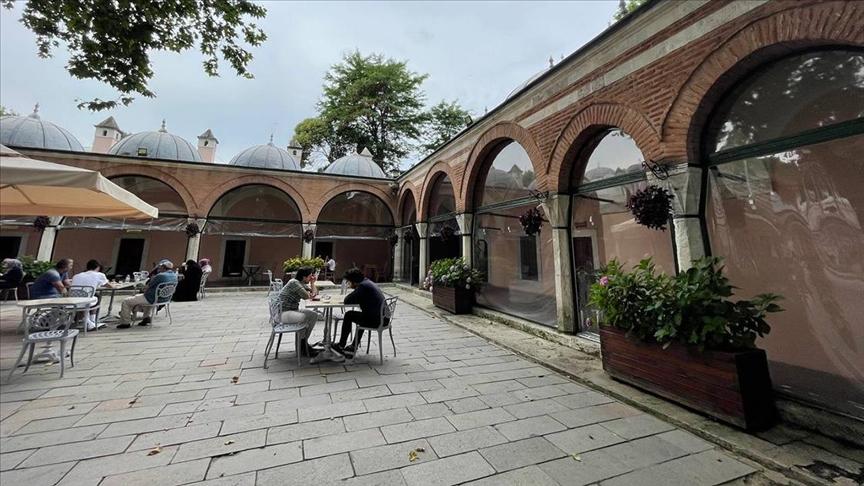
Zal Mahmut Paşa Mosque (AA)
The mosque was built on a sloping terrain in Eyüpsultan. This resulted in an asymmetrical appearance in the building’s geometry and necessitated the addition of an extra basement level on the eastern facade. This uneven integration with the terrain is cited as one of the primary causes of the mosque’s structural problems.
Engineering studies have determined that one of the piers supporting the dome has approximately 40 percent less rigidity than the others. This discrepancy has led to increased stress on the structure during earthquakes and has contributed to damage in load-bearing elements.【1】
The Zal Mahmut Paşa Mosque has suffered damage from several major earthquakes throughout Istanbul’s history.
By the 20th century, structural problems had intensified. One of the main arches lost its tension, major displacements occurred in the qibla wall, and one of the arches settled by 25 centimeters. Such extensive damage led to the mosque being closed for worship.
Between 1957 and 1963, major strengthening works were carried out on the mosque. During this period, reinforced concrete reinforcements were added particularly to the dome and arch areas. However, these interventions partially obscured the mosque’s original Sinan-style character.
Archival documents indicate that reports from that period drew attention to the tension system and noted that certain connections had been left “open for future repair.” Indeed, modern research has rediscovered and restored these elements.
Today, the mosque continues to serve the religious life of Eyüpsultan. It also remains a subject of ongoing research in both architecture and earthquake engineering. Studies by Istanbul Technical University have evaluated the mosque using scientific data ranging from vibration measurements to finite element models.
The Zal Mahmut Paşa Mosque stands out not only for its architectural and engineering features but also for the stories embedded in public memory. The epithet “Zal,” linked to the killing of Şehzade Mustafa, has overshadowed the mosque’s name; the structure has sometimes been referred to as “the mosque mourning the prince.”【2】 This illustrates how the dramatic dimensions of Ottoman politics became intertwined with its architectural monuments.
[1]
Yavuzer, M. N. Zal Mahmut Paşa Camii Yapısal Davranışı ve Geçmiş Hasarların İncelenmesi. Yüksek Lisans Tezi. İstanbul Teknik Üniversitesi, Fen Bilimleri Enstitüsü 2016. Son Erişim Tarihi: 25 Eylül 2025. https://polen.itu.edu.tr/items/c680e742-9f1d-4f3f-a611-5d4aac15e15b
[2]
İstanbul Ticaret Gazetesi. "Şehzade Mustafa’nın Yasını Tutan Cami." Son Erişim Tarihi: 25 Eylül 2025. https://istanbulticaretgazetesi.com/sehzade-mustafanin-yasini-tutan-cami
Zal Mahmut Paşa and His Complex
The Mosque as a Work of Mimar Sinan
Sloping Terrain and Structural Issues
Earthquakes and Damage
Strengthening and Restoration
Public Perception and Narratives