

This article was automatically translated from the original Turkish version.
+1 More
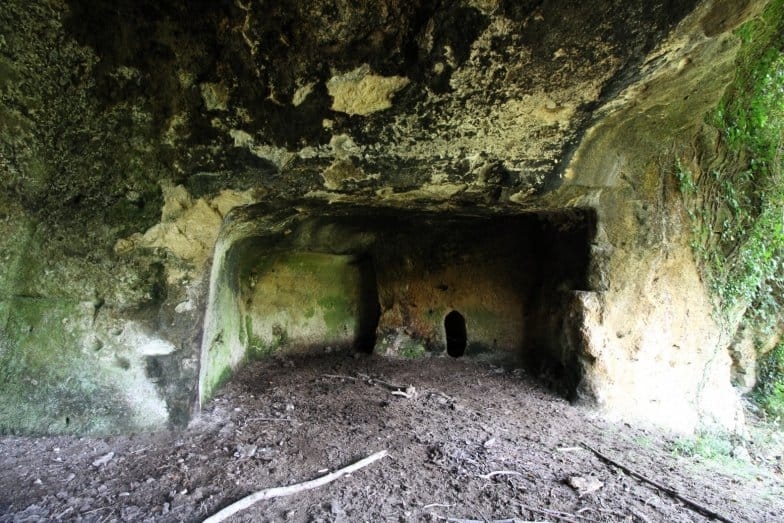
Acısu Rock Church is a historical structure carved into a single rock mass, located approximately 2 kilometers south of the Bulancak district center in Giresun Province. The church is situated within a private hazelnut orchard, west of the road leading from Bulancak town center to Erdoğan Village and west of İncüvez Stream. The structure derives its name from a nearby mineral spring, locally known as “acı su” (bitter water). The local population also refers to the building as “At Mağarası” (Horse Cave) or “Acısu Mağarası” (Acısu Cave), due to the belief that its ground floor was used as an animal shelter in past times. Carved into the western slope of the rock mass and oriented north-south, the structure consists of two levels with independent entrances; however, no staircase or connecting passage has been found either internally or externally between the levels.

Acısu Rock Church (
The ground floor, which constitutes the main worship area, is accessed through a linteled entrance on the north façade, shaped like a vaulted eyvan with a semicircular arch. This level, aligned along the north-south axis, comprises three independent single-nave sections (chapels), each terminating in a semicircular apse and opening into a shared western alcove. The first section, immediately in front of the entrance, features a circular apse with a diameter of 85 cm and a round-arched window opening outward; a niche on the north wall was likely used for storing liturgical objects. The central section, larger than the others, has an apse with a diameter of 120 cm. Its naos is covered by a barrel vault, and the apse rests on a raised platform, with two windows opening to the exterior. The southernmost section has a larger apse of 160 cm in diameter, a substantial niche on the western wall, and an “L”-shaped window. In addition to these three main sections, there are auxiliary spaces at the southern end of the structure, largely collapsed and later rebuilt with rubble stones to form a retaining wall, believed to have served as animal shelters in antiquity.
The second floor, located approximately 3.5 to 4 meters above the ground floor entrance, consists of two interconnected rooms aligned north-south, forming a living area. Access to this level is thought to have been provided in the past by movable wooden staircases. The larger rectangular room, measuring approximately 10.5–11 m², has a flat ceiling and an open eastern wall. A doorway from this room leads to a smaller chamber of about 3.5 m², which features a barrel-vaulted ceiling, a decorative arch, a niche functioning as a candle holder, and a mazgal window facing east, giving it the character of an “inziva hücresi” (hermit cell). Beneath the cell’s window, a carved stone step is embedded in the rock. Although the overall floor plan and apse arrangement show similarities to rock churches in Cappadocia, the structure exhibits a unique design without conforming to any established typology.
No artistic elements such as frescoes, iconographic scenes, or figurative wall paintings have been found inside the church. The only surface treatment identified on the interior walls consists of faint whitish plaster remnants, primarily preserved on the vault and walls of the central section of the ground floor. No inscriptions or dedicatory texts indicating the construction date have survived on or around the structure. However, comparative analyses of the architectural techniques, rock-carving tradition, and other nearby structures—particularly rock-cut tombs in the Ordu and Giresun regions—suggest that the church dates to the early Christian period or the early Byzantine era. While some researchers propose that the structure may have originally formed part of a three-story monastery complex, the extant remains and floor plan indicate a more modest religious building, likely consisting of expanded chapels and a hermit cell serving a local community.

Acısu Rock Church (Bulancak Municipality)
The Acısu Rock Church was officially registered and placed under protection by the Trabzon Board for the Conservation of Cultural and Natural Heritage on 11 October 1990, under decision no. 856. According to inventory records, the structure is marked as “not in use” and is currently in a state of ruin. The spaces located below ground level have been largely filled with earth. Particularly, the walls in the southeast section of the structure have collapsed and were subsequently sealed with rubble stones and mortar. Serious damage has occurred inside due to illegal excavations by treasure hunters: the carved stone step in the hermit cell on the second floor has been broken, and holes have been drilled into the floor and niches. Additionally, due to its historical use as an animal shelter, the interior surfaces exhibit darkening and layers of organic waste. A cemetery area lies to the west of the church entrance.
Architectural Features
Dating and Period Characteristics
Current Condition