

This article was automatically translated from the original Turkish version.
+1 More
Registration Number | 357 | ||||||||
|---|---|---|---|---|---|---|---|---|---|
Registration Date | 08.06.2018 | ||||||||
Application Number | C2017/123 | ||||||||
Application Date | 18.08.2017 | ||||||||
Name of the Geographical Indication | Adıyaman Besni Grape | ||||||||
Product / Product Group(s) | Grape/Processed and unprocessed fruits and vegetables and mushrooms | ||||||||
Type of Geographical Indication | Place of origin | ||||||||
Applicant/Registrant(s) | Besni Municipality | ||||||||
Address of the Registrant | Zübeyde Hanım Street, Yeni Besni Neighborhood, Besni, Adıyaman | ||||||||
Geographical Boundary | The villages of Suvarlı province of Adıyaman Burunçayır and Oyalı in the district of Besni Beşkoz Pınarbaşı Sarıyaprak Yayıklı Karalar Çorak | ||||||||
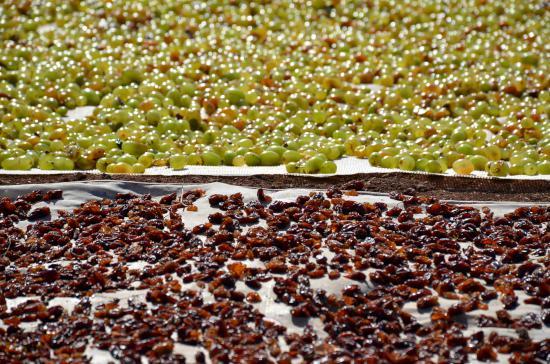
Adıyaman Besni Grape is a seeded, dried grape variety cultivated in the Besni district and surrounding areas of Adıyaman Province, Türkiye. Distinguished by its thin greenish-yellow skin, inverted egg-shaped berries, and large grains, this grape is typically grown under unique climatic and soil conditions using a special training system locally known as “serpene.” When dried, Adıyaman Besni Grape turns to a golden amber color close to that of amber and is notable for its high dry matter, sugar, and antioxidant capacity values. It is processed using traditional methods, dried with natural substances such as potassium carbonate solution or vine wood ash. This grape, registered under its place of origin, is produced and marketed within defined geographical boundaries under strict supervision.
The vineyard soils in Besni district are generally clay-loam in structure. Lime content ranges from 1–10%, and organic matter content varies between 1–2%. The soils exhibit a slightly alkaline character (pH 7.4–8.4) with no salinity issues. High potassium content (40–200 K₂O kg/da) and low phosphorus content (4–12 P₂O₅ kg/da) contribute to the high ash levels in the grape. The district lies at an elevation of 1050 meters, with an annual average rainfall of 565 mm. Additionally, the low groundwater table in the region facilitates the development of high dry matter content in fresh grapes.
Historically, the variety was propagated through hardwood cuttings, but today it is predominantly grafted onto American rootstocks, which provide resistance against phylloxera. Adıyaman Besni Grape is cultivated using a local training system known as “serpene.” In this method, the trunk is extended to a height of 80–100 cm, followed by the formation of arms that are trained horizontally along support wires. The arms are pruned either short or semi-long. Irrigation is generally not practiced; only a few vineyards use drip irrigation systems. Fertilization is carried out using livestock manure.
Harvesting begins in the second week of August and continues until mid-September. It is performed manually using pruning shears. Drying is carried out directly on drying racks set up in the vineyards, which prevents damage during transportation. Two traditional drying methods are employed. The first involves dipping the de-stemmed grapes into a mixture prepared from vine wood ash, water, and olive oil (or melted goat butter). The second method uses only pure olive oil. In both methods, the grape berries are dipped into the mixture, removed, and then laid out on the drying racks.
Before drying, the berries are additionally dipped in a potassium carbonate solution. Unlike common practices across Türkiye, in Adıyaman Besni Grape, this dipping is performed on de-stemmed berries rather than whole bunches. This allows for the removal of small, rotten, or discolored berries. The solution consists of 0.1% olive oil, 5% potassium carbonate (K₂CO₃), and water. It is applied using a cold-dipping method at 15–17 °C. This process prevents berry cracking and shrinkage, preserves product quality, and extends shelf life.
Inspections are conducted by a control body composed of representatives from the Besni District Directorate of Agriculture and Forestry, the Besni Chamber of Agriculture, and the Besni Municipality, under the coordination of the Besni Municipality. Inspections are carried out at least once annually, with additional inspections performed upon complaint or as needed. Control activities assess the suitability of the growing soils, adherence to the “serpene” training system, harvest timing, pre-drying quality control, and the appropriateness of the potassium carbonate solution. Inspection reports are prepared for submission to the Turkish Patent and Trademark Office.
Inspections are conducted at least once annually, and may be repeated upon request or at any time as deemed necessary. All reporting is submitted to the Turkish Patent and Trademark Office in accordance with Law No. 6769 on Industrial Property.
Adıyaman Besni Üzümü Coğrafi İşaret Belgesi. Turkish Patent and Trademark Office. PDF, 5 pages. Accessed August 16, 2025. https://ci.turkpatent.gov.tr/Files/GeographicalSigns/020d8487-c7e0-41a3-a3cb-70a5b3959b37.pdf.
Adıyaman Besni Üzümü. Turkish Patent and Trademark Office Geographical Indications Portal. Accessed August 16, 2025. https://ci.turkpatent.gov.tr/cografi-isaretler/detay/38352.
Peygamber üzümü'nün sofralara zorlu yolculuğu. Anadolu Ajansı, August 28, 2017. Accessed August 16, 2025. https://www.aa.com.tr/tr/yasam/peygamber-uzumunun-sofralara-zorlu-yolculugu/895324

Registration Number | 357 | ||||||||
|---|---|---|---|---|---|---|---|---|---|
Registration Date | 08.06.2018 | ||||||||
Application Number | C2017/123 | ||||||||
Application Date | 18.08.2017 | ||||||||
Name of the Geographical Indication | Adıyaman Besni Grape | ||||||||
Product / Product Group(s) | Grape/Processed and unprocessed fruits and vegetables and mushrooms | ||||||||
Type of Geographical Indication | Place of origin | ||||||||
Applicant/Registrant(s) | Besni Municipality | ||||||||
Address of the Registrant | Zübeyde Hanım Street, Yeni Besni Neighborhood, Besni, Adıyaman | ||||||||
Geographical Boundary | The villages of Suvarlı province of Adıyaman Burunçayır and Oyalı in the district of Besni Beşkoz Pınarbaşı Sarıyaprak Yayıklı Karalar Çorak | ||||||||
No Discussion Added Yet
Start discussion for "Adıyaman Besni Grape" article
Morphological Characteristics
Fresh Grape
Dried Grape
Phenological Characteristics
Soil and Climate Characteristics
Cultivation Practices
Harvest and Drying Methods
Potassium Carbonate Solution Application
Packaging and Storage
Control Mechanism
Relevant Institutions: