This article was automatically translated from the original Turkish version.
Location | Adıyaman | ||||||||
|---|---|---|---|---|---|---|---|---|---|
Year of Establishment | 1979 | ||||||||
Affiliated Institution | Ministry of Culture and Tourism of the Republic of Türkiye | ||||||||
Scope(s) | Archaeology Numismatic Collections Ethnography | ||||||||
Number of Works | 30000 | ||||||||
Collection Periods | Ottoman Seljuk Byzantine Roman Hellenistic Iron Bronze Chalcolithic Neolithic Paleolithic | ||||||||
Adıyaman Museum is an archaeology and ethnography museum located in the city center of Adıyaman in Türkiye’s Southeastern Anatolia Region. The museum was established in 1979 and opened to the public in 1982 in a single-story modern building with a garden on Atatürk Boulevard in the city center. Adıyaman Museum possesses a comprehensive collection comprising archaeological artifacts ethnographic items and coins. The museum houses approximately 30000 objects of which around 2000 are on display.

Stone hand axe made of flint from the Paleolithic period (Türkiye Culture Portal
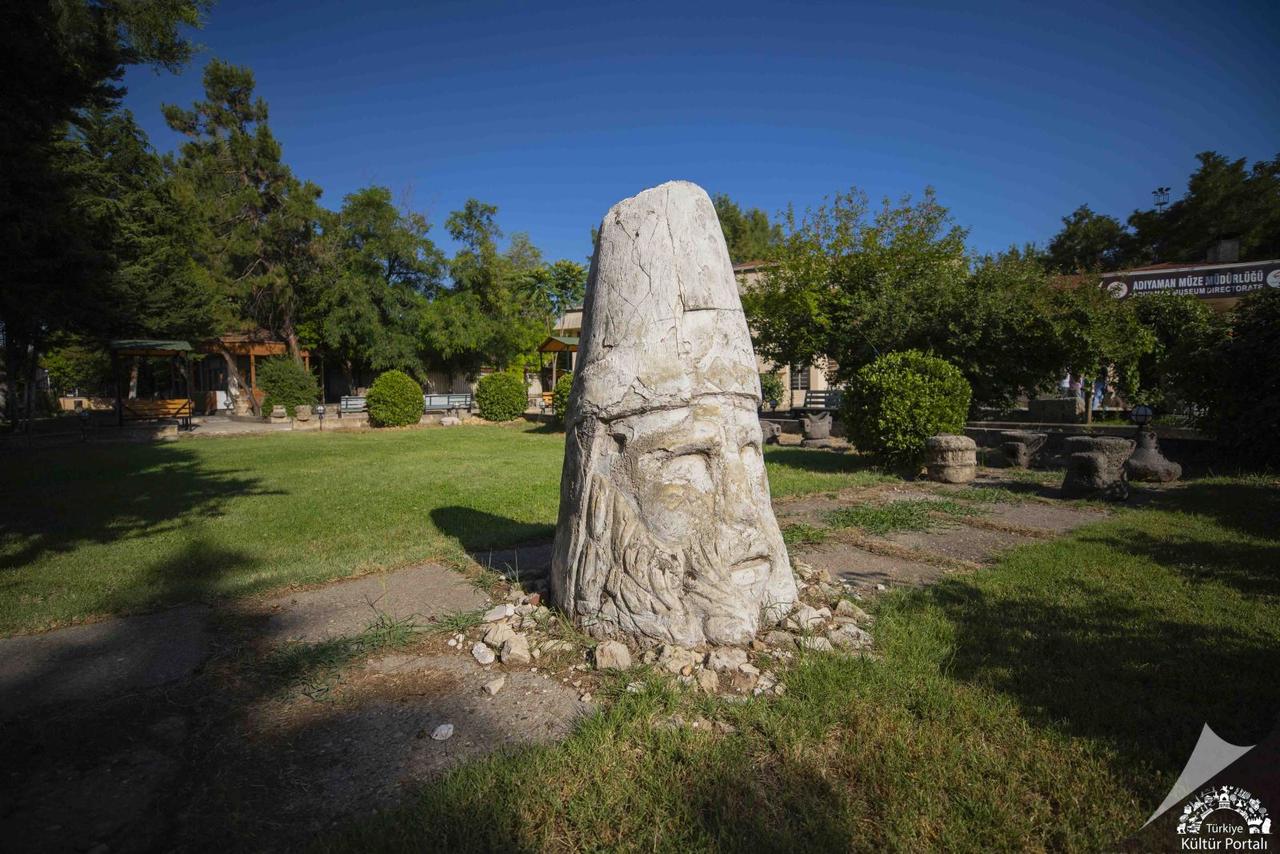
The museum building is a single-story structure constructed on a basement. It features a large garden and the artifacts are exhibited in two main halls an intermediate hall connecting them and an inner courtyard.
The archaeological artifacts hall of Adıyaman Museum contains objects from various cultural phases spanning from the Paleolithic Age to the Ottoman period. These include flint hand axes scrapers obsidian arrowheads various pottery vessels bronze spearheads hieroglyphic inscriptions mosaics statues lamps inscriptions glass objects and a large number of coins.
Particularly significant are the artifacts belonging to the Kommagene Kingdom (163 BC–72 AD). The head of King Antiochus I one of the kingdom’s most important rulers was discovered in 1983 during excavations in Samsat and is among the standout pieces in the archaeology section. Another notable find is a cult statue dating to 7500–7000 BC resembling the figures at Göbekli Tepe.
.jpg&w=1280&q=75)
Archaeological Collection (Türkiye Culture Portal
The ethnography hall displays local products such as handwoven carpets kilims and cicim textiles traditional women’s and men’s clothing silver jewelry and copper kitchenware. This collection is significant for illustrating the reflection of the region’s cultural heritage in daily life.
One of the most notable collections in the museum’s ethnography section is the lengers from the late Ottoman period. These copper serving vessels date to the 18th and 19th centuries and were produced using engraving and chasing techniques. Lengers were used for serving food and represent important examples of the craftsmanship of the era through their forms and decorations. While most of these vessels have simple forms some are adorned with details such as concentric circles shamsa motifs tulips and geometric borders. Some lengers also bear Armenian inscriptions and Ottoman Turkish dates.

Metal Artifacts and Lenger Collection (Türkiye Culture Portal
Another distinctive group of artifacts on display at the museum consists of mold-made bowls from the Hellenistic period. These are handleless footless vessels shaped like hemispheres used for drinking and are considered continuations of the Megara bowl tradition. Their outer surfaces feature relief decorations. The examples found in Adıyaman Museum generally belong to the Eastern Sigillata A group and show similarities to productions from Antioch in Syria-Palestine. The bowls have been evaluated comparatively with regard to aesthetic details production techniques and decorative motifs. Motifs include medallion rings palm trees altars dolphins and oak leaves.
Adıyaman Museum draws attention not only through its own collections but also through the significant archaeological sites under its responsibility. The main sites under its management are:
Adıyaman Museum is an important institution that documents the historical layers of the region through its vast array of artifacts from different periods as well as through its unique finds from the Kommagene Kingdom Ottoman metal vessels and Hellenistic ceramic collection. When evaluated together with ethnographic elements and archaeological materials obtained from local and international excavations the museum stands as a vital center documenting the cultural diversity and continuity of Southeastern Anatolia. The museum is open to visitors every day of the week except Monday from 08.00 to 12.00 and 13.30 to 17.30.
Adıyaman İl Directorate of Culture and Tourism. "Adıyaman Müzesi." _Ministry of Culture and Tourism of the Republic of Turkey_. Accessed July 7, 2025. https://adiyaman.ktb.gov.tr/TR-61369/adiyaman-muzesi.html.
Culture and Heritage General Directorate. "Adıyaman Müze Directorate." Ministry of Culture and Tourism of the Republic of Türkiye. Accessed July 7, 2025. https://kvmgm.ktb.gov.tr/TR-44056/adiyaman-muze-mudurlugu.html.
Kültür Portalı. "Adıyaman Müzesi - Adıyaman." Kültür Portalı. Accessed July 7, 2025. https://www.kulturportali.gov.tr/turkiye/adiyaman/gezilecekyer/muze.
T.C. Ministry of Culture and Tourism - Museum Information System. "Adıyaman Müzesi." T.C. Ministry of Culture and Tourism - Museum Information System. Accessed July 7, 2025. https://muze.gov.tr/muze-detay?DistId=MRK&SectionId=ADM01.
Turkish Museums. "Adıyaman Museum." Turkish Museums. Accessed July 7, 2025. https://www.turkishmuseums.com/museum/detail/1927-adiyaman-museum/1927/4.
Çorbacı, Hatice. “Adıyaman Müzesi Kalıp Yapımı Kâseleri.” *Adıyaman Üniversitesi Sosyal Bilimler Enstitüsü Dergisi* 8, no. 23 (2016): 494–507. Accessed July 7, 2025. https://dergipark.org.tr/tr/download/article-file/223963.
Özrili, Yaşar. “Adıyaman Müzesi’nde Bulunan Bir Grup Lenger.” *Iğdır Üniversitesi Sosyal Bilimler Dergisi* 22 (2020): 237–255. Accessed July 7, 2025. https://dergipark.org.tr/tr/download/article-file/2154396.

Location | Adıyaman | ||||||||
|---|---|---|---|---|---|---|---|---|---|
Year of Establishment | 1979 | ||||||||
Affiliated Institution | Ministry of Culture and Tourism of the Republic of Türkiye | ||||||||
Scope(s) | Archaeology Numismatic Collections Ethnography | ||||||||
Number of Works | 30000 | ||||||||
Collection Periods | Ottoman Seljuk Byzantine Roman Hellenistic Iron Bronze Chalcolithic Neolithic Paleolithic | ||||||||
Architecture and Exhibition Layout
Archaeological Collection
Ethnographic Collection
Metal Artifacts and Lenger Collection
Mold-Made Bowls
Associated Sites