


 Recently Added:
This article was automatically translated from the original Turkish version.
Africa Cup of Nations (AFCON 2025) is an edition of the Africa Cup of Nations, a prestigious tournament with a deep-rooted history in international football at the national team level on the African continent. This edition is being hosted by Morocco. The tournament has gained visibility not only through its competitive sporting stages but also through its stadium culture and public expressions, making headlines both on and off the pitch.
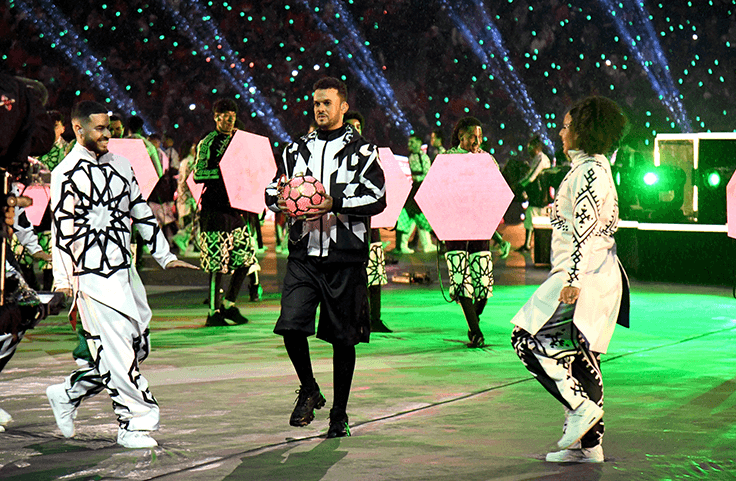
Performances before the AFCON 2025 opening match (AA)
The Africa Cup of Nations (AFCON) is a national team tournament organized under the authority of the Confederation of African Football (CAF). The tournament structure follows a format that begins with a group stage and progresses through knockout rounds, culminating in a final match to determine the champion. First held in 1957, the competition has expanded over time in terms of participation and scope, eventually adopting a 24-team format in later editions.
The origins of the Africa Cup of Nations are closely tied to the establishment of CAF. When CAF was founded in 1956, the inaugural tournament was planned for the following year with four participating nations. However, South Africa withdrew due to its apartheid policies, which refused to field a multi-racial team, reducing the first edition to three teams. The inaugural champion was Egypt. The 1959 edition also featured three teams; Egypt participated under the name United Arab Republic, formed in union with Syria, and its victory in that edition is officially recorded under Egypt’s name in the statistical records.
In 1962, the field expanded with qualifying rounds determining the final participants, and Ethiopia hosted a tournament won by the host nation. Ghana won back-to-back titles in 1963 and 1965. By 1968, the tournament became standardized to be held every two years. The 1970s saw a period of diverse champions from different countries. In 1996, the number of teams increased to 16, and South Africa returned to the tournament following the end of apartheid, winning the title as host. Egypt later extended its total number of titles to seven. To reduce overlap with the FIFA World Cup, the tournament calendar was later shifted to odd-numbered years.
AFCON 2025, the 35th edition of the Africa Cup of Nations, is being hosted by Morocco. The tournament will feature 24 teams and proceed through group stages, knockout rounds, semifinals, and a final.
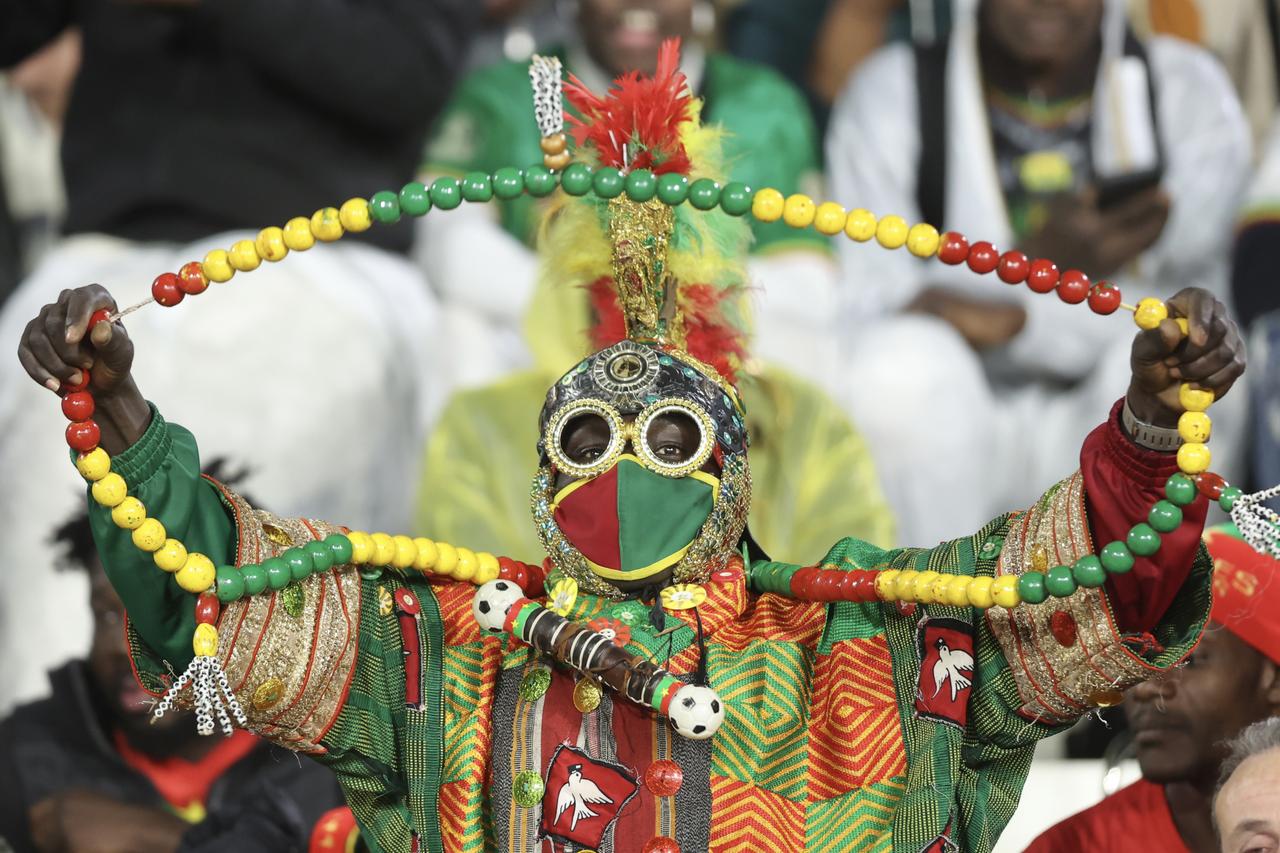
A fan in traditional attire (AA)
AFCON 2025 has not been perceived merely as a competition defined by match results. A vibrant atmosphere has emerged in the stands, where diverse social themes have become visible. Spectators have expressed responses to issues such as colonial exploitation, wars, internal conflicts, and racism. The presence of players from participating nations wearing traditional Moroccan attire, along with fans performing dances, wearing traditional clothing, and playing musical instruments in the stands, has become a defining feature of the tournament’s cultural identity.
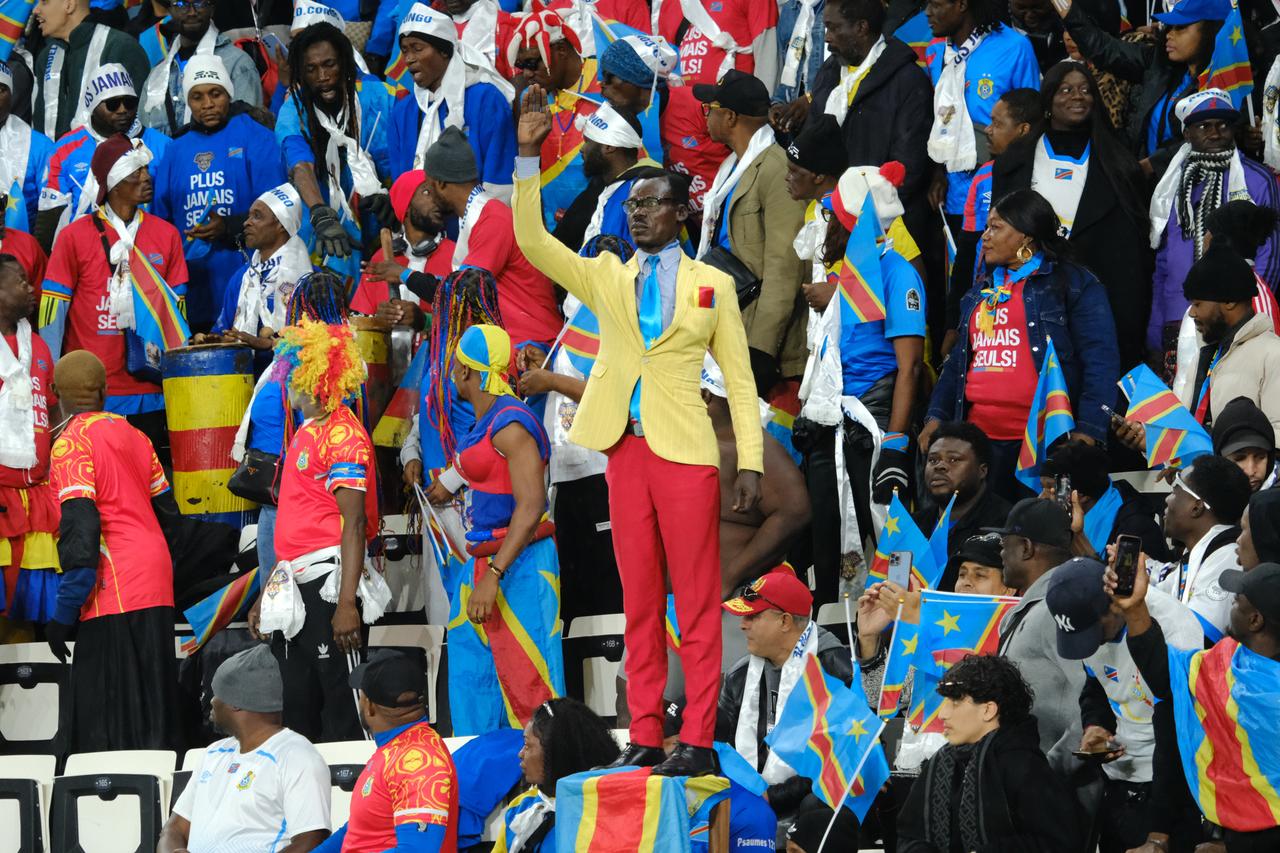
Michel Coca Mbuladinga (AA)
One of the most prominent tribune narratives during the tournament has been a commemorative practice observed by fans from the Democratic Republic of the Congo. Michel Coca Mbuladinga, known as the “grandson of Patrice Lumumba,” has stood motionless and silent throughout matches to honor Lumumba’s memory. During these moments, he raises his right arm toward the sky, maintaining a statue-like posture for the full 90 minutes. This act is rooted in historical details: Lumumba’s assassination in 1961, the dissolution of his body in acid, subsequent investigations revealing that Belgium had retained part of his remains, and the eventual handover of one of Lumumba’s teeth to his family on 20 June 2022.
One of the standout player narratives of the tournament is associated with Burkina Faso forward Georgi Minungo. Despite losing vision in one eye, Minungo has continued his football career, earning recognition among the human stories of the tournament. In 2023, he suffered a serious health issue in his left eye, lost all vision following surgery, yet still participated in the tournament and played during the knockout stages, making his journey one of the most compelling aspects of AFCON 2025.
AFCON 2025 has also been remembered for the long-distance journeys undertaken by fans. An Algerian supporter began his journey from India to Morocco, completing most of the approximately 18,000-kilometer trip by bicycle. Mohammed Boukhaliq, a visually impaired Moroccan fan, traveled 560 kilometers to support his national team. These examples illustrate the dynamic mobility surrounding the tournament.
Following the quarterfinals of AFCON 2025, the teams advancing to the semifinals were Senegal, Egypt, Nigeria, and Morocco. The quarterfinal results were as follows: Senegal defeated Mali 1–0, Morocco beat Cameroon 2–0, Nigeria overcame Algeria 2–0, and Egypt defeated Ivory Coast 3–2, thereby determining the semifinal matchups.
In Nigeria’s 2–0 victory over Algeria, goals were scored by Victor Osimhen in the 47th minute and Akor Adams in the 57th minute. This result secured Nigeria’s place in the semifinals, where they will face host nation Morocco.
The semifinal matches were played on 14 January 2026. The fixtures were Senegal vs Egypt and Nigeria vs Morocco. The Senegal–Egypt match kicked off at 20:00 Turkey time, while the Nigeria–Morocco match began at 23:00 Turkey time.
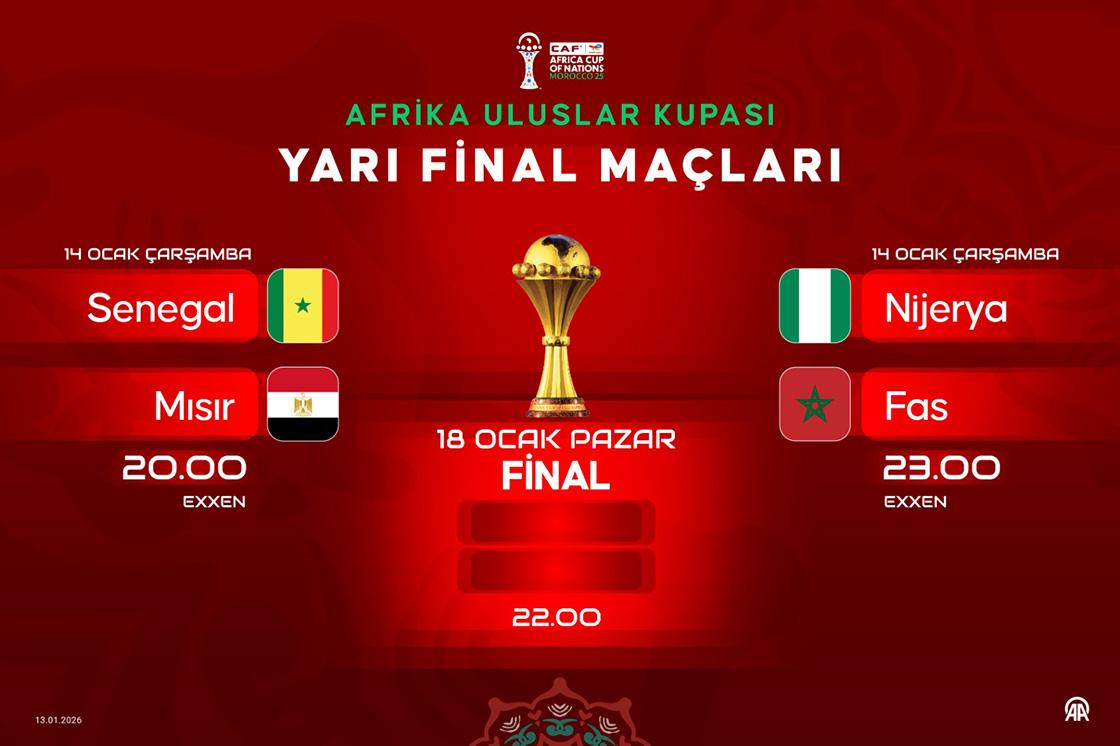
Infographic of the semifinal matches (AA)
Senegal’s 1–0 win over Mali secured their place in the semifinals. Morocco’s 2–0 victory against Cameroon ensured the host nation’s advancement. Nigeria’s 2–0 defeat of Algeria and Egypt’s 3–2 win over Ivory Coast completed the list of the tournament’s final four teams, shaping the semifinal pairings as Senegal vs Egypt and Nigeria vs Morocco.
A total of 21 players from the Trendyol Süper Lig participated in the tournament. Six of them, who play for clubs in Turkey, featured in the semifinalist squads. These players are Victor Osimhen (Nigeria) and Ismail Jakobs (Senegal) from Galatasaray, Wilfred Ndidi (Nigeria) from Beşiktaş, Youssef En-Nesyri (Morocco) from Fenerbahçe, Paul Onuachu (Nigeria) from Trabzonspor, and Cherif Ndiaye (Senegal) from Samsunspor.
In the Africa Cup of Nations semifinal, Senegal faced Egypt. Senegal emerged victorious with a 1–0 win on home soil, becoming the first team to reach the final of the tournament.
The only goal of the match was scored by Sadio Mané in the 78th minute. This goal secured Senegal’s place in the final, as they dominated the second half.
Senegal suffered a significant loss early in the match. Veteran defender Kalidou Koulibaly was forced to leave the field in the 23rd minute due to injury. Ismail Jakobs, who plays for Galatasaray, did not feature in the match.
After the final whistle, celebrations erupted among Senegal supporters for reaching the final. It was also recalled that Senegal, having previously reached the final three times, had won the trophy in 2022, marking a major achievement.
In the Africa Cup of Nations semifinal, Nigeria and Morocco faced off at the Prince Moulay Abdallah Stadium. The match ended goalless after regulation and extra time, with the finalist determined by a penalty shootout.
Without Wilfred Ndidi, Victor Osimhen started for Nigeria, while Paul Onuachu was on the bench. For Morocco, Youssef En-Nesyri began the match on the field.
Neither team managed to score during the 90 minutes of regulation or in extra time. In the 118th minute, Nigeria’s head coach Eric Chelle substituted Victor Osimhen with Samuel Chukwueze. This substitution became one of the most notable moments of the match.
Following extra time, the match proceeded to a penalty shootout. Paul Onuachu opened the scoring for Nigeria, but goalkeeper Bono saved penalties from substitute Samuel Chukwueze and Onyemaechi. For Morocco, Youssef En-Nesyri stepped up for the final penalty and converted his shot to send his team to the final.
As a result, Morocco will face Senegal in the Africa Cup of Nations final. Nigeria and Egypt will meet in the third-place match on 17 January.
Anadolu Ajansı. “Afrika Uluslar Kupası’nda yarı finaller yarın oynanacak.” Accessed January 13, 2026. https://www.aa.com.tr/tr/dunyadan-spor/afrika-uluslar-kupasinda-yari-finaller-yarin-oynanacak/3797620
Anadolu Ajansı. “Futboldan daha fazlasına sahne olan Afrika Uluslar Kupası.” Accessed January 13, 2026. https://www.aa.com.tr/tr/futbol/futboldan-daha-fazlasina-sahne-olan-afrika-uluslar-kupasi/3797936
EBSCO Research Starters. "Africa Cup of Nations." EBSCO Research Starters, Accessed January 13, 2026. https://www.ebsco.com/research-starters/sports-and-leisure/africa-cup-nations
beIN SPORTS Türkiye. “İşte Afrika Uluslar Kupası’nda yarı final eşleşmeleri.” beIN SPORTS Türkiye, Accessed January 13, 2026. https://beinsports.com.tr/haber/iste-afrika-uluslar-kupasinda-yari-final-eslesmeleri
The Africa Cup of Nations, one of the highest-level football competitions in African football, is approaching its conclusion in the 2025 edition. The 35th tournament, organized by the Confederation of African Football and hosted by Morocco, progressed through knockout rounds after the group stage. Following the semifinals, the final match has been confirmed. The two teams that reached the final after all previous matches are Morocco and Senegal. Thus, the framework for the match to determine the champion of the Africa Cup of Nations has been set.
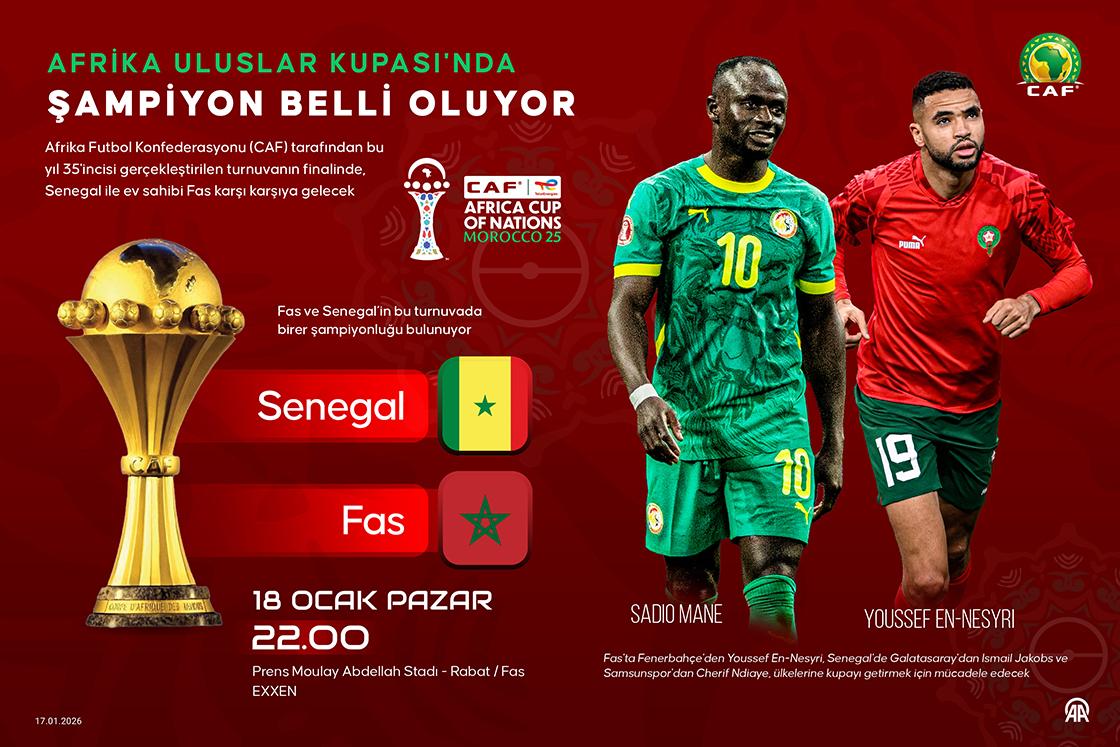
The Africa Cup of Nations 2025 final will be played on Sunday 18 January. The match will take place at the Prince Moulay Abdellah Stadium in Rabat, the capital of Morocco, which has a capacity of 69,500 spectators. The match is scheduled to kick off at 22:00 Turkey time. With both teams advancing to the final undefeated throughout the tournament, the champion of the competition will be determined by this match.
Host nation Morocco began the tournament in Group A. In the group stage, they defeated Comoros 2-0, drew 1-1 with Mali, and beat Zambia 3-0 to top their group. In the round of 16, Morocco defeated Tanzania 1-0. In the quarterfinals, they secured a 2-0 victory over Cameroon. In the semifinals, they faced Nigeria. The match ended goalless after regular time and extra time, and Morocco advanced to the final by winning 4-2 in a penalty shootout. This result marked Morocco’s first appearance in the Africa Cup of Nations final since 2004. The Moroccan national team won its only title in tournament history in 1976.
Senegal-Morocco final infographic (AA)
Senegal competed in Group D. In the group stage, they defeated Botswana 3-0, drew 1-1 with the Democratic Republic of the Congo, and beat Benin 3-0. In the round of 16, Senegal defeated Sudan 3-1. In the quarterfinals, they beat Mali 1-0, and in the semifinals, they defeated Egypt 1-0. With these results, Senegal reached the final for the fourth time in Africa Cup of Nations history. Senegal has reached the final in three of the last four editions of the tournament.
The Africa Cup of Nations 2025 final not only determines the tournament champion but also carries significant financial rewards. The winning team will receive a prize of $10 million. The runner-up will receive $4 million. The two semifinalists have each earned $2.5 million. The final match stands as the decisive contest that settles the economic and sporting outcomes of the tournament.
In the Africa Cup of Nations 2025 final, footballers who play in the Trendyol Süper Lig are also participating. A total of 21 players from the Süper Lig have taken part in the tournament. In the final, three players are expected to feature. Morocco’s squad includes Youssef En-Nesyri, who plays for Fenerbahçe. Senegal’s squad features Ismail Jakobs from Galatasaray and Cherif Ndiaye from Samsunspor. This has made the final notable for the presence of players from Turkish leagues.
Egypt holds the record for the most Africa Cup of Nations titles, having won the trophy seven times in 1957, 1959, 1986, 1998, 2006, 2008 and 2010. Cameroon has won five titles, Ghana four, and Nigeria and Ivory Coast three each. The 2025 final between Morocco and Senegal is a decisive match in this historical context, as it will either add a new champion to the record or extend existing achievements.
The final match of the 35th Africa Cup of Nations, due to its status as the tournament’s climax, was held under extensive security measures. Morocco, as the host nation, entered the final, while Senegal reached the final through their performance throughout the tournament. The match took place on 18 January 2026, with high spectator attendance in the stands. Prior to the match, both teams demonstrated a defensive-oriented playing style throughout the tournament. The match was played under the framework of CAF and officiated by an international referee panel.
The first half of the final was characterized by a balanced game. Senegal and Morocco prioritized defensive discipline during the first 45 minutes, with midfield battles becoming the decisive element of the match. Both teams created limited chances in the opponent’s penalty area and no clear goal-scoring opportunities emerged. The scoreboard remained unchanged throughout the first half, and the teams went into halftime level at 0-0. The game frequently revolved around midfield contests.
In the second half, the tempo of the game gradually increased. Morocco, benefiting from home advantage, intensified their offensive organization, while Senegal focused on maintaining defensive solidity and transitioning quickly. The score remained unchanged as the match entered its final stages. A decisive incident occurred in the 90th minute. After Malick Diouf fouled Brahim Diaz inside Senegal’s penalty area, the referee consulted VAR and awarded a penalty in favor of Morocco. Following this decision, Senegalese players protested for an extended period.
HIGHLIGHTS | Senegal 🆚 Morocco | #TotalEnergiesAFCON2025 - Final | ملخص مباراة السنغال والمغرب (Youtube)
Following the penalty decision, the Senegal team attempted to leave the pitch in protest. Senegalese players and coaching staff, objecting to the penalty call, headed toward the locker room. As a result, the match was suspended for an extended period, with a stoppage lasting approximately 13 minutes. After efforts by Senegal captain Sadio Mane, the team returned to the field. Tensions rose in the stands, and uncertainty grew over whether the match would continue. When play resumed, the penalty kick was taken in the 90+24th minute.
FIFA President Gianni Infantino made statements regarding certain on-field and off-field conduct by Senegal during the final of the 35th Africa Cup of Nations. Infantino criticized the protests against the penalty decision awarded to Morocco and the decision by Senegalese players and staff to leave the pitch.
In his statement, Infantino said that unacceptable scenes occurred both on the pitch and in the stands during the match. He emphasized that the conduct displayed by some fans as well as Senegalese players and staff was inappropriate, and stressed that leaving the pitch is not an acceptable behavior and that violence has no place in football at any level.
Infantino underscored that respect for referee decisions must be absolute under all circumstances. The FIFA President stated that football is a game that must be played within the rules on the pitch, and that deviating from this principle undermines the core values of sport.
In his statement, Infantino called on players and clubs to act with a sense of responsibility. He emphasized that teams are not only responsible for their on-field performances but also for setting an example for fans in the stands and viewers around the world through their conduct. Infantino affirmed that the incidents in the final must be condemned, reiterated that such scenes have no place in football, and stated that he expects the relevant disciplinary bodies within the Confederation of African Football to take the necessary steps.
In the continuation of his statement, Infantino also addressed the sporting outcome of the tournament. He congratulated Senegal, who won the African championship in Rabat, and extended best wishes to all those involved in this achievement, beginning with Abdoulaye Fall, President of the Senegalese Football Federation. He also commended Morocco, the runner-up and host nation, for its hospitality throughout the tournament.
In the final match, Senegal defeated Morocco 1-0 in extra time to win the 35th Africa Cup of Nations. After Malick Diouf fouled Brahim Diaz inside the penalty area in the 90+5th minute, VAR reviewed the incident and awarded a penalty to Morocco. Due to the Senegalese players’ protests, the match was suspended for an extended period, and the penalty was taken in the 90+24th minute. Moroccan goalkeeper Edouard Mendy saved Brahim Diaz’s penalty, sending the match into extra time. In the 94th minute of extra time, Pape Gueye scored the only goal of the match, giving Senegal the lead. The score remained unchanged for the remainder of the match, and the trophy went to Senegal.
The penalty kick taken by Morocco’s Brahim Diaz was saved by Senegal’s goalkeeper Edouard Mendy. After this save, no further goals were scored in regular time, and the match ended 0-0. The missed penalty forced the final into extra time. With the end of regular time, the game transitioned into the extra-time period.
At the start of extra time, Senegal took control of the game. The only goal of the final came in the 94th minute, scored by Pape Gueye. With this goal, Senegal led 1-0, and the score remained unchanged for the remainder of extra time. Morocco attempted to equalize with offensive efforts, but Senegal’s defense held firm. With the completion of extra time, the match concluded with Senegal’s victory.
With the conclusion of the final match, Senegal became the winner of the 35th Africa Cup of Nations. This result marked Senegal’s second title in the tournament’s history. The final match, marked by the team withdrawal attempt, prolonged stoppage, saved penalty, and the decisive goal in extra time, has been recorded as one of the most unusual finals in tournament history. Morocco finished as runners-up in the tournament they hosted. The match is officially recorded in CAF records as a Senegal victory following extra time.
Anadolu Ajansı. "Afrika Uluslar Kupası’nda şampiyon yarın belli olacak." Accessed January 17, 2026. https://www.aa.com.tr/tr/futbol/afrika-uluslar-kupasinda-sampiyon-yarin-belli-olacak/3802009.
NTV Spor. "Afrika Uluslar Kupası’nda final zamanı: Fas-Senegal, kadroda Süper Lig’den 3 futbolcu." NTV Spor. Accessed January 17, 2026. https://www.ntvspor.net/futbol/afrika-uluslar-kupasinda-final-zamani-fas-senegal-kadroda-super-ligden-3-futbolcu-416256.
TRT Spor. "Afrika’nın en büyüğü belli oluyor." TRT Spor. Accessed January 17, 2026. https://www.trtspor.com.tr/haber/futbol/afrikanin-en-buyugu-belli-oluyor-29375625.
beIN SPORTS Türkiye. "Afrika Uluslar Kupası’nda finalin adı belli oldu! Youssef En-Nesyri…" beIN SPORTS Türkiye. Accessed January 17, 2026. https://beinsports.com.tr/haber/afrika-uluslar-kupasinda-finalin-adi-belli-oldu-youssef-en-nesyri.
Africa Cup of Nations (AFCON 2025), held in Morocco, is the latest edition of the Africa Cup of Nations, a prestigious tournament with a deep-rooted history among international national team football competitions on the African continent. The tournament has gained visibility not only through its competitive sporting stages but also through its stadium culture and public expressions; its narratives beyond the pitch have become part of the global conversation.
Performances before the AFCON 2025 opening match (AA)
The Africa Cup of Nations (AFCON) is a national team tournament organized under the authority of the Confederation of African Football (CAF). The competition follows a structure beginning with a group stage, progressing through knockout rounds, and concluding with a final match to determine the champion. First held in 1957, the tournament has expanded over time in terms of participant numbers and scope, eventually adopting a 24-team format in later editions.
The origins of the Africa Cup of Nations are closely tied to the formation of CAF. Following CAF’s establishment in 1956, the inaugural tournament was planned for the following year with an initial expectation of four participating nations. However, South Africa withdrew due to its apartheid policies, which rejected the participation of multi-racial teams, reducing the first edition to three teams. Egypt emerged as the first champion. The 1959 edition also featured three teams; Egypt competed under the name United Arab Republic, formed in union with Syria, and its victory in that edition is officially recorded under Egypt’s name in statistical records.
In 1962, the field expanded, with qualifying rounds determining the final participants; the tournament was hosted by Ethiopia, which also won the title. Ghana achieved back-to-back victories in 1963 and 1965. By 1968, the tournament became standardized to be held every two years. The 1970s saw a period in which different nations claimed the title. In 1996, the number of teams increased to 16; South Africa returned to the tournament following the end of apartheid and won as host nation. Egypt later extended its total number of titles to seven. To reduce overlap with the FIFA World Cup, the tournament schedule was later shifted to odd-numbered years.
AFCON 2025, the 35th edition of the Africa Cup of Nations, is being hosted by Morocco. The tournament will feature 24 teams and proceed through group stages, knockout rounds, semi-finals, and a final.
A fan in traditional attire (AA)
AFCON 2025 has not been perceived merely as a competition defined by match results; it has fostered an atmosphere where diverse social themes are visibly expressed. Beyond football-watching practices, tribunes have displayed reactions to issues such as colonial exploitation, wars, internal conflicts, and racism. The presence of players arriving in traditional Moroccan attire, along with fans creating visual and auditory environments through dance, traditional clothing, and musical instruments, has become a defining feature of the tournament’s culture.
Michel Coca Mbuladinga (AA)
One of the most prominent tribune narratives during the tournament has been a commemorative practice observed by fans from the Democratic Republic of the Congo. Known as “the grandson of Patrice Lumumba,” fan Michel Coca Mbuladinga has stood motionless and silent throughout matches to honor Lumumba’s memory. During these moments, he raises his right arm toward the sky, remaining in a statue-like pose for the full 90 minutes. This act is grounded in historical context: Lumumba’s assassination in 1961, the dissolution of his body in acid, subsequent investigations revealing that Belgium had retained part of his remains, and the eventual handover of one of Lumumba’s teeth to his family on 20 June 2022.
One of the standout player stories of the tournament is associated with Burkina Faso forward Georgi Minungo. Despite losing vision in one eye, Minungo continued his football career. In 2023, he suffered a serious health issue in his left eye, and after surgery, he lost all sight in that eye. Nevertheless, he participated in the tournament and played during the knockout stages, making his journey one of the most compelling narratives of the competition.
AFCON 2025 has also been marked by long-distance fan journeys. An Algerian fan embarked on a journey from India to Morocco, completing most of the approximately 18,000-kilometer route by bicycle. A visually impaired Moroccan fan, Mohammed Boukhaliq, traveled 560 kilometers to support his national team. These examples illustrate the dynamic mobility surrounding the tournament.
Following the quarter-finals of AFCON 2025, the teams advancing to the semi-finals were Senegal, Egypt, Nigeria, and Morocco. In the quarter-final matches, Senegal defeated Mali 1–0; Morocco beat Cameroon 2–0; Nigeria overcame Algeria 2–0; and Egypt defeated Ivory Coast 3–2, thereby determining the semi-final pairings.
In Nigeria’s 2–0 victory over Algeria, goals were scored by Victor Osimhen in the 47th minute and Akor Adams in the 57th minute. This result secured Nigeria’s place in the semi-finals, where they would face host nation Morocco.
The semi-final matches took place on 14 January 2026. The fixtures were Senegal vs Egypt and Nigeria vs Morocco. The Senegal–Egypt match kicked off at 20:00 Turkey time, while the Nigeria–Morocco match began at 23:00 Turkey time.
Infographic of the semi-final matches (AA)
Senegal’s 1–0 victory over Mali secured their place in the semi-finals. Morocco’s 2–0 win against Cameroon ensured the host nation’s advancement. Nigeria’s 2–0 defeat of Algeria and Egypt’s 3–2 triumph over Ivory Coast completed the list of the tournament’s final four teams, shaping the semi-final matchups as Senegal vs Egypt and Nigeria vs Morocco.
A total of 21 players from the Trendyol Süper Lig participated in the tournament. Six of them, who play for clubs in Turkey, featured in the semi-finalist squads. These players are Victor Osimhen (Nigeria) and Ismail Jakobs (Senegal) from Galatasaray, Wilfred Ndidi (Nigeria) from Beşiktaş, Youssef En-Nesyri (Morocco) from Fenerbahçe, Paul Onuachu (Nigeria) from Trabzonspor, and Cherif Ndiaye (Senegal) from Samsunspor.
In the Africa Cup of Nations semi-final, Senegal faced Egypt. Senegal emerged victorious with a 1–0 win on home soil, becoming the first team to reach the final of the tournament.
The only goal of the match was scored by Sadio Mané in the 78th minute. This goal gave Senegal control of the game in the second half and secured their place in the final.
Senegal suffered an early setback in the match. Veteran defender Kalidou Koulibaly was forced off the pitch in the 23rd minute due to injury. Ismail Jakobs, who plays for Galatasaray, did not feature in the match.
After the final whistle, celebrations erupted among Senegal supporters as they celebrated reaching the final. It was also recalled that Senegal, having previously reached the final three times, won the trophy in 2022, marking a major achievement.
In the Africa Cup of Nations semi-final, Nigeria and Morocco faced off at the Prince Moulay Abdallah Stadium. The match ended goalless after regular time and extra time, with the team advancing to the final determined by a penalty shootout.
Without Wilfred Ndidi, Victor Osimhen started for Nigeria, while Paul Onuachu remained on the bench. For Morocco, Youssef En-Nesyri began the match on the bench.
Neither side managed to score during the 90 minutes of regular play or in extra time. In the 118th minute, Nigeria’s head coach Eric Chelle substituted Victor Osimhen with Samuel Chukwueze. This change became one of the most notable moments of the match.
Following extra time, the match proceeded to a penalty shootout. Paul Onuachu opened the scoring for Nigeria, but goalkeeper Bono saved penalties from substitute Samuel Chukwueze and Onyemaechi. For Morocco, Youssef En-Nesyri stepped up for the final penalty and converted his shot to send his team to the final.
As a result, Morocco will face Senegal in the Africa Cup of Nations final. Nigeria and Egypt will meet in the third-place match on 17 January.
Anadolu Ajansı. "Afrika Uluslar Kupası şampiyonluğu iptal edilen Senegal kararı tahkime taşıyacak" Accessed March 18, 2026. https://www.aa.com.tr/tr/dunyadan-spor/afrika-uluslar-kupasi-sampiyonlugu-iptal-edilen-senegal-karari-tahkime-tasiyacak/3869648
GZT. "Sadio Mane'den olay sözler: Fas -Senegal finali için verilen kararın tepkileri büyüyor" Accessed March 18, 2026. https://www.gzt.com/spor/fas-senegal-macinda-ne-yasandi-caftan-olay-karar-sampiyonluk-el-degistirdi-4024536
Mackolik.com. "Fas, 2025 Afrika Uluslar Kupası'nda şampiyon ilan edildi" Accessed March 18, 2026. https://www.mackolik.com/futbol/haber/fas-2025-afrika-uluslar-kupasinda-sampiyon-ilan-edildi/bf5e5492-2884-4306-a25a-a26a51a366c1
TRT Spor. "Afrika Kupası'nda şampiyon değişti" Accessed March 18, 2026. https://www.trtspor.com.tr/haber/futbol/afrika-kupasinda-sampiyon-degisti-30320481
beIN SPORTS. "Tarihi final maçı için flaş karar! Kupa el değiştirdi" Accessed March 18, 2026. https://beinsports.com.tr/haber/tarihi-final-maci-icin-flas-karar-kupa-el-degistirdi

The Africa Cup of Nations (AFCON 2025) was a national team tournament organized by the Confederation of African Football and hosted by Morocco, featuring 24 teams. The competition represented the latest edition of the Africa Cup of Nations tradition, which dates back to 1957. The tournament progressed through a group stage and knockout rounds, gaining visibility not only through sporting competition but also through stadium culture, social representations, and public narratives. The teams that reached the semifinals of AFCON 2025 were Senegal versus Egypt and Nigeria versus Morocco. Following the semifinal matches, Senegal and Morocco advanced to the final. The final match of the Africa Cup of Nations 2025 was played on Sunday 18 January between Morocco and Senegal. Both teams that reached the final remained undefeated throughout the tournament. The final was held at the Prince Moulay Abdellah Stadium in Rabat, which has a capacity of 69,500. Senegal won the match 1-0 after extra time.
No Discussion Added Yet
Start discussion for "Africa Cup of Nations (AFCON 2025)" article
January 13, 2026
Definition and Institutional Framework
January 13, 2026
AFCON 2025 Hosting and Overall Structure
January 13, 2026
Sporting Progression to the Semifinals and Semifinalists
January 13, 2026
Semifinal Matches
January 17, 2026
Final Match: Senegal 1-0 Morocco
January 17, 2026
Before the Match
March 18, 2026
Definition and Institutional Framework
March 18, 2026
AFCON 2025 Hosting and Overall Structure
March 18, 2026
Sporting Progression to the Semi-Finals and Semi-Finalists
March 18, 2026
Semi-Final Matches