


This article was automatically translated from the original Turkish version.
+2 More
Bread Kadayıf
Product / Product Group(s) | Bakery and confectionery products sweets dough products | ||||||||
|---|---|---|---|---|---|---|---|---|---|
Applicant/Registrant(s) | Afyonkarahisar Municipality | ||||||||
Registration Date | 11.12.2019 | ||||||||
File Number | C2017/117 | ||||||||
Registration Number | 473 | ||||||||
Afyon Kaymaklı Ekmek Kadayıfı is a syrup-based dessert prepared using traditional methods that reflect the palate of the local population. It has been officially registered as a “Geographical Indication” by the Turkish Patent and Trademark Office and is closely associated with the province of Afyonkarahisar.

Afyon Kaymaklı Ekmek Kadayıf (AA)
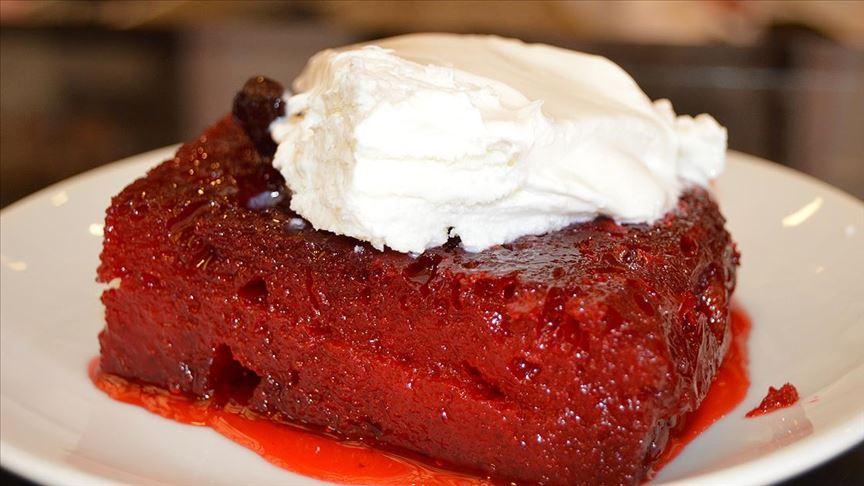
Afyon Kaymaklı Ekmek Kadayıfı is a syrup-soaked dessert prepared on a pide-like, dense and porous bread base made from bread wheat flour, water, fresh yeast and salt. The dessert is cooked by soaking the bread in a syrup made from white sugar, water and lemon salt, and is served with certified Afyon Kaymağı, designated as geographical indication No. 115.
Appearance: It has a circular shape with a characteristic porous texture. Portions are typically cut into circular wedges and are often presented in a double-layered arrangement.
Taste and Aroma: It features a rich flavor profile with a lightly caramelized outer surface. The aroma is enhanced by the syrup infusion and the addition of kaymak, resulting in a fragrant and complex profile.
Distinctive Features: The distinctive characteristics of Afyon Kaymaklı Ekmek Kadayıfı lie in the special preparation of the pide-like dough, which is evenly baked in stone ovens without the use of a pan, and in the skill required during the syrup-soaking process. Additionally, it is mandatory to top the dessert exclusively with the certified Afyon Kaymağı.
Dough Preparation: The fermented dough is shaped into round discs approximately 3 to 4 cm thick. It is baked on stone surfaces to produce a structure similar to pide but with a dense porous texture and brownish tones.
Soaking: The baked bread is placed on a large tray and soaked with water at room temperature. A weight is applied and the bread is left to rest for 10 minutes.
Syrup Preparation: Sugar and water are boiled together and lemon salt is added. The syrup is stirred only until the sugar has fully dissolved and is not reduced or thickened.
Draining: The soaked bread is hung to drain excess water without any manual contact.
Cooking: The syrup is carefully spread over the kadayıf using a ladle until the bread has fully absorbed it. The direction of the tray and the frequency of syrup application are adjusted with precision.
Serving: The dessert is placed on a serving plate with its bottom surface facing upward and topped with Afyon Kaymağı before presentation.
Storage: The product with kaymak can be stored for five days at 4 °C. The product without kaymak can be stored for five days at temperatures below 20 °C.
The production of Afyon Kaymaklı Ekmek Kadayıfı is permitted only within the boundaries of Afyonkarahisar province. Production outside this region is not considered appropriate due to the product’s uniqueness and the traditional craftsmanship required in its preparation.
Oversight is conducted by a five-member committee composed of representatives from the Afyonkarahisar Municipality, the Provincial Directorate of Agriculture and Forestry, the Directorate of Public Health, the Union of Craftsmen and Artisans, and the Chamber of Commerce. Inspections verify compliance with the product’s definition and production method, as well as the correct use of the official mark and logo.
Anadolu Ajansı. “Tescilli Lezzet ‘Ekmek Kadayıfı’ Satışlarında Ramazan Bereketi.” Accessed May 27, 2025. https://www.aa.com.tr/tr/ramazan-2020/tescilli-lezzet-ekmek-kadayifi-satislarinda-ramazan-bereketi/1829314
T.C. Ministry of Culture and Tourism. "Afyon Kaymaklı Ekmek Kadayıfı." Kültür Portalı. Accessed May 27, 2025. https://www.kulturportali.gov.tr/portal/afyon-kaymakli-ekmek-kadayifi
Turk Patent and Trademark Office. "Afyon Kaymaklı Ekmek Kadayıfı." Geographical Indication Registration Certificate No: 473. Accessed May 27, 2025. https://ci.turkpatent.gov.tr/cografi-isaretler/detay/38346

Bread Kadayıf
Product / Product Group(s) | Bakery and confectionery products sweets dough products | ||||||||
|---|---|---|---|---|---|---|---|---|---|
Applicant/Registrant(s) | Afyonkarahisar Municipality | ||||||||
Registration Date | 11.12.2019 | ||||||||
File Number | C2017/117 | ||||||||
Registration Number | 473 | ||||||||
No Discussion Added Yet
Start discussion for "Afyon Kaymaklı Ekmek Kadayıfı" article
Product Definition and Distinctive Characteristics
Production Method
Geographical Boundary and Oversight