

This article was automatically translated from the original Turkish version.
+2 More
Registration Number | 1050 | ||||||||
|---|---|---|---|---|---|---|---|---|---|
Registration Date | 17.03.2022 | ||||||||
Application Number | C2020/374 | ||||||||
Application Date | 09.11.2020 | ||||||||
Name of the Geographical Indication | Ağrı Geven Honey | ||||||||
Product / Product Group(s) | Honey / Honey | ||||||||
Type of Geographical Indication | Place of origin | ||||||||
Applicant/Registrant(s) | Ağrı Province Beekeepers Association | ||||||||
Address of the Registrant | Leylekpınar Mah. 1704. Sok. ER-SE Business Center Floor 6 No:30/22 Ağrı | ||||||||
Geographical Boundary | Ağrı province | ||||||||
Ağrı Geven Honey is a monofloral strained honey unique to Ağrı Province in Türkiye’s Eastern Anatolia Region, derived from the geven plant (Astragalus spp.). Produced by colonies of the Caucasian honey bee (Apis mellifera caucasia), this honey is distinguished by its color, which ranges from pale yellow to orange; its thick consistency; and its mild burning sensation in the throat. The pollen profile of the product contains at least 50% geven pollen, with supporting pollen from families Asteraceae, Rosaceae, Lamiaceae, Lauraceae, and Apiaceae.
The distinguishing feature of Ağrı Geven Honey lies primarily in its pollen composition originating from the geven plant (Astragalus spp.). The province of Ağrı, where the honey is produced, is located within the Upper Murat Basin and is characterized by a complex geomorphological structure of mountainous, hilly, and plateau areas at an average elevation of 2000 meters. Elevation differences within short distances in the region exceed 1000 meters, fostering microclimate formation and resulting in temporal variations in flowering periods. This topography enables a continuous floral cover from April to September, providing an extended season for beekeeping activities.
The extensive pastures, low levels of agricultural pest control, and areas free from intensive farming create an ideal environment for bee flora. Geven plants grow abundantly within the boundaries of Ağrı Province, with various species (Astragalus spp.) occurring naturally in mountainous zones. In addition to geven, plants from the Asteraceae (%3), Rosaceae, Lamiaceae, Lauraceae, and Apiaceae (%1) families play a secondary or supportive role in the pollen profile.
Ağrı Geven Honey is produced by colonies of the Caucasian honey bee (Apis mellifera caucasia). This bee race possesses a long tongue structure that provides an advantage in accessing deep nectar sources within flowers. Due to its long-standing use in the region, the Caucasian honey bee has adapted well to local environmental conditions. Colonies are positioned at valley floors during spring and relocated to high alpine meadows and mountain slopes during summer months to ensure continuous access to nectar sources.
The production period begins at the end of April and continues until mid-August. Harvesting occurs once annually between August 15 and September 10. Harvesting is performed exclusively from the upper honey super section of the hive; the lower brood chamber is not used. Honey is extracted using a cold centrifugal method when the combs are at least 100% sealed or two-thirds sealed. No heating process is applied. The harvested honey is stored in 100–200 liter stainless steel containers and allowed to rest for three days to achieve homogeneity.
Wintering typically begins in mid-November to early December. In enclosed wintering facilities, hives are kept in quiet, naturally ventilated environments with temperatures not exceeding 10°C and without risk of water freezing. In open-air wintering, hives are left in their natural environment; even when covered by snow, ventilation openings are maintained. Sufficient quantities of Ağrı Geven Honey are left within the hives to feed the bees during winter; no other honey or sugar syrup is used for feeding. Only honey syrup may be used in exceptional circumstances.
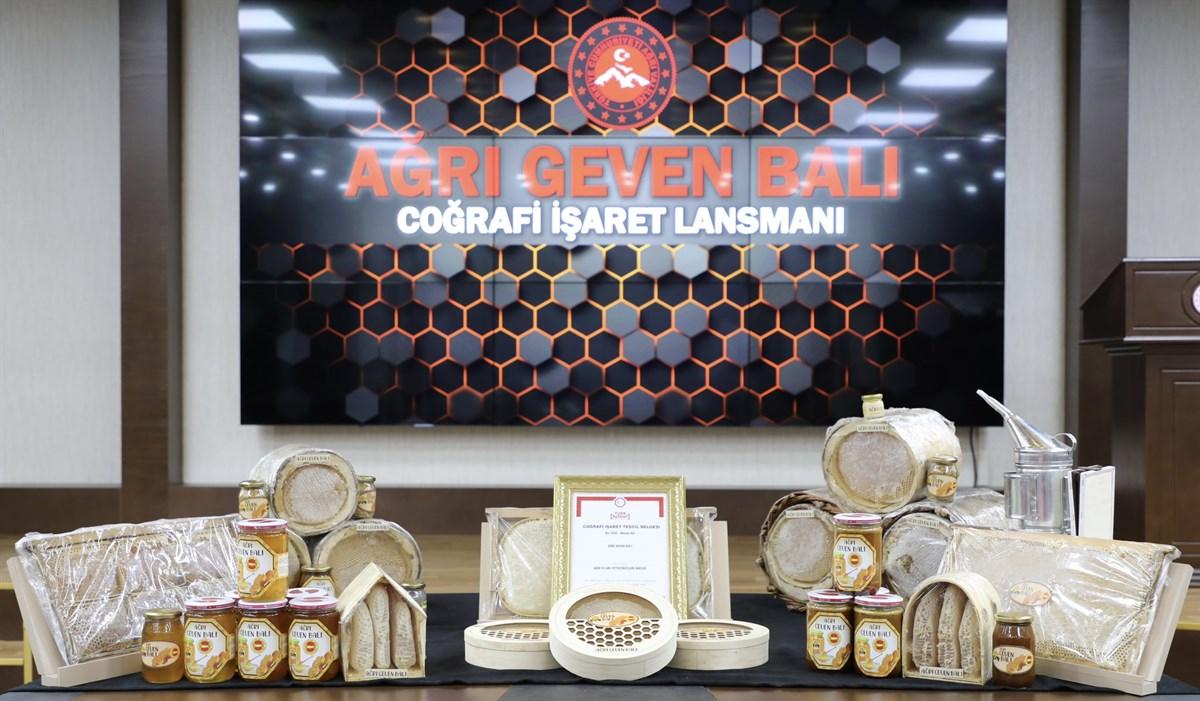
After harvest, suitable honey is packaged in facilities approved by the Ministry of Agriculture and Forestry and designated by the Ağrı Beekeepers Association. It is packaged in food-grade glass jars (500–1000 ml) or lacquered tin containers (1–2 kg). Packaging bears the label “Ağrı Geven Balı” and the origin emblem.
Product inspection is conducted by a minimum five-member inspection body coordinated by the Ağrı Province Beekeepers Association, comprising representatives from the Ağrı Provincial Directorate of Agriculture and Forestry, Serhat Development Agency (SERKA), Ağrı İbrahim Çeçen University, and the Ağrı Chamber of Commerce. Inspections are carried out at least once annually on a regular basis and additionally in response to complaints. Producers are required to notify the association at the beginning of the production season and inform them prior to harvest. The product is sampled and subjected to laboratory testing when necessary. Inspections cover all processes including bee race, production technique, wintering, filling, packaging, and labeling.
The production of Ağrı Geven Honey is a significant economic activity for the local population. Honey festivals and tasting events held during the harvest period contribute to the preservation of beekeeping culture and foster social interaction. Hives are moved only within Ağrı Province during the honey season; no transportation outside the province is permitted. The entire production remains within the defined geographic boundaries and is registered in compliance with the requirements of the origin emblem.
T.C.Ağrı Valiliği. "Ağrı Geven Honey Geographical Indication Launch Event." T.C. Ağrı Governorship. Accessed July 17, 2025. http://www.agri.gov.tr/vb-924.
Turk Patent and Trademark Office. "Ağrı Geven Balı." Turk Patent and Trademark Office. Accessed July 17, 2025. https://ci.turkpatent.gov.tr/cografi-isaretler/detay/2902.
Turkish Patent and Trademark Office. *Ağrı Geven Balı. Türk Patent ve Marka Kurumu*. https://ci.turkpatent.gov.tr/Files/GeographicalSigns/2c1a5af4-66c9-4006-8603-2118b4144375.pdf.

Registration Number | 1050 | ||||||||
|---|---|---|---|---|---|---|---|---|---|
Registration Date | 17.03.2022 | ||||||||
Application Number | C2020/374 | ||||||||
Application Date | 09.11.2020 | ||||||||
Name of the Geographical Indication | Ağrı Geven Honey | ||||||||
Product / Product Group(s) | Honey / Honey | ||||||||
Type of Geographical Indication | Place of origin | ||||||||
Applicant/Registrant(s) | Ağrı Province Beekeepers Association | ||||||||
Address of the Registrant | Leylekpınar Mah. 1704. Sok. ER-SE Business Center Floor 6 No:30/22 Ağrı | ||||||||
Geographical Boundary | Ağrı province | ||||||||
Botanical and Geographic Source
Bee Race and Production Conditions
Production Period and Harvesting Method
Chemical and Pollen Profile
Key Chemical Values
Pollen Distribution
Wintering Methods
Packaging and Labeling
Inspection and Registration Procedures
Social and Economic Context