


This article was automatically translated from the original Turkish version.
+2 More
Beekeeping in Türkiye
Active Sectors | Animal husbandry | ||||||||
|---|---|---|---|---|---|---|---|---|---|
Number of Colonies | 9.2 million (3rd in the world) | ||||||||
Honey Production (2023) | 889 thousand tons (2nd in the world) | ||||||||
Endemic Plant Species | 4319 (Total: 13,414 taxa) | ||||||||
Basic Bee Products | bee venom propolis royal jelly pollen beeswax Honey | ||||||||
Annual Honey Production (World) | ~1,830,000 tons | ||||||||
Export Leaders | Ukraine China | ||||||||
Importers | EU countries USA | ||||||||
Beekeeping in Türkiye is a multifaceted agricultural activity of strategic importance for rural development, food security, and ecosystem services. Bee products such as honey, beeswax, royal jelly, pollen, propolis, and bee venom are utilized in both nutrition and health sectors; simultaneously, the pollination activities of honeybees enhance the yield and quality of plant production. In this regard, beekeeping is also a significant sector in Türkiye from an ecological function perspective.
According to 2022 data from the Food and Agriculture Organization of the United Nations (FAO), approximately 996,000 beekeeping operations are active worldwide. These operations produce a total annual honey output of 1.83 million tons. China holds the position of the world’s largest honey producer, while countries such as Ukraine, Argentina, and Türkiye stand out in terms of production volume. In honey imports, the United States and European Union countries lead.
Türkiye occupies a privileged position in global beekeeping due to its high floristic diversity and ecological variation. The country hosts around 9.2 million colonies, ranking third in the world in terms of colony numbers. As of 2023, Türkiye’s annual honey production reaches approximately 889,000 tons, placing it second globally in honey production.
Türkiye is also the world leader in pine honey production and export. According to 2023 data, Türkiye generated approximately 32 million US dollars in foreign exchange revenue from exporting 9,500 tons of honey. However, despite the increase in the number of colonies, production areas have not expanded at the same pace, resulting in an average yield of 12.5 kg per hive. This situation highlights the need for improvements in efficiency and sustainability within the sector.

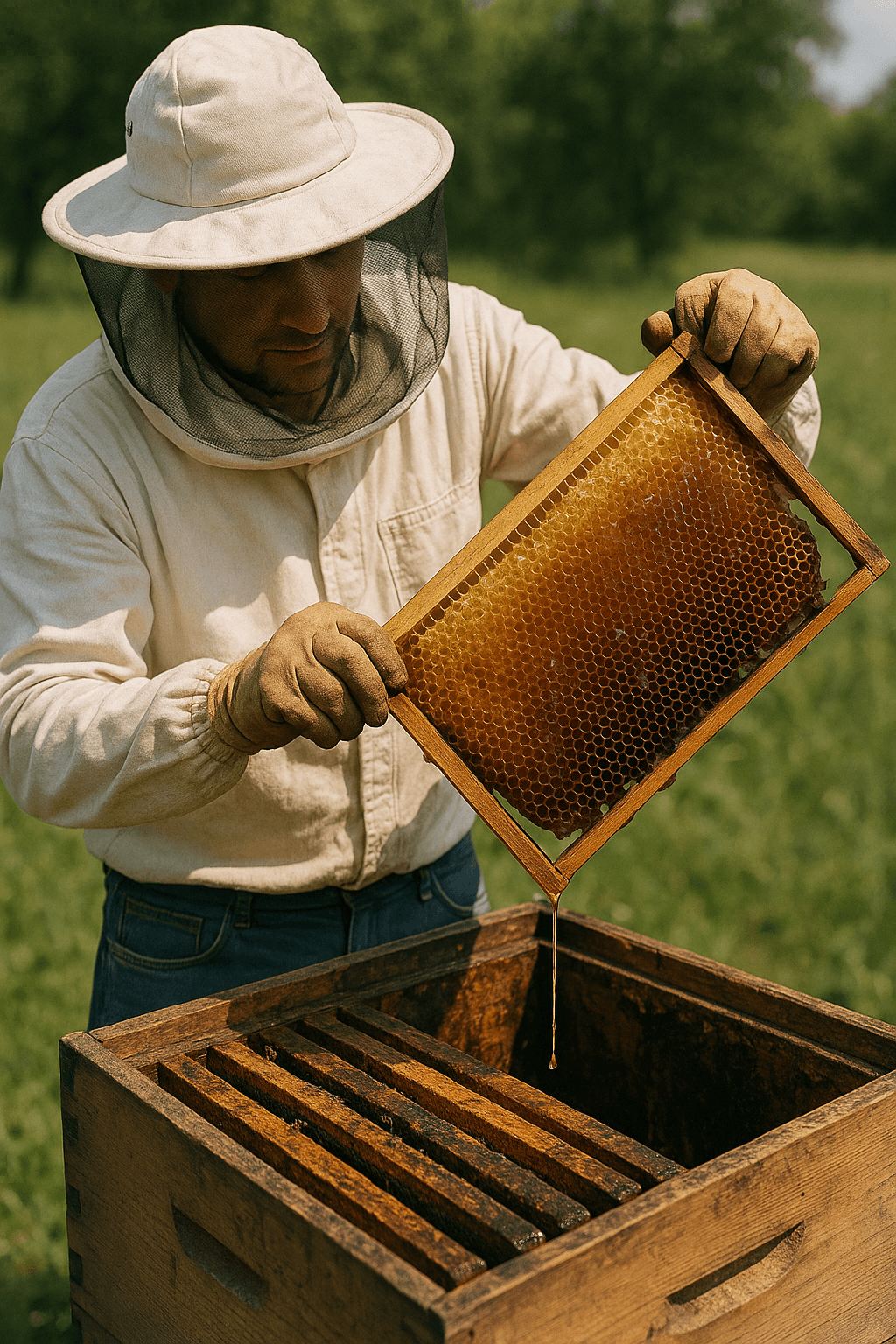
Honey and Bees (Generated by Artificial Intelligence.)
A honeybee colony consists of three fundamental individuals with specialized roles within a social organization: the queen bee, worker bees, and drone bees. Typically, a colony contains one queen bee, 20,000 to 80,000 worker bees depending on the season, and 100 to 500 drone bees. Colony members undergo complete metamorphosis (holometabolism), progressing through egg, larva, pupa, and adult stages to complete their development.
One of the most important ecological functions of honeybees is their role in plant reproduction through pollination. While collecting nectar and pollen, bees transfer pollen from male reproductive organs to female organs, initiating fertilization. This process directly affects crop yield and quality in agricultural production. Many characteristics such as fruit shape, size, ripening period, seed size, and germination capacity are dependent on bee pollination.
Approximately one-third of global food production depends directly or indirectly on bee pollination. Seventy-seven percent of food crops derived from 82 plant species require bee pollination. In the United States alone, the economic value of pollination performed by bees is estimated at 8 billion US dollars. This contribution extends beyond food production; it also indirectly supports livestock farming through pollination of forage crops such as alfalfa, thereby influencing meat and milk production.

Beekeeping (Generated by Artificial Intelligence.)
Beekeeping activities in Türkiye are not limited to honey production. The country is also notable for the diversity of bee products and produces numerous items beneficial to both nutrition and health sectors. According to data from the Türkiye Beekeepers Central Union (TAB) and field applications, the main bee products and their characteristics are summarized below:
Thanks to this diversity, beekeeping in Türkiye is not only a source of rural income but also a multifaceted sector that generates high-value products for the health, cosmetic, and food industries.
Ministry of Agriculture and Forestry of the Republic of Turkey. "Arı Yetiştiriciliği." *Ministry of Agriculture and Forestry of the Republic of Turkey*. Accessed July 6, 2025. https://www.tarimorman.gov.tr/Konular/Hayvancilik/Aricilik
Türkiye Arı Yetiştiricileri Merkez Birliği. "Arıcılık." *TAB*. Accessed July 6, 2025. https://tab.org.tr/aricilik/

Beekeeping in Türkiye
Active Sectors | Animal husbandry | ||||||||
|---|---|---|---|---|---|---|---|---|---|
Number of Colonies | 9.2 million (3rd in the world) | ||||||||
Honey Production (2023) | 889 thousand tons (2nd in the world) | ||||||||
Endemic Plant Species | 4319 (Total: 13,414 taxa) | ||||||||
Basic Bee Products | bee venom propolis royal jelly pollen beeswax Honey | ||||||||
Annual Honey Production (World) | ~1,830,000 tons | ||||||||
Export Leaders | Ukraine China | ||||||||
Importers | EU countries USA | ||||||||
No Discussion Added Yet
Start discussion for "Beekeeping in Türkiye" article
Beekeeping Activities in Türkiye
Bee Family and Colony Structure
Bees’ Contribution to Pollination
Production Diversity and Products in Beekeeping in Türkiye