
This article was automatically translated from the original Turkish version.
Propolis
Chemical Composition | minerals and other organic substances 5% Vitamins 5% Pollen 10% Volatile/Aromatic Oils 30% Beeswax 50% Resin (phenolic compounds) | ||||||||
|---|---|---|---|---|---|---|---|---|---|
Main Functions | Disinfecting the hive, Maintaining structural integrity, Defense against external threats | ||||||||
Color Range | Can vary from yellow to dark brown, with greenish or reddish tones | ||||||||
Prominent Bioactive Components | Flavonoids, Phenolic acids, Terpenoids | ||||||||
Consistency | Brittle in cold, sticky in heat | ||||||||
Solubility | Low in water, high in ethanol | ||||||||
Odor | Aromatic, resinous | ||||||||
Propolis is a natural product formed by honeybees (Apis mellifera) mixing resinous substances collected from plant buds stems and leaves with beeswax and secretions. Bees use this sticky substance to seal cracks and gaps within the hive stabilize honeycombs maintain hive sterility against microorganisms and create a physical barrier against external threats. The term “propolis” derives from the Greek words “pro” (before) and “polis” (city) symbolizing the defense of the bee colony.
The chemical composition of propolis varies according to the local flora and climatic conditions of its collection site and consists of resins beeswax volatile oils pollen and various organic compounds. Thanks to bioactive substances such as flavonoids phenolic acids and their esters propolis exhibits antimicrobial antioxidant anti-inflammatory and immunomodulatory properties. Due to these characteristics it has a wide range of applications from traditional medicine to modern pharmaceutical uses.
Propolis is not directly produced by bees but is a mixture created by bees processing resinous materials collected from plants. Bees collect resins primarily oozing from tree buds stems and leaves by chewing them. These resins are mixed with enzymes secreted by the bees’ salivary glands beeswax and pollen. This mixture is then used by bees for various purposes within the hive including sealing holes and cracks repairing honeycombs bonding combs together narrowing hive entrances and disinfecting the hive interior.
In addition corpses of large organisms that enter the hive and die but cannot be removed are encased in propolis to prevent decay and odor emission. This production process is part of the bees’ strategy for maintaining hive hygiene and health. Propolis production can vary depending on the richness of the vegetation and the genetic traits of the bee species.

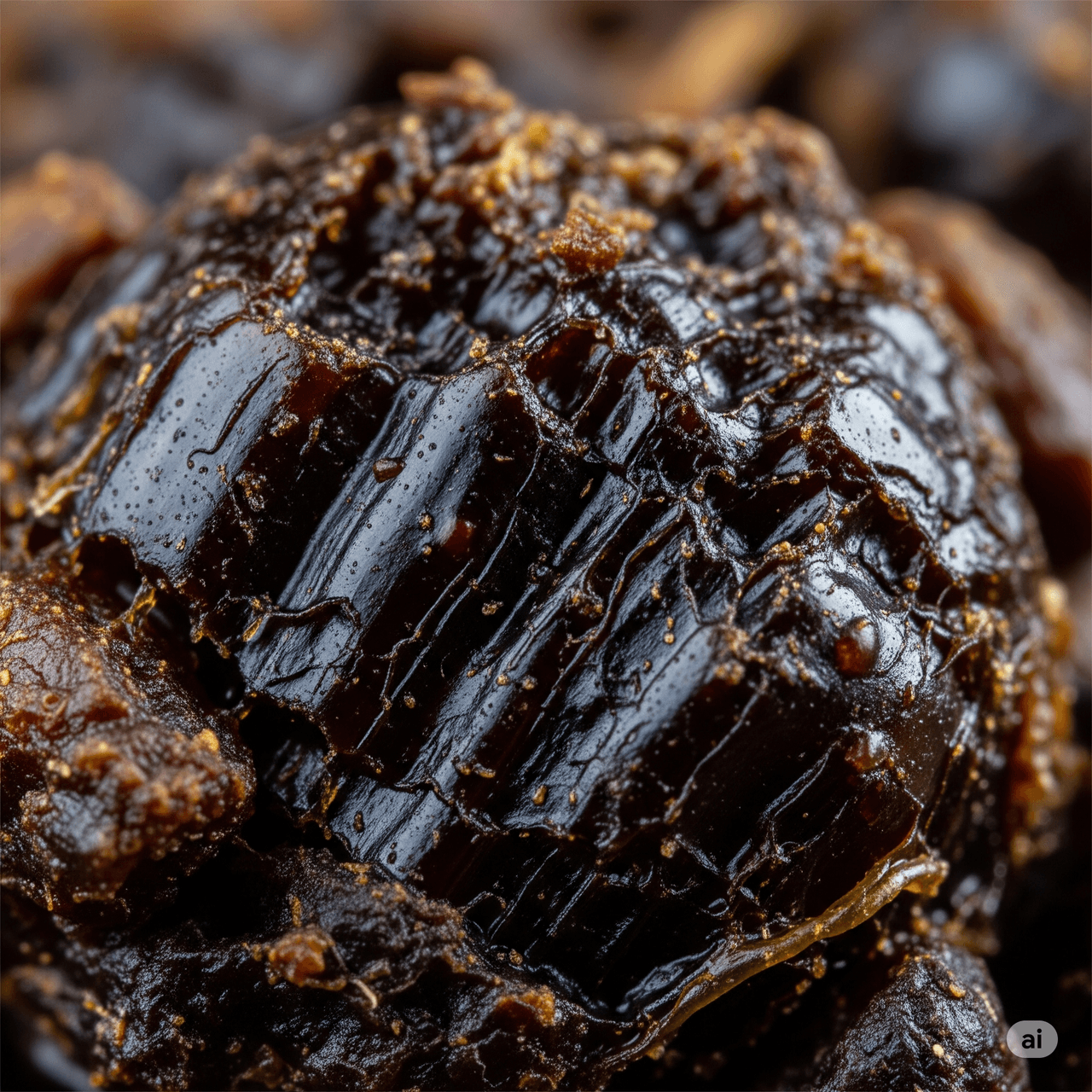
A Visual Representing Propolis (Generated by Artificial Intelligence.)
Propolis is a highly variable substance in appearance and consistency. It typically has a sticky resinous and balsamic structure. Its color ranges from light yellow to dark brown and can even exhibit greenish or reddish tones depending on the plant source and geographic region. Its consistency also changes with ambient temperature: it becomes hard and brittle in cold conditions but softens and gains flexibility at body temperature or in warm environments. Propolis has a distinctive usually pleasant and aromatic odor caused by its volatile oils and aromatic compounds. Its taste is often bitter and resinous.
In terms of solubility propolis generally has poor solubility in water but dissolves well in organic solvents such as ethanol ether and chloroform. This property has led to the widespread preference for ethanolic solutions in the extraction and formulation of propolis. Its physical properties can vary significantly depending on factors such as the plant species from which it is collected the season and the bee species. This variability poses a challenge for standardizing propolis and ensuring consistent quality in commercial products.
Propolis has a complex chemical composition that can differ significantly based on the plant sources geographic region season and bee species. Generally its chemical structure consists of the following components:
The main components responsible for propolis’s biological activity are:
The functional effects of propolis on humans are linked to its rich array of bioactive components such as flavonoids and phenolic acids. These properties define its applications in traditional medicine and modern pharmacology:
These functional properties form the basis for propolis’s widespread use in apitherapy cosmetics and functional food industries.
Propolis exhibits numerous biological activities due to its flavonoids phenolic acids esters and aromatic compounds. These effects are primarily associated with antioxidant antimicrobial and anti-inflammatory mechanisms.
These effects enable the widespread evaluation of propolis in pharmaceutical cosmetic and dietary supplement formulations. However standardization dosage and long-term safety studies are required for its clinical use.
Albayrak, Songül, and Sevil Albayrak. "PROPOLIS: NATURAL ANTIMICROBIAL MATTER." *Ankara Üniversitesi Eczacılık Fakültesi Dergisi* 37, no. 3 (2008): 201-215. Accessed June 18, 2025. https://doi.org/10.1501/Eczfak_0000000502
Dündar, Ezgi and Hatice Kalkan Yıldırım. "Propolisin Çeşitliliğine Etki Eden Faktörler." *Gıda ve Yem Bilimi Teknolojisi Dergisi*, no. 19 (2018): 1-7. Accessed June 18, 2025. https://dergipark.org.tr/tr/download/article-file/637861
Kafadar, İbrahim Halil. "Deneysel septik artrit modelinde eklem kıkırdağı hasarı üzerine intraartiküler uygulanan Propolisin etkileri." Master's thesis, Erciyes Üniversitesi, 2011. Accessed June 18, 2025. https://tez.yok.gov.tr/UlusalTezMerkezi/tezDetay.jsp?id=reGQCjBqarb6XLsyJNHj2w&no=sXEyGZZK74X-yFj0thQmBg
Kurek-Gorecka, A., et al. "Comparison of the Antioxidant Activity of Propolis Samples from Different Geographical Regions." *Plants* 11, no. 9 (2022): 1203. Accessed June 18, 2025. https://doi.org/10.3390/plants11091203
Silici, Sibel. "Propolis üzerine ön klinik araştırmalar." *Erciyes Üniversitesi Fen Bilimleri Enstitüsü Dergisi* 31, no. 3 (2015): 185-191. Accessed June 18, 2025. https://dergipark.org.tr/tr/pub/erciyesfen/issue/25552/269542
Svetikiene, D., et al. "The Comparative Study of the Antioxidant and Antibacterial Effects of Propolis Extracts in Veterinary Medicine." *Veterinary Sciences* 11, no. 8 (2024): 375. Accessed June 18, 2025. https://doi.org/10.3390/vetsci11080375

Propolis
Chemical Composition | minerals and other organic substances 5% Vitamins 5% Pollen 10% Volatile/Aromatic Oils 30% Beeswax 50% Resin (phenolic compounds) | ||||||||
|---|---|---|---|---|---|---|---|---|---|
Main Functions | Disinfecting the hive, Maintaining structural integrity, Defense against external threats | ||||||||
Color Range | Can vary from yellow to dark brown, with greenish or reddish tones | ||||||||
Prominent Bioactive Components | Flavonoids, Phenolic acids, Terpenoids | ||||||||
Consistency | Brittle in cold, sticky in heat | ||||||||
Solubility | Low in water, high in ethanol | ||||||||
Odor | Aromatic, resinous | ||||||||
Production
Physical Properties
Chemical Composition
Functional Effects on Human Health
Biological Effects