

This article was automatically translated from the original Turkish version.
+2 More
Type of Geographical İndication | Place of Origin | ||||||||
|---|---|---|---|---|---|---|---|---|---|
Registration Number | 469 | ||||||||
Registration Date | 06.11.2019 | ||||||||
Product / Product Group(s) | Honey | ||||||||
Province(s) | Muğla | ||||||||
Applicant/Registrant(s) | Marmaris Chamber of Commerce | ||||||||
Marmaris Pine Honey is a type of honeydew honey produced in the Marmaris district of Muğla Province, Türkiye. This honey is obtained when Apis mellifera bees collect and process the sugary secretion (known as basra) excreted by the insect Marchalina hellenica, which lives on Pinus brutia (Turkish pine) and Pinus sylvestris (Scots pine) trees. Protected as a geographical indication under Law No. 6769 on Industrial Property, it holds registration number 469. The application date was 13 January 2017 and the registration date was 6 November 2019. The registering institution is the Marmaris Chamber of Commerce and Industry, and the geographical boundary is limited to the Marmaris district of Muğla Province. The product is marketed with a logo bearing the term “Marmaris Pine Honey” and the geographical indication emblem.

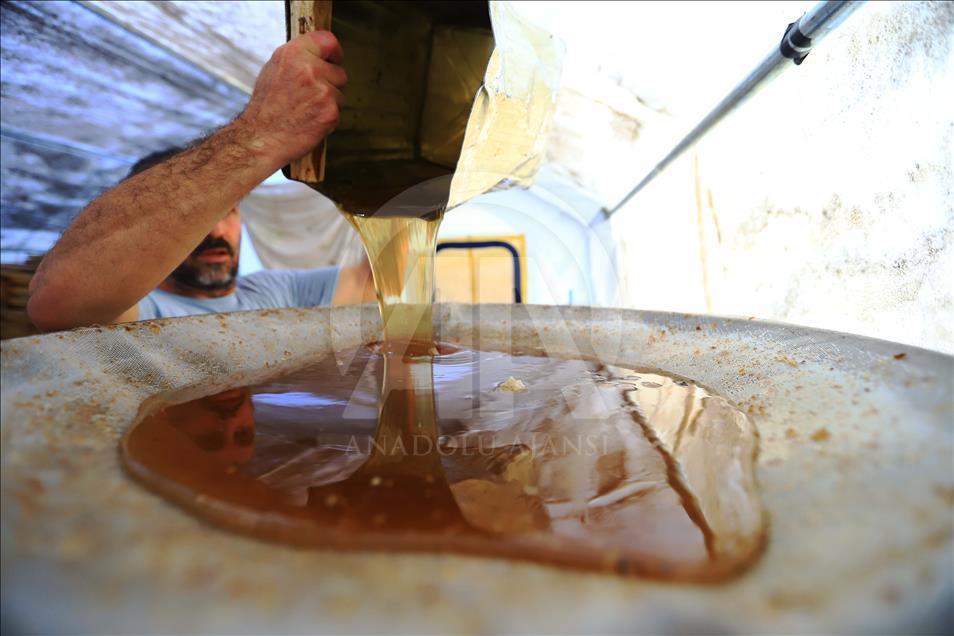
Marmaris Pine Honey (AA)
The production of pine honey in the Marmaris region dates back to the Ottoman period. Records from the Temettuât Defterleri compiled between 1840 and 1845 document that beekeeping was widespread in the area and that a large portion of the population owned hives. These registers serve as official evidence that pine honey has been produced in Marmaris for centuries. Marchalina hellenica has long adapted to the region’s climate and vegetation and remains one of the essential elements of honey production.
Marmaris’s Mediterranean climate shapes the distinctive qualities of the honey. Summers are hot and dry, while winters are mild and rainy, with annual precipitation exceeding 1200 mm. The period from May to September is dry, and frost events are rare during winter. These conditions create an ideal environment for the insect’s life cycle. Of the district’s total area of 87,100 hectares, 82,557 hectares are forested, providing extensive habitat for the insect population. The population of Marchalina hellenica begins to increase in the second half of July and reaches its peak in mid-August.
Marmaris pine honey is darker and more viscous than other pine honeys. Its moisture content does not exceed 18%, electrical conductivity is at least 1.09 mS/cm, hydroxymethylfurfural (HMF) is at most 40 mg/kg, free acidity is at most 46.89 meq/kg, proline content is at least 500 mg/kg, diastase number is at least 9, sucrose content is at most 10 g/100 g, glucose is 25.90 ± 2.40%, fructose is 28.93 ± 3.21%, glucose plus fructose is at least 45 g/100 g, fructose/glucose ratio is 1.0–1.4, and naphthalene content is at most 10 ppb. Compared to floral honeys, it is less sweet due to lower glucose and fructose levels and does not produce a burning sensation in the throat. It has high levels of enzymes, amino acids and mineral substances.
In terms of organoleptic properties, its color ranges from dark brown to reddish-brown; on the Hunter color scale, the L value is 35.06–72.36 (average 57.32), the a value is 13.12–28.23 (average 21.13), and the b value is 58.96–86.88 (average 78.58). Its taste is resinous and pine-scented, its aroma is characteristic of pine trees, its consistency is dense and its flow is slow. It can be stored for long periods without crystallizing. The dominant aroma compounds are nonanal (34%) and nonanol (19%), with other components including octanal (fatty, soapy, lemony, green), 1-octanol (soapy), and decanal (aldehydic, fatty, floral, green, orange peel). Pollen is predominantly from the Ericaceae family.
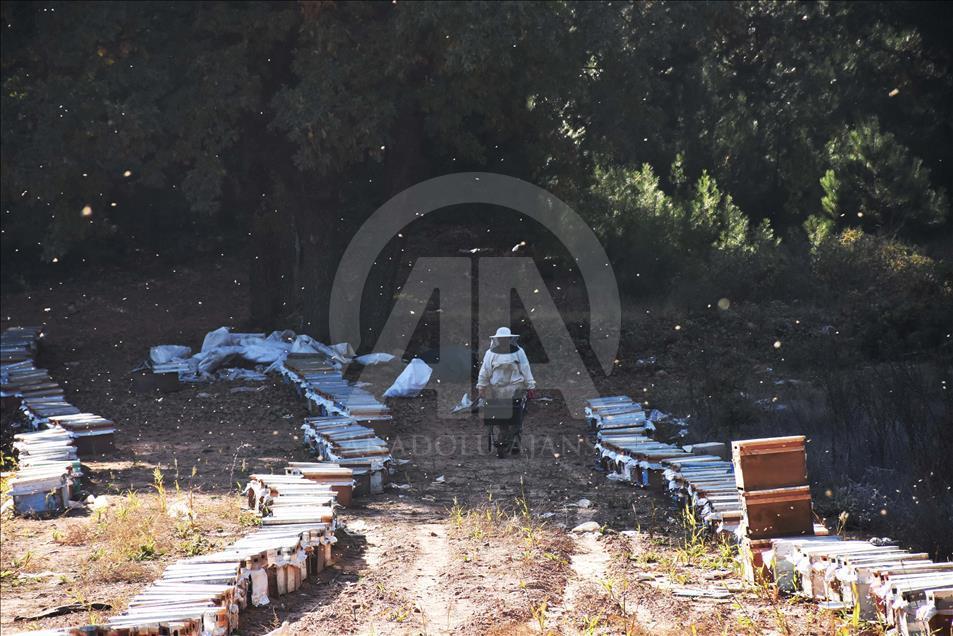
Marmaris Pine Honey (AA)
Production is carried out through both stationary and migratory beekeeping. During winter months (November–January), bees are housed in Marmaris; autumn feeding consists of thick syrup (2:1 sugar to water) for 15 days, followed by solid feeding using pollen supplements. Wintering sites must be dry, quiet, dark and have a 4% slope; hives are kept one meter above ground. In spring (February–May), bees forage on local flowers before migrating to neighboring provinces. Pine honey production begins in mid-July and continues until the end of October, allowing for up to three harvests.
Harvesting is conducted in the late afternoon when at least two-thirds of the combs are sealed. Combs are strained and then rested in stainless steel tanks. Varroa mite control is performed using licensed preparations in March–April and October, with techniques changed every two years. Honey is produced in three forms: strained (obtained by centrifugation), comb honey (at least 80% sealed), and wild hive honey (entirely constructed by bees and offered without straining). Packaging, storage and transportation comply with the Turkish Food Codex; honey is stored in light-protected packaging.
Monitoring is conducted at least once annually by a minimum three-member authority coordinated by the Marmaris Chamber of Commerce and Industry, comprising representatives from the District Directorate of Agriculture and Forestry, the Municipality and the Health Directorate. Producers must register with the chamber; apiaries are inspected for number of hives, location and flora. Notification prior to harvest is mandatory; on-site inspections and sampling are carried out during the second and third harvests. Analyses are performed in designated laboratories, with costs borne by the producer. Inspection reports are submitted annually to the Turkish Patent and Trademark Office. Additional inspections may be conducted in cases of complaints or suspicion.
Anadolu Ajansı. "Arıcıları çam balı kurtardı." Accessed October 19, 2025. https://www.aa.com.tr/tr/pg/foto-galeri/aricilari-cam-bali-kurtardi/6.
Turk Patent and Trademark Office. *Marmaris Çam Balı Tescil Belgesi*. Turk Patent and Trademark Office. Accessed October 19, 2025. https://ci.turkpatent.gov.tr/Files/GeographicalSigns/d995099f-ec4b-4fa8-b6fe-6ef788e33ba4.pdf.
Turkish Patent and Trademark Office. "Marmaris Çam Balı." *Geographical Indications Portal.* Accessed October 19, 2025. https://ci.turkpatent.gov.tr/cografi-isaretler/detay/38243.

Type of Geographical İndication | Place of Origin | ||||||||
|---|---|---|---|---|---|---|---|---|---|
Registration Number | 469 | ||||||||
Registration Date | 06.11.2019 | ||||||||
Product / Product Group(s) | Honey | ||||||||
Province(s) | Muğla | ||||||||
Applicant/Registrant(s) | Marmaris Chamber of Commerce | ||||||||
No Discussion Added Yet
Start discussion for "Marmaris Pine Honey" article
History and Origin
Geographical and Climatic Characteristics
Physical and Chemical Properties
Production Method
Monitoring and Protection