


This article was automatically translated from the original Turkish version.
+2 More
Agricultural Mechanization
Definition(s) | Use of machinery and technology to increase efficiency and quality in agricultural production. tools | ||||||||
|---|---|---|---|---|---|---|---|---|---|
Basic Objectives | Increased efficiency, cost reduction, labor savings, and improved product quality. | ||||||||
Basic Tools | Tractor, combine harvester, thresher, plow, spraying and fertilizing machines. | ||||||||
Number of Tractors in Türkiye (2019) | 1354912 | ||||||||
Agricultural mechanization is a scientific discipline encompassing all activities related to the design, manufacture, development, marketing, dissemination, training, selection, operation, use, and maintenance of energy sources and mechanical equipment used for the improvement of agricultural land, the execution of all types of agricultural production, and the evaluation of products as a requirement of advanced production technologies. In simple terms, mechanization, meaning the adoption of machinery, in agriculture refers to meeting the necessary energy and power requirements of farms through motorization (use of engine power) and electrification (use of electrical energy).
Agricultural mechanization is recognized as a production technology and serves as a tool that enables the effective and economic implementation of other agricultural technologies such as soil and water conservation, irrigation, fertilization, pest control, and biotechnology. Historically, agricultural activities that began with human muscle power evolved to the use of animal power, then transitioned to machine use with the Industrial Revolution and the invention of internal combustion engines, and today exhibit further development by incorporating advanced technologies such as sophisticated sensors, unmanned aerial vehicles (drones), computerized systems, and autonomous tractors.
The historical development of agricultural mechanization parallels humanity’s transition to settled life. The earliest developments began with the use of sticks to bury stored seeds into the soil, followed by simple tools drawn by domesticated animals. The most primitive forms of the plow are believed to have originated in Mesopotamia.
With the Industrial Revolution, large steam-powered tractors were developed, but widespread adoption occurred only after the discovery of internal combustion engines. The proliferation of tractors led to the development of new agricultural implements and machines designed to work alongside them. The addition of power take-off shafts to tractors in 1925 and the introduction of hydraulic suspension systems in 1937 marked significant milestones by enabling both stationary and mobile machines to draw power directly from the tractor engine and achieve more effective control.
In the period before the Republic, agricultural production in Türkiye relied heavily on human and animal power. The energy revolution experienced in Europe and the United States in the late 19th century had little noticeable impact on Turkish agriculture, and mechanization efforts remained limited. In the final years of the First World War, a number of tractors, threshers, and sickle machines were imported from Germany and Austria to address declining production levels.
During the Republican era, various measures were taken to promote the use of machinery in agriculture, and in 1924, 221 tractors were imported. However, global factors such as the Second World War slowed these efforts. The Turkish Agricultural Equipment Institution, established in 1944, contributed to the advancement of mechanization by providing machinery and maintenance services to farmers. The Marshall Plan in 1949 led to an increase in the number of tractors, rising from 11,729 in 1949 to 31,413 in 1952. Domestic production of combine harvesters began in Türkiye in 1968, but local manufacturing ceased after 1988 due to unplanned imports. Today, Türkiye has approximately 1,000 manufacturers and importers of agricultural machinery, with 14 firms operating in the tractor sector.

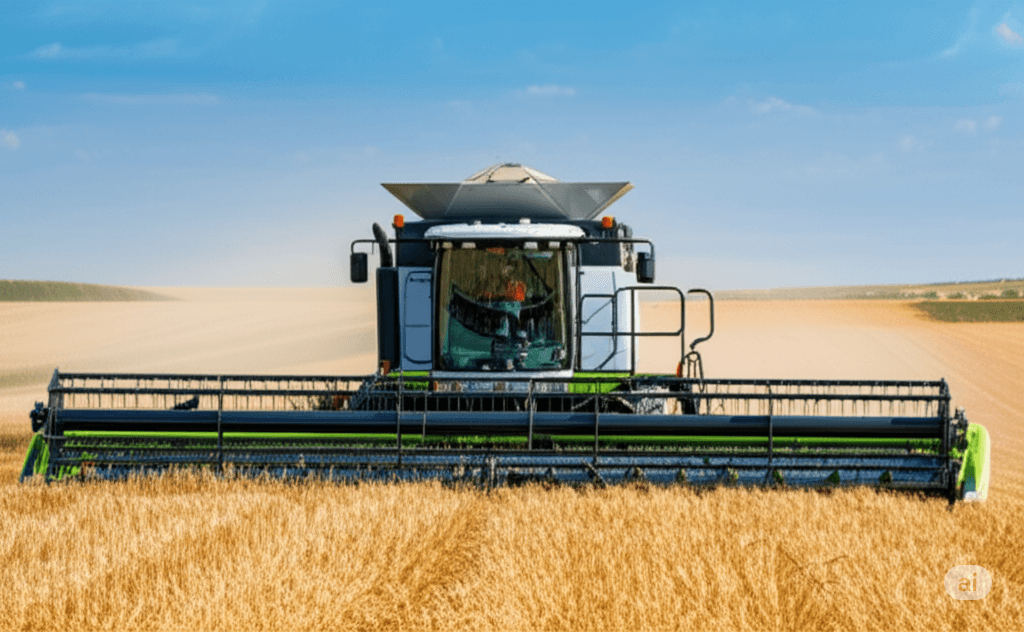
Modern Mechanization Systems Enhancing Agricultural Productivity (Generated by Artificial Intelligence)
The main purposes and benefits of agricultural mechanization practices can be summarized as follows:
When agricultural mechanization is implemented inappropriately or without planning, it can lead to several drawbacks. These negative effects include:

The Future of Agriculture Is Shaped by Technology (Generated by Artificial Intelligence)
In an agricultural enterprise, increased profitability depends on selecting tractors and machinery that match operational needs and using them economically. Mechanization costs can constitute the largest expense component after land and building costs.
Total costs associated with an agricultural machine are analyzed under two main categories: “fixed costs” and “variable costs.”
Due to the high cost of mechanization investments, the method of acquiring machinery is of critical importance. Common methods in Türkiye include:
Standard indicators are used to determine and compare the level of agricultural mechanization in a region or country. Since tractors serve as the primary power source, indicators are generally based on tractor availability. The most commonly used criteria are:
The global agricultural machinery sector is evolving around food quality, efficiency, and technology use. According to 2008 data, the global market for agricultural machinery and tractors reached 67 billion Euros. In 2007, Germany led global tractor and equipment exports, followed by the United States (%15), Italy (%10), and France (%7). It is estimated that approximately 27.7 million tractors are in use worldwide, with 41% in Europe, 26% in the Americas, and 29.5% in Asia.
In Türkiye, agricultural mechanization has shown quantitative growth in terms of both tractor and equipment availability. However, structural issues and regional disparities persist. Compared with the European Union (EU), Türkiye’s mechanization indicators fall below EU averages. According to 2010 data, some key indicators are as follows:
One of the main reasons for these differences is the small and fragmented structure of agricultural holdings in Türkiye. The average farm size in Türkiye is 6 hectares, compared to 15.8 hectares in the EU.
The number of tractors in Türkiye increased from 654,636 in 1988 to 1,332,139 in 2018. However, the average age of the tractor fleet is 24 years, and a significant portion (less than 33%) is considered economically usable, having reached the end of its economic life. Tractors that have reached the end of their economic life consume approximately 30% more fuel and emit higher levels of pollutants compared to newer models. According to 2018 data, 39.3% of two-axle tractors fall within the 35–50 HP range, and 40.3% fall within the 51–70 HP range.
The number of combine harvesters increased from 12,578 in 2000 to 17,266 in 2018. However, as of 2018, 52.9% of the combine harvester fleet is over 10 years old, and 29.9% is over 20 years old. Harvesting with these aging machines results in approximately 8% grain loss, causing significant economic damage.
In Türkiye, as of 2017, 1,161 manufacturing firms operate in the agricultural machinery sector. While the number of traditional tools such as animal-drawn plows and seeders has declined, the number of modern equipment such as fruit harvesters and motorized reapers has increased. Analysis of foreign trade data shows that Türkiye has become a net exporter of agricultural mechanization equipment. In 2018, equipment exports amounted to 406.4 million US dollars, while imports reached 298.2 million US dollars. The largest share of exports, at 32%, consists of soil preparation, sowing, fertilization, and crop care equipment; the largest share of imports, at 54.5%, is for harvesting and threshing equipment.
The level of agricultural mechanization in Türkiye varies significantly between regions and provinces. Generally, mechanization levels are lower in dryland farming areas and mountainous regions compared to irrigated areas. According to 2004 data, Düzce had the highest mechanization level at 10.01 kW/ha, while Trabzon had the lowest at 0.09 kW/ha.
Agricultural mechanization involves human-machine-environment interactions, which have significant implications for occupational safety and health. Ergonomics as a science aims to study these interactions and establish healthy and safe working conditions.
Users of agricultural machinery are exposed to various ergonomic risk factors during work. These factors include:
Research shows that work accidents related to agricultural mechanization occur on a significant scale. Accidents most frequently result from tractor rollovers, attempts to clear blockages while machinery is in operation (leading to limb amputations), getting on and off tractors, and transportation accidents involving farm vehicles. Preventive measures such as engineering services (safe designs, protective guards), training, use of personal protective equipment, and workplace discipline are essential to reduce these accidents.
Ertekin, Can, Haşmet Emre Akman, and İsmail Boyar. "Türkiye’de Tarımsal Mekanizasyona Bir Bakış." *Yüzüncü Yıl Üniversitesi Tarım Bilimleri Dergisi* 31, no. 3 (2021): 786–798. Accessed July 9, 2025. https://dergipark.org.tr/en/pub/yyutbd/issue/64890/872793
Gökdoğan, Osman. “Türkiye ve Avrupa Birliği’nin Tarımsal Mekanizasyon Düzeyi Göstergelerinin Karşılaştırılması.” *Adnan Menderes Üniversitesi Ziraat Fakültesi Dergisi* 9, no. 2 (December 2012): 1–4. Accessed July 9, 2025. https://dergipark.org.tr/tr/pub/aduziraat/issue/26423/278160
Kabaş, Önder. *Tarımsal Mekanizasyonun Dünyada ve Türkiye’deki Yeri.* Accessed July 9, 2025. https://arastirma.tarimorman.gov.tr/batem/Belgeler/Kutuphane/Teknik%20Bilgiler/tarimsal%20mekanizasyon.pdf
Koçtürk, Derya, and A. Avcıoğlu. "Türkiye’de bölgelere ve illere göre tarımsal mekanizasyon düzeyinin belirlenmesi." *Tarım Makinaları Bilimi Dergisi* 3, no. 1 (2007): 17–24. Accessed July 9, 2025. https://dergipark.org.tr/en/download/article-file/119126
Öztekin, Serdar. *Tarımsal Mekanizasyon 1: Ders Notları.* Çukurova Üniversitesi Tarım Makinaları Bölümü. Accessed July 9, 2025. https://tarimmakinalari.cu.edu.tr/storage/Serdar%20%C3%B6ztekin%20ders%20notu/Tar%C4%B1msal%20Mekanizasyon%201.pdf#page=1.00

Agricultural Mechanization
Definition(s) | Use of machinery and technology to increase efficiency and quality in agricultural production. tools | ||||||||
|---|---|---|---|---|---|---|---|---|---|
Basic Objectives | Increased efficiency, cost reduction, labor savings, and improved product quality. | ||||||||
Basic Tools | Tractor, combine harvester, thresher, plow, spraying and fertilizing machines. | ||||||||
Number of Tractors in Türkiye (2019) | 1354912 | ||||||||
No Discussion Added Yet
Start discussion for "Agricultural Mechanization" article
Historical Development
Historical Development in Türkiye
Purposes, Benefits, and Drawbacks of Agricultural Mechanization
Purposes and Benefits
Drawbacks
Agricultural Mechanization Management
Machinery Costs
Machinery Acquisition Methods
Determining the Level of Application: Indicators
Current Situation in the World and in Türkiye
Global Situation
Situation in Türkiye
Overview and Comparison with the European Union
Tractor and Combine Harvester Availability
Agricultural Machinery Industry, Foreign Trade, and Regional Disparities
Ergonomics and Occupational Safety in Agricultural Mechanization
Ergonomic Factors and Health Issues
Work Accidents and Preventive Measures