


This article was automatically translated from the original Turkish version.
Tırpan; a farming and landscaping tool originally operated by hand for cutting grass, cereals, and similar crops, later developed into motorized and battery-powered variants.
In the Ottoman Empire, the tırpan was one of the fundamental tools of agricultural production and played a significant role in the farming practices of both smallholders and large estates (çift-hâne). It served as the primary labor instrument in cereal harvesting, meadow cutting, and general field management. In this context, the tırpan was an integral part of the daily life of the Ottoman peasant, directly influencing agricultural labor intensity and production processes.
Following the Industrial Revolution, advancements in metalworking and motor technology enabled traditional tırpans to become more durable and ergonomic. Simultaneously, the development of motorized harvesting machines introduced new cutting techniques.
The Industrial Revolution transformed the materials and usage dynamics of the tırpan: lighter, more durable, and longer-lasting blades were produced, and motorized models began to spread widely in rural areas.
Small and medium-scale farmers increasingly prefer motorized and battery-powered tırpans as energy-efficient and environmentally sensitive tools. According to this study, within the framework of sustainable agricultural policies, tırpans are particularly favored in sloped or mechanically inaccessible terrain. Additionally, the use of motorized tırpans contributes to preventing excessive soil compaction and preserving biodiversity.
Motorized lawn mowers and modern motorized tırpans are widely used in landscape management and rural area maintenance.
The following aspects are emphasized in this guideline:
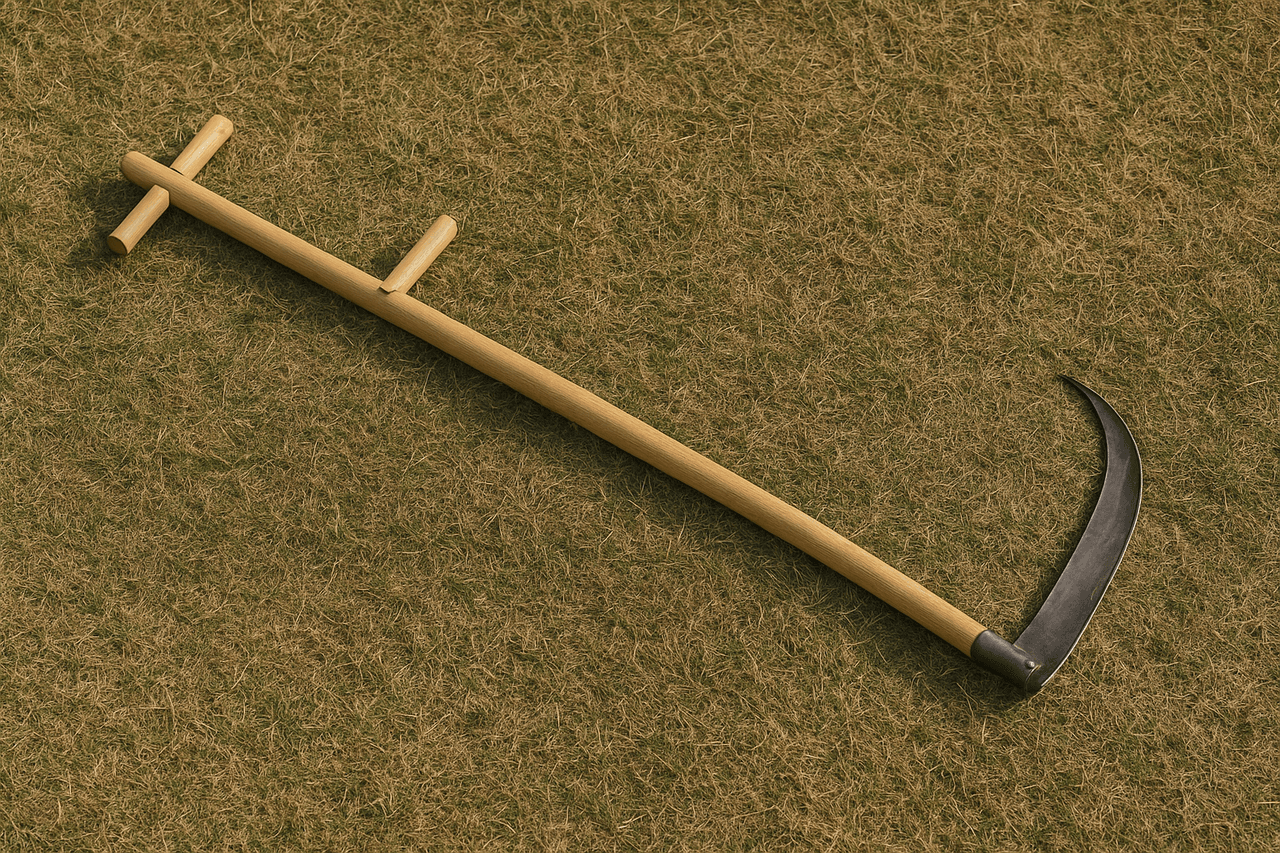
Hand Tırpan. (Generated by artificial intelligence.)
İskenderun Technical University’s Shoulder-Mounted Lawn Mowing Tırpan Instruction highlights the following aspects for the use of motorized shoulder-mounted tırpans:
The Safe Operation Instruction for Motorized Tırpan, prepared by Bitlis Eren University, provides detailed safety measures and operational procedures for motorized tırpan use:
A study of agricultural mechanization in Türkiye between 1980 and 2018 analyzed the process by which traditional tools such as the tırpan were gradually replaced by motorized equipment. Despite this transition, tırpans continue to play a vital role in small-scale and subsistence farming. This is primarily due to the fact that full mechanization systems, which require high investment costs, are not always accessible to small rural farms.
The most common risks encountered during motorized tırpan use have been identified as:
Safety guidelines published by universities and relevant official institutions must be strictly implemented in the field.
Bartın Üniversitesi. "Çim ve Ot Biçme Makineleri Kullanma Talimatı." Accessed June 8, 2025. https://cdn.bartin.edu.tr/yapiisleri/c1e42b54ec62fc73cae66024814521c7/cim-ve-ot-bicme-makineleri-kullanma-talimati.pdf
Bitlis Eren Üniversitesi. "Motorlu Tırpan Güvenli Çalışma Talimatı." Accessed June 8, 2025. https://www.beu.edu.tr/Dosyalar/Birimler/293/Talimatlar/TL_%C4%B0SG_011_Motorlu_T%C4%B1rpan_G%C3%BCvenl.pdf
Divitçioğlu, Sencer. *Osmanlı Klasik Çağı’nda (1300–1600) Tarım ve Vergileme.* İstanbul Üniversitesi, 2010. Accessed June 8, 2025. https://nek.istanbul.edu.tr/ekos/TEZ/53433.pdf
Istanbul University. *Sürdürülebilir Tarım – Dalaman Ovası Mekânsal Analizi.* 2023. Accessed June 8, 2025. https://nek.istanbul.edu.tr/ekos/TEZ/54064.pdf
Kara, Orhan, and Arslan, Emine. "Motorlu El Aletleri Kullanımında İş Sağlığı ve Güvenliği Üzerine Makale." Dergipark. Accessed May 24, 2025. https://dergipark.org.tr/tr/download/article-file/4562914
Yazıcı, Arife. *Tarım Sektörünün Türkiye Ekonomisine Katkısı (1980–2018).* Nevşehir Üniversitesi, 2021. Accessed June 8, 2025. https://acikerisim.nevsehir.edu.tr/bitstream/handle/20.500.11787/5992/AR%C4%B0FE%20YAZICI.pdf
İskenderun Teknik University. "Omuz Askılı Çim Biçme Tırpanı Talimatı." 2022. Accessed June 8, 2025. https://iste.edu.tr/files/594_files_1670879299.pdf
İstanbul Üniversitesi. *Sanayi Devrimi Tarımın Modernizasyonuna Etkileri.* 2019. Accessed June 8, 2025. https://nek.istanbul.edu.tr/ekos/TEZ/47876.pdf

Historical Background
The Role of the Tırpan in the Ottoman Period
Industrial Revolution and Mechanization
Sustainable Agriculture and Environmental Impacts
Landscape and Grass Cutting Applications
Shoulder-Mounted Motorized Tırpans
Occupational Health and Safety in Motorized Tırpan Use
Socio-Economic Perspective
Development of Mechanization in Turkish Agriculture
Occupational Health and Safety Perspective