


This article was automatically translated from the original Turkish version.
+1 More
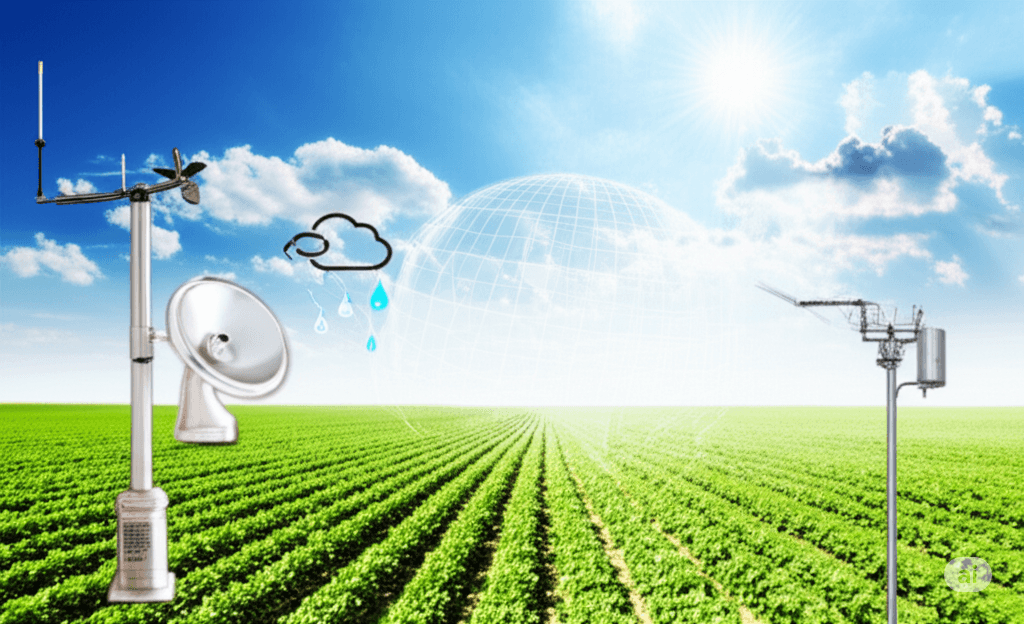
Agricultural Meteorology (generated with artificial intelligence)
Main Area | Agriculture and Atmospheric Sciences | ||||||||
|---|---|---|---|---|---|---|---|---|---|
Purpose(s) | Increase agricultural yield and quality minimize the damage of adverse weather conditions | ||||||||
Related Disciplines | Meteorology, Agronomy, Biology, Ecology, Technology | ||||||||
Important Factors | Temperature, Precipitation, Humidity, Wind, Frost, Sunlight, Leaf Wetness | ||||||||
Application Area(s) | Planting Disease and Pest Management Frost Protection Harvest Planning Fertilization Spraying Irrigation | ||||||||
Modern Technologies | Automatic Meteorological Stations, Mobile Applications, Satellite Data, Disease Modeling, API Services | ||||||||
Agricultural Meteorology is a scientific discipline that studies the effects of physical phenomena in the atmosphere on agricultural production and the behavioral responses and reactions of living organisms—including economically significant crop plants, livestock animals, insects, and pathogenic microorganisms—to their physical environment. Recognized as a subfield of meteorology, agricultural meteorology focuses on the use and interpretation of a large portion of meteorological data in agriculture.
The primary objective of this discipline is to provide producers and farmers with the necessary information and warnings regarding climate and weather conditions to enhance the yield and quality of agricultural production, minimize potential damages caused by adverse weather conditions, and ensure the economic use of agricultural inputs such as fertilizers, pesticides, and labor. According to an assessment by the World Meteorological Organization (WMO), the cost-benefit ratio of meteorological services in agriculture is 1:15, meaning that for every unit of cost spent on weather forecasting, 15 units of benefit are generated in agriculture.
The earliest records of the impact of weather and climate on agriculture date back to Roman and Chinese civilizations. The history of phenological calendars, which track developmental stages of living organisms, extends as far back as 500 BCE. The invention of instruments such as the hydrometer (1593) and the barometer (1643) during the Renaissance laid the groundwork for advancements in this field.
The institutionalization of the relationship between agriculture and meteorology at the international level began with the establishment of the "Commission on Agricultural Meteorology" within the International Meteorological Organization (IMO) in 1913. Work was interrupted due to World War I but resumed after the commission was re-established in 1919 and has continued since 1951 under the auspices of the World Meteorological Organization (WMO), a specialized agency of the United Nations.
In Türkiye, the origins of agricultural meteorology applications developed in parallel with the institutionalization of agricultural education. In 1891, an observatory section was established within the Halkalı Higher Agricultural School, where meteorological observations such as temperature, humidity, precipitation, wind direction, and wind speed were conducted. These observations were regularly published in the school’s publication, the Halkalı Higher Agricultural School Journal. Modern agricultural education continued with the establishment of the Higher Agricultural School in Ankara in 1930 and its successor, the Higher Institute of Agriculture. From 1955 onward, the opening of new agricultural faculties within Ankara University, Aegean University, Atatürk University, and Çukurova University expanded agricultural education and, consequently, research in agricultural meteorology.
Agricultural meteorology maintains close ties with meteorology and climatology but possesses its own distinct approach and area of study.
Meteorology generally examines atmospheric phenomena and processes, presenting data in raw or generalized terms. For example, synoptic meteorology may report that the lowest temperature in a region was 3°C, while agricultural meteorology interprets this same value in terms of frost risk for local crop species or as accumulated heat units affecting plant development. Similarly, hydro-meteorology may report total monthly precipitation as 45 mm, whereas agricultural meteorology evaluates whether this amount meets the water needs of local plants and determines if and how much irrigation is required.
Climatology studies long-term averages, deviations, and climate types of atmospheric phenomena over many years. It essentially functions as a database and analytical framework for processed meteorological data. Agricultural meteorology takes these climatological data—such as frost calendars, prevailing wind directions, and long-term averages of precipitation and temperature—and develops specialized interpretations and plans for agricultural applications such as farm planning, crop pattern selection, and drought analysis.

Climate Conditions Monitored for Livestock Productivity (Generated by Artificial Intelligence)
Agricultural meteorology transforms meteorological data into actionable information for every stage of agricultural production. Its main areas of study include:
The temperature range required for plants to sustain vital activities generally varies between 0–54°C. Agricultural meteorology examines the minimum, optimal, and maximum temperatures required by different crops for germination, growth, and development. It also investigates the following:
Wind plays a role in plant transpiration, soil evaporation, and the dispersal of seeds and disease spores. The optimal wind speed for plants is generally considered to be 3–5 m·s−1; however, speeds exceeding 10 m·s−1 can cause mechanical damage and wind erosion.
Decreasing air humidity combined with rising temperatures increases evaporation, while humid conditions create favorable environments for the proliferation of plant diseases and fungi. Soil moisture is a critical factor for seed germination, root development, and nutrient uptake; deficiency leads to wilting, while excess causes root rot.
Light drizzle, rain, and snow are the most beneficial forms of precipitation for agriculture. Snow cover acts as an insulating layer that protects plants from freezing during winter months. Hail, however, is a destructive form of precipitation that causes significant damage, particularly during the growth phase of crops and in fruit orchards.
Light directly influences physiological processes such as chlorophyll formation, photosynthesis, transpiration, and hormone production. Cloud cover reduces sunlight and temperature while increasing humidity and precipitation, potentially promoting certain fungal diseases.
One of the most damaging meteorological events in agriculture. Agricultural meteorology classifies frost events by their formation type (radiation frost and advection frost), timing (late spring frosts and early autumn frosts), and intensity. It develops both passive (site selection, crop selection, soil tillage methods) and active (heaters, wind machines, sprinkler irrigation) protective measures and operates early warning systems to mitigate frost risk.
Drought, generally defined as water deficiency, occurs when precipitation falls below normal levels. Agricultural drought is specifically defined as the point at which available soil moisture drops to the wilting point of plants. Drought analyses are typically conducted using methods such as the Standardized Precipitation Index (SPI), Percent of Normal Index (PNI), and Palmer Drought Severity Index (PDSI).
Agricultural meteorology plays a key role in assessing the risk of forest fires. Parameters such as air temperature, relative humidity, wind speed, and the time elapsed since the last precipitation influence the moisture content of forest floor litter (fuel), thereby determining fire risk.
The monitoring and recording of key developmental stages in plants and animals, such as budburst, flowering, harvest, and migration. These observations enable the determination of optimal crop patterns and planting-harvesting schedules for a given region.
Water and wind erosion are processes that remove the fertile topsoil layer. Agricultural meteorology analyzes factors such as rainfall intensity and wind speed to assess erosion risk and supports the planning of protective farming techniques such as windbreaks and strip cropping.
In Türkiye, the General Directorate of Meteorology (MGM) provides various products and services to the agricultural sector through its Agricultural Meteorology Sub-Directorate. These services include:
Karaoğlu, Mücahit. "Türkiye Ziraat Eğitiminde Ziraî Meteoroloji." *Journal of Agriculture* 1, no. 1 (2018): 42–48. Accessed July 10, 2025. https://dergipark.org.tr/en/download/article-file/495129
Karaoğlu, Mücahit. "Ziraat ve meteoroloji veya ziraȋ meteoroloji." *Journal of Agriculture* 1, no. 1 (2018): 49–54. Accessed July 10, 2025. https://dergipark.org.tr/en/download/article-file/495117
Ministry of Environment and Forestry of the Republic of Turkey, General Directorate of Meteorological Affairs. *Zirai Meteoroloji.* Accessed July 10, 2025. https://mgm.gov.tr/FILES/genel/kitaplar/zirai-meteoroloji.pdf
T.C. Ministry of Forest and Water Affairs, General Directorate of Meteorology. *Zirai Meteoroloji.* Directorate of Agricultural and Meteorological Research, Agricultural Meteorology Branch Directorate, October 2016. Accessed July 10, 2025. https://www.mgm.gov.tr/files/genel/kitaplar/ziraimeteoroloji.pdf

Agricultural Meteorology (generated with artificial intelligence)
Main Area | Agriculture and Atmospheric Sciences | ||||||||
|---|---|---|---|---|---|---|---|---|---|
Purpose(s) | Increase agricultural yield and quality minimize the damage of adverse weather conditions | ||||||||
Related Disciplines | Meteorology, Agronomy, Biology, Ecology, Technology | ||||||||
Important Factors | Temperature, Precipitation, Humidity, Wind, Frost, Sunlight, Leaf Wetness | ||||||||
Application Area(s) | Planting Disease and Pest Management Frost Protection Harvest Planning Fertilization Spraying Irrigation | ||||||||
Modern Technologies | Automatic Meteorological Stations, Mobile Applications, Satellite Data, Disease Modeling, API Services | ||||||||
No Discussion Added Yet
Start discussion for "Agricultural Meteorology" article
Historical Development
Conceptual Framework and Relationship with Other Disciplines
Meteorology and Agricultural Meteorology
Climatology and Agricultural Meteorology
Areas of Study and Applications
Analysis of Meteorological Parameters and Their Agricultural Impacts
Temperature
Wind
Humidity
Precipitation
Sunlight and Radiation
Analysis and Forecasting of Agricultural Meteorological Events
Frost Events
Drought
Forest Fires
Phenological Observations
Erosion
Institutional Products and Services