


This article was automatically translated from the original Turkish version.
Orographic precipitation is a meteorological phenomenon in which terrain features, particularly mountains, force air masses to rise and cool, resulting in precipitation. This mechanism occurs due to the interaction between topography and the atmosphere. As moist air is forced to ascend along a slope, it cools, condenses, and ultimately produces precipitation.
This type of precipitation typically concentrates on the windward slopes of mountains, while the leeward side — the side not exposed to the wind — develops a rain shadow. Consequently, orographic precipitation not only creates a moist and green climate on one side of a mountain range but can also lead to arid conditions on the opposite side. This effect is highly decisive for agriculture, water resources, and settlement planning.
Orographic precipitation must not be considered solely in terms of geographic factors but must also be evaluated alongside meteorological dynamics. Many variables, including temperature profile, humidity levels, air mass stability, and wind direction, play a role in the formation of this precipitation type. For example, stable air masses limit orographic precipitation, whereas moist and unstable air masses ready to rise can produce significant rainfall.
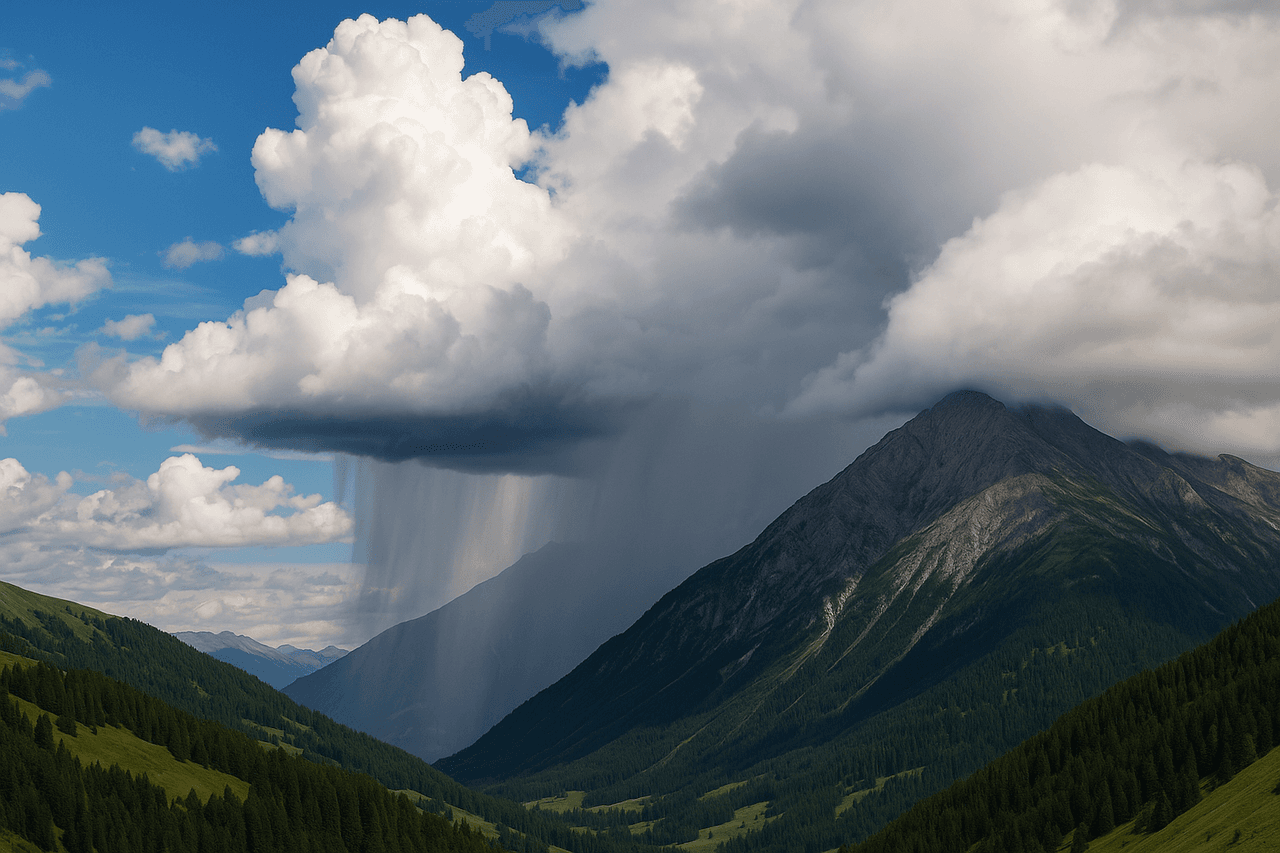
A visual representing precipitation formed by rising air (generated by artificial intelligence).
The fundamental mechanism of orographic precipitation lies in the forced ascent of an air mass along a mountain slope. As air rises, atmospheric pressure decreases, causing the air to expand and cool. This cooling is known as adiabatic cooling. If the air is sufficiently moist, condensation begins as it cools, leading to cloud formation. Following condensation, precipitation occurs.
When the rising air reaches saturation, the water vapor within it changes into liquid form. During this process, latent heat of condensation is released, which helps the rising air to continue ascending for a longer duration. This energy feedback mechanism can intensify the precipitation.
For precipitation to begin, the air mass must be both sufficiently moist and unstable. If the air is too dry, it may reach the summit without undergoing condensation, resulting in no cloud formation and no precipitation.
Clouds formed along the slope are typically of the stratocumulus and nimbostratus types. Orographic precipitation is generally more continuous than convective precipitation but tends to be lighter in intensity. This characteristic provides long-lasting and stable moisture.
Orographic precipitation can occur in various geographic regions worldwide. This type of precipitation is especially prevalent in areas dominated by mountain ranges. For instance, high terrain such as the Himalayas, Rocky Mountains, Andes, Alps, and Black Sea coastal mountains provide ideal conditions for orographic precipitation.
The Indian monsoon system triggers intense orographic precipitation on the southern slopes of the Himalayas, while creating a significant rain shadow over the northern part of the Tibetan Plateau. Similarly, the western slopes of the Sierra Nevada Mountains in the United States receive heavy rainfall, while arid conditions prevail in states such as Nevada and Arizona on the eastern side.
In Türkiye, the Eastern Black Sea Mountains and the Taurus Mountains are the regions where this type of precipitation is most frequently observed. Cities such as Rize and Artvin are affected by these rains for much of the year. This situation shapes numerous parameters, from agricultural production to forest cover.
In some areas, orographic precipitation gives rise to microclimates. For example, heavy rainfall at high elevations can create a cooler and more humid environment compared to surrounding areas. This condition directly influences agricultural patterns and biological diversity.
Orographic precipitation plays a significant role in shaping regional climate characteristics. On permanently moist mountain slopes, forests and rich vegetation thrive, while the leeward slopes may experience aridity, semi-desert, or steppe conditions. Therefore, the concept of climatic asymmetry is closely associated with orographic precipitation.
Ecologically, orographic precipitation sustains both the water cycle and local ecosystems. Terrestrial moisture balance, groundwater reserves, and river regimes are shaped by this type of precipitation. Flora and fauna in these regions consist of species adapted to moist environments. However, persistent and excessive rainfall can also lead to soil erosion, landslides, and flooding. Especially on steep terrain, the intensity and duration of rainfall affect soil stability, a factor that must be considered in rural settlement planning.
From an agricultural perspective, orographic precipitation can be both advantageous and risky. While it reduces the need for irrigation — a positive effect — excessive moisture can increase the risk of plant diseases. Therefore, accurate analysis of the precipitation regime is critical for agricultural planning.
Another consequence of orographic precipitation is the rain shadow effect. As air ascends the windward side of a mountain and releases precipitation, it descends on the leeward side, warming as it does so. This descending air becomes dry and stable, resulting in almost no precipitation on the leeward slope. This phenomenon creates geographically close yet climatically distinct regions. Examples include the Thar Desert in India, the Atacama Desert in Chile, and the Mojave Desert in the United States. In Türkiye, the Iğdır Plain lies within the rain shadow of Mount Ağrı.
This effect has important consequences not only for climate but also for economy and settlement. Agriculture is often impossible in arid zones, while windward slopes can support moisture-loving crops such as tea and hazelnut. This influences both production patterns and population distribution.
The rain shadow effect also influences the atmosphere’s heat and cooling balance. Leeward areas develop warmer and drier microclimates. This contrast is an important consideration in land-use planning.
Accurate placement of meteorological stations is essential for observing orographic precipitation. By installing measurement stations on both the windward and leeward sides of mountains, precipitation distribution can be analyzed. Automatic rain gauges, radiosondes, radars, and satellite imagery are used in these observations.
In particular, Doppler radar systems can map the spatial distribution of orographic precipitation with high resolution, enabling short-term flood risk predictions. Remote sensing technologies also provide significant advantages in mountainous areas where field measurements are difficult.
Numerical weather prediction models are also used to simulate orographic precipitation. In these models, topographic parameters are precisely defined to calculate atmospheric behavior. However, they require high-resolution data and substantial computational power.
Model outputs are calibrated by comparing them with ground observations. This method is widely applied in early warning systems and disaster risk management. Additionally, these models serve as fundamental tools for generating climate scenarios.

Automatic Observation Station (generated by artificial intelligence).
Houze Jr, Robert A. "Orographic effects on precipitating clouds." *Reviews of Geophysics* 50, no. 1 (2012): RG1001. https://doi.org/10.1029/2011RG000365
Roe, Gerard H. "Orographic precipitation." *Annual Review of Earth and Planetary Sciences* 33 (2005): 645–671. https://doi.org/10.1146/annurev.earth.33.092203.122541
Smith, Ronald B. "The influence of mountains on the atmosphere." *Advances in Geophysics* 21 (1979): 87–230. https://doi.org/10.1016/S0065-2687(08)60262-9

No Discussion Added Yet
Start discussion for "Orographic Precipitation" article
Formation Process of Orographic Precipitation
Geographic Regions Affected
Climatic and Ecological Consequences
Rain Shadow Effect
Observational Measurements and Modeling