

This article was automatically translated from the original Turkish version.
+2 More
Location | Istanbul, Eyüpsultan, Feshane Street | ||||||||
|---|---|---|---|---|---|---|---|---|---|
Architectural Plan | Square-plan structure | ||||||||
Construction Material | Regular pattern of three rows of brick and one row of cut stone | ||||||||
Roof Structure | Wood | ||||||||
Restoration Date | 1957 | ||||||||
Buried Personality | Ahmet Pir Edirnevi (according to the Kitabeye, the author of Tecvid, Karabaş Ahmed Efendi) | ||||||||
Ahmet Pir Edirnevi Türbesi is located on Feshane Caddesi in the Eyüpsultan district of Istanbul. The structure is surrounded by cemeteries on both sides. To the right of the türbe are the tombs of Mehmed Vusuli Efendi and Hubbi Hatun, while to the left are the Zal Mahmud Paşa Medresesi and Camii. At the end of the garden behind the building stands the Nakkaş Hasan Paşa Türbesi.【1】
Pir Ahmed Edirnevi (Türbe Delisi)
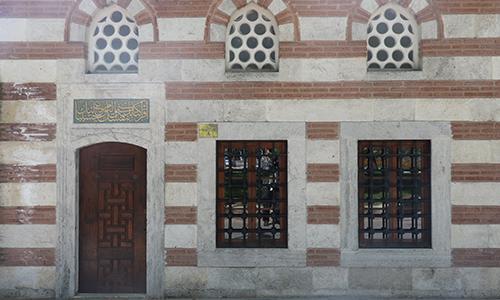
The türbe has a square plan and is constructed using a regular brickwork system consisting of three rows of brick and one row of cut stone. The structure underwent restoration in 1957. Its architectural elements include a wooden roof and windows on both the lower and upper levels.
The entrance door is made of marble with an arch; above this door is a verse from the Qur’an written by the calligrapher Hâmid. On the facade facing the street, there is a classical iron grille window.【2】
The türbe contains a single grave. An inscription added later identifies the interred individual as "Tecvid müellifi Karabaş Ahmed Efendi." According to historical sources, Pir Ahmed Edirnevi belonged to the Melâmiye-i Bayramiye Sufi order, and his spiritual lineage traces back to Ömer Sikkini, who died in 1475 (H. 880).
Pir Ahmed Edirnevi was a successor of Pir Ali Aksarayi (d. 1528), who himself was a disciple of Bünyâmin Ayaşî (d. 1520). Pir Ali Aksarayi sent his disciples, his son known as "Oğlan Şeyh" İsmail Maşuki (d. 1528) and Şeyh Ahmed Edirnevi, to Istanbul.【3】
Edirneli Pir Ahmed Efendi composed a special devotional hymn that was performed in all tekkes until their closure. This composition, beginning with the lines "The path to God is this path / The purpose of all creation is here," addresses the oneness and perfection of God and the devotee’s surrender along this path. In the pen name section of the work, the name "Ahmed Üryan" is used.【4】
In the cemetery to the right of the türbe lies the four-cornered kofeke stone tomb of Cafer Efendi, Anatolian Kadıasker and son of Abdünnebi Efendi, who died in 1577 (H. 985) and was the uncle of Şeyhülislam Ebû's-su'ud Efendi. Also in this area are the graves of Ahmed Efendi, imam of Zal Paşa (dated 1738 H. 1151), Debbag Mehmed Ağa (dated 1768 H. 1182), Bilal Ağa, chief attendant of Esma Sultan (dated 1802 H. 1217), İbrahim Bey, copyist of Muhsin-Zâde (dated 1804 H. 1219), and Debbağ Süleyman Ağa (dated 1806 H. 1221).
In the cemetery to the left of the türbe and behind the grille window are the tombstones of Yahya Bey, kethüda of Hüsrev Paşa, who died in 1841 (H. 1257); his wife Şerife Ayşe Hanım, who died in 1848 (H. 1264); and Raif Bey, who died in 1890 (H. 1308).【5】
Eyüpsultan Belediyesi. "Ahmet Pir Edirnevi Türbesi." Accessed July 2, 2026. https://www.eyupsultan.bel.tr/tr/main/pages/ahmet-pir-edirnevi-turbesi/961
Türbe Delisi. "PİR AHMED EDİRNEVİ (İstanbul Evliyaları - İstanbul Türbeleri)." YouTube. Accessed July 2, 2026. https://www.youtube.com/watch?v=zXGhVfh8T4M
[1]
Eyüpsultan Belediyesi. "Ahmet Pir Edirnevi Türbesi." Erişim Tarihi 2 Temmuz 2026. https://www.eyupsultan.bel.tr/tr/main/pages/ahmet-pir-edirnevi-turbesi/961
[2]
Eyüpsultan Belediyesi. "Ahmet Pir Edirnevi Türbesi." Erişim Tarihi 2 Temmuz 2026. https://www.eyupsultan.bel.tr/tr/main/pages/ahmet-pir-edirnevi-turbesi/961
[3]
Eyüpsultan Belediyesi. "Ahmet Pir Edirnevi Türbesi." Erişim Tarihi 2 Temmuz 2026. https://www.eyupsultan.bel.tr/tr/main/pages/ahmet-pir-edirnevi-turbesi/961
[4]
Eyüpsultan Belediyesi. "Ahmet Pir Edirnevi Türbesi." Erişim Tarihi 2 Temmuz 2026. https://www.eyupsultan.bel.tr/tr/main/pages/ahmet-pir-edirnevi-turbesi/961
[5]
Eyüpsultan Belediyesi. "Ahmet Pir Edirnevi Türbesi." Erişim Tarihi 2 Temmuz 2026. https://www.eyupsultan.bel.tr/tr/main/pages/ahmet-pir-edirnevi-turbesi/961

Location | Istanbul, Eyüpsultan, Feshane Street | ||||||||
|---|---|---|---|---|---|---|---|---|---|
Architectural Plan | Square-plan structure | ||||||||
Construction Material | Regular pattern of three rows of brick and one row of cut stone | ||||||||
Roof Structure | Wood | ||||||||
Restoration Date | 1957 | ||||||||
Buried Personality | Ahmet Pir Edirnevi (according to the Kitabeye, the author of Tecvid, Karabaş Ahmed Efendi) | ||||||||
No Discussion Added Yet
Start discussion for "Ahmet Pir Edirnevi Türbesi" article
Architectural Features
Historical Background and Identity of Ahmet Pir Edirnevi
Literary and Sufi Legacy
Cemetery and Buried Individuals