


This article was automatically translated from the original Turkish version.
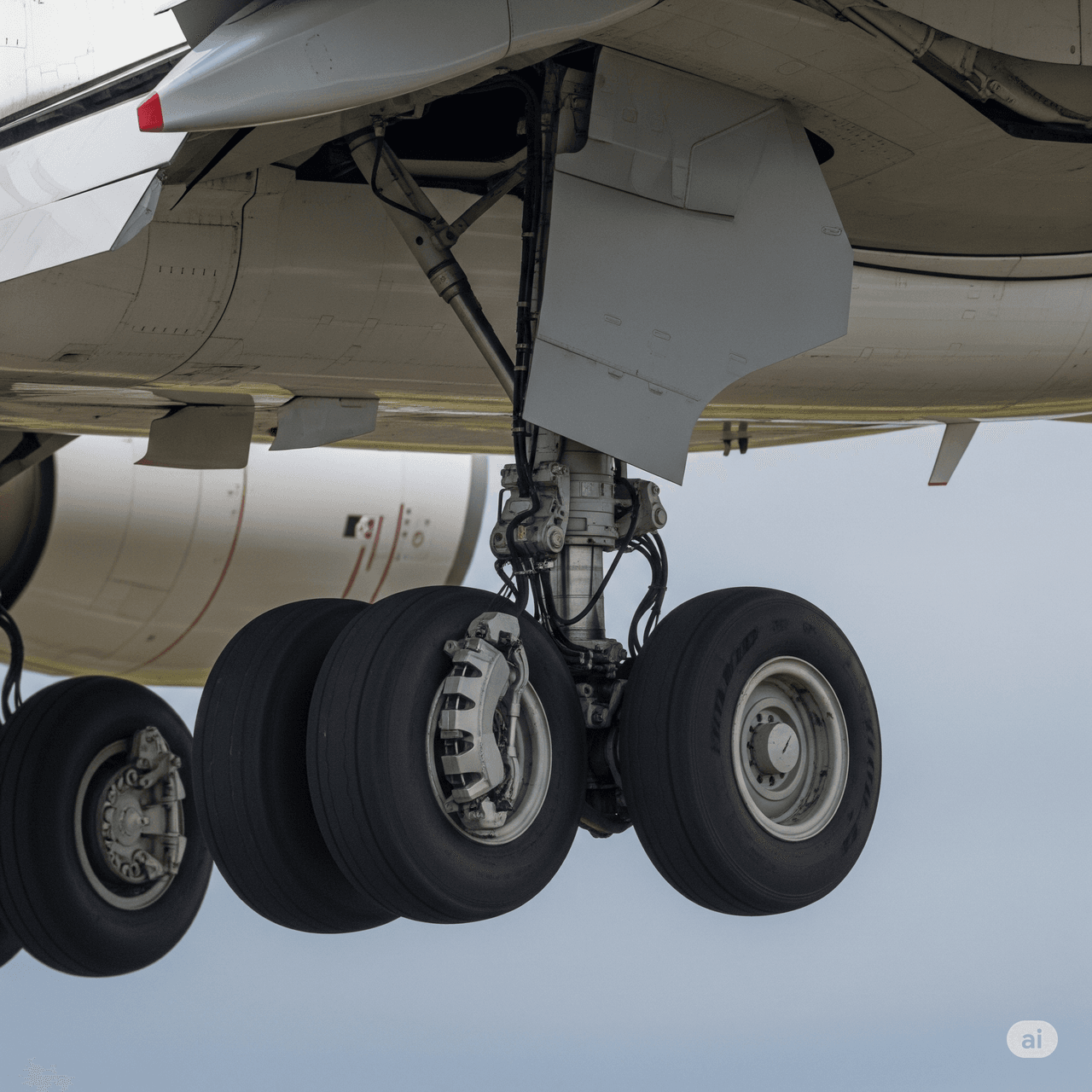
Generated by artificial intelligence.
Aircraft Braking Systems
Main Brake Types | Aerodynamic Braking, Reverse Thrust, Wheel Brake, Auxiliary Systems | ||||||||
|---|---|---|---|---|---|---|---|---|---|
Aircraft are among the most complex engineering achievements in the history of aviation. Just as crucial as the takeoff and cruise phases, the landing process and safe ground maneuvers are operationally critical. To ensure controlled and safe touchdown on the ground, advanced engineering mechanisms have been developed that integrate and synchronize multiple braking systems. These systems are designed to effectively reduce the aircraft’s high speed and enable a safe stop on the runway.
Commercial passenger aircraft can reach speeds of approximately 240 to 280 km/h during landing. For such large, heavy aircraft to come to a complete stop within an average runway length of 1.5 to 3 kilometers, highly powerful and reliable braking technologies are required. Adverse weather conditions, short runways, high payload capacity, or emergency situations further increase the critical importance of braking systems and elevate performance requirements to the highest level.
For aircraft capable of traveling thousands of kilometers in flight, the landing phase is a multidimensional engineering challenge requiring the synchronized operation of aerodynamic, mechanical, and digital subsystems. In modern aircraft, the braking process is not limited to the pilot pressing the brake pedal; it also involves the deployment of aerodynamic surfaces, redirection of engine airflow in reverse, and the use of advanced computerized control systems—all integral components of the braking operation.
Aerodynamic braking utilizes the drag generated by airflow as soon as the aircraft’s landing gear makes contact with the runway to reduce speed. The most commonly used aerodynamic components in this context are spoiler systems.
Operation of the Spoiler Mechanism: Spoiler panels mounted on the upper surface of the wings are activated automatically or by pilot command upon touchdown, lifting upward to disrupt airflow. This process creates two primary effects:
Aerodynamic braking is an efficient method as it requires no energy consumption; however, it is insufficient on its own to bring the aircraft to a complete stop. Therefore, it is typically used as a supplementary aid during the initial deceleration phase.

Eight spoilers per wing assist the A380’s mechanical brakes with aerodynamic braking (generated by artificial intelligence).
Although jet engines are primarily designed to propel the aircraft forward, after landing this thrust can be redirected in the opposite direction to serve a braking function. This method is known as reverse thrust and is widely used in jet-powered aircraft.
Working Principle: During normal operation, engines direct airflow rearward to generate forward thrust. In reverse thrust mode, movable deflector doors at the engine exhaust activate and redirect the airflow forward. This generates a reverse force that decelerates the aircraft. This method:
In turboprop aircraft, a similar braking effect is achieved by reversing the pitch angle of the propellers. However, to prevent engine overheating, reverse thrust systems are typically used only for short durations.

Examples based on the principle of reverse thrust (generated by artificial intelligence).
Spoilers are not only used during landing but can also be actively deployed during flight for speed control, particularly when a reduction in speed or controlled descent is required. Some aircraft are additionally equipped with body airbrakes. Airbrake systems, commonly found in military jets and certain specialized civil aircraft, extend outward from the fuselage to create drag perpendicular to the airflow.
Comparison of Spoilers and Airbrakes:
From the moment of runway contact, the primary braking load is carried by the wheel brakes on the landing gear. In modern commercial aircraft, carbon disc brakes are the most commonly used system for this purpose.
Technical Features:
In some aircraft, additional braking methods are employed based on specific operational requirements:
After touchdown, the coordinated activation of braking systems is essential:
Grove Aircraft. "Brake System Design and Theory."
Lomas, Chris. "How do aircraft slow down on landing? – Reverse thrust explained." FlightRadar24, 2024. Accessed Adresi.
Nair, Shruti, and Nair, Shreya. "Aircraft Braking System." International Journal of Research in Mechanical Engineering & Technology, Volume 4, no. 1 (2014): 1-5. Accessed Adresi.
SKY Brary. "Brakes." Flight Technical. Accessed Adresi.

Generated by artificial intelligence.
Aircraft Braking Systems
Main Brake Types | Aerodynamic Braking, Reverse Thrust, Wheel Brake, Auxiliary Systems | ||||||||
|---|---|---|---|---|---|---|---|---|---|
No Discussion Added Yet
Start discussion for "Aircraft Braking Systems" article
Classification of Braking Methods
Aerodynamic Braking (Air Resistance / Lift Reduction)
Reverse Thrust System
In-Flight Speed Control: Spoilers and Airbrakes
Wheel Brakes
Auxiliary Systems and Emergency Braking
Coordinated Operation of Braking Systems