

This article was automatically translated from the original Turkish version.
+1 More
Location | Niğde | ||||||||
|---|---|---|---|---|---|---|---|---|---|
Commissioned by | Ali Bey of the Karamanoğulları | ||||||||
Construction Date(s) | 812 AH / 1409–1410 CE | ||||||||
Architectural Period | Beylik of the Karamanoğulları | ||||||||
Plan Type | four-iwan two-story Open courtyard | ||||||||
Building Materials | white marble basalt ignimbrite Sarı tüf stone (Niğde yellow) | ||||||||
Historical Uses | current social-cultural activity space library museum storage nalbant Medrese | ||||||||
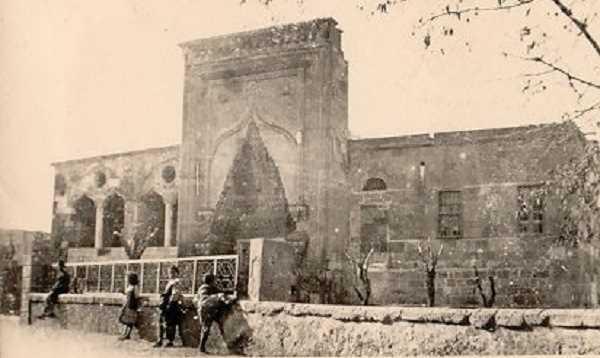
Ak Medrese is a two-story, four-iwan, open-court madrasa structure located in the center of Niğde province, built in the early 15th century during the Karamanid Beylik period. The building is known as "Ak Medrese" due to its white marble portal. It is regarded as a unique example in Turkish madrasa architecture for its symmetrical plan layout.

Ak Medrese (Türkiye Culture Portal)
The madrasa is situated in the Saruhan neighborhood of Niğde city center, just outside the outer walls of İç Kale. The name "Ak Medrese" derives from the white marble portal on its northern façade. In some sources, the building is also referred to as "Medresetü’l-Beyzâ" or, after its founder, "Ali Bey Medresesi."
The foundation inscription and endowment deed of the building have survived to the present day. According to these documents, the madrasa was constructed in 812 AH / 1409–1410 CE by Ali Bey, son of Karamanid Alâeddin Ali Bey, and Nefise Sultan, daughter of Ottoman Sultan I. Murad Hüdavendigâr. Ali Bey served as the Emir of Niğde under his elder brother Mehmed Bey. The endowment deed was drawn up in 818 AH / May 1415 and confirmed one year later.
According to the endowment deed, the madrasa was established to provide education in accordance with the Hanafi and Shafi'i schools of Islamic jurisprudence. The endowments associated with the madrasa included the Niğde Bedesten, an adjacent caravanserai, a double bathhouse in Meydan Mahallesi, various shops, lands, a mill, and vineyards. Over time, the building served various functions. During World War I, it was used as a stable; in 1922, it resumed operations as a madrasa. During World War II, it served as a storage facility for the Istanbul Archaeology Museums (1939–1950), followed by the Niğde Museum’s storage (1950–1957) and administration (1957–1977). From 1993 onward, it was allocated as a library for Niğde University for a period of ten years; today, it is used by the Niğde Municipality for social and cultural purposes.
Ak Medrese features an open courtyard, two-story layout, and four-iwan plan. The ground floor contains two iwans, while the main iwan on the upper floor spans the full height of two stories. The building’s symmetrical plan design draws attention and gives it a distinctive position within Turkish madrasa architecture. Its external dimensions are approximately 21.80 x 24.50 meters, oriented along a north-south axis.
The northern façade is dominated by the monumental portal. The portal is constructed projecting outward from the building and above the level of the side walls. Twin arched niches flanking the portal create a symmetrical gallery arrangement on the façade. The twin arched windows on the upper floor were later converted into rectangular windows, and staircases were added to the façade. Recent restoration efforts have restored the façade to its original form.
The primary building material used in the madrasa is yellow tuff stone known locally as "Niğde sarısı." Additionally, ignimbrite, basalt, and blocks of white marble are used, particularly in the entrance portal. Stonework is of high quality, with decorative elements concentrated especially on the portal. Decorations are carved into the stone using high and low relief techniques. No other decorative materials were employed in the structure.
At ground level, particularly in areas of ignimbrite stone, efflorescence, discoloration, and surface stone loss have been observed due to groundwater exposure. During the 2008–2009 restoration, samples taken from the building underwent geomechanical and petrographic analyses. These analyses revealed that new stones installed in areas affected by capillary rise, which did not match the original stone properties, accelerated the deterioration process.
Standing for approximately six centuries, Ak Medrese is one of the most notable examples of madrasa architecture in Anatolia. Despite undergoing various functional transformations, the building has largely preserved its uniqueness, highlighted by its plan layout, stonework, and especially its monumental portal.
Korkanç, Mustafa. “Ak Medresenin (Niğde) Yapımında Kullanılan Taşların Mühendislik Özellikleri ve Sorunları.” *Niğde Ömer Halisdemir Üniversitesi Mühendislik Bilimleri Dergisi* 9, no. 2 (2020): 975–989. Accessed July 9, 2025. https://dergipark.org.tr/tr/download/article-file/1166398.
Turkish Ministry of Culture and Tourism. "Ak Medrese." *Niğde İl Directorate of Culture and Tourism Publication*. Accessed July 9, 2025. https://nigde.ktb.gov.tr/Eklenti/48870,akmedresepdf.pdf?0.
Yılmaz, İlknur. “Niğde’deki Tarihi Yapıların Korunmasında Karşılaşılan Sorunlar ve Çözüm Önerileri.” Master's thesis, Gazi Üniversitesi, 2009. Accessed July 9, 2025. https://tez.yok.gov.tr/UlusalTezMerkezi/tezDetay.jsp?id=7z2mnbEyeScErmTpCCFChw&no=n-WDiQ_V0Ub802q26o9A5Q.
“Akmedrese.” TDV İslâm Ansiklopedisi. Accessed July 9, 2025. https://islamansiklopedisi.org.tr/akmedrese.

Location | Niğde | ||||||||
|---|---|---|---|---|---|---|---|---|---|
Commissioned by | Ali Bey of the Karamanoğulları | ||||||||
Construction Date(s) | 812 AH / 1409–1410 CE | ||||||||
Architectural Period | Beylik of the Karamanoğulları | ||||||||
Plan Type | four-iwan two-story Open courtyard | ||||||||
Building Materials | white marble basalt ignimbrite Sarı tüf stone (Niğde yellow) | ||||||||
Historical Uses | current social-cultural activity space library museum storage nalbant Medrese | ||||||||
Location and Nomenclature
Construction and Founder
Endowments and Purposes of Use
Architectural Features
Façade and Portal Design
Building Materials and Decorations
Stone Deterioration and Restoration Process