This article was automatically translated from the original Turkish version.
+2 More
Akçadağ Carpet
Registration Number | 422 | ||||||||
|---|---|---|---|---|---|---|---|---|---|
Registration Date | 08.03.2019 | ||||||||
Application Number | C2018/088 | ||||||||
Application Date | 16.03.2018 | ||||||||
Name of the Geographical Indication | Akçadağ Carpet | ||||||||
Product / Product Group(s) | Carpet / Carpets and Kilims | ||||||||
Type of Geographical Indication | Mahreç mark | ||||||||
Applicant/Registrant(s) | Malatya Provincial Directorate of Culture and Tourism | ||||||||
Address of the Registrant | İnönü Mah. Buhara Cad. No: 252 Yeşilyurt / MALATYA | ||||||||
Geographical Boundary | The central area of Akçadağ district of Malatya province and the Kürecik and Ören regions | ||||||||
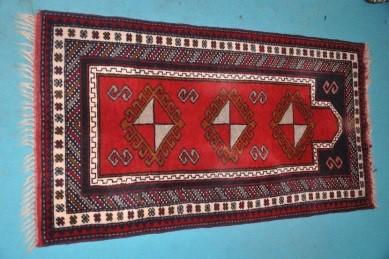
Akçadağ Carpet is a hand-woven carpet with a geographical indication, produced in the Akçadağ district of Malatya Province, Türkiye, and its surrounding areas, particularly in the Kürecik and Ören regions. These carpets are dominated by red, with black, navy, and other vibrant colors also used. The yarn is typically dyed using natural colors from wool or root dyes. The Gördes knot technique is employed in weaving, with approximately 670 to 700 knots per square decimeter. Traditional motifs are the most distinctive feature of Akçadağ carpets; patterns such as “Eli Belinde Kız,” “Koç Boynuzu,” “Su Yolu,” and “Akrep/Nık” reflect the cultural heritage of the region. In the composition, geometric and botanical designs are arranged symmetrically, and sometimes large central motifs known as “göbek” or “göl” are present.
The Akçadağ carpet is a product of a long-standing hand-weaving tradition practiced by the local population. Various Ottoman-era chronicles have recorded the existence of carpets and kilims woven in Akçadağ. The Mamuretül-Aziz chronicle dated 1310 AH (1892 CE) highlights the elegance and beauty of carpets and kilims produced in Akçadağ, noting with interest that such crafts had flourished in remote settlements. Ottoman records also indicate that women from the Kürne (today known as Küçükkürne) and Kürecik tribes, as well as those in the Hasan Çelebi neighborhood, wove carpets, kilims, prayer rugs, floor coverings, and curtains from wool and yarn, and that these products were in such demand that they generated annual exports worth one hundred thousand kurush.
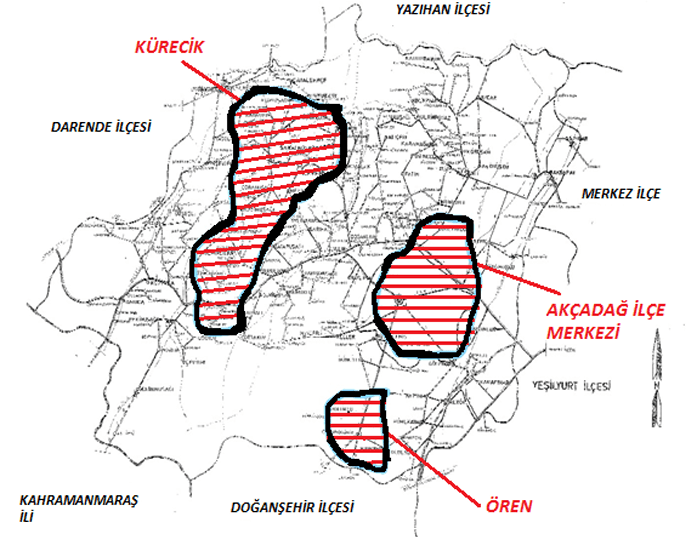
Akçadağ Carpet Geographical Boundaries (Turkish Patent)
Today, Akçadağ carpets are supported by the Directorate of Public Education under the supervision of the Akçadağ Sub-provincial Governorship, with carpet-weaving courses offered in the district center and villages. Production areas within the district are defined within the established geographical boundaries.
The primary material used in Akçadağ carpet production is wool. The wool intended for weaving is first dried and then combed using a tool called a “tarak.” The simplest comb consists of nails arranged in rows on a flat wooden board. Combing aligns the wool fibers parallel to each other. Subsequently, the wool is hand-rolled into a wick-like form and twisted using a “kirman” or a needle. The spinning process varies depending on the type and thickness of the yarn required. The wool preferred for Akçadağ carpets is low-twist, fine, and double-ply. Local producers predominantly use wool they have obtained themselves and dye it with root dyes. The warp threads forming the carpet’s structure are also made from wool.
The yarn used in Akçadağ carpets is dyed before weaving. Each village in the region has its own traditional dyeing methods. Dyeing is traditionally carried out in domestic settings using natural dyes derived from plants. This practice is commonly referred to locally as “kök boya.” While warp and weft threads are often left undyed in their natural colors, the pattern threads are typically dyed. In some examples, warp and weft threads are selected from white, brown, or black natural wool.
In the past, dyeing was also outsourced to itinerant dyers, but this practice has nearly disappeared today. Shades such as brown, purple, off-white, and yellow are mostly derived from the natural colors of sheep or lamb wool. Other colors are obtained as follows: brown tones from walnut and oak leaves or bark; yellow tones from chamomile, vine leaves, juniper leaves, and milkweed; lemon yellow from apricot roots; and red tones from onion skins. Alum is used as a mordant to fix the colors. The lightness or darkness of the tones is controlled by the duration of boiling and soaking the yarn in water.
For example, to obtain a camel hair or yellowish hue, onion skins and salt are boiled together in a pot, after which the yarn is immersed in the mixture and boiled for approximately 30 minutes. The yarn is then removed from the pot and rinsed in cold water to fix the color.
Akçadağ carpets are primarily woven on simple looms set up in homes. These looms operate on the principle of tensioning or relaxing the warp threads between vertical posts mounted to the ceiling. In workshop settings, in addition to simple looms, modern metal-frame looms are also used.
Tools used to convert wool into yarn include the “taraklık” (wool comb) and the “kirmen” or locally called “taşi” needle. During weaving, the “dişkit” is used to adjust the spacing of the weft threads, and the “kirkit” is used to compact the knots. The pile threads of the carpet are cut with a sharp knife, and the pile height is adjusted to the desired level using special shears. The shears, kirkit, and dişkit are essential tools in the production process.
The weaving of Akçadağ carpets is performed using the Gördes knot technique, also known as the Turkish knot or double knot. This technique involves passing the knot between two independent warp threads and securing it to both, creating a symmetrical structure that enhances the carpet’s durability. The knot density in Akçadağ carpets is recorded as 27.32 and 32.36 knots per square centimeter, amounting to approximately 670 to 700 knots per square decimeter. The pile height of the carpet is around 4 to 5 centimeters.
Akçadağ carpets exhibit rich diversity in motif and composition. Red is the dominant color, often combined with black or navy. Other common colors include brown, yellow, white, orange, green, and blue. Preference is given to using the natural colors of wool rather than dyeing.
The motifs used in Akçadağ carpets are also referred to locally as “desen” or “model.” Motifs are either memorized and woven from memory or copied from previously woven carpets. The carpet’s structure typically includes outer borders such as “dar kenar su,” “ince suyu,” “geniş su,” “zemin,” and “göbek” sections, each decorated with different motifs.
Common motifs include:
Some of these motifs are known by different names in other regions. For instance, in the Kürecik area, the “Eli Belinde” motif is also called the “Kirmen Ucu” motif. The “Nık” motif is stylized to resemble either a scorpion or a goat’s horn.
The composition of Akçadağ carpets is dominated by symmetry. The central section, known as “göbek” or “göl,” is filled with geometric or botanical patterns. In some carpets, this central motif is designed as interlocking star shapes. Rectangular “göbek” motifs are adorned with stylized designs. Weavings are prepared in either single-wing or double-wing compositions. Vertical or horizontal mihrap arrangements are also present.
In mihrap carpets, the inner edges of the mihrap are decorated with small floral motifs. In some examples, the mihrap steps are embellished with hook motifs. Mihrap-free carpets also exist. Ground decorations feature eight- or six-pointed star patterns, U and V shapes, koçboynuzu motifs, and floral designs. In some carpets, the ground is filled with three or four vertically arranged square-shaped göbek motifs, which are typically separated by eye motifs or zigzag lines.
Akçadağ carpets are produced exclusively in the Akçadağ district of Malatya Province and its surrounding areas. The motifs, colors, and techniques used reflect the region’s cultural heritage and require skilled craftsmanship. Production, including wool sourcing, yarn dyeing, and weaving, must be carried out within the defined geographical boundaries.
Whether Akçadağ carpets are produced in accordance with their designated distinctive characteristics is subject to a monitoring process coordinated by the Malatya Provincial Directorate of Culture and Tourism. Monitoring activities are conducted by a commission composed of three representatives from the Malatya Provincial Directorate of Culture and Tourism, the Akçadağ Sub-provincial Governorship, and the Association of Cities Preserving Heritage. Inspections are carried out twice a year, in February and May, and may also be conducted at any time upon request or complaint.
The monitoring commission has the authority to initiate and follow up on necessary administrative and legal procedures to protect the geographical indication and ensure compliance with production standards. It is also responsible for initiating legal action against unauthorized use of the geographical indication. Reports on monitoring results are submitted annually by the Malatya Provincial Directorate of Culture and Tourism to the Turkish Patent and Trademark Office.
Monitoring activities cover not only the production phase but also marketing and sales processes. The commission determines how inspections are conducted and may seek support from expert institutions or procure services for this purpose.
During inspections, the following aspects are specifically examined:
The monitoring commission may continue its activities by utilizing resources from public institutions, private sector entities, or expert individuals and organizations, and is responsible for pursuing legal measures to protect the geographical indication.
Turk Patent and Trademark Office. "Akçadağ Halısı." Turk Patent and Trademark Office. Accessed July 13, 2025. https://ci.turkpatent.gov.tr/Files/GeographicalSigns/81bc6a8f-ac99-4d93-bdb8-28ade46c7860.pdf.
Turk Patent and Trademark Office. "Akçadağ Halısı." Turk Patent and Trademark Office. Accessed July 13, 2025. https://ci.turkpatent.gov.tr/cografi-isaretler/detay/38545.

Akçadağ Carpet
Registration Number | 422 | ||||||||
|---|---|---|---|---|---|---|---|---|---|
Registration Date | 08.03.2019 | ||||||||
Application Number | C2018/088 | ||||||||
Application Date | 16.03.2018 | ||||||||
Name of the Geographical Indication | Akçadağ Carpet | ||||||||
Product / Product Group(s) | Carpet / Carpets and Kilims | ||||||||
Type of Geographical Indication | Mahreç mark | ||||||||
Applicant/Registrant(s) | Malatya Provincial Directorate of Culture and Tourism | ||||||||
Address of the Registrant | İnönü Mah. Buhara Cad. No: 252 Yeşilyurt / MALATYA | ||||||||
Geographical Boundary | The central area of Akçadağ district of Malatya province and the Kürecik and Ören regions | ||||||||
History and Production Culture
Materials and Production Techniques
Materials and Tools Used
Obtaining Colors
Weaving Loom
Weaving Technique
Design, Motif, and Composition Features
Motif Characteristics
Composition Features
Geographical Boundary and Production Dependency
Monitoring