This article was automatically translated from the original Turkish version.
+2 More
Location | Akdağmadeni Türkiye Yozgat | ||||||||
|---|---|---|---|---|---|---|---|---|---|
Year of Construction | 1862 | ||||||||
Plan | Three-aisled basilical plan | ||||||||
Material(s) | Cut stone and marble | ||||||||
Protection | Registered in 1983 and 2005 | ||||||||
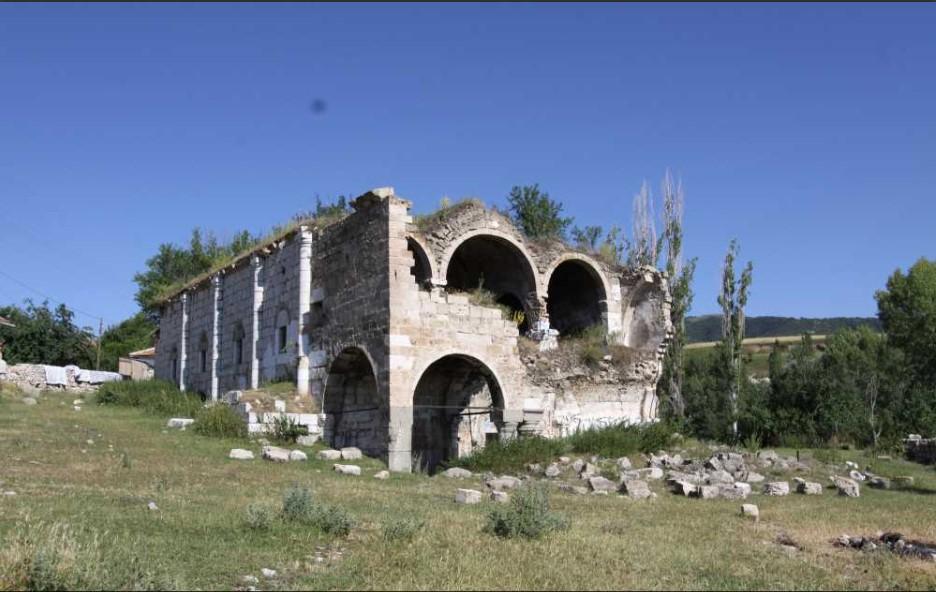
The Akdağmadeni Church, located in the Akdağmadeni district of Yozgat province in Türkiye, was constructed in the mid-19th century as a product of the social structure that emerged alongside the Ottoman Empire’s mining activities. Built specifically to meet the religious needs of the non-Muslim population, the structure reflects typical elements of Rum church architecture through its architectural features and decorations. Today recognized as a protected cultural heritage site, the church is notable both for its structural characteristics and its historical context.

Akdağmadeni Church (Türkiye Culture Portal)
The Akdağmadeni Church is situated in the Yeşildere neighborhood (formerly known as Tahmaz) in the southeastern part of Akdağmadeni district, Yozgat province. In the mid-19th century, Akdağmadeni became an administrative unit under the Directorate of Lead Mines and was also referred to as the miners’ quarter. As the majority of workers in the region at that time were non-Muslim, the church was constructed to fulfill their religious needs. Greek inscriptions on the building’s entrance indicate that it was built in 1862. Following the population exchange between Türkiye and Greece (1924–1927), the significant decline in the Greek population led to the church falling out of use.
The church was constructed on a rectangular plan oriented east-west. The building follows a three-aisle basilical plan. While the western facade was originally divided into three sections, only the northern portion has survived to the present day. The eastern facade is partially buried due to the slope of the terrain. Three apses projecting outward from this facade each contain a small lancet window. Above the apses, circular windows align with the axis of the central nave.
The north and south facades are symmetrically designed. These surfaces are animated by four embedded columns, with lancet windows placed in alignment within each section. At the junction of the narthex and naos on the north facade, a remnant of an external staircase is present, believed to have provided access to a bell tower.
At the western end of the building, a rectangular narthex extends in a north-south direction. Remnants indicate that the narthex was originally divided into three sections. Access to the naos is gained through an arched doorway on the eastern side of the narthex. The arch is rounded and framed by multi-layered, ornamental bands. The decorations include floral, woven, star, and medallion motifs.

Akdağmadeni Church (Türkiye Culture Portal)
The naos consists of three aisles, with the central nave being wider and taller than the side aisles. The interior space is covered by a barrel vault, while the exterior is enclosed by a broken-pitch roof. At the eastern end of the naos, aligned with the supporting piers, is a rectangular bema oriented north-south. The apses at the eastern extremities are semicircular internally and three-faceted externally, projecting outward. The central apse is larger than the others. All apses are covered with half-domes.
Inside the church, particularly on the eastern wall surfaces, blue and white geometric patterns, Maltese crosses, and medallion decorations are prominent. In the barrel vault of the central nave, crosses and christogram-like figures are enclosed within medallions set against a white background and bordered by blue bands. Additionally, star and floral motifs in blue and black are visible on the arches.

Akdağmadeni Church (Türkiye Culture Portal)
The church’s facade is constructed of cut stone, while the other facades are built using cut marble stone. The arch at the entrance is supported by two round stones in the center and two angular stones on either side. The floor of the interior is paved with stone. Within the naos, eight round columns divide the space into three equal sections along the east-west axis. These columns are connected by round arches and wooden lintels.
Boy, Nazım. “Akdağmadeni Yukarı Kilise (Hagios Kharalampos Katedrali).” *Türkiye Turizm Ansiklopedisi.* Accessed June 23, 2025. https://turkiyeturizmansiklopedisi.com/akdagmadeni-yukari-kilise-hagios-kharalampos-katedrali.
Ministry of Culture and Tourism of the Republic of Türkiye. "Akdağmadeni Kilisesi." *Kültür Portalı*. Accessed June 23, 2025. https://www.kulturportali.gov.tr/turkiye/yozgat/gezilecekyer/akdagmadeni-kilisesi.

Location | Akdağmadeni Türkiye Yozgat | ||||||||
|---|---|---|---|---|---|---|---|---|---|
Year of Construction | 1862 | ||||||||
Plan | Three-aisled basilical plan | ||||||||
Material(s) | Cut stone and marble | ||||||||
Protection | Registered in 1983 and 2005 | ||||||||
Historical Background
Architectural Features
Interior Layout and Decoration
Materials and Construction Technique